
Market Headline: Private Credit Enters the "Great Bifurcation" as Assets Hit $3.5 Trillion
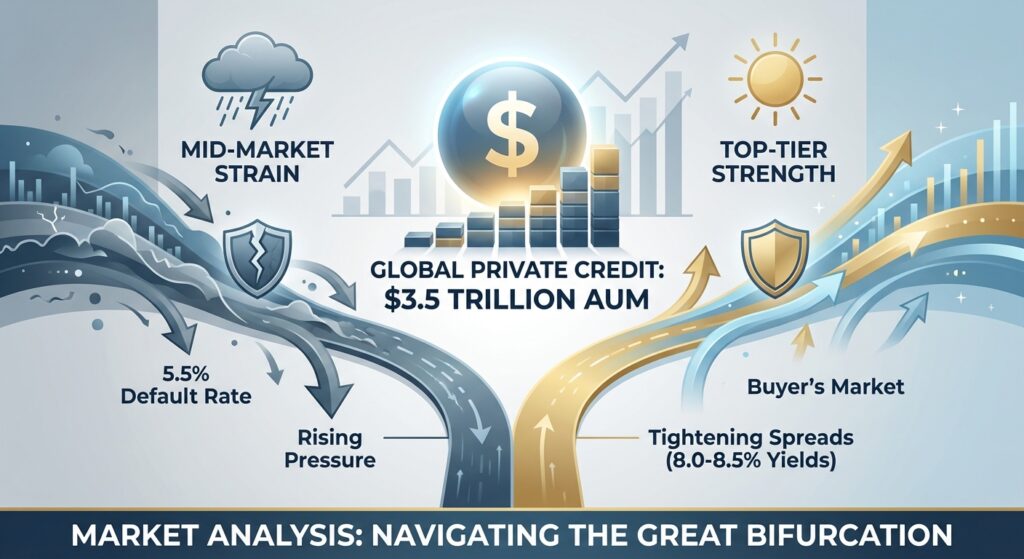
As of April 2026, the private credit market has reached a watershed moment. Global assets under management have surpassed $3.5 trillion, cementing the asset class as a mainstream component of institutional and retail portfolios. However, this growth comes amid the sector’s first genuine stress test since the 2008 financial crisis. A distinct bifurcation has emerged: top-tier borrowers are benefiting from a "buyer’s market" characterized by spread compression and fierce competition between direct lenders and banks, while the middle market faces mounting pressure with default rates climbing to 5.5%.
Major players like Apollo Global Management describe the current environment as a shift from a seller’s to a buyer’s market for investors, requiring heightened selectivity. While capital deployment surged nearly 80% year-over-year in 2024, the easy money era has ended for weaker credits. Structural shifts (including the entry of 401(k) plans into the asset class and massive bank partnerships) are rewriting the rules of engagement just as credit conditions tighten.
Quantitative Snapshot: Key Market Metrics
| Metric | Current Level (Q1/Q2 2026) | Trend / Comparison | Source |
|---|---|---|---|
| Global Private Credit AUM | $3.5 Trillion | Mainstream adoption (Retail & DC plans) | Private Markets Insights |
| Middle Market Default Rate | 5.5% | Rising significantly from <2% historic lows | Private Markets Insights |
| First Lien Direct Loan Yields | 8.0% – 8.5% | Down from 10%+ peaks; spreads tightening | Private Markets Insights |
| LBO Deal Volume | +40% YoY (trailing) | M&A revival driving new issuance | Private Markets Insights |
| IG Private Placement Issuance | >$170 Billion (2025 est) | Record volume; Oversubscribed 5-10x | SLC Management |
Sector Analysis & Capital Flows
Hot Sectors: Asset-Based Finance & Investment Grade
Lender appetite is shifting aggressively toward Asset-Based Finance (ABF), with 65% of managers identifying it as the highest growth potential area. Major firms project the total addressable market for ABF at $40 trillion, dwarfing corporate direct lending. Simultaneously, Investment Grade (IG) private credit is seeing robust demand. Despite macro uncertainty, IG private placements have seen spreads tighten by an average of 5 basis points, with deals frequently 5-10x oversubscribed as insurers and pensions seek safety.
Regional Rotation: Europe Rising
Geographically, capital is rotating toward Europe. The continent now represents 30% of global AUM, and analysts describe a "structural shift" in allocator behavior favoring European private credit. This contrasts with the US market, where saturation in traditional direct lending is forcing managers to diversify into niche strategies.
Structural Shift: The Bank-Nonbank Blur
The adversarial relationship between banks and private lenders has dissolved into partnership. Traditional banks committed $96 billion to private credit vehicles in the last year alone, including JPMorgan’s significant $50 billion commitment. This liquidity is fueling the upper end of the market but hasn’t alleviated pressure on lower-middle-market borrowers facing maturity walls.
Implications for Borrowers & Lenders
For Borrowers:
The market has turned into an issuer’s market for high-quality borrowers. The "supply-demand imbalance" in investment-grade and upper-middle-market credit is driving spread compression. Borrowers with clean balance sheets can play the broadly syndicated loan (BSL) market against private lenders to secure tighter pricing and looser covenants. However, stressed borrowers face a cold reality: with default rates at 5.5% and rising, access to rescue financing is expensive and selective.
For Lenders & Investors:
The era of "set it and forget it" allocations is over. Yields on first lien loans have compressed to the 8.0% – 8.5% range, reducing the buffer against losses. Investors must pivot from generalist direct lending funds to specialists capable of navigating workouts. The widening gap between top-tier managers and average performers means manager selection is now the primary driver of returns, rather than beta exposure to the asset class. Additionally, the rise of payment-in-kind (PIK) toggles is a warning sign of underlying portfolio stress that requires vigilance.
Key Market Insights
- Default Watch: Middle market default rates reaching 5.5% signals the end of the benign credit cycle; expect increased workout activity in Q2/Q3 2026.
- Yield Compression: High competition for quality assets has pushed first lien yields down to ~8%; lenders are sacrificing margin for safety.
- The New Growth Engine: Asset-Based Finance (ABF) is replacing corporate direct lending as the primary growth vector for large asset managers.
- Retail Liquidity: With 401(k) access opening up, a wall of semi-liquid retail capital is entering the market, potentially dampening volatility but raising liquidity mismatch concerns.
- Borrower Power: High-quality issuers currently hold the leverage, able to demand tighter spreads as banks and private funds compete for limited top-tier deal flow.


