
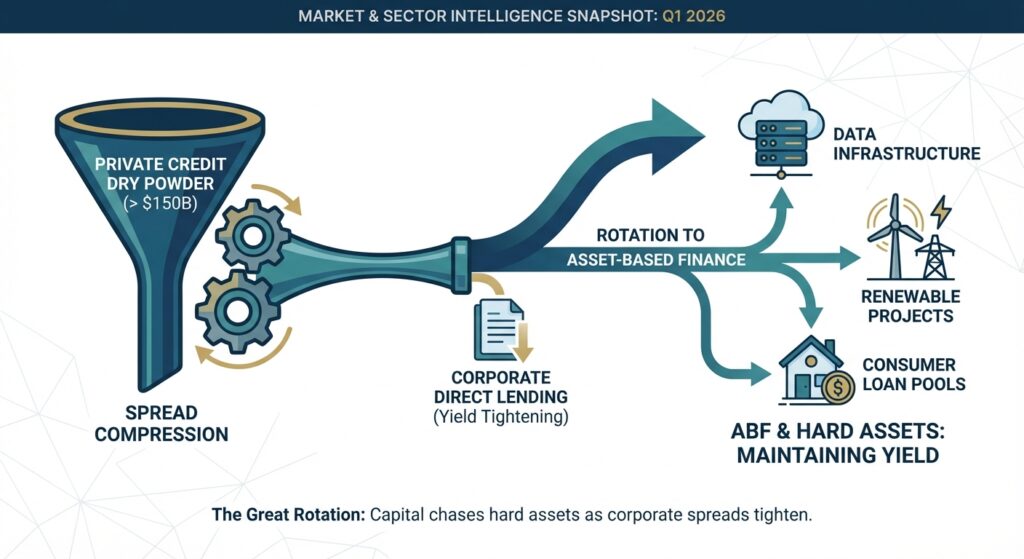
Market Headline: The Great Rotation to Asset-Based Finance Amidst Spread Compression
As of February 2, 2026, the private credit market has entered a phase of aggressive maturity defined by two opposing forces: record levels of dry powder forcing corporate spread compression, and a structural pivot toward Asset-Based Finance (ABF) to maintain yield. While the "Golden Age" of easy double-digit returns in vanilla direct lending has cooled, the asset class continues to expand, with Moody's projecting assets under management (AUM) to exceed $2 trillion this year.
The defining narrative for Q1 2026 is the borrower-friendly environment. A technical imbalance, too much capital chasing limited M&A deal flow, has handed pricing power back to sponsors and corporates. In response, managers are moving down-market or shifting allocation into infrastructure debt, data centers, and consumer loan pools (ABF) where banks continue to retrench due to regulatory capital constraints.
Quantitative Market Snapshot
The following metrics illustrate the current "borrower-friendly" shift in market dynamics as of early 2026.
| Metric | Current Status | Trend / Comparison | Source |
|---|---|---|---|
| Market AUM | ~$2 Trillion | Projected growth toward $4T by 2030 | Moody’s |
| Dry Powder | >$150 Billion | Record highs driving competition | Capstone / Pitchbook LCD |
| ABF Spreads | Tightening 10-30 bps | Yield compression in asset-based deals | MetLife IM |
| Fund Size | >$900 Million (Avg) | Up 50% vs. 2020 levels | Private Debt Investor |
| Deal Terms | Aggressive | Higher leverage, PIK optionality | Capstone Partners |
Sector Analysis: The Pivot to Hard Assets
Hot: Asset-Based Finance & Infrastructure
The most significant capital rotation is occurring in ABF. With corporate credit spreads tightening, managers are targeting diverse asset pools including consumer loans and data infrastructure. Recent data from MetLife Investment Management highlighted $3.3 billion in infrastructure debt activity, driven specifically by renewable energy projects and data centers. As traditional banks face capital constraints, private credit is filling the void in these capital-intensive sectors.
Cooling: Middle Market Direct Lending
Traditional corporate direct lending is facing saturation. Capstone Partners reports a "pronounced technical supply/demand imbalance" where investment capital has poured into the market faster than deal flow can absorb it. This has resulted in a hyper-competitive environment for plain-vanilla middle-market LBOs, forcing lenders to accept tighter spreads to win allocations.
Emerging: NAV Lending & Liquidity Solutions
To address the need for alternative liquidity distributions (DPI) in a slower exit environment, financial innovation is accelerating. Use of Net Asset Value (NAV) lending and Payment-in-Kind (PIK) structures is rising, allowing funds to generate liquidity without selling underlying assets in a potentially unfavorable market.
Implications for Borrowers & Lenders
For Borrowers (Corporates & Sponsors):
Conditions are currently optimal for refinancing and M&A financing. The abundance of dry powder has eroded some lender protections, resulting in tightened SOFR spreads and more flexible document terms. Borrowers in hard-asset sectors (digital infrastructure, power) will find particularly deep pockets as lenders seek alternatives to corporate cash-flow loans.
For Lenders & Investors:
The "illiquidity premium" is shrinking in the most crowded segments of the market. To maintain target returns, active management is becoming critical. As noted by Nuveen, the market is maturing, and simple buy-and-hold strategies in corporate direct lending may underperform compared to diversified strategies that include ABF and opportunistic credit. Investors should expect increased complexity as managers utilize structured credit and rated fund structures to deploy capital.
Forward-Looking Outlook: Q2-Q3 2026
- M&A Resurgence: Following the rate cuts in late 2025, M&A activity is inching upward. We expect this to accelerate in Q2 2026, which may help balance the supply/demand equation and stabilize spreads.
- Retail Capital Influx: The democratization of private credit continues, with "evergreen" funds and BDCs aggressive raising capital from wealth channels, potentially adding volatility.
- Regulation Watch: While regulatory guardrails remain limited, scrutiny is increasing regarding the "interconnectivity" between private credit funds and traditional banks, particularly regarding synthetic risk transfers.
- Credit Quality Bifurcation: As terms loosen, the gap between top-tier managers (who maintain discipline) and volume-chasers (who engage in "creditor-on-creditor" violence) will widen if default rates uptick.
- Convergence: The lines between syndicated loans and private credit will continue to blur, with large-cap private unitranches competing directly with the BSL market.


