
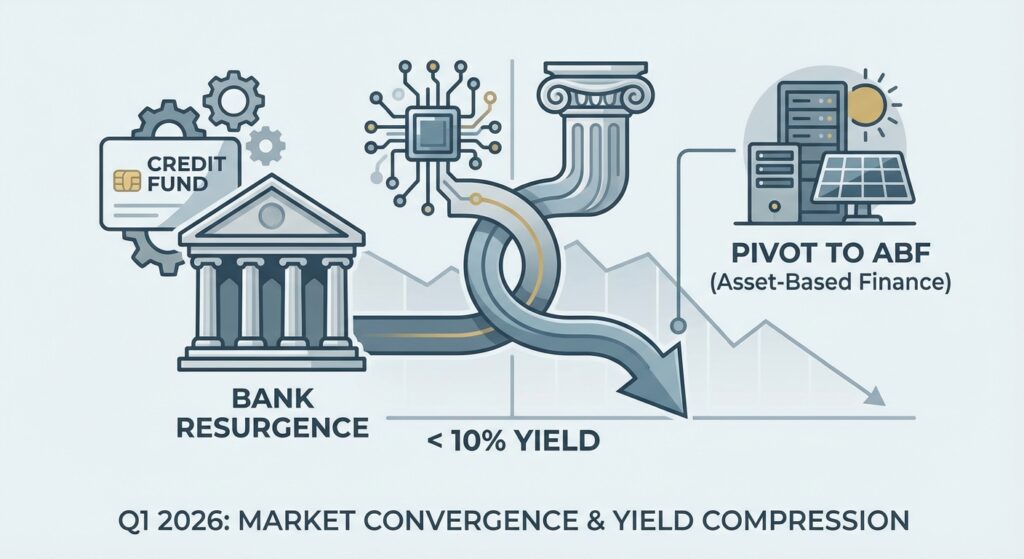
Market Headline: The Great Convergence
As of February 2026, the firewall between private credit and the broadly syndicated loan (BSL) market is eroding rapidly. The defining narrative for Q1 is the aggressive re-entry of traditional banks into leveraged finance, triggered by the withdrawal of regulatory leveraged lending guidelines in December 2025. This regulatory pivot has unleashed banks to compete at higher leverage levels, forcing private credit lenders to defend their turf through significant spread compression.
For the first time in three years, direct lending yields have fallen below 10%. While deal volume remained resilient with approximately $140 billion in 2025, the BSL market successfully recaptured market share via $48 billion in refinancings and takeouts. We are observing a distinct shift from a “lender's market” to a fierce competitive landscape where borrowers are effectively utilizing dual-track processes to drive pricing down across both public and private execution channels.
Quantitative Snapshot: Q1 2026
The following metrics highlight the intensifying competition and loosening financial conditions defining the current quarter.
| Metric | Current Level (Q1 ’26) | Trend / Comparison | Key Driver |
|---|---|---|---|
| Direct Lending Yields | < 10% | First time sub-10% since 2022 | Fed cuts (Target 3.75%) & competition |
| Deal Volume (LTM) | ~$140 Billion | Stable/Resilient | M&A escalation & LBOs |
| BSL Takeouts | $48 Billion | Rising (Recapturing share) | Banks re-entering leveraged finance |
| Fed Fund Rate | 3.75% | -50bps in Q4 2025 | Macro softening & inflation stabilization |
Data Sources: CreditSights, McDermott Will & Emery.
Sector Analysis: The Pivot to Asset-Based Finance
With corporate cash-flow lending becoming saturated and aggressively priced, capital is rotating toward Asset-Backed Finance (ABF). Investment activity is shifting noticeably from pure corporate lending to diverse asset pools, specifically consumer loans and data infrastructure.
Hot Sectors:
- Data Infrastructure: Demand for AI and cloud compute capacity is driving massive capital needs that exceed bank balance sheet capacity. Private credit is stepping in to finance physical infrastructure against hard asset collateral.
- Consumer Finance: Alternative asset managers are partnering with originators to fund consumer credit pools, filling the void left by regional bank consolidation.
Sectors to Watch:
- Technology & Healthcare: These sectors remain the bedrock of private credit portfolios but face concentration risks. High-profile liability management transactions (LMTs) at firms like Pluralsight suggest that “recurring revenue” dominance is facing stress tests, leading lenders to scrutinize documentation more closely despite market frothery.
Implications for Market Participants
For Borrowers:
Conditions are arguably the most favorable they have been since 2021. The withdrawal of bank leverage caps means borrowers can demand higher leverage multiples while simultaneously pushing for lower spreads. Covenants are converging toward BSL standards; “covenant-lite” features are creeping back into the upper middle market as funds deploy capital to match renewed M&A activity.
For Lenders & Investors:
The “easy beta” of soaring base rates is over. With yields compressing, managers must rely on financial innovation to maintain returns. This includes an increase in NAV lending, PIK (Payment-in-Kind) structures to preserve borrower cash flow, and rated note structures to access insurance capital. However, interconnectivity risks are rising; as private funds and banks deepen ties, systemic vulnerability to a downturn increases.
Forward Outlook (6 Months):
Expect continued volatility stemming from macro ambiguity. The Federal Reserve’s “data dependence” is complicated by recent government data blackouts, making rate path forecasting difficult. Market consensus points toward an additional 25-50 bps of cuts in 2026, which will further compress all-in yields.
Key Market Insights
- Yield Compression: Sub-10% yields are the new baseline for high-quality direct lending; price discovery is now driven by bank competition.
- Regulatory Arbitrage Gone: The December 2025 removal of leveraged lending guidelines removes a key advantage private credit held over banks.
- Structural Innovation: Expect a surge in ABF and NAV lending as managers look beyond competitive corporate cash flows for yield.
- Refinancing Wave: BSL markets will continue to aggressively target high-quality private credit borrowers for refinancing, pressuring direct lenders to reprice existing books.
- Complexity Risk: As documentation loosens, “lender-on-lender” violence and coercive liability management exercises (like drop-downs and uptiers) will become more common in the private market.


