
The Story: A Father, a Son, and a Lesson About the Real Cost of Equity
Greg and Timothy Holifield had been here before. Four times, in fact. By the time they founded SafePointe, an AI-based weapons detection company headquartered in Florida, they had already built and sold three other businesses. They understood exits. More importantly, they understood capital.
When SafePointe began gaining traction with recurring hardware-enabled SaaS contracts, the founders faced a structural problem familiar to any hardware-software hybrid: accounts receivable lines were heavy, working capital was thin, and new contracts required upfront hardware investment before a single dollar of recurring revenue hit the books. Growth was real, but cash was the bottleneck.
The instinct for many founders at this stage is to raise equity. Pitch decks go out. Term sheets come in. Ownership gets carved up. But the Holifields had watched equity investors make 10x returns on nine-month investments before. They had done the math. They knew what “expensive money” really looked like, and it wasn’t the interest rate on a debt facility.
In September 2022, they engaged timiacapital.com for a $1 million USD venture debt facility, structured in three disbursements to match SafePointe’s contract deployment timeline. Less than twelve months later, SafePointe was acquired by SoundThinking, Inc. (Nasdaq: SSTI), a leading public safety technology firm. It was the Holifields’ fourth successful exit, and by their own account, their most satisfying.
The Decision: Debt vs. Equity When the Clock Is Ticking
SafePointe’s capital need was specific and time-sensitive. New customer contracts required hardware procurement and deployment before monthly recurring revenue (MRR) began flowing. The company wasn’t pre-revenue (it had real customers and real contracts) but the cash conversion cycle created a persistent drag on growth velocity. Every new win required capital before it generated returns.
The equity path was available. SafePointe did take on some equity capital alongside the TIMIA debt facility. But Greg Holifield was deliberate about the ratio. He had seen equity investors make 10x on their money in under a year and understood the compounding cost of that dilution at exit. “They think the interest rate is too high,” he said of skeptics who balk at venture debt, “but when there are no warrants associated with debt, it is truly fantastic money, and much cheaper than equity.”
TIMIA’s $1 million facility, disbursed in three tranches timed to contract milestones, solved the working capital problem without requiring SafePointe to give up meaningful ownership at a critical pre-exit valuation inflection point. The structure was surgical: capital in, hardware deployed, MRR accelerated, acquisition multiple expanded.
The contrast is worth quantifying. Equity investors who participated alongside TIMIA returned approximately 10x their capital in nine months. TIMIA’s debt cost a fraction of that, the interest expense on a $1 million facility over twelve months at venture debt rates is measured in tens of thousands of dollars, not multiples of the principal. The cost difference was not marginal. It was an order of magnitude.
The Outcome: MRR Tripled, Exit Secured, Equity Preserved
By the time SoundThinking acquired SafePointe, the company had tripled its monthly recurring revenue from the baseline at the time TIMIA’s facility was engaged. The capital had done exactly what it was designed to do: compress the timeline between contract signing and revenue recognition, accelerate market penetration, and increase the valuation at which the Holifields could exit.
SafePointe’s story is not an isolated case. It sits within a broader pattern emerging across the venture-debt and revenue-based financing landscape. Consider Myagi, a retail sales enablement SaaS platform co-founded by Simon Turner. In early 2021, just as the pandemic accelerated demand for digital retail tools, Myagi turned to timiacapital.com for a $2.5 million non-dilutive investment facility rather than pursuing the large equity round it had originally planned.
The result: ARR climbed from $2.4 million to $4.4 million within two years. In 2023, Rallyware acquired Myagi: a successful exit by any measure, achieved without the governance friction, board pressure, or forced-growth mandates that accompany institutional equity. Turner reflected candidly: “One thing venture capital doesn’t take into account is that many businesses have a natural cadence at which they grow. For many companies, growing too fast can be detrimental.”
At the smaller end of the market, the same logic holds. Ken Hoppe, CEO of Modigi, a bootstrapped SaaS company serving enterprise clients inside the Salesforce ecosystem, used founderpath.com revenue financing of $400,000 to hire his first sales and customer success hires without diluting his founding team. The result: $1.7 million in ARR, profitably, with 100% ownership retained and a clear runway toward $3–4 million in EBITDA. No board seats surrendered. No cap table complications at the next liquidity event.
The Lessons: When Non-Dilutive Capital Wins, and When It Doesn’t
The through-line across SafePointe, Myagi, and Modigi is not that debt is always superior to equity. It is that the cost of equity is almost always underestimated at the moment of decision, and the cost of debt is almost always overestimated. Founders fixate on interest rates. They should be modeling dilution at exit multiples.
Non-dilutive financing works best when several conditions align:
- Predictable, recurring revenue: Revenue-based financing and venture debt are underwritten against MRR visibility. Without it, the facility doesn’t get structured. Myagi, SafePointe, and Modigi all had recurring revenue streams that gave lenders confidence to deploy capital without equity participation.
- A defined use of proceeds: The capital had a job: hardware inventory, sales hires, customer success capacity. Diffuse capital needs with unclear ROI timelines are better suited to equity’s longer-dated patience.
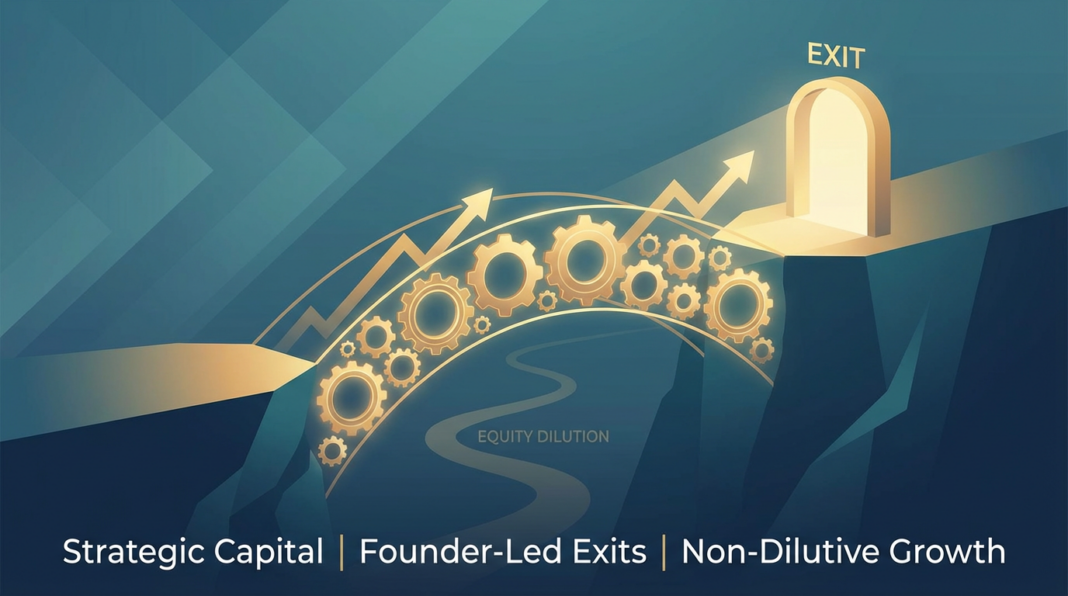
- An exit or inflection point on the horizon: Non-dilutive financing is most powerful when it bridges a company to a value-creation milestone: a revenue threshold, a contract win, an acquisition conversation. The Holifields knew they were positioning for an exit. TIMIA’s facility was the bridge, not the destination.
- Founder-controlled governance: All three founders cited control as a core value. Equity, especially institutional VC, introduces board dynamics, return timelines, and growth mandates that can misalign with a company’s natural operating rhythm. Debt carries no such governance cost.
The framework is straightforward: if you can service the debt from existing or near-term cash flows, and the proceeds will materially accelerate a value-creation event, non-dilutive capital almost always produces a better founder outcome than equity at the same stage. The equity investors who backed SafePointe alongside TIMIA made 10x in nine months. That return came directly out of the Holifields’ pocket. The debt did not.
Key Insights
- The interest rate is not the cost of debt, dilution at exit multiples is the real cost of equity. Founders who model both correctly almost always find that venture debt is dramatically cheaper than equity capital taken at the same stage.
- Non-dilutive capital is most powerful as a bridge, not a foundation. SafePointe and Myagi used debt to close the gap between their current state and a higher-value exit. The precision of that deployment (tied to specific contract milestones and growth levers) is what made it work.
- Recurring revenue is the underwriting asset. Revenue-based financing and venture debt are priced and structured against MRR visibility. For SaaS and hardware-enabled SaaS businesses, this is a structural advantage that pure product or project-based businesses cannot easily replicate.
- VC timelines and founder timelines are structurally misaligned. As Simon Turner observed, institutional equity demands growth at a pace the market may not support, because the fund has its own clock. Debt carries an interest obligation, but not a forced-exit mandate.
- The governance cost of equity is hidden but real. Board seats, investor approval rights, and return-profile pressure all influence operating decisions in ways that compound over time. Founders who preserve governance control through debt financing retain the ability to manage their companies on their own terms, including the timing and structure of any eventual exit.


