
The Story: A Seasonal Clock, a Capital Gap, and a Fork in the Road
It was a decision that most early-stage founders have faced at least once: you can see the wave coming, you know exactly how to ride it, but you don’t have the board to paddle hard enough.
For Ranvir Singh and his co-founders at Inkle, an all-in-one financial operations platform built specifically for VC-backed tech startups; that wave had a calendar attached to it. Demand for their bookkeeping, tax filing, compliance, and reporting services surged in predictable seasonal windows. If they could hire fast, push product development, and move into new markets ahead of those windows, the growth was essentially already priced in. The market was there. The customers were coming. The only missing variable was capital.
Founded in 2022 and operating on a $1.5M pre-seed raise with a lean team of 11 to 50 people, Inkle had already proven product-market fit. They were serving over 500 companies. The founding team had conviction they were on a trajectory to hit Series A metrics organically. What they didn’t want was to arrive at that milestone having given away 20%, 30%, or more of their company to fund a runway they didn’t structurally need.
The traditional playbook would have said: raise a seed round. Take the dilution, take the capital, and sprint. Inkle chose a different road entirely.
The Decision: Seed Round vs. Non-Dilutive Revenue-Based Financing
Let’s be precise about what Inkle’s options actually looked like at this decision point, because the framing matters enormously.
Option A, Traditional Seed Round: Raise $1M–$3M from institutional seed investors at a negotiated valuation. Accept dilution of roughly 15%–25% per round, give up board seats or observer rights, and absorb the governance overhead and expectation-setting that comes with institutional capital. Repeat at Series A, where cumulative dilution compounds further.
Option B, Non-Dilutive Growth Financing via Efficient Capital Labs (ECL): Access capital structured around Inkle’s existing revenue visibility, their predictable, recurring B2B revenue streams from fintech clients. Drawdowns in multiple tranches, timed to actual growth opportunities. No equity surrendered. No board seats lost. No cap table complexity added.
Inkle chose Option B. According to Singh, the logic was direct: “With ECL, our founding team avoided two rounds of dilution, held onto control of our company, and kept our high growth trajectory intact without giving up equity.”
The structure ECL provided was built on Inkle’s revenue visibility, a hallmark of revenue-based financing models where repayment scales with top-line performance rather than fixed debt service schedules. This meant Inkle wasn’t taking on the kind of rigid liability that could crater the business in a slow quarter. Capital moved with the company, not against it.
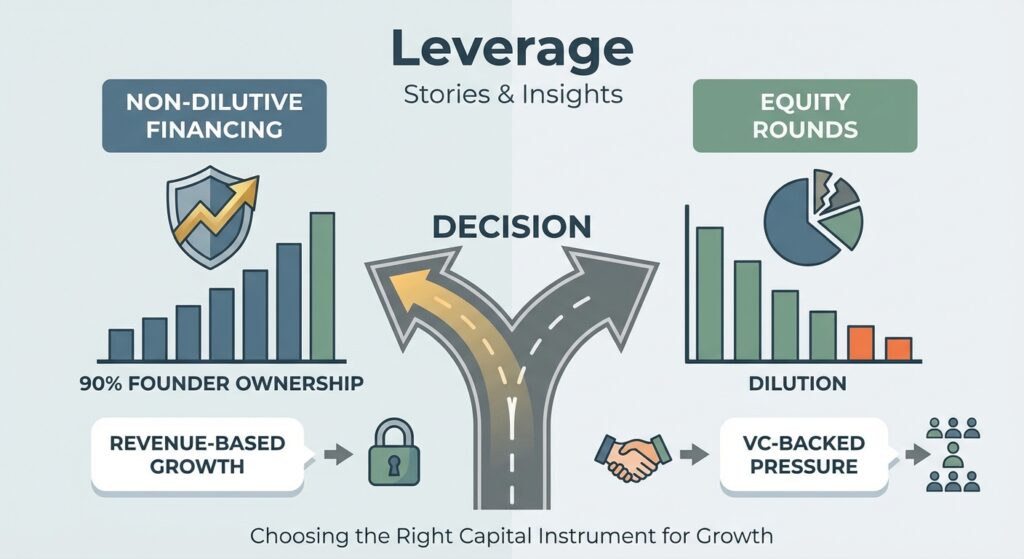
The quantified outcome was stark: approximately two dilution rounds avoided. Founding team equity retained at roughly 90%. Zero board control lost. Growth trajectory maintained. By every measure that matters to a founder who intends to stay at the helm of the company they built, this was a structurally superior outcome to the equity path, at this stage, for this business, with this revenue profile.
The Outcome: What 90% Ownership Actually Means in Dollar Terms
It’s easy to talk about dilution in percentages. It’s harder to feel it until the exit happens. Consider the arithmetic.
If Inkle reaches a Series A at a $15M valuation (modest for a fintech SaaS with 500+ clients and strong retention) the difference between 90% founder ownership and 55% (the approximate outcome after two conventional equity rounds) is $5.25 million in real founder value at that single inflection point. At a $30M valuation, that gap doubles to over $10.5 million. This is money that doesn’t come from a future investor. It comes from decisions made years earlier, at the seed stage, when the numbers looked small but the ownership math was being permanently set.
This is precisely the lesson Charles Chang’s story reinforces from a different angle. Chang co-founded Vega, the plant-based nutrition company, in 2001: bootstrapping through credit card debt, a second mortgage, and the sale of his car before ultimately selling to WhiteWave Foods for approximately US$550 million in 2015. Chang’s obsessive control over equity through the early years meant that when the exit came, the founders captured an overwhelming share of the value they had created. His philosophy, that founders who aren’t willing to bet their own capital shouldn’t be in business, is a different expression of the same underlying principle: dilution is a tax on conviction, and it compounds over time. As documented by beancount.io, Chang’s path was extreme, but the ownership lesson translates across capital strategies.
For Inkle, non-dilutive financing provided the fuel without extracting the future upside. The company expanded into new markets, accelerated product development, and added headcount across key functions, all the outcomes a seed round would have funded, but without resetting the ownership table.
The Cautionary Counterpoint: When Debt Goes Wrong
Non-dilutive capital is not categorically safer than equity. The story of Divvy Homes is a necessary counterweight to any clean narrative about the virtues of avoiding VC.
Divvy Homes raised over $400 million in venture equity at a peak $2.3 billion valuation, then took on approximately $735 million in debt financing in October 2021 to fund its rent-to-own home-buying model. When interest rates surged in 2022, the model broke. By January 2025, Brookfield Properties had acquired the company for approximately $1 billion, a number that sounds like a success until you read the fine print. After repaying the debt stack, covering transaction costs, and satisfying preferred equity liquidation preferences, founders, employees, and most VC investors received zero proceeds, as reported by SaaStr.
The distinction between Inkle’s outcome and Divvy’s collapse is not debt versus equity in the abstract. It is the right capital instrument for the right business model at the right moment. Divvy’s debt was massive relative to its asset base, rate-sensitive, and structurally mismatched to a real estate model exposed to macro conditions it could not control. Inkle’s revenue-based financing was modest, revenue-matched, and tied directly to the contractual cash flows of a recurring B2B SaaS business. One was a bet on macro stability. The other was a bet on customers already signed.
The Lessons: A Framework for Founders at the Capital Crossroads
The Inkle story, set against the broader landscape of the 2025–2026 private capital market, produces a clear set of principles for founders navigating the equity-versus-debt decision:
1. Dilution is permanent; debt is temporary: if structured correctly.
Equity given away in an early round compounds its cost through every subsequent round and into the exit. Revenue-based financing or non-dilutive debt, when matched to the company’s cash flow profile, is discharged and disappears. The ownership table after Inkle’s ECL financing looks identical to before it. That is not true of a seed round.
2. Non-dilutive capital works best when revenue is predictable and recurring.
ECL’s model (and most legitimate revenue-based financing structures) prices capital against revenue visibility. A company with predictable B2B SaaS contracts, strong net dollar retention, and short CAC payback periods is a natural fit. A pre-revenue company or a business with lumpy, project-based cash flows is not. Know which one you are before approaching a non-dilutive lender.
3. The VC clock creates misaligned incentives by design.
Venture capital funds have fixed 10-year lifespans with return expectations that require portfolio companies to grow aggressively toward large exits. That incentive is not inherently aligned with a founder who wants to build a durable, profitable company over 15 years. Non-dilutive financing carries no such mandate. The capital serves the company’s timeline, not a fund manager’s IRR.
4. Match your capital instrument to your model’s risk profile.
Divvy needed equity, not debt, or it needed far less debt relative to a model whose core asset (residential real estate) was acutely sensitive to interest rate movements. Inkle needed temporary acceleration capital, not permanent partners. The instrument must fit the model, not the other way around.
5. The decision compounds: get it right early.
Ownership decisions made at the $1.5M stage echo at the $15M stage and the $150M stage. Inkle’s co-founders appear to have understood that the highest-leverage capital decision they would ever make was the one they made when the stakes looked smallest. That is the founder’s paradox, and the ones who solve it early tend to be the ones celebrating at the exit.
Key Insights
- Inkle avoided approximately two rounds of equity dilution by using revenue-based financing from Efficient Capital Labs, retaining roughly 90% founding team equity while sustaining high growth across new markets, products, and headcount.
- Non-dilutive financing is not universally safer than equity: Divvy Homes’ $735M debt load destroyed founder and employee value despite a $1B exit, illustrating that capital instrument fit to business model is the critical variable, not debt versus equity in the abstract.
- Revenue predictability is the core underwriting criterion for non-dilutive financing; B2B SaaS companies with recurring contracts, strong retention, and short CAC payback periods are structurally well-suited to revenue-based structures.
- VC capital carries embedded incentive misalignment: fund timelines and return mandates create pressure for exits and growth trajectories that may not reflect what is optimal for the founder or the business over a longer horizon.
- Early dilution decisions compound permanently through every subsequent financing round and into the terminal exit event; the ownership percentage retained at the seed stage is often the most consequential financial decision a founder makes.


