
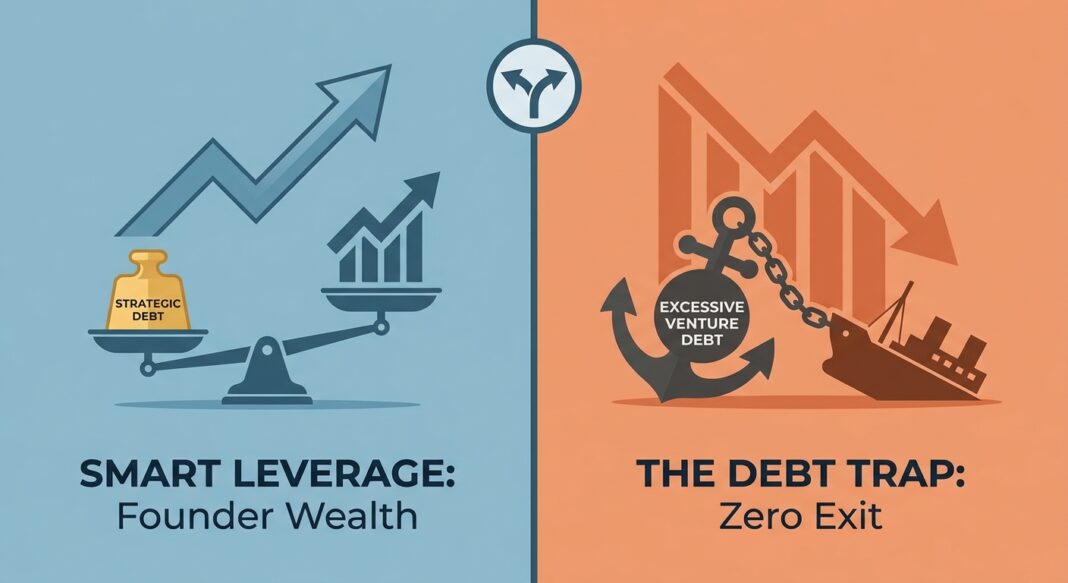
The Story: A Father, a Son, and a $1M Bet That Beat Equity Ten Times Over
Greg Holifield spent 22 years on active duty overseas. He missed graduations, birthdays, and the ordinary moments that accumulate into a life. When he finally came home, he and his son Timothy started building companies together, not as a business strategy, but as an act of recovery. They would build four startups and exit each one successfully.
Their final company, SafePointe, was an AI-powered weapons detection system based in Florida. It was technically a SaaS business (recurring revenue, enterprise contracts) but it carried a hardware dependency that made traditional financing complicated. Every new customer required upfront hardware investment. That hardware sat on the balance sheet before a single subscription dollar came in, creating a working capital gap that threatened to cap growth right when momentum was building.
In September 2022, the Holifields turned to TIMIA Capital for a $1 million USD debt facility, taken in three staged disbursements. They were deliberate about the choice. They had already fielded conversations with two other debt providers. TIMIA won on terms, fund structure, and, critically, their understanding of hardware-enabled SaaS as a business model.
Less than twelve months later, SafePointe was acquired by SoundThinking, Inc. (Nasdaq: STTI), a leading public safety technology firm. SafePointe had tripled its monthly recurring revenue between financing and acquisition. It was the Holifields’ fourth exit, and, in Greg’s words, their most satisfying.
Meanwhile, roughly 1,200 miles north and a year earlier, another founder was signing a very different kind of debt agreement. One that would eventually cost her everything.
The Decision: Two Founders, Two Debt Philosophies, Two Entirely Different Outcomes
To understand what the Holifields got right, it helps to understand what Divvy Homes got catastrophically wrong, not because their intentions were bad, but because their capital structure made a good outcome nearly impossible.
Divvy was a rent-to-own residential platform founded in 2016. The model was elegant: buy homes for customers, rent them back, and set aside a portion of monthly payments toward a future down payment. It had real social impact. It also had a brutal capital requirement, because the business model literally required Divvy to purchase houses at scale.
By 2021, Divvy had raised over $400 million in venture equity and achieved a $2.3 billion valuation on the back of a $200 million Series D led by Tiger Global. Then, in October 2021, at the absolute peak of the zero-interest-rate era, Divvy took on approximately $735 million in debt financing. The logic seemed airtight at the time: rates were near zero, housing appreciated reliably, and debt was cheap. What could go wrong?
The Holifields, by contrast, took on $1 million: modest, staged, and sized precisely to the working capital gap their hardware deployment created. No more, no less. The debt was a tool with a specific job: fund hardware for new contracts and bridge the gap to subscription revenue. It was not a substitute for a business model. It was not a bet on macroeconomic conditions holding steady. It was a scalpel, not a sledgehammer.
Greg was direct about the internal skepticism they faced. Some board members questioned whether TIMIA’s interest rate was too high. His response cut through the noise: “When there are no warrants associated with debt, it is truly fantastic money, and much cheaper than equity. I love this class of debt.” He was right. The equity capital SafePointe raised alongside TIMIA’s facility returned 10x to those investors in just nine months. TIMIA’s debt cost a fraction of that, in real dollar terms, over the same period. The Holifields kept their equity, and their exit proceeds.
The Outcome: $1B In, $0 Out, And Why the Math Was Never Going to Work
When interest rates surged in 2022, Divvy’s model fractured at every joint. The cost of financing rose. Customers’ ability to qualify for mortgages fell. New home acquisitions halted entirely. Three rounds of layoffs followed. By January 2025, Brookfield Properties acquired Divvy for approximately $1 billion: a headline number that sounds like a success until you understand the waterfall.
The payout cascade at exit is merciless and mathematical:
- First: $735M+ in debt repayment, in full, before anyone else sees a dollar
- Second: Transaction costs: legal fees, advisory fees, estimated at $20–40M
- Third: Liquidation preferences for preferred shareholders across Series A through D
- Last: Common shareholders: founders, early employees, the people who built it
By the time the line reached the founders, there was nothing left. CEO Adena Hefets wrote to shareholders that after repaying outstanding debt, covering transaction costs, and fulfilling liquidation preferences, neither common shareholders nor founders would receive any proceeds. A $1 billion sale. Zero for the builders. As reported by saastr.com, Hefets helped 2,000 families become homeowners, built operations across 20 cities, and navigated a brutal market downturn, and received nothing for it.
The contrast with SafePointe could not be starker. The Holifields’ $1M facility was repaid from operating cash flow before the acquisition closed. TIMIA was made whole. The founders captured the full value of the equity they had preserved. As documented by timiacapital.com, Greg called it their most satisfying exit of four, because for the first time, the capital structure worked for them, not against them.
A third data point reinforces the pattern. Myagi, a retail sales enablement SaaS, used a $2.5 million TIMIA facility in 2021 to grow ARR from $2.4M to $4.4M before being acquired by Rallyware in 2023. Co-founder Simon Turner, having run the full gamut from venture capital to debt, was unambiguous in his retrospective: venture capital pressure to grow at all costs can force founders to outrun their market’s natural cadence. Non-dilutive debt let Myagi grow on its own terms, and exit on its own timeline, as detailed by timiacapital.com.
The Lessons: A Framework for Founders Facing the Debt vs. Equity Decision
These stories are not arguments against debt, nor against equity. They are arguments for precision, for understanding exactly what each instrument does to your outcome before you sign.
Debt shrinks the pie before you eat. Equity reduces your slice. Founders obsess over dilution and happily take on debt because it leaves the cap table unchanged. But debt is a senior claim on your future. At any exit below a threshold determined by your total debt load, your equity, regardless of percentage, is worth zero. Divvy’s founders needed an outcome above their peak valuation just to see a single dollar from the Brookfield sale.
Know your waterfall before you need it. Every founder should be able to answer one question clearly: at what exit price do I personally make $0? If you cannot answer that today, your investors and lenders already can. Model every scenario. Understand the cascade. Know the floor.
Size debt to a specific operational gap, not to a macro thesis. The Holifields used $1M to bridge a hardware working capital gap with a clear path to repayment from subscription revenue. Divvy used $735M to bet on interest rates staying low and home values rising indefinitely. One is a tool. The other is a structural dependency on conditions you cannot control.
Non-dilutive does not mean free. Revenue-based financing, venture debt, and private credit are real instruments with real costs. But for capital-efficient businesses with predictable recurring revenue, the cost of debt, when sized correctly, is almost always cheaper than the long-run cost of equity, as Ken Hoppe of Modigi discovered when he used a $400K Founderpath facility to reach $1.7M ARR profitably, retaining 100% ownership throughout, as outlined by founderpath.com.
Debt works when the business model is proven. It fails when it subsidizes the model itself. SafePointe, Myagi, and Modigi all had demonstrable recurring revenue before they borrowed. Debt accelerated what was already working. Divvy needed debt to buy the assets that generated the revenue, making the business structurally dependent on the debt remaining serviceable under all conditions. It wasn’t.
Key Insights
- Precision beats scale in debt sizing: The Holifields’ $1M facility and Myagi’s $2.5M facility were surgical, sized to a specific working capital gap with a clear repayment path. Divvy’s $735M was structural. One class of debt accelerates; the other consumes.
- Model your waterfall, or someone else will: Every dollar of debt raises the minimum exit price at which founders see any return. Divvy’s founders needed an exit well above their peak valuation to profit. Know your zero-outcome threshold before you sign, not after.
- Non-dilutive capital is cheaper than equity when sized correctly: SafePointe’s equity co-investors made 10x in nine months. TIMIA’s debt cost a fraction of that in real dollars. For founders with recurring revenue and a clear repayment horizon, debt preserves far more value than the equity it replaces.
- VC pressure can distort natural growth: Simon Turner’s experience at Myagi illustrates a structural tension in venture capital, fund dynamics incentivize growth at all costs, often forcing founders to outpace the market’s capacity to absorb their product. Non-dilutive capital lets founders grow at their own cadence and exit on their terms.
- Debt secured by revenue, not assets, is the cleanest leverage for SaaS: Revenue-based facilities from TIMIA, Founderpath, and similar lenders are underwritten against MRR and carry no warrants, no board seats, and no equity dilution. For bootstrapped or capital-efficient founders, this is the instrument that preserves the most value from first dollar to last.


