
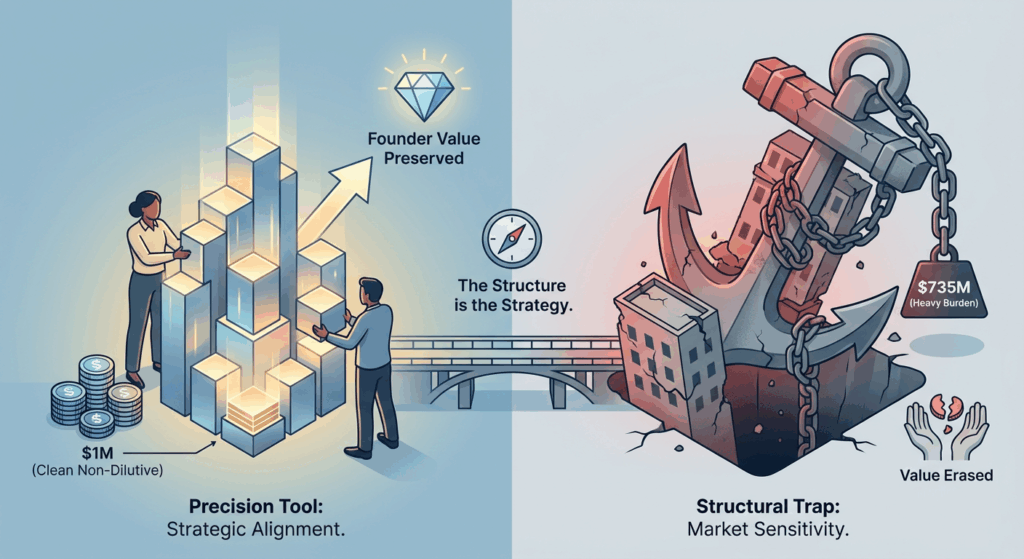
Two Deals, One Lesson: Debt Is a Tool, Not a Shortcut
In the same twelve-month window, two companies made high-stakes capital decisions involving debt. One walked away with a life-changing exit and 100% of their equity intact. The other closed a $1 billion sale and handed founders exactly zero dollars. The difference wasn’t luck, market timing, or even the quality of the business. It was the structure of the debt, and whether the founders truly understood what they were signing.
These two stories, when read side by side, form the clearest possible map of when non-dilutive capital is a founder’s greatest weapon, and when it becomes the very mechanism that erases everything they built.
The Story: A Father, A Son, and a $1M Facility That Paid Off
Greg and Timothy Holifield had been building and exiting companies together since 2010, four startups, four exits. Their final venture together was SafePointe, a Florida-based AI-powered weapons detection company operating in the hardware-enabled SaaS model. It was a capital-intensive structure by design: hardware costs were embedded in license fees, which meant every new customer contract came with a working capital burden before a dollar of recurring revenue arrived.
By September 2022, SafePointe had traction and recurring revenue, but it was straining under the weight of heavy accounts receivable lines and insufficient working capital to fund incoming contracts. The Holifields had a choice familiar to every founder at this stage: dilute equity to bring in new investors, or find another way to bridge the gap.
They chose debt. Specifically, a $1 million non-dilutive venture debt facility from TIMIA Capital, drawn in three structured disbursements timed to contract milestones. No warrants. No board seats. No equity given away.
Twelve months later, SafePointe was acquired by SoundThinking, Inc. (Nasdaq: SSTI), a public safety technology firm, in a deal announced in September 2023. In the lead-up to the acquisition, SafePointe had tripled its monthly recurring revenue. The TIMIA debt was repaid. The equity providers who came in at the same time made 10x on their investment in nine months, but the debt cost the Holifields only a fraction of that, while preserving the ownership percentage that made their exit meaningful.
“I love this class of debt,” Greg Holifield told TIMIA Capital afterward. “When there are no warrants associated with debt, it is truly fantastic money, and much cheaper than equity.”
The Holifields’ fourth exit was, by Greg’s own account, their most satisfying, precisely because the capital structure aligned with the outcome they were building toward. Source: timiacapital.com
The Cautionary Twin: Divvy Homes and the $735 Million Weight
While the Holifields were quietly engineering their clean exit, another story was unfolding that illustrates the exact opposite principle at catastrophic scale.
Divvy Homes was a rent-to-own real estate startup founded in 2016 with genuine social impact, buying homes for families who couldn’t yet qualify for a mortgage, renting them back with a portion of each payment set aside toward a future purchase. The model worked, and investors believed in it. By 2021, Divvy had raised over $400 million in venture equity from firms including a16z and Tiger Global, reaching a $2.3 billion valuation on its Series D.
Then, in October 2021, Divvy added approximately $735 million in debt financing to fund home acquisitions at scale. The logic was airtight at the time: interest rates were near zero, housing prices were rising, and the debt seemed like leverage in the truest sense, a multiplier on an already-working model.
It was not. When the Federal Reserve began its historic rate-hiking cycle in 2022, Divvy’s cost of financing surged, its customers’ ability to secure mortgages cratered, and the entire model seized. Three rounds of layoffs followed. New home acquisitions were paused entirely by 2023.
In January 2025, Brookfield Properties acquired Divvy’s portfolio of roughly 7,000 homes for approximately $1 billion. CEO Adena Hefets wrote in a letter to shareholders that after repaying the outstanding debt, covering transaction costs, and satisfying liquidation preferences for preferred shareholders, neither common shareholders nor founders would receive any proceeds.
A billion-dollar exit. Zero for the people who built it. Source: saastr.com
The Capital Decision: Why the Same Tool Produced Opposite Results
Both companies used debt. Both were growing. Both had investors with conviction. So why did one founder family walk away satisfied and the other walk away with nothing?
The answer lives in four variables that every operator must stress-test before signing a debt facility:
- Debt size relative to realistic exit range. SafePointe’s $1M facility was modest against any plausible acquisition value in their market. Divvy’s $735M in debt meant the company needed an exit above its peak valuation just to return a single dollar to founders.
- Model sensitivity to macro conditions. SafePointe’s recurring revenue from government and enterprise contracts was relatively rate-insensitive. Divvy’s entire model depended on cheap debt and an appreciating housing market, two conditions that vanished simultaneously.
- Debt as accelerant vs. debt as enabler. TIMIA’s capital helped SafePointe move faster toward an outcome it was already approaching. Divvy’s debt was structural, without it, there was no business. When structural debt fails, everything fails with it.
- Waterfall awareness. The Holifields understood exactly what their exit economics looked like at every disbursement. The Divvy story suggests that the full downstream impact of stacking $735M in senior debt on top of hundreds of millions in preferred equity with liquidation preferences was not fully modeled at the moment of decision, or was accepted as an acceptable risk at peak-market euphoria.
The Lessons: A Framework for Using Debt Without Becoming Its Prisoner
The SafePointe story is not a fluke. Ken Hoppe, CEO of Modigi, a Salesforce-ecosystem SaaS company with six employees, used $400,000 in revenue-based financing from Founderpath to hire his first sales and customer success roles, reaching $1.7 million in ARR profitably while retaining 100% founder ownership. No board. No dilution. No warrants. Source: founderpath.com
These outcomes share a structural DNA. Here is the framework they reflect:
- Right-size the debt to the exit floor, not the valuation ceiling. Debt must be repayable at the low end of your exit range, not just the optimistic scenario.
- Prefer debt with no warrants. Warrant coverage quietly re-introduces dilution through the back door. Clean debt (fixed cost, fixed term, no equity kicker) is the version that truly preserves founder value.
- Know your waterfall before you sign. At what exit price do you personally make zero? If you cannot answer that question in under thirty seconds, you are not ready to take on debt.
- Use debt to accelerate a trajectory, not to fund the thesis. If your business only exists because of the debt, the debt owns the business, not you.
- Model macro sensitivity. Debt has fixed obligations. Revenue does not. Any capital structure that requires both cheap financing and a favorable market to survive is not a capital structure; it is a bet.
The Holifields built four companies and exited four times by treating debt as a precision instrument. They borrowed exactly what they needed, at exactly the right moment, with terms they could model to the outcome. That discipline (not the size of the check, not the fame of the investor) is what made their final exit their best one.
Adena Hefets built something real at Divvy. Two thousand families became homeowners because of her work. The capital structure did not fail the mission. It failed the math. And in the end, the math is what determines who gets paid.


