
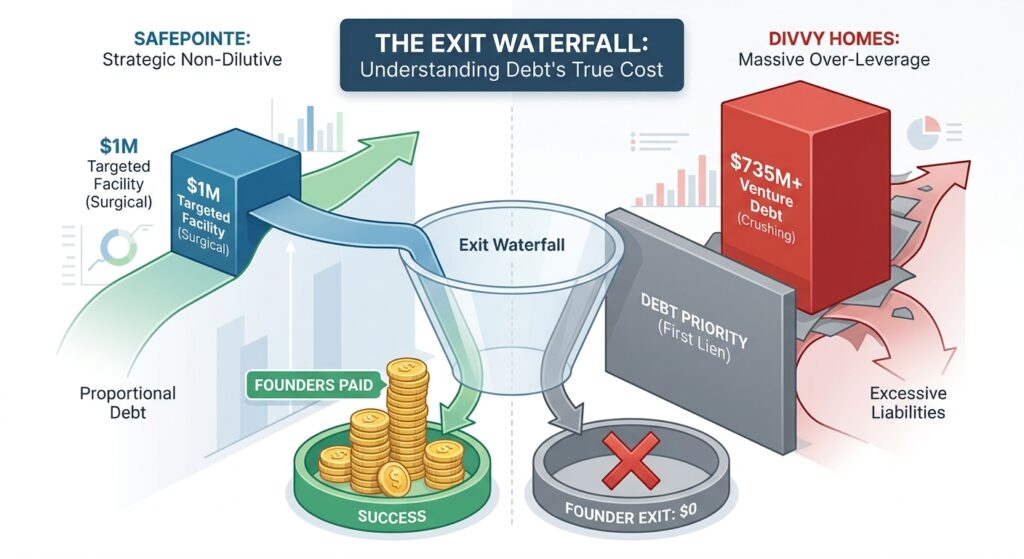
Two Companies. Two Capital Structures. Two Very Different Outcomes.
In January 2025, Divvy Homes sold to Brookfield Properties for $1 billion. The founders got $0. The employees got $0. Even most of the venture investors walked away empty-handed. A billion-dollar exit, and the people who built it saw nothing.
Around the same time, a small Florida-based AI weapons detection company called SafePointe was quietly celebrating the most satisfying exit its founders had ever experienced. The deal was a fraction of Divvy’s size. But every founder walked away whole.
The difference between these two stories isn’t talent, timing, or even market conditions. It’s capital structure, specifically, the discipline with which each founding team understood what debt actually costs when the exit finally arrives.
The Story: SafePointe’s Surgical Use of Non-Dilutive Capital
Greg and Timothy Holifield, a father-son team with four prior exits between them, founded SafePointe as a bootstrapped, hardware-enabled SaaS company offering next-generation AI-based weapons detection systems. Their business model was elegant but capital-intensive: recurring software revenue embedded in hardware that had to be financed upfront before customers paid a dime.
By September 2022, SafePointe had modest but growing recurring revenue and a clear path to scale, if they could solve a working capital problem. Heavy accounts receivable lines and hardware deployment costs were choking growth. New contracts were sitting on the table. Cash was the bottleneck.
The Holifields faced a classic founder’s dilemma: raise equity and dilute ahead of what they believed would be a near-term exit, or find a smarter capital instrument that could bridge the gap without surrendering ownership. They chose the latter, engaging TIMIA Capital for a $1 million USD venture debt facility, disbursed in three targeted tranches tied directly to operational milestones.
The result: SafePointe tripled its monthly recurring revenue within twelve months. Less than a year after closing the TIMIA facility, SoundThinking, Inc., a Nasdaq-listed public safety technology firm, acquired SafePointe. The Holifields called it their most satisfying exit process in over a decade of entrepreneurship.
The Decision: Sizing Debt to the Business, Not the Dream
What made SafePointe’s use of debt work where Divvy’s failed catastrophically comes down to one word: proportion.
SafePointe’s $1 million facility was sized to a specific, solvable operational problem, hardware financing and working capital for new contract deployment. It was not used to fund core operations indefinitely. It was not a substitute for a business model that required perpetual capital infusion. It was a precision instrument deployed against a defined constraint.
Greg Holifield was direct about the misconception founders carry into these conversations: “They think the interest rate is too high, but when there are no warrants associated with debt, it is truly fantastic money, and much cheaper than equity.” That framing matters. SafePointe did take on some equity capital alongside the TIMIA debt. By exit, those equity investors had made 10x on their capital in nine months. The TIMIA debt cost a fraction of that, and didn’t require surrendering a single board seat or governance right.
Contrast this with Divvy Homes. In October 2021, at the absolute peak of the zero-interest-rate era, Divvy took on approximately $735 million in debt on top of hundreds of millions in preferred venture equity already carrying its own liquidation preferences. As SaaStr documented, the logic at the time seemed airtight: rates were near zero, housing only goes up, and the model was working. But the debt didn’t care about the model. When interest rates surged in 2022, the entire capital structure became a trap.
The Outcome: When the Waterfall Runs Dry
The mechanics of why Divvy’s $1 billion exit produced $0 for founders are not complicated; they are simply brutal. Every dollar in a company exit flows through a strict priority waterfall:
- Debt holders: repaid in full, first, without exception
- Transaction costs: legal, advisory, and banking fees
- Preferred shareholders: each series with its own liquidation preference
- Common shareholders: founders, employees, early believers
At Divvy’s $1 billion sale price: subtract ~$735 million in debt repayment, subtract $20–40 million in transaction costs, subtract liquidation preferences on hundreds of millions in preferred equity. The line runs out of money before it reaches the people who built the company. CEO Adena Hefets confirmed as much in her letter to shareholders: after debt, transaction costs, and liquidation preferences, neither common shareholders nor founders’ preferred stock received any proceeds.
This is the insight that too many founders miss when they celebrate non-dilutive debt financing: debt doesn’t dilute your ownership percentage; it dilutes your exit outcome. You can own 100% of a company and receive $0 at the finish line if the debt ahead of you consumes everything first.
SafePointe’s founders understood this intuitively from prior experience. They sized the debt to preserve exit optionality, not to unlock a growth ceiling that the business model couldn’t structurally support.
The Lessons: A Framework for Using Debt Without Destroying Your Outcome
These two stories (one cautionary, one instructive) converge on a set of principles that every founder, operator, and family business owner should internalize before signing any debt facility.
1. Model your waterfall before you model your growth. At every realistic exit price, know exactly who gets paid and in what order. Ask the question Divvy’s founders never answered clearly enough: at what exit price do I personally receive $0? If the answer is uncomfortably close to your most likely outcome, the debt is a trap, not a tool.
2. Debt sized to a specific constraint is a tool. Debt sized to a vision is a liability. SafePointe used $1M to solve a defined hardware financing problem with a measurable outcome. Divvy used $735M to sustain a capital-intensive model in a macro environment that could reverse without warning. The instrument was the same. The discipline was not.
3. Non-dilutive doesn’t mean cost-free; it means the cost shows up later. Venture debt, revenue-based financing, and private credit all have real economic costs. The founders who deploy these tools most effectively are those who fully price the cost into their exit math, not those who treat it as “free money.”
4. Proportionality is everything. The private credit market has matured significantly, direct lending volumes have grown substantially, and sophisticated non-bank lenders like TIMIA now offer flexible facilities with no warrants and milestone-linked disbursements. These instruments work beautifully when the debt-to-realistic-exit ratio is conservative. They become catastrophic when debt approaches or exceeds any plausible exit scenario.
5. The best debt preserves optionality. The worst debt eliminates it. SafePointe’s facility gave the Holifields the runway to triple MRR and negotiate from strength. Divvy’s debt load meant the company needed an exit above its peak private valuation just for founders to see a dollar. One structure expanded the range of good outcomes. The other narrowed it to nearly zero.
Key Insights
- Debt doesn’t dilute ownership; it dilutes exit outcomes. Founders who focus only on cap table dilution miss the more dangerous economic risk hiding in their waterfall.
- Right-sized venture debt can dramatically outperform equity on a cost-of-capital basis: SafePointe’s TIMIA facility cost a fraction of the 10x return its concurrent equity investors captured in the same nine-month window.
- The waterfall is non-negotiable. Debt holders are first in line at exit. Every founder must model this at multiple exit prices before committing to any debt facility.
- Macro risk lives inside debt structures. Divvy’s $735M facility looked rational at zero interest rates and broke catastrophically when rates rose. Stress-test your debt assumptions against macro scenarios your model may not currently contemplate.
- Proportionality and purpose are the two variables that separate disciplined leverage from destructive leverage. Size debt to solvable, specific constraints, not to sustain models that require perpetual capital to function.


