
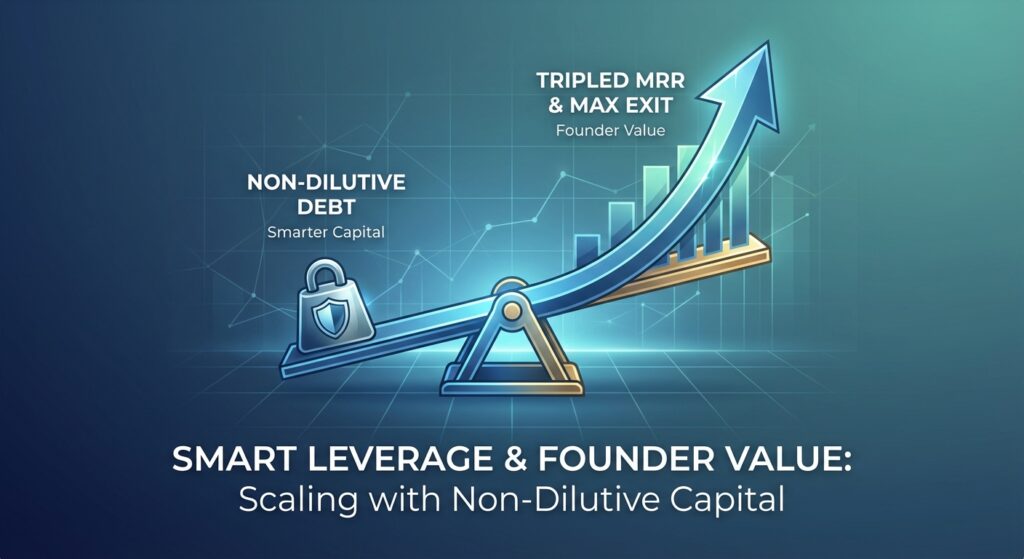
The Story: A Father, a Son, and a Smarter Way to Scale
Greg and Timothy Holifield had already done this before. By the time they founded SafePointe (a next-generation, AI-powered weapons detection company based in Florida) they had already built and exited three companies together. They knew the playbook. They also knew its most expensive chapter: equity dilution before exit.
SafePointe was a hardware-enabled SaaS business. Think of it as a recurring-revenue model with a heavy upfront cost, the hardware that makes the software sing. Every new customer contract meant new hardware to finance, new installation costs to absorb, and a longer wait before that recurring revenue started to compound. It was capital-intensive by design, and growing it meant choosing between two very different roads: take on venture capital partners and share the upside, or find a smarter, cheaper form of capital that let them own more of the exit they were already engineering.
In September 2022, the Holifields engaged TIMIA Capital for a $1 million USD venture debt facility, drawn in three separate disbursements tied to operational milestones. Less than twelve months later, SafePointe was acquired by SoundThinking, Inc. (Nasdaq: SSTI), a leading public safety technology firm. It was the Holifields’ fourth successful exit, and, by Greg’s own account, their most satisfying one.
The Decision: When Equity Capital Is the Most Expensive Money in the Room
SafePointe wasn’t without options. The company had raised some equity capital alongside its TIMIA debt facility, and the Holifields had conversations with multiple debt providers before settling on their structure. The core tension was familiar to any capital-intensive founder: they needed cash to win new contracts, but every dollar of equity they gave away now would cost multiples at exit.
The structural problem was clear. Hardware costs embedded into license fees created an accounts receivable drag, cash went out the door before recurring revenue came back in. Working capital was the constraint on growth, not product-market fit, not sales pipeline. This is precisely the scenario where venture debt, used correctly, acts as a force multiplier rather than a liability.
The TIMIA facility ($1 million, no warrants, structured in tranches) allowed SafePointe to fund hardware procurement for new customer deployments without permanently surrendering equity. Greg Holifield was direct about the math: “They think the interest rate is too high, but when there are no warrants associated with debt, it is truly fantastic money, and much cheaper than equity. I love this class of debt.”
The proof came at exit. The equity investors who participated alongside TIMIA earned approximately 10x on their capital in nine months. TIMIA’s debt facility, by contrast, cost a fraction of that in total financing expense. The Holifields retained far more of the exit proceeds precisely because they had been disciplined about which capital they used to fund growth.
The Outcome: Tripling MRR, Then Selling at Maximum Founder Value
Between September 2022 and the acquisition closing in late 2023, SafePointe tripled its monthly recurring revenue. That growth trajectory, compressed into roughly twelve months, was made possible by the working capital the TIMIA facility unlocked. New customer hardware was financed. Contracts were executed. The MRR curve bent sharply upward at exactly the moment a potential acquirer would be running their diligence.
SoundThinking, operating in the $20 billion global weapons detection market, acquired SafePointe as a strategic add-on to its public safety technology portfolio. Timothy Holifield joined the combined executive team post-acquisition, a signal that this wasn’t a distressed asset sale; it was a value-maximizing exit engineered with precision.
The counterfactual matters here. Had the Holifields taken a venture equity round to solve the same working capital problem, the equity investors earning 10x would have taken a proportionally larger slice of the acquisition proceeds. The $1 million in venture debt, paid back with a modest interest cost, left the founders holding far more of the exit waterfall. As Greg summarized: “Thanks to TIMIA, this has been the most satisfying exit process that we have ever had.”
The contrast with cautionary tales is instructive. Consider Divvy Homes, which raised over $400 million in venture equity and then took on approximately $735 million in debt in October 2021 at peak zero-interest-rate euphoria. When Brookfield acquired Divvy for $1 billion in early 2025, the debt was repaid first, transaction costs consumed additional proceeds, and preferred equity liquidation preferences absorbed the remainder. Founders and common shareholders received nothing. A billion-dollar exit. Zero dollars out. The capital structure, not the business, determined the outcome.
The Lessons: A Framework for Founders Facing the Debt vs. Equity Decision
SafePointe and Divvy Homes sit at opposite ends of the same spectrum. Both companies used debt. Both were working toward exits. The difference was in how much, why, and whether the capital structure was calibrated to a realistic exit scenario. From these two stories, and from cases like Modigi’s $400k Founderpath facility that helped a six-person SaaS team reach $1.7M ARR with 100% ownership intact, a clear framework emerges.
When Non-Dilutive Debt Works
- The constraint is working capital, not product-market fit. SafePointe had customers. It needed cash to serve them. Debt solves a timing problem; equity solves an uncertainty problem. Know which one you have.
- The debt amount is modest relative to realistic exit scenarios. A $1 million facility against an exit that would clearly generate multiples of that in proceeds is structurally sound. A $735 million debt load against a $1 billion exit ceiling is structurally lethal.
- No warrants means the true cost of capital stays fixed. Venture debt with warrants is equity in disguise. Warrant-free debt is a pure financing instrument. Understand what you are actually signing.
- The debt funds revenue-generating activity, not operations. When each dollar of debt directly enables a new customer contract, the debt pays for itself. When debt funds overhead and runway, the calculus changes entirely.
The Waterfall Question Every Founder Must Answer
Before signing any capital raise (debt or equity) model your exit waterfall at three scenarios: your base case, a 50% haircut, and a 75% haircut on your target valuation. At each price, trace who gets paid first: debt holders, transaction costs, preferred liquidation preferences, and finally common shareholders. If you cannot answer “At what exit price do I personally receive zero?”, stop. Find that number before you sign anything. Your investors already know it.
Debt Shrinks the Pie. Equity Reduces Your Slice.
This is the core insight that founders consistently underweight. Equity dilution reduces your ownership percentage, but the pie can still grow large enough for everyone to win. Excessive debt shrinks the pie available to equity holders before a single slice is cut. The Holifields understood this intuitively. They used debt to grow the pie, kept it small enough that it never threatened the waterfall, and exited with maximum founder value intact. That is the model.
Key Insights
- Non-dilutive debt is not inherently cheaper, but warrant-free debt almost always is. When equity investors earn 10x in nine months, the interest cost on venture debt looks trivial by comparison. Do the math on total cost of capital, not just the headline rate.
- Capital structure determines exit outcomes, not exit price alone. Divvy Homes sold for $1 billion and founders received nothing. SafePointe tripled MRR and founders kept the lion’s share of proceeds. The business result was less important than the capital stack sitting above common equity.
- Tranche-based debt facilities align lender and founder incentives. Drawing capital in milestone-tied disbursements, as SafePointe did with TIMIA, keeps both parties focused on operational progress rather than burning a lump sum against a fixed repayment clock.
- Bootstrapped companies have a hidden advantage: no preferred equity preferences. Without a stack of Series A, B, C, and D liquidation preferences above common equity, even a modest debt facility leaves founders in a far stronger waterfall position than a heavily VC-backed peer at the same exit price.
- The best time to learn your debt preference is before you need capital. Model your waterfall today, at your current structure. Then model it with $500k in debt. Then $2 million. Then $10 million. Watch where your personal return hits zero, and treat that number as a hard ceiling on how much debt you will ever take on.


