
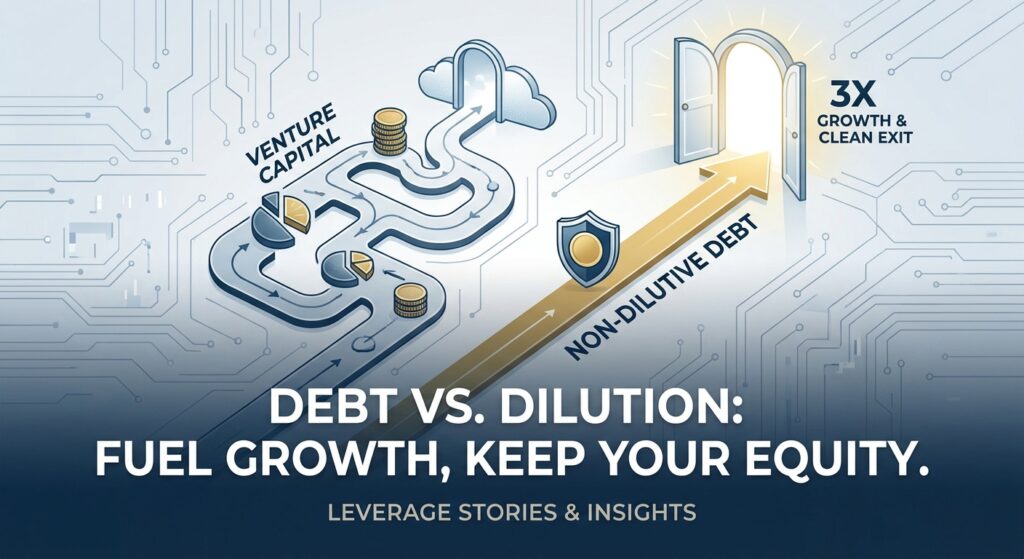
The Story: A Father, His Son, and a $1 Million Bet Against Dilution
Greg Holifield spent 22 years on active duty overseas. He missed birthdays, graduations, and the slow accumulation of ordinary family life. When he finally came home, he made a decision that would define the next chapter of his career: he would build businesses alongside his son, Timothy.
Together, the Holifields built and exited four startups over fourteen years. By the time they founded SafePointe, an AI-powered weapons detection system company based in Florida, they had developed something rarer than a strong product or a hot market: a sophisticated, hard-won philosophy about capital.
And that philosophy was simple. Equity is the most expensive money you’ll ever spend.
SafePointe’s technology operated at the intersection of hardware and SaaS, a notoriously capital-hungry model. Customers required physical detection units to be deployed before the recurring software revenue could begin flowing. That meant large upfront hardware costs, heavy accounts receivable, and a working capital gap that could strangle growth if left unaddressed.
In September 2022, rather than returning to the VC fundraising circuit, the Holifields approached TIMIA Capital for a $1 million non-dilutive debt facility. Less than twelve months later, SafePointe was acquired by SoundThinking, Inc. (Nasdaq: SSTI), a leading public safety technology company. The founders walked away having tripled their monthly recurring revenue, with their equity intact and their outcome maximized.
It was their most satisfying exit yet. And debt was the reason why.
The Decision: Debt or Dilution at the Worst Possible Moment
When SafePointe went to market for growth capital, they had modest but real revenue. They were not pre-product or pre-revenue, the kind of company that genuinely needs venture capital to get off the ground. They were a post-traction company with a working model, paying customers, and a clear path to scale. What they needed was working capital, not a new set of investors at the cap table.
The Holifields had lived the alternative. In a prior venture, they had navigated a $4 million government contract using a patchwork of bank instruments and negotiated terms. That experience, frustrating as it was, gave them the financial literacy to recognize when debt was not just viable but structurally superior to equity.
Greg Holifield put it directly when speaking about the TIMIA facility: “They think the interest rate is too high, but when there are no warrants associated with debt, it is truly fantastic money, and much cheaper than equity. I love this class of debt.”
The structure TIMIA offered was clean: a $1 million facility disbursed in three tranches, timed to SafePointe’s contract milestones, with no equity warrants and no board seats. SafePointe’s cap table remained exactly as it was the day before the first disbursement. The founders did not give up a single percentage point of ownership.
Compare that with what a venture round at that stage might have looked like. An early-growth equity round typically prices at a level that implies 15–25% dilution per round, often with liquidation preferences that rank preferred shareholders well above the founders in any exit waterfall. If SafePointe had raised even a modest $1–2 million equity round, their equity (and therefore their exit proceeds) would have been materially reduced.
Instead, by the time SoundThinking made their acquisition offer, the Holifields owned what they had built. Every dollar of acquisition consideration flowed toward them without a preferred stack sitting upstream.
The Outcome: Triple the Revenue, a Clean Waterfall, and Their Best Exit Yet
The $1 million TIMIA facility, deployed across three disbursements, allowed SafePointe to finance the hardware required to onboard new customers, clear the accounts receivable bottleneck, and accelerate market penetration. According to TIMIA Capital’s published case study, SafePointe tripled its monthly recurring revenue during the financing period.
That revenue acceleration directly shaped the acquisition valuation. SoundThinking was not buying a startup; it was buying a high-growth AI company with a proven recurring revenue engine and a clear foothold in the underserved $20 billion global weapons detection market.
Now consider the counterfactual. The same twelve-month period, the same product, the same market, but with a venture equity round instead of debt. The capital cost would have been structural rather than financial: founders diluted, preferences layered in, and exit proceeds subject to a waterfall that would have paid preferred investors first. In a strategic acquisition of a high-growth but early-stage company, those preferences can be outcome-defining.
The equity investors who did participate alongside the TIMIA facility, a modest co-investment, reportedly earned approximately 10x on their capital in just nine months. That figure is a testament to SafePointe’s performance. But it is also a signal of just how expensive equity capital would have been had the Holifields leaned on it more heavily. TIMIA’s debt cost a fraction of what that equity returned.
Greg Holifield called it their most satisfying exit process in four tries. The structure earned that result.
The Lessons: What SafePointe Teaches Every Founder About Capital Structure
The SafePointe story is not a rejection of equity capital. It is a case study in using the right instrument at the right time. There are several durable principles embedded in how the Holifields approached this decision.
1. Debt Does Not Dilute Your Slice: It Preserves It
Venture equity reduces your percentage ownership. But non-dilutive debt, when used for the right purpose at a manageable size relative to your revenue, leaves your ownership untouched. In an acquisition, that ownership difference translates directly into dollars in founders’ pockets, not just a line on a cap table.
2. The Interest Rate Is Not the Cost of Debt. The Cost of Equity Is.
Founders routinely balk at interest rates on venture debt while accepting venture equity terms that imply a far higher implicit cost. A 10–12% annual interest rate on a twelve-month facility is categorically cheaper than giving up 20% of your company to investors whose capital will return 10x at exit. The math is not subtle. As Greg Holifield noted, once you remove warrants from the equation, venture debt is remarkably cheap money.
3. Tranche Structures Align Capital With Milestones
SafePointe drew the TIMIA facility in three separate disbursements. This structure is often underappreciated. Milestone-linked tranches reduce interest burden, force capital discipline, and ensure the business earns its next draw rather than burning a large lump sum. It is a structure that VC rarely offers, because VC’s incentive is deployment, not efficiency.
4. A Clean Cap Table Is a Competitive Asset in Acquisition Negotiations
When SoundThinking acquired SafePointe, there was no complex preferred stack to unwind. No multiple liquidation preferences. No ratchets or anti-dilution provisions to negotiate around. A clean capital structure simplifies deal execution, accelerates closing timelines, and removes friction that can erode acquisition consideration in late-stage negotiations.
5. Know When Equity Is the Right Tool, And When It Is Not
The Divvy Homes story offers a cautionary bookend. Divvy raised over $400 million in venture equity and then layered in approximately $735 million in debt to fund home acquisitions at the peak of the zero-rate era. When rates surged and the housing model broke, the $1 billion Brookfield acquisition left founders and common shareholders with nothing, debt and preferred liquidation preferences consumed every dollar before common equity could participate. As SaaStr’s analysis makes clear, debt does not dilute ownership; it dilutes your exit outcome when the exit price fails to clear the debt ceiling. The lesson is symmetrical: misused debt destroys founders just as surely as misused equity does. The Holifields succeeded precisely because they used a modest, appropriately sized facility for a specific, revenue-generating purpose, not as a substitute for a business model that required massive leverage to function at all.
Framework: Should You Use Debt or Equity for Your Next Growth Phase?
Use this decision filter when evaluating your next capital raise:
- Do you have predictable recurring revenue? If yes, debt is likely appropriate. Lenders like TIMIA Capital and Founderpath underwrite against MRR/ARR, no equity required. Founderpath-funded Modigi, for example, used a $400,000 revenue financing facility to reach $1.7 million ARR profitably with six employees and 100% founder ownership intact, as documented in Founderpath’s published case study.
- Is the capital funding a specific, time-bound need? Working capital gaps, hardware deployment costs, and hiring for a known contract are ideal debt use cases. Open-ended product development or market creation are better served by equity.
- Have you modeled your exit waterfall at three price points? Know exactly what each dollar of debt and each preferred share does to your personal proceeds at a 1x, 2x, and 3x exit outcome. If you cannot answer that question today, answer it before your next term sheet.
- Is the debt amount modest relative to realistic exit scenarios? SafePointe’s $1 million facility was a fraction of their acquisition value. Divvy’s $735 million in debt exceeded their realistic exit ceiling. Scale matters enormously.
- Are there warrants attached? Warrant-free debt is structurally closer to a bank loan than to venture capital. Warrant-heavy debt is dilutive by another name. Scrutinize the full economics, not just the interest rate.
Greg Holifield will likely build one more company before retirement. When he does, he has already said he will bootstrap and bring in debt capital when the time is right. That is not ideology. That is the compounded wisdom of four exits distilled into a single sentence.
The Holifields did not get lucky. They got the capital structure right. And in the end, that mattered more than almost anything else.
Key Insights
- Non-dilutive debt preserved 100% of SafePointe’s founder equity, enabling the Holifields to capture the full upside of their acquisition by SoundThinking (Nasdaq: SSTI) with no preferred stack diluting their proceeds.
- The true cost of equity dwarfs the stated cost of debt. Equity investors in SafePointe earned approximately 10x in nine months, a return that would have been extracted from founder proceeds had debt not been available as an alternative.
- Milestone-linked debt tranches enforce capital discipline and reduce interest burden, a structural advantage that lump-sum equity rounds cannot replicate.
- A clean cap table is a negotiating asset. SafePointe’s debt-led capital structure simplified acquisition mechanics and removed the preferred liquidation complexity that derails many founder exits.
- Debt becomes dangerous when it outscales realistic exit values: as the Divvy Homes story illustrates, where $735 million in debt consumed an entire $1 billion acquisition, leaving founders and employees with nothing. Right-sizing is everything.


