
The Story: A Father, a Son, and a $1 Million Decision
Greg Holifield had spent 22 years on active duty. He had missed his son Timothy’s high school years, graduations, the small moments that compound into a life. When he finally came home, he built something more than businesses; he built a partnership. Over the next 14 years, father and son co-founded, scaled, and exited four startups together. Their fourth, SafePointe: an AI-based weapons detection system headquartered in Florida, would become their most instructive lesson in capital structure.
By mid-2022, SafePointe had demonstrated real traction. The product worked. Customers were signing on. But the business faced a structural tension familiar to any hardware-enabled SaaS company: the cost of physical hardware was embedded into license fees, meaning every new customer contract required upfront capital before a single recurring dollar hit the books. Accounts receivable were heavy, working capital was thin, and the growth rate that would make or break an exit was hanging in the balance.
The Holifields needed capital. The question, as it always is, was what kind, and at what cost.
The Decision: Debt vs. Equity at the Inflection Point
SafePointe was not without options. Equity investors were available, and some were brought on board. But Greg had been here before. On a previous startup, he had navigated government contracts and complex bank negotiations, learning firsthand how different capital instruments behave under pressure. That experience sharpened his instincts for what this moment required.
In September 2022, the Holifields engaged TIMIA Capital for a $1 million USD venture debt facility, drawn in three separate disbursements timed to operational milestones. The structure was deliberately staged, each tranche deployed against specific growth levers, including the hardware procurement needed to onboard new customers and accelerate monthly recurring revenue.
The internal debate was not without friction. Some investors and board members pushed back on the interest rate, viewing debt as expensive relative to equity already on the table. Greg’s counter was precise: “They think the interest rate is too high, but when there are no warrants associated with debt, it is truly fantastic money, and much cheaper than equity. I love this class of debt.”
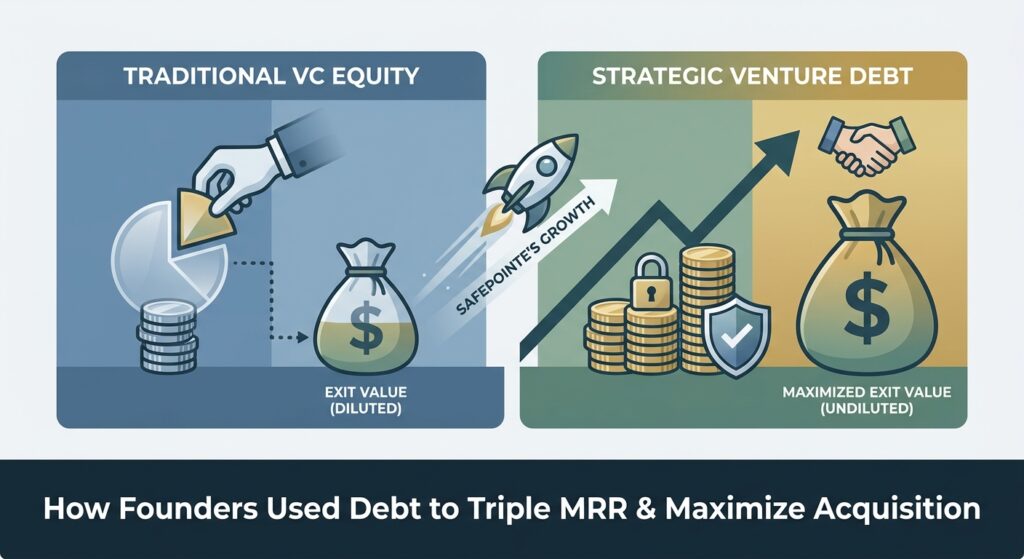
The math behind that conviction is worth unpacking. SafePointe did take on equity capital alongside the TIMIA debt. Within nine months, those equity investors returned 10x on their investment. Every dollar of founder equity diluted to raise that capital cost ten dollars in exit proceeds. TIMIA’s debt, by contrast, cost a fixed fraction of that, principal plus interest, nothing more. No warrants. No ownership. No upside participation.
The choice was not debt instead of equity, it was debt used strategically to minimize how much equity had to be surrendered at a critical valuation inflection point.
The Outcome: Tripling MRR, Then a Strategic Acquisition
The TIMIA capital did exactly what it was designed to do. SafePointe used the three disbursements to fund hardware for new customer deployments, convert pipeline into contracts, and sustain the growth rate needed to make the business acquisition-ready. By the time the final tranche closed, on a timeline Greg described as “really tight”, SafePointe had tripled its monthly recurring revenue.
Less than 12 months after the TIMIA facility was signed, SoundThinking, Inc. (Nasdaq: SSTI), a leading public safety technology firm, acquired SafePointe. The deal gave SafePointe access to SoundThinking’s platform and positioned the company within a $20 billion global weapons detection market. Timothy joined the SoundThinking executive team. Greg called it the most satisfying exit of his career.
The counterfactual is instructive. Had the Holifields funded that same growth entirely through equity, the dilution incurred (at a pre-exit valuation stage when equity is cheapest for investors and most expensive for founders) would have transferred a meaningful share of the acquisition premium to outside investors. The debt preserved that value where it belonged: with the people who built the company.
“Thanks to TIMIA, this has been the most satisfying exit process that we have ever had,” Greg reflected after the close.
The Lessons: What SafePointe Gets Right About Capital Structure
SafePointe’s story is not an argument against equity. It is an argument for precision. The Holifields used equity where appropriate and debt where optimal, and they understood the difference. Several principles emerge from their approach that apply broadly to founder-led businesses approaching a growth or exit inflection:
1. The True Cost of Equity Is Measured at Exit, Not at Close
When founders evaluate a funding round, they tend to anchor on the dilution percentage at closing. The more accurate metric is the dollar cost at exit. A 10% dilution at a $10M valuation costs $1M in nominal terms. At a $50M acquisition, that same 10% costs $5M. Debt, priced at origination and fixed, does not scale with your success. Equity does, against you.
2. Hardware-Enabled SaaS Creates a Specific Capital Mismatch
Companies where upfront physical costs precede recurring revenue (hardware, installation, onboarding infrastructure) face a structural gap that equity rarely solves cleanly. Venture debt, revenue-based financing, and asset-backed facilities are purpose-built for this mismatch. SafePointe’s challenge was not unique; it was structural, and the capital solution matched the structure.
3. Staged Disbursements Reduce Risk for Both Sides
TIMIA’s three-tranche structure was not incidental. It aligned capital deployment with operational milestones, reducing lender exposure and forcing founder discipline around how growth capital is absorbed. This is a feature, not a constraint. Founders who can articulate milestone-based deployment are more fundable, and better operators.
4. Debt Preserves Optionality Going Into an Exit Process
A cleaner cap table (fewer equity holders, no warrant overhangs, no complex preference stacks) simplifies acquisition negotiations. Acquirers price complexity into their offers. SafePointe’s use of debt rather than additional equity rounds kept the ownership structure clean and the exit mechanics straightforward.
5. The Best Capital Partners Understand Your Business Model
Greg specifically cited TIMIA’s understanding of hardware-enabled SaaS, recurring revenue dynamics, and government contract cycles as differentiating factors, above even pricing. Capital is not a commodity when the provider’s judgment affects deployment timing, covenant flexibility, and partnership behavior under pressure. SafePointe’s final tranche closed on a tight deadline because TIMIA’s team invested time in understanding the business. That operational alignment has real dollar value.
A Framework for Founders Facing the Same Decision
If you are approaching a growth inflection or pre-exit phase and weighing equity against non-dilutive debt, the SafePointe case suggests a straightforward diagnostic:
- Model the exit cost, not the round cost. Apply your expected exit multiple to the equity you are considering selling. That is the real price of the capital.
- Identify the specific capital mismatch. Is the gap structural (hardware, receivables, inventory) or speculative (market development, brand building)? Debt suits the former. Equity may suit the latter.
- Assess your revenue predictability. Non-dilutive instruments (venture debt, revenue-based financing, growth loans) price off revenue visibility. The more predictable your MRR, the more favorably you will be underwritten.
- Evaluate the cap table impact on your exit process. Every additional equity holder is a party whose consent or coordination may be required. Debt holders do not participate in exit governance the same way.
- Choose partners who understand your model. The cheapest rate from the wrong lender can cost more than a higher rate from a partner who moves when it matters.
The Holifields will likely build again. Greg has said as much: one more startup, bootstrapped, with debt brought in at the right moment. That is not a capital philosophy formed in a classroom. It is one earned across four exits, four inflection points, and one very well-timed $1 million decision.
Key Insights
- Equity diluted at pre-exit valuations is the most expensive capital a founder can raise. SafePointe’s equity investors returned 10x in nine months; that upside came directly from founder and operator value creation.
- Venture debt with no warrants is genuinely cheaper than equity when measured against exit proceeds, even when the nominal interest rate feels high at origination.
- Hardware-enabled SaaS companies face a structural working capital gap that non-dilutive debt instruments are specifically designed to bridge, without surrendering ownership to do it.
- A clean cap table is a strategic asset in M&A. Fewer equity stakeholders, no warrant overhangs, and simpler preference structures reduce friction and risk in exit negotiations.
- The right capital partner understands your business model: not just your financials. Operational alignment between founder and lender has real monetary value, especially when timing is critical.


