
The Growth-Stage Financing Problem Nobody Talks About
A software business generating $8M in ARR with 85% gross margins and 120% net revenue retention walks into a capital raise. It needs $25M-$10M to fund a product-led acquisition, $8M to expand its go-to-market team, and $7M to extend runway through profitability. Three distinct use-of-proceeds buckets. Three very different risk profiles. And yet, most founders and operators treat this as a single financing event and reach instinctively for whatever instrument closed fastest in the last deal they heard about.
That instinct is expensive. At the growth stage (broadly defined as $5M to $50M in recurring or predictable revenue) the capital stack is no longer a single-layer decision. The gap between what a senior bank will lend and what a growth equity fund wants to own represents a structuring challenge that has real consequences for dilution, control, covenant flexibility, and long-term enterprise value. Getting the structure right means mapping each dollar of need to the right layer of the stack before the first investor conversation begins.
This article walks through how to do exactly that: from use-of-proceeds mapping and cost-of-capital positioning, to running the gap capital process and negotiating the final term sheet.
Step 1: Map Use-of-Proceeds Before You Touch the Capital Stack
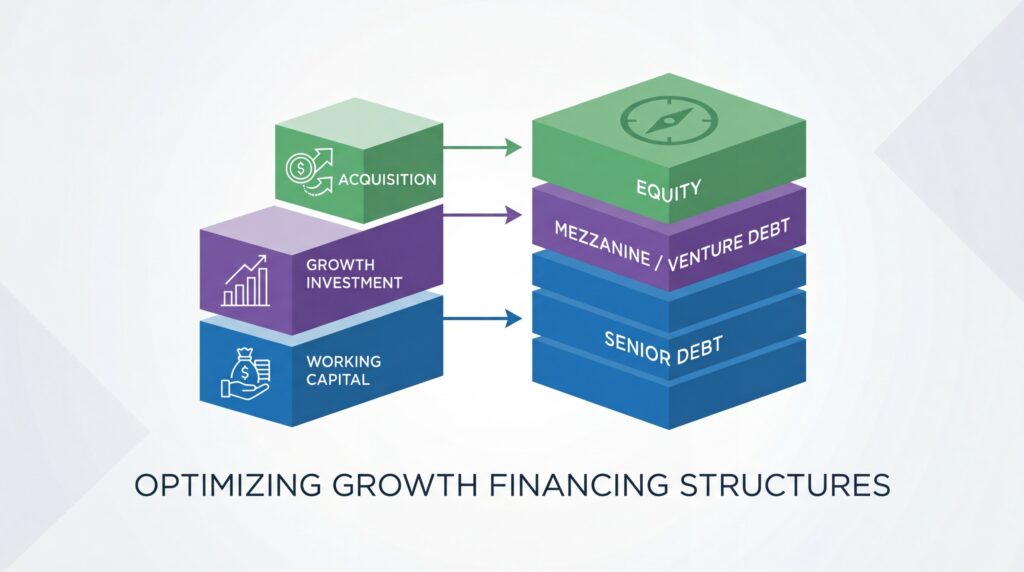
Capital need is not monolithic. Before selecting an instrument, decompose the raise into its constituent purposes, because each purpose carries a different risk profile and therefore attracts a different class of capital at a different price.
A practical framework segments use-of-proceeds into four categories:
- Working Capital & Operations: Funding recurring business expenses: payroll, infrastructure, customer support. Low risk, highly predictable. This is a bank’s territory: revolving credit facilities, asset-based lines, or revenue-based facilities from lenders like Silicon Valley Bridge successors or specialty fintech lenders.
- Growth Investment: Sales headcount, marketing spend, product development. Medium risk, returns realized over 12–36 months. This maps to venture debt with warrant coverage or non-dilutive revenue-based financing, both of which preserve equity while accepting moderate interest cost.
- Acquisition or Strategic Expansion: Buying a competitor, entering a new geography, or acquiring a customer base. Higher risk, binary outcomes. This typically justifies structured mezzanine debt with a PIK toggle, or preferred equity with defined conversion mechanics, instruments that absorb risk without forcing immediate cash interest burden.
- Balance Sheet Strengthening / Runway Extension: Pure optionality capital held against macro uncertainty. This is equity capital’s job; it carries no repayment obligation and should be priced as a long-duration call option on the business, not as cheap debt.
Once each bucket is sized and categorized, the capital stack layers itself logically. The mistake most operators make is collapsing all four into a single equity round, paying equity-level dilution for working capital that a senior lender would price at SOFR + 250bps.
Step 2: Position Each Bucket on the Cost-of-Capital Spectrum
The cost-of-capital spectrum runs from the cheapest and most senior, secured bank debt, through to the most expensive and most junior: common equity. At the growth stage, the relevant instruments in order of ascending cost are:
- Senior secured bank debt / ABL: Lowest cost (SOFR + 200–350bps), maximum collateral requirement, limited tolerance for losses or covenant breach. Appropriate for working capital and asset-backed needs. As noted in frameworks discussed by lendity.com, bank loans represent the lowest-cost, lowest-dilution layer of the stack, but they come with the highest covenant intensity.
- Venture debt / revenue-based financing: Moderate cost (10–15% all-in), warrant coverage of 5–20% of facility, covenants light or incurrence-based. Best suited to growth investment in businesses with strong recurring revenue. Providers include traditional venture lenders and specialist growth credit funds.
- Mezzanine / unitranche: Higher cost (14–20% cash + PIK), subordinated to senior, equity kicker via warrants or co-investment right. Appropriate for acquisition financing or bridge-to-equity scenarios where senior debt is insufficient to close the gap. The unitranche structure (a single blended facility combining senior and mezzanine economics into one instrument) has gained material traction in the sub-$100M enterprise value market precisely because it reduces structural complexity for borrowers while giving lenders a blended yield.
- Preferred equity: Most expensive non-common instrument (target IRR 20–30%), carries liquidation preference, often includes anti-dilution protection and board participation. Suitable for strategic runway capital or scenarios where debt service capacity is genuinely constrained.
- Common / growth equity: Most dilutive, no repayment obligation, aligned to long-duration upside. Use for truly binary bets: market expansion, product pivots, or where the asymmetry of outcome justifies the dilution math.
As highlighted in capital structure guidance from scaleupmethodology.com, the decisions made at each funding stage carry long-lasting consequences, poorly structured rounds introduce investor rights and covenant packages that constrain future flexibility. The cost of getting the stack wrong compounds.
Step 3: The Gap Capital Playbook, Quantify, Prepare, Run, Negotiate
Quantify the Gap
The gap is the difference between what your senior lender will advance against your balance sheet or cash flow and what you actually need to execute your plan. For a $25M raise on a business with $8M ARR and moderate EBITDA, a senior bank might advance $6–8M on a 0.75–1.0x ARR revolving facility. The remaining $17–19M is the gap, and it requires a deliberate structure, not a catch-all equity round.
Build a 13-week cash flow model and a 24-month operating plan before you approach any capital provider. Lenders underwrite to the model; equity investors underwrite to the narrative. You need both clean.
Prepare the Materials
For debt capital markets at this size, your core package includes: audited or reviewed financials for the trailing two years, a management presentation with detailed cohort data and unit economics, a sources-and-uses table tied explicitly to your use-of-proceeds map, and a debt capacity analysis showing DSCR under base and stress scenarios. For mezzanine or structured equity, add a waterfall model showing returns to each layer under multiple exit scenarios.
Run the Process Competitively
Even at sub-$25M deal sizes, running a competitive process (approaching three to five targeted lenders or structured credit funds simultaneously) materially improves pricing and terms. The market for growth-stage credit has deepened significantly since 2023, with specialist direct lenders, business development companies (BDCs), and non-bank credit funds actively competing for quality paper. According to startup funding research published by vcbacked.co, the 2022–2023 market correction has led to tighter investor expectations and more rigorous due diligence, but it has also created a cohort of disciplined lenders with genuine risk appetite for well-structured deals.
Negotiate the Structure: Not Just the Rate
Rate is the last thing you negotiate. The structural terms that matter most:
- Maintenance vs. incurrence covenants: Maintenance covenants (tested quarterly regardless of borrower action) constrain operating flexibility. Push for incurrence-only packages where possible, covenants triggered only by a specific action like additional debt or a distribution.
- PIK toggle: On mezzanine or structured tranches, negotiate the right to PIK interest during the first 12–18 months. This preserves cash for the growth investment the capital is funding, rather than servicing the cost of capital from day one.
- Warrant coverage and strike price: For venture debt and mezzanine, warrants are expected, but coverage percentage (the face amount on which warrants are calculated) and strike price are negotiable. Target coverage of 5–10% of facility size; resist strike prices set at a discount to your last round valuation.
- Prepayment flexibility: Growth businesses often outperform plan. Negotiate call protection that steps down (3% in year one, 2% in year two, 1% in year three) or include a make-whole cap tied to a minimum return threshold rather than a fixed call premium.
Key Takeaways
- Decompose before you structure. Map each dollar of capital need to a specific use-of-proceeds category before selecting an instrument. Working capital is a bank problem; acquisition financing is a mezzanine or structured equity problem.
- The gap between senior debt capacity and total need is a structuring opportunity, not a problem. Filling it intelligently with layered capital (venture debt, mezz, preferred) preserves equity that compounds to enterprise value.
- Unitranche simplifies at the cost of blended pricing. For sub-$100M EV businesses where structural complexity is a genuine friction point, a unitranche facility offers one lender relationship and one covenant package, at a yield that blends senior and junior economics.
- Negotiate structure, not just rate. PIK optionality, covenant type (maintenance vs. incurrence), warrant coverage, and prepayment flexibility have more long-run impact on enterprise value than a 50bps difference in margin.
- Run a process. Even at smaller deal sizes, competitive tension among lenders and structured credit providers materially improves terms. Prepare institutional-grade materials and approach the market deliberately.


