
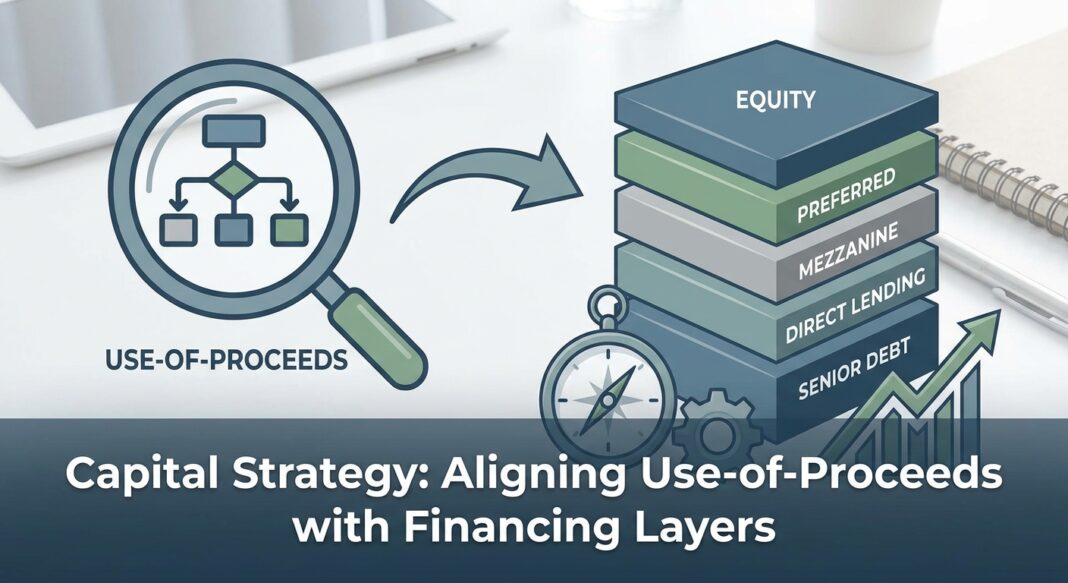
The Growth-Stage Financing Problem: Too Much Capital, Wrong Structure
A company crossing $5M in annual recurring revenue faces a capital problem that looks like a success problem. Revenue exists. Unit economics are positive. The pipeline is real. And yet the financing market (banks, direct lenders, mezzanine funds, venture capital) presents a confusing menu of instruments that carry wildly different costs, covenants, and consequences for ownership.
The central error at this stage is not failing to raise capital. It is raising the wrong layer of capital for the wrong use of proceeds. A founder who funds organic sales headcount with convertible preferred equity is paying a 25–35% implied cost of capital for an asset that earns a 14-month payback. A CEO who taps a bank revolver to close a bolt-on acquisition will discover that maintenance covenants and amortization schedules were not designed for acquisition integration. The structure must match the strategy, and at the growth stage, that match is rarely obvious.
This article maps the cost-of-capital spectrum available to growth-stage operators, explains how use-of-proceeds should drive instrument selection, and provides a tactical playbook for quantifying the gap, preparing materials, running a competitive process, and negotiating the final structure.
The Cost-of-Capital Spectrum: Banks to Equity
Every layer of the capital stack has a structural purpose. Operators who treat all capital as interchangeable will consistently over-pay or under-deploy. The spectrum, from cheapest to most expensive, runs as follows:
1. Senior Bank Debt (Revolvers & Term Loans A)
The cheapest institutional capital available. Bank commercial and industrial lending to non-financial corporations grew at a 3.2% annualized rate in Q2 2026, reversing an eighteen-month contraction. This reopened channel undercuts direct lending pricing by 100 to 200 basis points. Bank debt suits companies with hard assets, predictable receivables, or a track record of positive EBITDA. The covenant structure is strict: traditional bank loans rely on maintenance covenants, financial tests measured every ninety days against agreed benchmarks, where missing a debt-to-EBITDA threshold by a fraction of a point can trigger technical default and expensive waiver negotiations. This is manageable for stable businesses; it is operationally punishing for companies in rapid growth mode.
2. Unitranche / Direct Lending (Private Credit)
Unitranche debt is a single-tranche loan that combines what would otherwise be senior debt and mezzanine or subordinated debt into one instrument with one lender and one credit agreement. It has become the dominant mid-market financing structure. This structure has become the financing standard for acquisitions valued between $25M and $200M enterprise value, with roughly 70 to 80 percent of deals in that range using at least partial unitranche funding.
Pricing in 2026 reflects a market that has tightened meaningfully from 2024 peaks. S&P LCD’s middle-market print shows unitranche pricing tightening by 100 basis points in the twelve months to June 2026. For context, unitranche facilities typically price at SOFR + 425–475 basis points for sponsored upper middle market transactions, with core middle market credits commanding 50–100 basis points higher. On an all-in basis, unitranche pricing in 2026 runs at SOFR + 500–700bps plus a 2–3% original issue discount (OID) and a 2–3% prepayment fee declining over the first 24 months, with all-in cost of capital for a typical 5x leverage deal at 9.5–11% blended.
On covenant design, the direct lending market has evolved. Direct lenders increasingly favor incurrence covenants, which trigger only when a company takes a specific action such as issuing new debt or paying an equity dividend. However, this is not universal: a review of more than 1,000 credit agreements in the private credit universe found most include at least one financial maintenance covenant, except for loans to larger entities with debt sizes of $1 billion and above. For growth-stage borrowers, the covenant package is a central negotiation point, not a boilerplate formality.
3. Mezzanine Financing
Mezzanine sits in the subordinated layer, below senior debt but above equity. Mezzanine debt has three defining structural features that distinguish it from senior debt: its subordinated and unsecured position, its option for Payment-in-Kind (PIK) interest, and its equity kicker, almost always in the form of stock warrants.
Current pricing reflects the higher-rate environment. In 2026, all-in cost is 10–14% (cash coupon 8–11% plus PIK 2–4% plus warrants). The PIK feature provides cash flow relief but compounds the balance: when borrowers elect PIK interest, the outstanding balance compounds, increasing total debt burden, and if the anticipated liquidity event is delayed, the growing PIK balance creates a larger refinancing burden at bullet maturity. Warrants carry a real dilution cost: every warrant granted to a mezzanine lender dilutes existing common equity, and in a successful exit, the equity kicker reduces the return available to the sponsor and management team.
Despite unitranche competition, mezzanine retains relevance in specific scenarios. It remains relevant in very large transactions where unitranche lenders cannot provide the full quantum of debt needed, situations where the borrower wants to minimize total cost by maximizing cheaper senior debt separately, deals where the sponsor or management team wants equity kickers to align lender incentives, and portfolio company add-on financings where existing credit agreements restrict additional senior debt.
4. Preferred Equity & Venture Debt
Venture debt is a form of term debt designed specifically for growth-stage companies, typically structured as a senior secured loan with interest-only payments and a small tranche of warrants. The global venture debt market reached roughly $49 billion in 2025, and Deloitte projects the asset class could grow to represent 20% of total venture funding by 2027.
Preferred equity is more expensive still, and more dilutive. According to Carta’s State of Private Markets data, median dilution in 2025 sits at approximately 19.5% for seed rounds and 18% for Series A rounds. These figures are actually higher than the peak of 2021, reflecting a market where capital has become more expensive and investors are demanding more ownership for the risk they take on.
Structure Breakdown: A $45M Growth-Stage Capital Event for a Software Business
Consider a B2B SaaS company with $18M ARR, 85% gross retention, and 120% net revenue retention. It is pursuing two simultaneous objectives: (1) funding a sales team build-out with an 18-month payback, and (2) closing a $22M tuck-in acquisition of a complementary tool.
A single instrument will not serve both use cases efficiently. The optimal capital structure separates the two:
Tranche A: Senior Secured Unitranche ($30M)
- Use: Acquisition financing (purchase price + transaction costs)
- Pricing: SOFR + 525 bps, 100 bps OID, 5-year maturity, bullet at year 5
- Leverage: 4.5x LTM Adjusted EBITDA at close
- Covenant: Single maintenance covenant, Total Net Leverage < 6.0x, tested quarterly with a 35% cushion at close; step-down to 5.0x at month 18
- Prepayment: 3% / 2% / 1% call protection, declining over 36 months
- Lender profile: Single direct lender; no syndication risk; closes in 45–60 days
Tranche B: Revenue-Based Facility ($8M)
- Use: Sales headcount, marketing programs, organic growth capital with 14–18 month payback
- Pricing: 1.35x revenue cap; repayment as a fixed percentage of monthly receipts (8–12%)
- Dilution: Zero equity dilution; no covenants
- Conditions: Minimum $1.5M MRR, 80%+ gross retention
Tranche C: Equity Round ($7M Preferred, Series B)
- Use: Integration reserve, product development, balance sheet buffer
- Dilution: ~14% on a post-money basis at 4.5x ARR valuation
- Rationale: Equity funds the highest-uncertainty use (integration); debt funds the highest-predictability uses (acquisition, recurring revenue-backed growth)
The blended cost of this structure, approximately 9–11% on the debt tranches plus the dilution cost of the equity tranche, is meaningfully lower than funding the entire $45M need through a single preferred equity raise, which at current dilution levels would cost 18–20% of the company’s equity on a fully-diluted basis. The fully-loaded dilution cost of a single growth-stage priced round, measured at exit, typically runs 30 to 35 percent of the pre-money founder position, versus an 8 to 10 percent after-tax cost of senior secured debt.
The Gap Capital Playbook: Quantify, Prepare, Run the Process
Step 1: Quantify the Gap Precisely
The most common mistake operators make is arriving at lenders with a round number and a vague use-of-proceeds narrative. Lenders underwrite specifics. Before any outreach, build a bottoms-up model that answers three questions: (1) What is the maximum debt capacity at current EBITDA multiples? (2) What is the minimum equity required to satisfy lender loan-to-value thresholds? (3) What is the residual gap that mezzanine or preferred equity must fill?
For a unitranche lender, total leverage typically runs 4–6x EBITDA with a single covenant package and single intercreditor relationship. If your EBITDA is $4M and the acquisition requires $30M of financing, the arithmetic shows a maximum debt capacity of approximately $20–24M, and the remaining $6–10M must come from equity or subordinated capital. That gap, sized precisely before process launch, is what drives lender confidence.
Step 2: Prepare Lender-Ready Materials
The materials package for a debt raise differs structurally from a VC pitch deck. The lender’s underwriting question is not “how big is the TAM?”; it is “how will this company service and repay this facility in a downside scenario?”
Required materials include: a trailing twelve-month and projected three-year financial model (base / upside / downside cases), an EBITDA bridge showing adjustments with supporting documentation, a debt waterfall at close, a use-of-proceeds schedule mapped to specific line items, and a management presentation covering competitive moat, customer concentration, and churn analytics. Direct lenders in 2026 underwrite off logo concentration, contract length, and gross retention; these three data points should be prominent and supported by cohort-level data, not summarized in a single slide.
Step 3: Run a Competitive Process
Ares Capital, Blue Owl Capital, Antares Capital, Twin Brook Capital Partners, Apollo Global Management direct lending, Carlyle Direct Lending, KKR Capital Markets, Golub Capital, and Monroe Capital lead the unitranche market for $25M–$200M EV deals. Contacting three to five of these lenders simultaneously creates optionality and price tension. A single-lender process leaves 50–100 bps of spread on the table and eliminates negotiating leverage on covenants and call protection.
Speed matters. The speed premium is real: if unitranche financing can close 30 to 45 days faster than a syndicated alternative, sponsors often justify 50 to 100 basis points of extra spread by avoiding financing gaps or broken syndications that jeopardize purchase agreements. In an acquisition context, the cost of a broken deal exceeds the cost of a slightly wider spread.
On the equity side, companies that arrive with a pre-modeled mixed stack close their equity component 4 to 6 weeks faster than companies pitching equity-only, because the equity investor sees a founder who has already tested the market on cheaper capital and concluded equity is the right marginal dollar, which shortens the diligence loop on capital efficiency.
Structuring Guidance: What to Negotiate and What to Concede
For Operators: The Five Negotiation Levers
- Covenant headroom. Negotiate at least 30–35% cushion between your projected leverage and the covenant trigger at close. Maintenance covenants, quarterly tests of leverage or fixed charge coverage, have returned to many PE-backed deals financed by non-bank lenders, requiring enhanced focus on realistic covenant cushions and headroom in financial models. A tight covenant negotiated in a strong market becomes a default trigger in a soft quarter.
- Call protection structure. The 3%/2%/1% step-down is standard in 2026 but negotiable. If your exit or refinancing timeline is 18–24 months, push for a 2%/1%/0% schedule to reduce prepayment friction.
- PIK toggle. If cash flow visibility is uncertain in years 1–2, negotiate a PIK election option on 25–50% of interest. This preserves cash during integration without triggering a default. Understand, however, that PIK usage has risen notably in private credit in recent years, with public BDCs now receiving an average of 8% of investment income via PIK, and PIK is increasingly appearing in senior secured loan documentation. Lenders are watching PIK usage as a credit signal; deploy it strategically, not habitually.
- Equity kicker scope. If mezzanine financing includes warrants, negotiate the strike price at a meaningful premium to current valuation, and include a buyout provision at a fixed multiple that allows you to retire the warrants before a strategic sale. Uncapped warrant coverage can create cap table complexity that delays or complicates exits. Equity kickers can complicate the capital structure, add layers to future financing rounds, and create challenging negotiations in a potential exit scenario, and once accepted, dedicated cap table management is required.
- Accordion / incremental facility. Negotiate committed incremental capacity (typically 0.5–1.0x EBITDA) at close to preserve optionality for add-on acquisitions without a full re-underwriting. The ability to work with a single lending group simplifies ongoing portfolio management, particularly during covenant modifications or add-on acquisitions.
For Investors: What the Structure Signals
A well-structured growth-stage capital raise (one that separates acquisition financing from growth capital, uses debt for high-certainty cash flows, and reserves equity for genuine uncertainty) is a signal of capital discipline. According to SaaS Capital, companies in the $2M–$5M ARR range that leverage hybrid capital stacks grow 30% faster than those relying solely on equity. Evaluate the covenant package carefully: a borrower with a single incurrence-based covenant carries more operational flexibility but less lender oversight than a borrower with a maintenance-tested structure. In a late-cycle environment where corporate credit is beginning to display signs of late-cycle behavior, and the true default rate in private credit approaches 5% once selective defaults and liability management exercises are taken into account, covenant discipline is not a formality.
Key Takeaways
- Match instrument to use-of-proceeds, not to convenience. Acquisition debt (unitranche, 4–6x EBITDA, SOFR + 500–700bps) and organic growth capital (revenue-based financing, venture debt) serve different cash flow profiles and should be structured separately, not consolidated into a single instrument that forces one set of covenants onto two different risk profiles.
- Unitranche dominates the $25M–$200M acquisition market in 2026. Single-lender, single-covenant, closing in 45–60 days, the structure’s speed and simplicity carry a pricing premium over syndicated alternatives that is often justified by execution certainty alone.
- The covenant package is a control rights document, not boilerplate. Maintenance covenants give lenders quarterly intervention rights; incurrence covenants gate specific actions. Operators who accept a maintenance covenant without negotiating adequate headroom are effectively handing lenders a periodic veto over their own business plan.
- PIK interest and equity kickers are liability management tools, not free optionality. PIK compounds the debt balance and creates a larger refinancing requirement at bullet maturity. Warrants dilute the equity at exit. Both must be modeled explicitly, including under a delayed-exit scenario, before accepting mezzanine terms.
- The mixed-stack process closes faster and cheaper. Operators who arrive at equity investors with a pre-structured debt component, demonstrating that cheaper capital has been tested first, close equity rounds 4–6 weeks faster and at less dilution than single-instrument processes. The structure is the strategy.


