
The Growth-Stage Financing Problem Nobody Talks About Clearly
A founder has built a business to $8M in EBITDA. The senior lender, a regional bank, is comfortable at 3.0x leverage, providing $24M. The acquisition or recapitalization target requires $45M of total capital. Equity is available, but the valuation discussion is stuck: the market is pricing the business at a multiple the owner finds unacceptable, and full dilution at this point would permanently impair the exit economics.
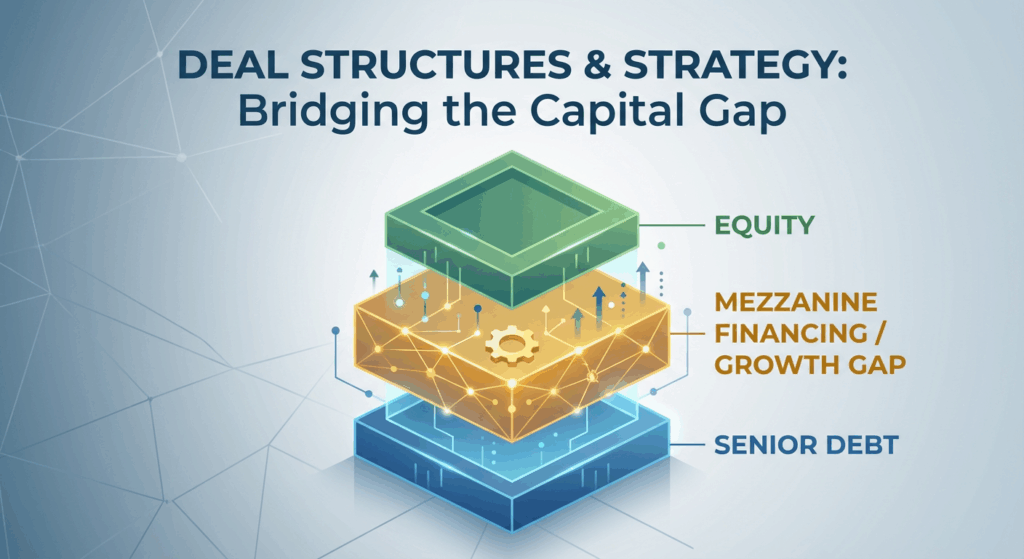
This is the growth-stage capital gap. It is not a niche edge case; it is the central financing challenge for privately held businesses generating between $3M and $20M in EBITDA that are executing acquisitions, ownership transitions, or aggressive organic expansion. The senior lender has reached its ceiling. Pure equity is too expensive or too dilutive. What fills the $21M between $24M of senior debt and $45M of total need?
The answer, in most institutional transactions at this stage, is mezzanine financing: subordinated debt with equity-linked features that earns its position in the capital stack by absorbing more risk than a bank and accepting less dilution than a full equity investor. Understanding how to structure it, price it, and negotiate it is one of the most valuable competencies in mid-market deal finance.
Mezzanine Financing: Component Breakdown
Mezzanine debt sits structurally below senior secured debt but above common equity. That position (subordinated in priority, junior in a liquidation waterfall) is why it commands a yield premium over senior lending and why it often carries equity participation features that senior lenders do not require.
A typical mid-market mezzanine tranche has the following structural components:
- Cash Interest: A current pay coupon, typically in the range of 7%–10% per annum, paid quarterly. This is the base yield the mezzanine lender requires to service their fund’s obligations and compensate for subordination risk.
- PIK (Payment-in-Kind) Interest: An additional accrued interest component, often 2%–4%, that is not paid in cash but added to the outstanding principal balance. PIK preserves operating cash flow for the borrower during the growth or integration phase and compounds into a larger payoff at maturity or exit. The blended cash-plus-PIK coupon typically produces an all-in interest rate of 11%–14%.
- Equity Kicker / Warrant Coverage: To bring the total internal rate of return (IRR) for the mezzanine fund to its target, usually 15%–20%, the lender takes a warrant or equity co-investment right representing a small percentage of the company’s fully diluted equity, commonly 2%–8%. Warrants are typically struck at a nominal or at-money price and exercisable at exit.
- Maturity: Mezzanine tranches are typically structured with 5–7 year maturities, with no amortization or back-ended amortization, making them closer in cash flow behavior to bullet bonds than to amortizing term loans.
- Incurrence Covenants: Unlike maintenance covenants on senior bank facilities, mezzanine debt more commonly uses incurrence-based tests: restrictions that trigger only when the borrower takes a specific action (additional indebtedness, asset sales, dividends) rather than ongoing quarterly compliance hurdles.
Illustrative Example: A $45M Growth-Stage Acquisition
Consider a $45M enterprise value acquisition of a regional services business with $8M in EBITDA. The capital stack might be constructed as follows:
| Tranche | Amount | Leverage Multiple | Pricing | Key Features |
|---|---|---|---|---|
| Senior Secured Term Loan | $24M | 3.0x EBITDA | SOFR + 275–325 bps | First lien, maintenance covenants, quarterly amortization |
| Mezzanine Debt | $12M | 1.5x EBITDA (incremental) | 8.5% cash + 3.5% PIK + warrants (5% equity) | Subordinated, 6-year bullet, incurrence covenants |
| Common Equity (Sponsor / Owner Rollover) | $9M | – | Target IRR 25%+ | Last in waterfall, uncapped upside, board control |
Total leverage of 4.5x EBITDA. Blended cost of debt capital: approximately 9.5%–10.5% all-in. The mezzanine tranche at $12M bridges the gap without requiring the owner to sell a controlling equity stake at a compressed valuation.
Mezzanine vs. The Alternatives: Where It Fits and Where It Doesn’t
Understanding when mezzanine is the right tool requires mapping it honestly against its alternatives across the cost-of-capital spectrum, as outlined in frameworks from sources including capitalxo.com and capital strategy practitioners:
- Senior Bank Debt (Cheapest, Most Restrictive): SOFR + 250–400 bps. Requires collateral, personal guarantees, and maintenance covenants. Capacity is capped by collateral and debt-service coverage ratios. The right tool for the base tranche, not for filling the gap.
- Unitranche (Single Lender, Middle Market): A blended first-out / last-out structure that eliminates the senior/mezz intercreditor complexity. Pricing typically SOFR + 450–600 bps. Faster to close but more expensive than a bifurcated senior/mezz stack for larger transactions. Appropriate when execution speed and simplicity outweigh cost optimization.
- Mezzanine (The Gap Filler): As structured above. Higher cost than senior, lower dilution than equity. Appropriate when the borrower has the cash flow to service PIK and cash interest, and when warrant dilution (2%–8%) is preferable to full equity dilution (20%–30%).
- Preferred Equity (Hybrid, No Mandatory Payment): No cash interest obligation, but liquidation preference ahead of common. Often used in situations where cash flow cannot reliably service PIK. More dilutive than mezzanine, less dilutive than common equity. Common in pre-revenue or early-stage contexts where debt serviceability is uncertain.
- Common Equity (Most Expensive, Most Flexible): No repayment schedule, no covenants. Appropriate for experiment-stage capital (product development, pre-revenue pivots) where cash flow uncertainty makes any debt layer dangerous, as noted by frameworks from angelinvestorsnetwork.com.
The critical selection principle: match the risk profile of the use-of-proceeds to the risk tolerance of the capital layer. Debt funds predictable, cash-generative activities. Equity funds uncertain, exploratory, or pre-revenue activities. Mezzanine funds the middle, growth initiatives with evidence of cash flow but insufficient collateral or track record for full senior coverage.
Current Market Terms and Standards (Q1–Q2 2026)
The mezzanine and private credit market has repriced materially over the 2023–2026 period as base rates stabilized at elevated levels and direct lending competition intensified. Practitioners and market participants should be calibrated to the following current benchmarks:
- All-in Mezzanine Yield: The blended cash + PIK yield for traditional subordinated mezzanine in the lower-to-mid market ($5M–$25M EBITDA businesses) is running approximately 12%–16% as of Q1 2026, reflecting a SOFR base that remains elevated relative to the pre-2022 environment. Larger, more liquid transactions with institutional sponsor backing can clear at the lower end of this range.
- Warrant Coverage: Equity kickers remain standard in true mezzanine structures, typically representing 3%–7% of fully diluted equity. In sponsor-backed transactions with strong asset coverage, warrant-free structures are occasionally achievable at a cash yield premium of 150–200 bps above the warrant-inclusive alternative.
- Leverage Multiples: Senior leverage for middle-market, cash-flow-lending transactions is broadly 3.0x–3.5x EBITDA at bank lenders and 4.0x–4.5x at direct lenders (unitranche). Total leverage including mezzanine is typically capped at 5.0x–5.5x for businesses in the $5M–$15M EBITDA range: structures above 5.5x require exceptional business quality, recurring revenue, or defensive market positioning.
- Covenant Design Trend: The market has moved steadily toward incurrence-based covenant packages in sponsor-backed mezzanine, mirroring the high-yield bond market. Non-sponsored or founder-owned businesses still commonly face maintenance covenants on both the senior and mezzanine tranches, with quarterly EBITDA and leverage tests. Negotiating these tests with adequate headroom (20%–30% cushion to the covenant trigger) is a critical pre-close exercise, as described in capital stack architecture frameworks from capitalxo.com.
- Intercreditor Complexity: A bifurcated senior/mezz structure requires a negotiated intercreditor agreement governing standstill periods (typically 90–180 days), payment blockage rights, and the mezzanine lender’s ability to cure senior defaults. This adds 3–6 weeks to closing timelines relative to a unitranche. Borrowers should budget for it early in the process.
The Gap Capital Playbook: Quantify, Prepare, Run the Process
Identifying the need for mezzanine is the easy part. Executing the raise efficiently, particularly for owner-operated businesses without institutional deal teams, requires a structured process.
Step 1: Quantify the Gap with Precision
Before approaching any capital provider, define the gap with arithmetic precision. Total capital need minus senior debt capacity equals the gap. Then determine how much of the gap is best filled by mezzanine versus equity based on the sustainable debt service capacity of the business. A useful constraint: total debt service (cash interest on senior + cash interest on mezzanine) should not exceed 50%–60% of trailing EBITDA in a conservative scenario. PIK interest, by design, defers the cash burden, model both the cash and the compounding PIK payoff at exit.
Step 2: Prepare the Materials That Mezzanine Lenders Actually Underwrite
Mezzanine lenders are not equity storytellers; they underwrite cash flow coverage, downside protection, and exit liquidity. The information package must include: trailing twelve months and three-year historical P&L with EBITDA bridges; a detailed three-year projection with sensitivity analysis on revenue, margin, and debt service coverage; a clear description of the collateral position and intercreditor framework; and a capitalization table showing the full stack, including all existing debt obligations. Clean financial reporting is non-negotiable, as noted by growth capital underwriting frameworks from angelinvestorsnetwork.com, lenders reject applications with disorganized books as an operational risk signal.
Step 3: Run a Parallel Process
Approach 4–6 mezzanine providers simultaneously. The market includes traditional subordinated debt funds, business development companies (BDCs), family office credit desks, and insurance company private credit arms. Each has different return targets, warrant preferences, and covenant philosophies. Running competitive tension across providers is the single most effective mechanism for improving terms: on warrant coverage, PIK/cash split, covenant tightness, and prepayment flexibility.
Negotiation Guidance: What to Push on, What to Accept
Mezzanine term sheets have more negotiable surface area than borrowers typically realize. The following points are worth contesting:
- Warrant Strike Price and Dilution Cap: Push for a fair market value strike or a fixed-price cap that limits dilution at exit. A 3% warrant at fair market value is meaningfully different from a 5% warrant struck at a nominal penny price. Model both at your expected exit multiple before signing.
- PIK vs. Cash Split: A higher PIK component preserves near-term cash flow but compounds into a larger exit payoff. If the business has strong near-term cash generation, negotiate for more cash interest and less PIK, the total cost is lower if the PIK doesn’t compound over the full term.
- Prepayment Penalties: Most mezzanine structures include call protection, typically a make-whole or declining call premium (e.g., 3%–2%–1% in years one through three). Push to eliminate or reduce the call premium in years three and beyond if you anticipate a refinancing or exit event within that window.
- Covenant Cushion: If maintenance covenants are unavoidable, negotiate the trigger levels with explicit headroom. A leverage covenant set at 5.0x when your current leverage is 4.5x provides only 11% cushion, any operational softness creates a technical default. Push for 5.5x or build in a cure right that allows equity injection to fix a covenant breach without acceleration.
- What to Accept: Subordination to senior debt, lender consent on material acquisitions or additional indebtedness above a defined threshold, and quarterly financial reporting obligations. These are standard structural protections that mezzanine lenders require to manage their subordinated position, contesting them adds friction without producing meaningful economic benefit.
Key Takeaways
- Mezzanine fills a specific, definable gap: it is the tool for growth-stage businesses that have exhausted senior debt capacity but cannot or should not issue equity at current valuations.
- The blended cost matters more than the headline rate: always model cash interest, PIK compounding, and warrant dilution together to understand the true all-in cost of mezzanine capital at your expected exit multiple.
- Incurrence vs. maintenance covenants are a binary outcome risk: negotiate covenant levels and cure rights before close; a technical default on a mezzanine tranche can accelerate the senior facility through cross-default provisions, creating a liquidity crisis from a paperwork breach.
- Parallel process drives better terms: approaching multiple mezzanine providers simultaneously is the most effective negotiating lever available to borrowers without institutional deal infrastructure.
- Match capital to risk profile: mezzanine is appropriate for cash-generative activities with evidence-based projections; it is the wrong instrument for pre-revenue experiments, product pivots, or highly cyclical businesses where debt service coverage is speculative.


