
The Growth-Stage Acquisition Dilemma: When Senior Debt Runs Out and Equity Costs Too Much
A founder-led software services company ($12M in EBITDA, three years of 25% organic revenue growth, a clean balance sheet) has identified a bolt-on acquisition that will add $4M in EBITDA and materially expand its geographic footprint. The deal enterprise value is $48M at a 12x multiple. The company’s existing senior lender extends a 3.5x leverage commitment, generating roughly $42M in senior debt capacity. That leaves a $6M gap between what the bank will fund and what equity the founder is willing to give away.
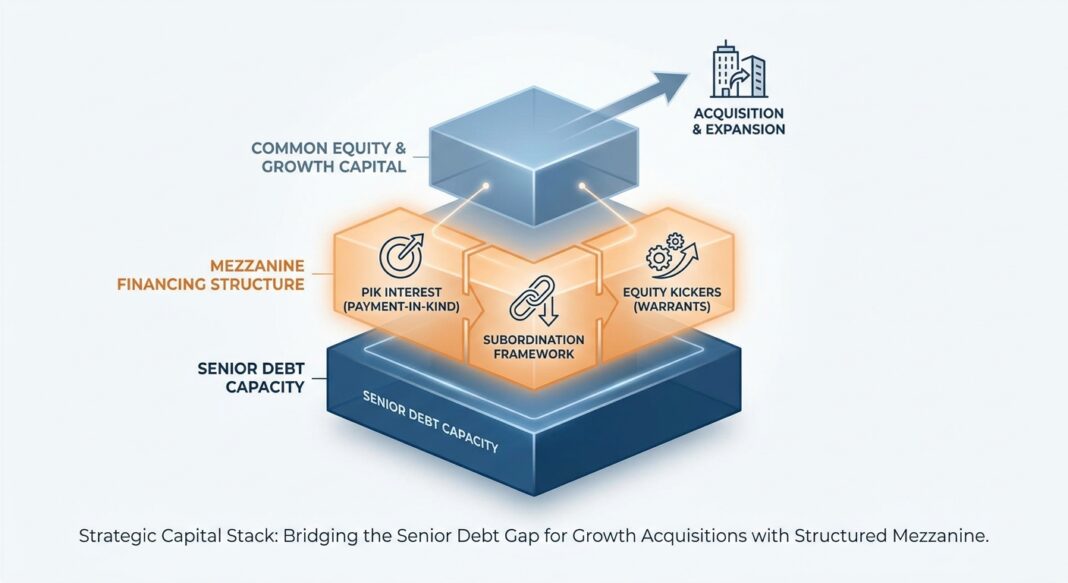
This is the canonical mezzanine moment. The capital need is real, the senior market is tapped, and diluting equity at this stage, ahead of a potential platform exit in two to three years, is strategically costly. Mezzanine debt exists precisely to fill this layer: subordinated in priority, priced to reflect that subordination, and structured with features that give lenders equity-like upside without displacing the ownership table.
Understanding how to size, structure, and negotiate a mezz tranche (rather than reflexively reaching for preferred equity or accepting unwanted dilution) is one of the highest-leverage financing decisions a growth-stage operator can make.
Mapping the Capital Stack: From Bank Debt to Common Equity
Before structuring the mezz tranche, operators must map their full cost-of-capital spectrum and understand where each layer sits, both in priority and in price.
- Senior Secured Bank Debt (First Lien): Lowest cost, typically SOFR + 200–350 bps for established middle-market credits in 2025–2026 market conditions. Constrained by collateral coverage, leverage covenants, and lender appetite for EBITDA-stage or acquisition-heavy credits. Coverage ratios and total leverage caps (typically 3.0x–4.5x for traditional banks) create hard ceilings.
- Private Credit / Unitranche: Direct lenders can extend leverage to 5.0x–6.0x for quality credits, priced at SOFR + 500–650 bps. Unitranche eliminates the senior/mezz intercreditor complexity but bundles the full cost of subordination into one blended rate. For deals where simplicity matters, this is the trade-off.
- Mezzanine Debt (Second Lien / Subordinated): Sits between senior secured and equity. All-in yields typically range from 13%–18% depending on credit quality, deal complexity, and equity kicker structure. The yield is split between cash pay interest and PIK (payment-in-kind) components, reducing near-term cash burden on the borrower.
- Preferred Equity: No contractual debt service, but dividend accrual and liquidation preferences create a structural overhang. More dilutive than mezz; typically used when the company cannot service additional fixed charges or when the lender requires more governance control.
- Common Equity / Sponsor Co-Investment: Highest cost in dilution terms. Appropriate for early-stage capital needs or situations where the capital structure cannot support any additional debt service, but for a cash-flowing growth-stage business, it should be the last resort, not the default.
For the acquisition scenario above, the gap-filling layer is mezzanine debt, priced above senior but preserving the equity table until exit.
Dissecting the Mezz Tranche: PIK, Subordination, and Equity Kickers
A well-structured mezzanine tranche for a $6M subordinated need in a $48M acquisition might look like the following illustrative term framework:
- Tranche Size: $6M subordinated note, sitting behind $42M in senior secured first-lien debt. Total leverage at close: 4.0x EBITDA on a combined $16M EBITDA post-acquisition basis.
- Interest Structure: 8.0% cash pay interest + 5.0% PIK, for a total coupon of 13.0% per annum. PIK interest accretes to principal rather than requiring cash outflow, protecting operating cash flow during the integration period.
- Maturity: 5-year term, subordinated to the senior credit agreement. Mezz lenders typically accept bullet repayment at maturity, relying on the enterprise value trajectory rather than amortization schedules for their return.
- Equity Kicker / Warrant Coverage: Warrants representing 3%–5% of fully diluted equity at a strike price equal to the current enterprise value per share at close. Warrants are the mezz lender’s participation in upside, if the company exits at a higher multiple, the warrant coverage amplifies their total return. Borrowers should negotiate hard on warrant coverage percentage, strike price, and anti-dilution provisions.
- Subordination: Governed by an intercreditor agreement with the senior lender. Mezz holders agree to a standstill period (typically 90–180 days) before exercising remedies, giving the senior lender priority enforcement rights over collateral.
- Covenant Package: Mezz notes commonly carry incurrence-based covenants (triggered only when the company takes a specific action, such as incurring additional debt or making distributions) rather than the maintenance covenants found in bank credit agreements. This structural flexibility is a meaningful advantage for operators managing through integration cycles.
The Gap Capital Playbook: Quantify, Prepare, Run the Process
Step 1: Quantify the Gap Precisely
Before approaching any mezz provider, build a uses-and-sources table that demonstrates, with precision, why senior debt cannot close the gap and why equity is structurally inefficient. Lenders underwrite to the story of why this layer exists, not just whether the company can service it. A clean gap analysis showing senior capacity by leverage covenant, acquisition consideration, transaction costs, and required minimum liquidity reserves will compress the diligence timeline and signal that management operates with financial discipline.
Step 2: Prepare the Financing Package
The mezz market underwrites on cash flow coverage, not asset collateral. Your package must lead with a credible EBITDA bridge from standalone to pro forma, a detailed integration timeline with cost synergy quantification, and a fixed-charge coverage analysis demonstrating that the combined entity can service all tranches of debt, including the PIK accrual, under a reasonable downside scenario. Historical audited financials, trailing twelve-month management accounts, and a 5-year operating model with explicit debt paydown assumptions are table stakes.
Step 3: Run a Targeted Process
The mezzanine market in 2025–2026 is dominated by business development companies (BDCs), insurance-affiliated private credit platforms, and dedicated mezz funds. Unlike broadly syndicated loans, mezz is a relationship-driven, bilateral market. Target three to five providers with demonstrated appetite for your sector, deal size, and leverage profile. Parallel processes create competitive tension on the warrant coverage and call protection terms, the two levers where the spread between lender asks and borrower-friendly outcomes is widest.
Negotiating the Final Structure: Where Operators Win and Lose
The five negotiating pressure points in any mezz term sheet are predictable, and operators who understand the underlying economics can push back effectively on each:
- Warrant Coverage Percentage: Lenders will open at 5%–8%. Operators with strong cash flow coverage and multiple lender options should target 2%–4%. The clearing price depends directly on how competitive the process is.
- PIK vs. Cash Pay Split: Higher PIK reduces near-term cash burden but accelerates principal accretion and increases total interest cost over the life of the loan. If the business generates sufficient free cash flow post-close, negotiate a higher cash pay component to reduce the total cost of the PIK compounding effect.
- Call Protection: Mezz lenders typically request non-call periods of one to two years followed by a call premium schedule (e.g., 103, 102, 101, par). For operators expecting a liquidity event within the mezz term, negotiate the shortest possible non-call window and the shallowest premium schedule.
- Warrant Strike Price and Anti-Dilution: Push for a strike price set at the post-close enterprise value divided by fully diluted shares, with broad-based weighted-average anti-dilution protection rather than ratchet provisions that penalize the company disproportionately in future financing rounds.
- Equity Cure Rights: Ensure the mezz agreement mirrors any equity cure provisions in the senior credit agreement, allowing sponsor or founder equity injections to cure covenant breaches during an integration period without triggering cross-defaults.
Key Takeaways
- Mezzanine debt is a precision instrument: It is not a fallback; it is the structurally appropriate layer when senior leverage is exhausted and equity dilution is strategically expensive for a cash-flowing business pursuing acquisitions.
- PIK interest is a cash flow tool, not a free lunch: Every dollar of PIK accretes to principal and compounds at the full coupon rate. Model the total cost over the loan term before accepting a high PIK split.
- Warrant coverage is the real cost of mezz: The equity kicker, not the coupon, is where lenders capture their risk-adjusted return. Operators should treat warrant negotiation as a core deal term, not a footnote.
- Incurrence covenants are a structural advantage: Unlike maintenance-tested bank facilities, mezz notes typically use incurrence covenants, giving operators meaningful operational flexibility through an integration cycle without triggering technical defaults.
- A competitive process compresses economics: The mezzanine market is relationship-driven, but process discipline, engaging three to five credible lenders in parallel, is the single most effective tool for reducing warrant coverage, improving call protection terms, and accelerating close timelines.


