
The Gap That Banks Won’t Fill, and Equity Shouldn’t Have To
Every growth-stage operator eventually hits the same wall. The bank has maxed out its senior lending appetite at 3.0x EBITDA. A full equity raise would dilute ownership at a multiple the founder refuses to accept. The deal (whether an acquisition, a facility expansion, or a platform recapitalization) requires $15M to $40M more capital than the senior stack can safely carry. This is the structural gap that mezzanine financing was purpose-built to fill.
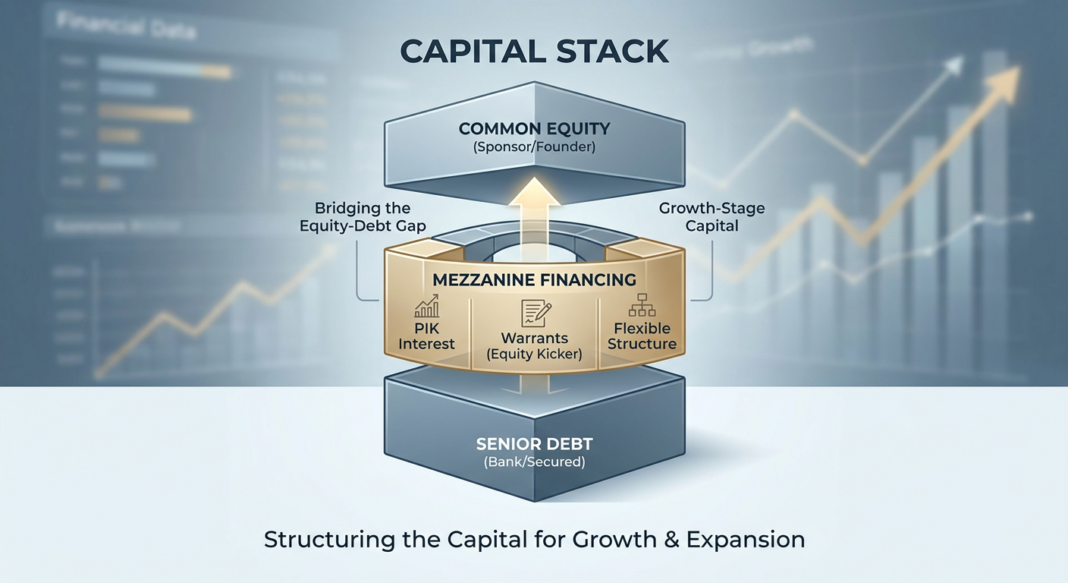
At its core, mezzanine debt is a hybrid instrument: it sits between senior secured debt and common equity in the capital stack, carries the subordinated risk profile of the latter but the contractual repayment structure of the former. For a business generating $6M to $15M in EBITDA, executing a growth or acquisition strategy without resorting to a full equity round, mezzanine is frequently the most capital-efficient path: provided the operator understands its true cost, its structural mechanics, and its negotiation levers before signing a term sheet.
This article breaks down exactly how mezzanine financing works at the growth stage, maps it against the cost of capital spectrum, walks through a real-world term sheet anatomy, and provides a tactical playbook for operators and investors navigating this layer of the capital stack in mid-2026 market conditions.
The Structure: Three Components, One Instrument
Mezzanine debt has three defining structural features that distinguish it from every other instrument in the capital stack. Understanding each in isolation (and then how they interact) is prerequisite to evaluating whether a given term sheet represents market-standard economics or a lender-favorable outlier.
1. Cash Interest
The base coupon on mezzanine is a current cash-pay rate, typically fixed. In mid-2026 market conditions, cash coupons for performing middle-market companies range from 8% to 12% annually, paid quarterly. This component functions identically to interest on a senior term loan and hits the income statement immediately.
2. PIK Interest (Payment-in-Kind)
The PIK component is where mezzanine structurally diverges from senior debt. Rather than paying a portion of the coupon in cash, the borrower rolls it into the principal balance, which compounds over the life of the facility. The immediate liquidity benefit is real, but so is the cost. A $20M facility carrying 3% PIK annually will see its outstanding principal grow to approximately $22.5M by year three before any amortization occurs. Operators running integration programs or capex cycles frequently elect PIK to preserve near-term cash flow, but the compounding mechanics must be modeled carefully. PIK interest accrues on the principal balance rather than being paid in cash, with the investor receiving cash only at bullet maturity or exit.
3. Equity Kicker (Warrants or Co-Investment Rights)
The equity kicker is the component that makes mezzanine genuinely dilutive despite being structured as debt. Warrants typically allow the mezzanine lender to purchase 1% to 5% of the borrower’s equity at a nominal strike price, sometimes as low as $0.01 per share. The warrant compensates the lender for subordination risk that the cash coupon alone does not fully price. If the company exits at a high multiple, the warrants convert into meaningful equity proceeds, lifting the lender’s blended IRR from the coupon range into the 15%–20% target range that most mezzanine providers require.
Equity kicker forms include warrants or options to buy between 1% and 5% of the borrower’s equity, conversion rights that let debt change into equity under specific conditions, profit participation rights giving a share of EBITDA, and co-investment rights alongside the controlling sponsor.
Worked Example: A $50M Platform Acquisition
Consider a business services company with $8M in EBITDA acquiring a competitor for $50M (6.25x EBITDA). The capital structure might be constructed as follows:
- Senior Secured Term Loan: $24M at SOFR + 450 bps (≈8.2% all-in), 3.0x EBITDA, provided by a regional bank or BDC senior facility
- Mezzanine Tranche: $14M at 10% cash + 2.5% PIK + warrants for 3% equity: 1.75x EBITDA, subordinated, bullet at year 5
- Equity Contribution: $12M, sponsor or founder equity (24% of total sources)
The mezzanine tranche fills the $14M gap that the senior lender cannot underwrite and that the founder is unwilling to fund with dilutive equity. Total leverage sits at 4.75x EBITDA, within acceptable range for a business services company with recurring revenue characteristics. The mezzanine lender’s all-in IRR, including the warrant value at a 7x exit multiple, reaches approximately 18%, while the founder retains 97% common equity at close.
In 2026, the all-in cost of mezzanine capital for a performing middle-market company is 10% to 14%, structured as cash interest of 8%–12% plus PIK of 2%–4%, plus warrants or equity co-investment representing 1%–5% of equity, producing 16%–22% all-in IRR for the lender. Origination fees of 1% to 3% of the facility are paid at closing.
Mezzanine vs. the Alternatives: Trade-Offs at Each Layer
The operator’s decision to use mezzanine is never made in isolation; it is always evaluated against three adjacent instruments: senior debt, unitranche, and equity. Each has a different cost, different control implication, and different strategic fit depending on the use of proceeds and the business’s stage.
vs. Unitranche
The rise of direct lending has put significant pressure on traditional mezzanine as a standalone product. Unitranche debt (a single facility combining senior and subordinated economics) now dominates the lower middle market for $25M–$200M enterprise value acquisitions, carrying pricing of SOFR + 500–700 bps and all-in costs of 9.5%–11% for a typical 5x leverage deal. The structural simplicity is real: one negotiation, one closing, one lender to manage post-close, no intercreditor agreement between senior and mezzanine providers. For acquisitions in the $25M–$200M EV range, unitranche closes 45–90 days faster than syndicated alternatives.
Traditional mezzanine remains relevant, however, in several specific contexts: very large transactions where unitranche lenders cannot provide the full quantum of debt needed; situations where the borrower wants to minimize total cost by maximizing cheaper senior debt separately; deals where the sponsor wants equity kickers to align lender incentives; and portfolio company add-on financings where existing credit agreements restrict additional senior debt.
vs. Growth Equity
The mezzanine versus equity decision comes down to one question: which form of capital is cheaper when calculated correctly? A mezzanine facility advertised at 14% interest is not a 14% cost of capital: add PIK interest compounding over a three-to-five year term, warrants giving the lender 5%–15% of the company, and 2% upfront fees, and the all-in cost frequently exceeds the cost of an equity round when modeled at the same exit multiple. The founders who use mezzanine well are those who run this comparison explicitly before signing the term sheet. Mezzanine wins when the company has high growth conviction and strong free cash flow to service current interest, meaning the equity upside protected at close is worth more than the warrants surrendered to the mezz lender.
When Mezzanine Is Optimal
Mezzanine wins when the deal is too large for SBA financing (which caps at $5M), equity capacity is constrained, the target has predictable free cash flow, and the business is growing at 8%+ annually such that the exit multiple will make the warrant dilution economically immaterial relative to the value created.
Current Market Terms: Mid-2026 Benchmarks
The private credit market entered the second half of 2026 in a materially different condition than 12 months prior, with a reset toward lender-friendly structures after a prolonged period of borrower-favorable terms.
Five Data Points Structuring the Mid-2026 Mezzanine Market
- All-In Mezzanine Cost: 10%–14%. For a performing middle-market credit in 2025–2026, mezzanine pricing runs 8%–12% cash coupon plus 2%–4% PIK, generating 16%–22% all-in IRR for the lender, inclusive of warrant value. This compares to unitranche all-in yields on new private credit deals of approximately 9.3% in 2025, down from 10.5% in 2024, per McKinsey’s Global Private Markets Report, driven by declining three-month SOFR, which averaged 4.35% in 2025.
- Leverage Ratios Holding Steady. Average new-issue leverage on private credit transactions averaged 4.9x EBITDA in 2025, compared with 5.0x in 2024 and 5.2x in 2023, per the Kroll StepStone Private Credit Benchmarks. For mezzanine-augmented structures, total leverage (senior plus mezz) commonly reaches 5.5x–6.5x EBITDA, depending on sector and cash flow quality.
- Covenant Architecture: Private Credit Retains Maintenance Tests. While covenant-lite transactions rose to 21% of direct lending deals in 2025 (up from 4% in 2023), private credit lenders have maintained firmer positions on covenant inclusion in mid-market transactions. Maintenance covenants (quarterly tests of leverage or fixed charge coverage) remain standard in mezzanine and unitranche structures for sub-$100M EBITDA borrowers. In the broadly syndicated loan market, by contrast, covenant-lite structures represented 91.7% of large corporate new-issue institutional loans in 2024, per PitchBook LCD. The divide between public and private covenant architecture is a critical structural distinction borrowers must understand.
- PIK Prevalence Rising. In 2025, public BDCs received an average of 8% of their investment income through PIK interest, reflecting the growing prevalence of PIK structures across the private credit market. The increased use of PIK toggle facilities, which allow the borrower to elect PIK for a defined period, has become a leading negotiation point in mid-market mezzanine deals, particularly for acquisition integration periods of 12–24 months.
- Market Reset Improving Lender Terms. As of mid-2026, more active M&A transaction volumes combined with more selective capital deployment have improved supply-demand balance for lenders with dry powder: more transactions to finance, less capital competing aggressively for each deal, and greater ability to negotiate price and structure. The direct lending market, now matching the broadly syndicated loan market at $1.5–$2 trillion in size, is forecast to reach $3 trillion by 2028.
The Gap Capital Playbook: Quantify, Prepare, Execute
Operators approaching the mezzanine market for the first time frequently underestimate how much process preparation determines term quality. Mezzanine lenders underwrite credit risk and equity upside simultaneously, their diligence scope is materially broader than a bank’s. Here is the tactical playbook for running the process effectively.
Step 1: Quantify the Gap Precisely
Before approaching any lender, build a fully integrated financial model that answers four questions: (a) What is the maximum senior debt the company can service at 1.2x DSCR? (b) What equity contribution is available or acceptable? (c) What is the resulting funding gap? (d) What EBITDA trajectory supports the mezzanine coupon, PIK compounding, and bullet repayment at maturity? The mezzanine tranche should never be sized to fill the residual gap after equity; it should be sized to what the business can service across a base, downside, and stress case.
Step 2: Prepare the Materials
Mezzanine lenders evaluate financial health, customer concentration, industry analysis, and management team quality, in addition to the standard bank-level financial review. Prepare a Confidential Information Memorandum (CIM) that includes: three years of audited financials, trailing twelve-month EBITDA with detailed add-back schedule, customer cohort analysis, sector growth narrative, management bios, and detailed use-of-proceeds mapping. Lenders also request the current cap table, financial projections with debt service modeling, and documentation of all existing debt obligations and covenant packages.
Step 3: Run a Competitive Process
Never approach a single mezzanine provider. In mid-2026, the competitive provider landscape includes BDCs (Ares Capital, Blue Owl, Main Street Capital, FS KKR), specialty mezzanine funds (Audax Mezzanine, Madison Capital, Twin Brook, Maranon Capital, Antares), and family office direct capital. Running three to five parallel term sheet processes, with a structured bid deadline, is the only reliable way to establish market pricing and create negotiation leverage. The underwriting process runs 60–90 days from term sheet to close.
Step 4: Negotiate the Structure
The four highest-leverage negotiation points in a mezzanine term sheet are: (1) the PIK toggle, negotiate the ability to elect PIK for at least the first 12–24 months post-close without triggering a step-up in margin; (2) warrant coverage, push for a lower dilution percentage (1%–2% vs. the lender’s opening ask of 4%–5%) and negotiate valuation floors at which warrants can be called back; (3) call protection (standard mezzanine includes call premiums declining from 3% in year one to 1% in year three; negotiate make-whole provisions carefully, as they can dramatically increase the cost of early refinancing; (4) covenant headroom) ensure the leverage maintenance covenant has at least 25%–30% headroom above your base-case projections, with a cure right of at least two quarters before an event of default is declared. Failure to define PIK mechanics and equity kicker interactions with specificity is a frequent source of post-closing disputes, especially when the company outperforms and the equity kicker becomes valuable.
Key Takeaways
- Mezzanine fills the structural gap between maximum senior debt capacity (typically 2.5x–3.5x EBITDA for banks) and total leverage required for a growth or acquisition strategy, without forcing a dilutive equity raise at current market multiples.
- The true all-in cost exceeds the stated coupon. Cash interest (8%–12%) plus PIK compounding (2%–4%) plus warrant dilution (1%–5% equity) plus origination fees (1%–3%) produces lender IRRs of 16%–22% in mid-2026, operators must model this fully before accepting a term sheet.
- Unitranche has displaced mezzanine in most $25M–$200M EV transactions due to structural simplicity and speed, but traditional mezzanine retains a clear role in large transactions, complex capital structures, and add-on financing scenarios where existing credit agreements limit incremental senior debt.
- Covenant architecture is a critical structural variable. Private credit mezzanine retains maintenance covenants with quarterly testing, unlike the covenant-lite structures dominating the broadly syndicated loan market, meaning operators must model headroom carefully and negotiate cure provisions before close.
- The mid-2026 market is resetting toward lender discipline: improving M&A deal flow combined with more selective capital deployment is widening spreads and improving covenant and documentation quality for lenders, operators who run competitive processes with well-prepared materials are still finding attractive terms, but the borrower-favorable window of 2023–2024 has narrowed.


