
The Growth-Stage Financing Gap: When Senior Debt Runs Out and Equity Costs Too Much
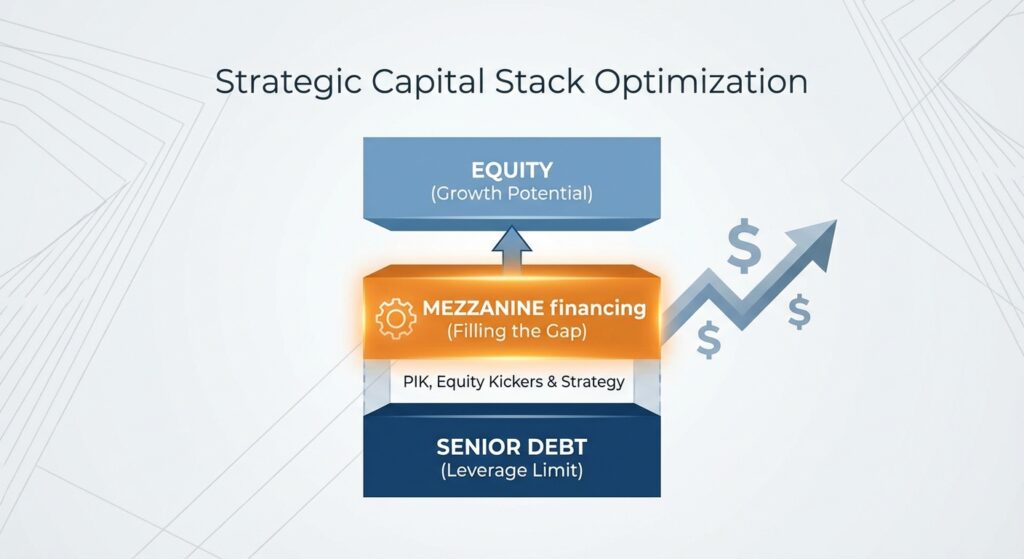
A company generating $8M in EBITDA on $40M in revenue has outgrown its bank relationship. The senior lender, a regional commercial bank, is comfortable at 3.0x leverage, providing a $24M term loan. But the business needs $40M to acquire a competitor, fund a new distribution channel, and carry the working capital of a combined entity. The equity sponsor doesn’t want to inject another $16M in fresh equity at the current valuation. The gap sits squarely in the middle of the capital stack.
This is the defining financing challenge of the growth stage: too leveraged for conventional senior debt, too early for public credit markets, and too value-accretive to simply dilute equity. The answer, in most mid-market transactions structured since 2020, is mezzanine capital, subordinated debt with hybrid equity features designed to fill exactly this structural gap.
Understanding how to size, price, and negotiate mezzanine financing is one of the most consequential skills in deal structuring. Done well, it unlocks transactions that wouldn’t otherwise close. Done poorly, it creates a covenant trap or a dilution event that undermines the equity story entirely.
Structure Breakdown: Components, Mechanics, and a Live Example
Mezzanine debt sits below senior secured debt in the capital stack hierarchy but above common equity. Because it accepts a subordinated repayment position (meaning senior lenders are made whole first in any liquidation or restructuring) mezzanine providers demand higher returns, typically through a combination of:
- Cash interest: A current-pay coupon, typically in the 8%–13% range in today’s private credit market, depending on leverage, sector, and sponsor quality.
- PIK (Payment-in-Kind) interest: Deferred interest that accretes to the principal balance rather than being paid in cash, preserving operating cash flow during critical growth phases. PIK toggles (where the borrower elects cash or PIK at each payment date) are common in sponsored deals.
- Equity kickers: Warrants or co-investment rights that give the mezzanine lender participation in upside. Warrant coverage is typically sized at 1%–5% of fully diluted equity, struck at a nominal or current fair market value.
- OID (Original Issue Discount): A discount to par at closing that boosts the lender’s effective yield without increasing the stated coupon.
A concrete example: A $50M mezzanine tranche for a $120M enterprise value distribution business structured as follows: $50M subordinated note, 10% cash pay + 2% PIK, 5-year bullet maturity, 3% warrant coverage on fully diluted equity struck at current valuation, 1% OID, incurrence-based covenants only (no maintenance leverage test). All-in yield to the lender: approximately 14%–15%. All-in cost to the borrower: meaningfully below selling equity at the current implied multiple.
The intercreditor relationship between the senior lender and the mezzanine provider is governed by a subordination agreement that defines payment blockage rights, standstill periods, and enforcement restrictions. Mezzanine lenders typically accept a 90–180 day standstill before they can take enforcement action, a critical term that senior lenders will insist upon and mezzanine providers will negotiate hard on.
Mezzanine vs. Alternatives: Where It Wins and Where It Doesn’t
The decision to use mezzanine capital is always a comparison across the cost-of-capital spectrum. Mapping that spectrum for a growth-stage borrower looks like this:
| Capital Type | Typical All-In Cost | Dilution | Key Constraint |
|---|---|---|---|
| Senior Bank Debt | 7%–9% | None | Leverage cap (2.5x–3.5x) |
| Unitranche (Direct Lending) | 10%–12% | Minimal (small warrants) | Single-lender concentration |
| Mezzanine | 13%–16% all-in | Low–Moderate (warrants) | Subordination, intercreditor |
| Preferred Equity | 15%–20%+ | Moderate | Liquidation preference stack |
| Common Equity | 20%–30%+ (implied) | High | Valuation, control |
Mezzanine wins when: the equity story is strong enough that warrant dilution is manageable; the business generates sufficient cash flow to service current-pay interest; and the acquisition or growth event being funded is expected to create enterprise value well above the cost of the mezz layer. It loses to a unitranche when deal size and lender appetite support a single-facility solution, increasingly common in the $20M–$75M EBITDA range as direct lenders have scaled. It loses to preferred equity when the business cannot support fixed cash interest payments, making a non-mandatory-return instrument more appropriate despite higher long-run dilution.
The Gap Capital Playbook: Quantify, Prepare, Process, Negotiate
Step 1: Quantify the Gap
Before approaching any capital provider, the borrower must define the gap with precision. This means building a uses-of-proceeds schedule that isolates: (a) total transaction or growth capital need, (b) maximum senior debt capacity at the lender’s leverage limit, and (c) equity the sponsor or management is willing and able to contribute. The residual is the mezzanine quantum. Sizing the gap to a round number that fits standard mezzanine fund minimums (typically $10M and up) matters for process efficiency.
Step 2: Prepare the Mezzanine CIM
Mezzanine providers underwrite differently from senior lenders. They focus on enterprise value coverage (is the mezz tranche covered by equity value at a stress multiple?), cash flow durability, and downside scenarios. The information package should include a detailed LTM and forward EBITDA build with addbacks clearly documented, a scenario analysis showing debt service coverage at base and stress cases, a clear articulation of the equity cushion beneath the mezz, and, critically, a cogent exit narrative. Mezzanine lenders need to believe the equity is worth something at the end of the hold. As the capital stack framework makes clear, the size of the equity cushion directly influences the cost and availability of every layer above it.
Step 3: Run a Targeted Process
Mezzanine capital is not a broadly competitive market the way senior debt is. The universe of active providers (BDCs, family office credit funds, dedicated mezz funds, and insurance company credit arms) is finite and relationship-driven. A targeted outreach to six to ten providers, with a well-prepared teaser and clear timeline, is more effective than a broad blast. Establish a consistent set of terms across all conversations so you are comparing apples to apples: interest rate (cash vs. PIK split), warrant coverage and strike, call protection, and covenant package.
Step 4: Negotiate the Structure
The highest-leverage negotiation points for a borrower in a mezzanine deal are:
- PIK vs. cash split: Push for a higher PIK component if near-term cash flow is constrained, or a PIK toggle that gives operational flexibility without locking in the higher stated rate that pure PIK commands.
- Warrant strike and coverage: Negotiate the warrant strike at current valuation rather than a discount, and cap coverage at 2%–3% if business momentum supports it. A 5% warrant at a below-market strike is a materially different outcome than 2% at fair market value over a five-year hold.
- Incurrence vs. maintenance covenants: Insist on incurrence-based covenants (tested only when the company takes an action (new debt, acquisition, dividend)) rather than maintenance covenants tested quarterly. The former gives management flexibility to operate through normal performance variability without triggering a technical default.
- Call protection: Mezzanine providers typically ask for 2–3 years of call protection (no-call 2, step-down thereafter). Borrowers expecting a near-term exit or refinancing should negotiate a shorter no-call window or a make-whole structure that is genuinely makeable based on the business plan.
- Intercreditor terms: Review the standstill period and payment blockage provisions carefully. A 180-day standstill is standard; anything longer gives the senior lender disproportionate leverage in a workout scenario.
Key Takeaways
- Mezzanine financing exists to solve a specific structural problem: it fills the gap between a senior lender’s leverage limit and the total capital need without requiring full equity dilution at an inopportune valuation point.
- The all-in cost of mezz (13%–16%) must be benchmarked against the implied cost of equity dilution: when the business is growing into its multiple, debt at a fixed cost is almost always cheaper than selling equity today.
- PIK interest and warrant coverage are the two most negotiable levers in a mezzanine term sheet; understanding the trade-offs between them is essential for optimizing the structure.
- Incurrence-based covenants are the standard in sponsor-led mezz deals and should be the baseline expectation for well-prepared borrowers with strong equity stories.
- The gap capital playbook works only when the equity cushion is credible: mezzanine providers are underwriting enterprise value, not just cash flow, so the equity story and exit narrative must be airtight before approaching the market.


