
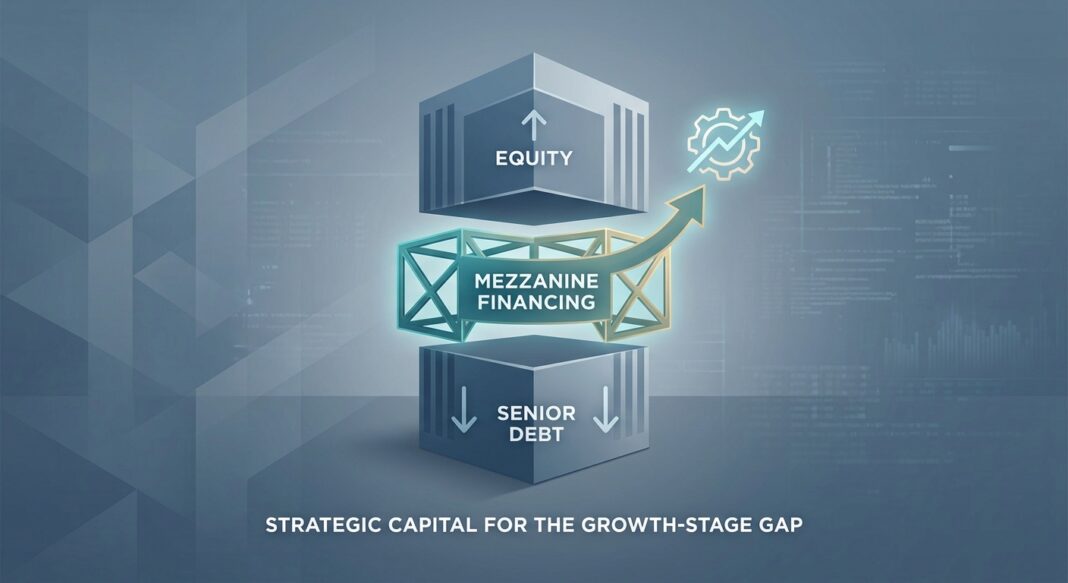
The Growth-Stage Capital Gap: When Senior Debt Runs Out and Equity Costs Too Much
Every growing company eventually reaches the same inflection point: the senior lender has hit its ceiling, the equity market demands too high a price for the next round, and the gap between the two is exactly the amount needed to fund the next acquisition, geographic expansion, or product line buildout. This is the structural problem that mezzanine financing was designed to solve.
At the growth stage (typically a company with $5M–$30M in EBITDA, a proven business model, and a clear use-of-proceeds tied to a value-creation event) the capital stack becomes a strategic lever, not just a funding mechanism. The question is no longer can we get money? but from which layer of the stack, at what cost, and under what structural terms? Getting this wrong means either over-paying for equity capital by diluting ownership at an inopportune moment, or over-leveraging the business with senior debt that strangles operating flexibility.
Mezzanine financing fills that middle floor. Mezzanine financing can be viewed as either expensive debt or cheap equity; it carries a higher interest rate than senior bank debt, but is substantially less expensive than equity in terms of overall cost of capital. For growth-stage operators and financial sponsors navigating this exact tension in 2026, understanding how to structure, price, and negotiate mezzanine capital is a core competency.
Structure Breakdown: How Mezzanine Capital Is Built
Mezzanine debt is a hybrid financing instrument that combines characteristics of both debt and equity. Structurally, it sits junior to senior debt but senior to common equity in the capital stack, creating a unique risk-return profile that appeals to both growth-oriented companies and yield-seeking investors.
The Core Components
A typical mezzanine facility in 2026 carries the following structural elements:
- Cash Interest: Regular interest payments typically ranging from 8–12%, a Payment-in-Kind (PIK) toggle for optional interest accrual to preserve cash flow, and equity kickers, warrants or conversion rights providing equity upside, typically 3–8% of the loan amount.
- Subordination: Mezzanine debt sits between senior debt and equity in the capital structure, meaning the debt is paid after senior debt and before equity in a default or liquidation scenario.
- Tenor and Repayment: Mezzanine facilities typically carry a longer tenor of 5–7 years versus 3–5 years for senior debt, and are often structured with bullet repayment, which may require refinancing or a sale event for principal repayment.
- PIK Toggle: PIK interest is commonly structured as a toggle, meaning the borrower can decide whether and when to use it. Typically, some portion of interest must still be paid in cash, and using PIK comes at an additional premium on top of the interest rate, as the risk for lenders increases, though so does their yield.
- Equity Kicker: The equity kicker refers to the warrant or conversion right component that provides lenders with potential upside participation in the borrower’s success, the feature that transforms mezzanine from pure debt into a hybrid instrument, aligning lender and borrower interests around growth and value creation.
Worked Example: A $25M Mezzanine Tranche for a $60M EV Business Services Company
Consider a business services company with $8M EBITDA seeking $40M to fund a bolt-on acquisition that would bring combined EBITDA to $14M. A senior lender provides $25M at 4.5x EBITDA (the senior limit), leaving a $15M gap. Rather than issuing equity at a compressed valuation, the CFO structures a mezzanine tranche:
- Tranche Size: $15M
- Interest Rate: 10% cash pay + 3% PIK toggle (total 13% blended if PIK is activated)
- Equity Kicker: Warrants for 5% of fully diluted equity at current enterprise value
- Tenor: 6 years, bullet maturity
- Covenant Package: One maintenance covenant, total leverage ratio tested quarterly at 5.5x, with a 30% cushion to closing leverage
- Intercreditor Agreement: Subordination agreement with senior lender; mezzanine lender holds a second lien on substantially all assets
- Prepayment: No-call period of 2 years, then 103/102/101 premium declining to par
In a classic LBO scenario, a mezzanine fund steps in to cover roughly 17% of the deal: a mezzanine tranche carrying, say, a 13% cash coupon plus 2% PIK plus warrants for 5% equity, targeting a 17% all-in IRR. The borrower keeps operational control, management avoids diluting their equity stake prematurely, and the lender earns a risk-adjusted return that compensates for its subordinated position.
How It Compares: Mezzanine vs. the Alternatives
Before committing to mezzanine, a growth-stage operator must understand what they are giving up versus the alternatives across the cost-of-capital spectrum.
Mezzanine vs. Unitranche
Unitranche debt combines senior and subordinated debt into a single tranche from one direct lender, typically offering 4x to 6x leverage at blended rates of 8–11% in the lower middle market, and has become the financing standard for acquisitions valued between $25M and $200M enterprise value, with roughly 70–80% of deals in that range using at least partial unitranche funding. Unitranche wins on execution simplicity and speed, closing in 45–90 days versus 90–150 for broadly syndicated loans. However, unitranche consolidates all lender control in a single party, which can create friction during amendments or add-on transactions. Mezzanine, paired with a conventional senior facility, allows the borrower to optimize pricing at each layer.
Mezzanine vs. Equity
Mezzanine financing is less dilutive than raising additional equity to satisfy a capital need, and ultimately allows existing owners to maintain control. According to Carta’s State of Private Markets data, median dilution in 2025 sits at approximately 19.5% for seed rounds and 18% for Series A rounds, figures that represent permanent ownership transfer. Mezzanine’s equity kicker (typically warrants for 3–8%) is comparatively modest, and the lender’s participation is structurally capped.
Mezzanine vs. Additional Senior Debt
Mezzanine acts as a funding bridge that fills the gap between the amount a traditional bank will lend and the firm’s existing equity base. Mezzanine financing is a creative means of raising capital for companies that have maximized their senior debt capacity, a point usually considered to be around 80% of a company’s capital structure, but still want to pursue growth opportunities that require large amounts of capital, such as acquisitions.
When Each Option Makes Sense
- Use mezzanine when: senior debt is maxed, equity dilution is prohibitively expensive, there is a defined value-creation event (acquisition, recapitalization, geographic expansion) and the company generates stable, predictable cash flows sufficient to service a blended 12–14% cost.
- Use unitranche when: speed and structural simplicity are the priority, deal size sits in the $25M–$200M EV range, and the borrower accepts a slightly higher blended cost in exchange for a single counterparty relationship.
- Use growth equity when: the company is pre-profitable, cash flows cannot service meaningful debt, and the strategic value of the investor’s network or operational expertise outweighs dilution cost.
Current Market Terms: What Mezzanine Looks Like in 2026
The mezzanine market has evolved materially over the past 24 months, shaped by the sustained higher-rate environment, competition from unitranche and direct lending products, and a rebound in mezzanine fundraising activity.
Pricing and Return Targets
Mezzanine targets 12–20% total returns by combining a cash coupon of 8–12%, PIK accretion of 2–4%, equity warrant upside of 2–8%, and origination fees of 1–3%. A decade ago, cash-plus-PIK yields on mezzanine ran 14–16%. Competition has compressed that to roughly 12–14% today, according to 2026 pricing data.
Leverage Multiples
Average total leverage in sponsored middle-market unitranche deals hovered around 5.0x EBITDA in mid-2024 as lenders focused on free cash flow and covenant headroom. In a senior-plus-mezzanine stack, total leverage typically reaches 5.5x–6.5x EBITDA, with the mezzanine tranche accounting for 1.0x–1.5x of that range. For example, 5.0x EBITDA of financing under a traditional senior/junior debt structure could instead become 6.0x EBITDA of financing under a stretch structure.
Fundraising and Market Momentum
Mezzanine fundraising rebounded approximately 26% after a sharp 80% decline in 2024, though the strategy remains highly concentrated and can experience significant year-to-year volatility based on the timing of a small number of large fund closures. Global private credit assets under management reached approximately $2.1 trillion in 2025, up from $1.5 trillion a year earlier.
Covenant Dynamics
Maintenance covenants require borrowers to pass financial tests every quarter regardless of any action taken, while incurrence covenants only apply when the borrower takes a specific action. Most syndicated leveraged loans today are covenant-lite (incurrence only), though private credit deals typically retain maintenance covenants for earlier lender intervention. In practice, many private credit funds are now providing “covenant loose” terms, while covenant-loose loans typically retain at least one maintenance financial covenant such as a quarterly tested leverage ratio, the cushions are set generously enough that a breach would be unlikely to trigger under normal operating conditions.
The Covenant-Lite Creep in Private Credit
Loan documentation has become more borrower-friendly as well, especially at the upper end of the market. Overall, covenant-lite transactions rose to 21% of direct lending deals in 2025, up from 4% in 2023, per Proskauer’s 15th Annual Private Credit Insights Report. Mezzanine documentation, however, tends to retain more lender protections than senior unitranche facilities, a structural feature borrowers should understand is non-negotiable at smaller loan sizes.
The Gap Capital Playbook: Quantify, Prepare, Run the Process
Mezzanine capital does not arrive by accident. Borrowers who execute well follow a structured, sequential process, not a reactive one. Reactive fundraising costs 20–40% more than strategic fundraising. Here is how to execute properly:
Step 1: Quantify the Gap
Before approaching any lender, define the use-of-proceeds with surgical precision. Mezzanine lenders underwrite specific cash flow events, not vague growth narratives. Map:
- Total capital requirement for the triggering event (acquisition price, expansion capex, recap amount)
- Maximum senior debt capacity at the company’s current and pro forma leverage (typically 3.5x–4.5x EBITDA for private credit senior facilities)
- Equity contribution available (sponsor equity, management rollover, existing cash)
- The residual, that is the mezzanine need
The resulting number must be large enough to justify mezzanine’s documentation overhead. Below $25M enterprise value, SBA 7(a) and traditional senior bank loans dominate because minimum check sizes for structured private credit ($15–25M typical) do not pencil.
Step 2: Prepare the Financing Materials
Mezzanine providers are credit underwriters first, equity participants second. They require:
- Three years of audited financials plus a trailing twelve-month period
- A detailed financial model with three scenarios (base, downside, stress) that shows debt service coverage ratios across the full tenor of the facility
- A clear use-of-proceeds memorandum tying every dollar to a measurable value-creation outcome
- A management presentation demonstrating competitive moat, customer concentration risk, and the specific thesis for how leverage is repaid or refinanced at maturity
- Audited financials, a transparent cap table, legal agreements, and compliance records, growth capital partners will scrutinize every aspect, from customer concentration to intellectual property protections.
Step 3: Run a Focused Competitive Process
Unlike syndicated lending, mezzanine is a relationship-driven market with a limited number of specialist funds. Target 4–6 lenders with demonstrated experience in the company’s sector and deal size. When choosing a mezzanine provider, it is vital that the provider has the capacity to grow as a financial partner and has the knowledge to help a company navigate through challenging times; they should be relationship-oriented rather than transaction-oriented.
Run term sheets in parallel with a defined deadline. The key variables to surface are: all-in yield (cash + PIK), equity kicker mechanics (warrants vs. conversion rights, strike price, dilution cap), covenant package, prepayment schedule, and amendment consent thresholds.
Negotiation Guidance: Where Borrowers Leave Value on the Table
The term sheet is a negotiation, not a take-it-or-leave-it document. The most consequential deal points for growth-stage borrowers are:
For Operators and Founders
- PIK Toggle Economics: Push for a true cash/PIK toggle with no additional rate penalty for activating PIK, rather than a fixed PIK structure. This preserves operating cash flow optionality during integration periods or temporary revenue disruptions.
- Equity Kicker Strike Price: Negotiate warrants at current enterprise value rather than a discount. Even a modest difference in strike price can represent millions of dollars at exit. Cap the warrant coverage at a fixed percentage of fully diluted equity and include anti-dilution provisions.
- Covenant Headroom: Typical financial maintenance covenants now include total leverage ratios with 30% or higher cushions to model, with 40% headroom common in aggressive large-cap documentation. Negotiate for at least 30% cushion on the leverage covenant against your base-case model, not your optimistic case.
- Prepayment Flexibility: Negotiate the shortest possible no-call period (12–18 months rather than the lender’s standard 24–36 months), and push for a make-whole structure rather than a fixed call premium if rates change materially.
- Equity Cure Rights: Ensure the credit agreement grants equity cure rights, the ability to inject equity capital to cure a covenant breach, for at least two consecutive quarters and up to four times over the life of the facility.
For Investors Evaluating Capital Structure
- Assess whether the mezzanine layer creates a debt service cliff at maturity that cannot be refinanced from operating cash flow alone, bullet maturities require a clear exit or refinancing thesis.
- Examine the intercreditor agreement between senior and mezzanine lenders. In private credit, covenants serve as functional tools for risk management: maintenance covenants provide early warning signals, and incurrence covenants prevent actions that increase lender risk. Understand which party controls enforcement remedies in a distress scenario.
- Stress-test the total cost of capital. Mezzanine debt is more expensive than senior debt, with a typical loan for a performing company expected to yield 12.5–14% for the lender. Model whether the value-creation event being financed generates enough incremental EBITDA or equity value to justify the all-in cost on a risk-adjusted basis.
Key Takeaways
- Mezzanine solves a structural problem, not a liquidity problem. It is purpose-built for growth-stage companies that have exhausted senior debt capacity but cannot afford the dilution cost of equity at their current valuation. Map the use-of-proceeds first; the financing structure follows.
- The all-in cost is 12–14% in 2026, but the real cost is the equity kicker. Cash and PIK interest are visible on the income statement; warrant dilution at exit is not. Model the equity kicker impact at multiple exit multiples before signing.
- Covenant packages are negotiable, but the direction of travel in private credit favors lenders at the mezzanine layer. While unitranche covenant-lite penetration reached 21% of direct lending deals in 2025, mezzanine documentation retains more lender protections. Negotiate headroom, cure rights, and amendment thresholds explicitly.
- Run a competitive process with 4–6 specialist lenders. Mezzanine is a relationship market, but competition compresses pricing and improves structural terms. A properly run process can narrow spread by 50–100 basis points and materially improve equity kicker terms.
- Strategic fundraising outperforms reactive fundraising. Build the mezzanine layer into the capital plan before the triggering event occurs. Borrowers who approach the market under time pressure from a signed LOI or pending maturity consistently pay more and accept worse structural terms than those who begin the process 6–9 months in advance.


