
Deal Structures & Strategy, Bond Capital
Mezzanine Financing in the Growth-Stage Capital Stack: A Practitioner’s Guide to PIK, Warrants, and Filling the Subordinated Gap
Published: September 25, 2026 • 8 min read
The Financing Challenge: When Senior Debt Runs Out and Equity Costs Too Much
Every growth-stage operator reaches the same inflection point. The business has proven its model, cash flows are positive, and the board has approved an aggressive acquisition or expansion program. The problem: the senior lender caps out at 3–4x EBITDA, the target deal requires 5–6x, and selling a meaningful equity stake at the current valuation would destroy the economics of the trade.
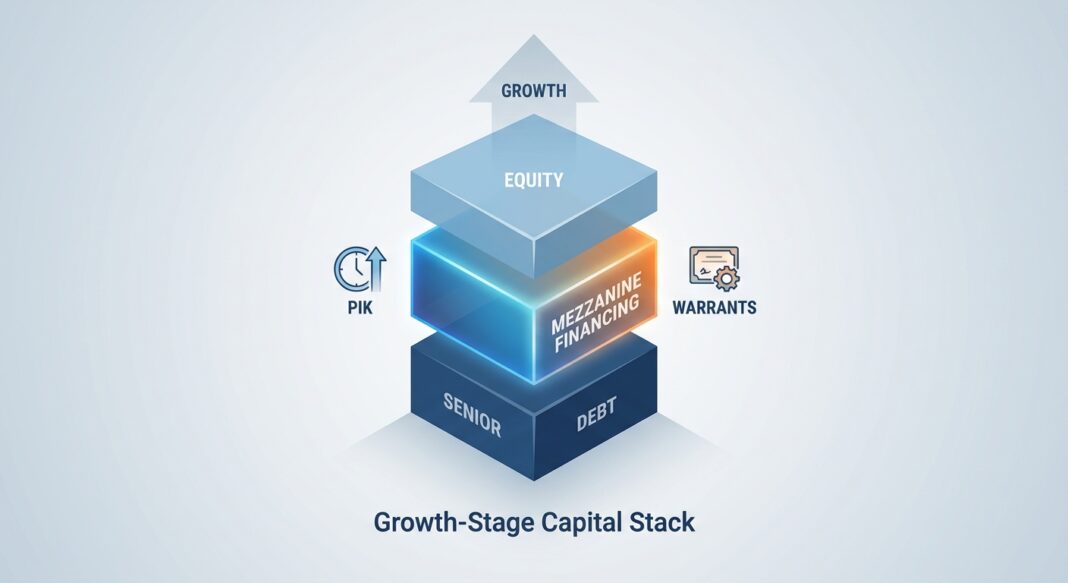
This is the structural gap that mezzanine financing exists to fill. Mezzanine debt is a hybrid financing instrument that combines characteristics of both debt and equity: sitting junior to senior debt but senior to common equity in the capital stack, creating a risk-return profile that serves both growth-oriented operators and yield-seeking lenders. It is the capital stack’s most tactical layer: expensive enough to motivate repayment, flexible enough to accommodate cash flow constraints, and structured enough to preserve founder or sponsor equity when deployed correctly.
In 2026, the mezzanine market is experiencing a notable resurgence. As the broadly syndicated loan market competes hard for large-cap deals and direct lenders tighten pricing at the top of the market, the subordinated middle layer, the true mezzanine tranche, is becoming both more relevant and more competitively structured for growth-stage companies in the $10M–$75M EBITDA band. This guide breaks down how it works, what it costs, and how to negotiate it.
Structure Breakdown: Components, Mechanics, and the Term Sheet
The Three Pillars of a Mezzanine Instrument
Mezzanine debt has three defining structural features that separate it from senior debt and from equity:
- Subordinated, Unsecured Position: Mezzanine sits below all senior creditors in the payment waterfall. In a liquidation or restructuring, senior lenders are made whole before a single dollar flows to mezz holders. This structural subordination is why the instrument requires a materially higher yield than senior debt.
- Payment-in-Kind (PIK) Interest Option: Rather than requiring full cash-pay interest, mezzanine lenders frequently permit a PIK toggle, allowing the borrower to accrue a portion of interest onto the principal balance rather than paying it in cash. This preserves operating cash flow during high-growth or high-reinvestment periods. However, PIK compounds the outstanding balance: when borrowers elect PIK, the growing principal creates a larger refinancing burden at bullet maturity, a risk that intensifies if the anticipated liquidity event is delayed.
- Equity Kicker via Warrants or Conversion: Warrants give the mezzanine lender the right to purchase equity at a fixed price, allowing participation in enterprise value appreciation at exit. Every warrant granted dilutes existing common equity, a cost that must be modeled against the benefit of reduced upfront equity contribution. Warrant coverage is typically structured as a percentage of the loan amount, exercisable at the current valuation at the time of issuance.
Illustrative Term Sheet: $30M Mezzanine Tranche for a $90M EV Software Business
Consider a bootstrapped B2B SaaS operator with $8M EBITDA and a $90M enterprise value seeking to acquire a complementary platform for $45M. A regional bank will provide $24M in senior secured debt (3.0x EBITDA). The remaining $21M gap, after $10M of sponsor equity, is filled by a mezzanine lender. The indicative term sheet looks as follows:
| Term | Detail |
|---|---|
| Instrument | Subordinated Mezzanine Note |
| Principal Amount | $21M |
| Cash Interest Rate | 10.0% per annum (quarterly) |
| PIK Toggle | 2.0% PIK, accruing to principal (electable per interest period) |
| All-In Yield (with warrants) | ~17–18% IRR |
| Maturity | 6 years, bullet repayment |
| Warrant Coverage | 4% equity stake, exercise price set at current valuation ($90M EV) |
| Amortization | None (interest-only; principal due at maturity or exit) |
| Security | Second lien on assets; pledge of equity interests |
| Prepayment Premium | 3-2-1 call schedule (years 1-3) |
| Financial Covenant | Maximum Total Leverage: 5.5x EBITDA (quarterly tested) |
| Intercreditor | Standard subordination and standstill provisions; senior lender cure rights |
The resulting capital stack: $24M senior (3.0x) + $21M mezzanine (2.6x) + $10M equity = $55M total capitalization against $45M acquisition price, with the balance supporting working capital and integration costs.
On pricing, current market data anchors the ranges. Cash interest on mezzanine notes typically runs 8–12%, with an additional 2–4% PIK component, and warrant or equity co-investment of 1–5% creating an all-in IRR target of 16–22% for the lender. The interest income is tax-deductible for the borrower, a meaningful advantage over equity, and mezzanine almost always costs less than the 20%+ return threshold demanded by equity investors.
How It Compares: Mezzanine vs. Unitranche vs. Senior + Equity
The Cost-of-Capital Spectrum
Positioning mezzanine correctly requires understanding the full cost-of-capital spectrum available to a growth-stage company at this enterprise value band:
| Instrument | Typical Yield / Cost | Leverage Capacity | Dilution | Speed to Close |
|---|---|---|---|---|
| Senior Bank Debt | SOFR + 250–350 bps | 3.0–4.0x EBITDA | None | 60–90 days |
| Unitranche (Direct Lending) | SOFR + 475–550 bps | 4.0–5.5x EBITDA | None (minimal warrant) | 45–90 days |
| Mezzanine | 10–12% cash + 2–4% PIK | Fills to 5.5–6.5x combined | Low (warrant only) | 45–75 days |
| Preferred Equity | 12–15% + participation | Limited (equity-counted) | Moderate | 30–60 days |
| Growth Equity | 20%+ IRR target | Not leverage-based | High | 60–120 days |
Unitranche: The Main Competitor
The unitranche structure (which collapses senior and subordinated debt into a single instrument with one rate, one set of covenants, and one lender relationship) has become the dominant structure for middle-market deals. For companies with $50M–$200M enterprise value pursuing acquisitions, unitranche typically wins on execution speed (closing 45–90 days faster than a traditional senior/mezz syndication) and simplicity. The borrower trades a modestly higher all-in cost for deal certainty, faster execution, and fewer counterparties to manage.
However, traditional mezzanine retains clear advantages in specific contexts: transactions where the borrower wants to maximize cheap senior bank debt separately and layer mezz only for the incremental gap; deals where PE sponsors want equity kickers to formally align lender incentives; and portfolio company add-on financings where existing credit agreements restrict additional senior debt. Sponsors also use mezzanine to reduce equity contribution because even at 15–20% yields, mezzanine is cheaper than the 20%+ returns expected on equity.
When Each Structure Wins
- Unitranche wins when speed is the primary constraint, the deal is in the $50M–$200M EV band, and the borrower wants a single lender relationship with streamlined documentation.
- Mezzanine wins when maximizing senior bank debt cheapness is the goal, the operator wants to preserve equity ownership rigorously, and cash flow supports at least partial cash-pay interest.
- Equity wins when leverage capacity is already exhausted, the business is pre-EBITDA, or strategic value-add from the investor outweighs dilution cost.
Current Market Terms: What Mezzanine Looks Like in 2026
The 2026 mezzanine market is shaped by three converging forces: a higher-rate environment that has revived demand for built-in cash yields, a competitive direct lending market that has compressed unitranche spreads, and a covenant pendulum that is swinging back toward lender protections.
Pricing Benchmarks
Based on current market data across deal sizes:
- LMM deals ($10M–$50M): 10–12% cash interest + 2–4% PIK + warrants of 3–6% equity, generating 16–22% all-in IRR for the lender.
- Core middle market ($50M–$150M): 8–10% cash interest + 1–3% PIK + warrants of 1–4% equity, generating 14–18% all-in IRR.
- Upper middle market ($150M+): Unitranche increasingly displaces traditional mezz; where mezz persists, cash interest runs 8–10% with minimal PIK and limited or no warrants.
For context, mezzanine funds have seen renewed institutional interest in 2025–2026 as investors seek strategies with built-in cash yields in a higher-rate environment, creating a deeper and more competitive lender pool for quality borrowers.
Covenant Trends: The Pendulum Swings Back
The covenant environment is a critical variable in 2026 mezzanine structuring. In the broadly syndicated loan market, over 85% of institutional leveraged loans now lack quarterly maintenance testing, the dominant shift to incurrence-only, covenant-lite structures that only test financial ratios when a borrower takes a specific action such as incurring new debt or paying a dividend.
Private credit, however, is diverging. A Proskauer survey found that the portion of U.S. private lenders who will not do deals without financial maintenance covenants grew to 46% in 2026, up 11 percentage points from 2025, a sharp reversal signaling that lenders are reasserting credit protections after years of covenant erosion. The practical implication: growth-stage borrowers accessing mezzanine capital should expect a quarterly-tested leverage covenant (typically set at 5.0–5.5x total debt/EBITDA with a 20–25% cushion to closing leverage), and in many cases a minimum liquidity or interest coverage test alongside it.
At the lower middle market level, covenant packages remain substantially tighter, with conservative leverage, stronger documentation, and earlier lender intervention rights than in the upper market, a feature that rewards disciplined operators but requires careful financial modeling before close.
The Gap Capital Playbook: Quantifying, Preparing, and Running the Process
Step 1: Quantify the Gap
Before approaching any mezzanine lender, operators must define the capital gap precisely. The framework is straightforward: Total Capitalization Needed minus Maximum Senior Debt Available minus Available Equity equals the Mezzanine Requirement. Build a detailed sources-and-uses table, model the post-close cash flow under three scenarios (base, downside, severe stress), and stress-test debt service coverage against each. If DSCR falls below 1.15x in the downside case, the PIK toggle should be sized accordingly, lenders will model this independently and so should the borrower before entering any negotiation.
Step 2: Prepare the Materials
A credible mezzanine process requires a Confidential Information Memorandum (CIM) that goes beyond standard senior lender expectations. Mezzanine providers are making a subordinated bet and need to underwrite both the downside recovery (via intercreditor position and enterprise value support) and the upside participation (via warrant dilution analysis and exit scenario modeling). The package should include: 24+ months of audited or reviewed financials; detailed use-of-proceeds mapping linking the mezzanine tranche to specific value creation levers; a cap table showing pre- and post-close dilution (inclusive of warrant scenarios); and a 3-year integrated financial model with monthly granularity in year one.
Step 3: Run a Competitive Process
A bilateral negotiation with a single mezzanine fund produces one bid, no leverage, and documentation drafted entirely by the lender’s counsel. A curated process across 15–25 pre-qualified capital sources (including BDCs, specialty mezzanine funds, and family office mezz vehicles) creates competitive tension, multiple term sheets, and genuine negotiating room on pricing, warrant coverage, and covenant headroom. The standard process runs 12–20 weeks from mandate to funding, with parallel debt and equity tracks where the capital stack requires both.
Structuring Guidance: What to Negotiate and What to Protect
For Operators (Borrowers)
- Negotiate on structure, not just price. Most borrowers accept the first term sheet as a starting point for rate negotiation. The sophisticated move is to negotiate on structure: PIK toggle flexibility, warrant exercise price mechanics, covenant headroom, and prepayment call schedule. Rate reductions matter at the margin; structural flexibility matters over the life of the instrument.
- Warrants: shift from percentage to fixed share count. Standard warrant coverage is expressed as a percentage of the loan amount, exercisable at the current valuation. The problem: if a subsequent equity round closes at a materially higher valuation, percentage-based warrants become significantly more expensive in real economic terms. Negotiate for a fixed share count with a defined exercise price instead.
- PIK toggle design. Push for a fully electable PIK toggle rather than mandatory PIK, and negotiate for the PIK rate to be lower than the cash-pay rate (not additive). This preserves optionality: you cash-pay when cash flow allows and use PIK only as a genuine liquidity management tool.
- Covenant cushions. Insist on 25–30% headroom above the maintenance covenant level at close. Lenders will test quarterly; build in enough room to absorb a challenging quarter without triggering a technical default and the attendant amendment fees.
- Rate step-downs. Increasingly, operators are negotiating contractual interest rate reductions that activate once the company hits a defined ARR or EBITDA milestone. This aligns lender incentives with growth execution and rewards performance with lower cost of capital over time.
For Investors (Mezzanine Lenders)
- Underwrite warrant dilution rigorously. Every warrant granted reduces sponsor and management returns at exit, model the full IRR bridge from cash interest to PIK accretion to warrant participation before committing.
- Prioritize intercreditor terms. The subordination and standstill provisions (particularly senior lender cure rights and mezz lender step-in rights) are the structural backbone of the position. Non-standard intercreditor terms are a red flag.
- Assess PIK risk early. PIK compounds leverage: a borrower who consistently elects PIK is signaling cash flow pressure. Build a PIK-heavy scenario into credit approval and tie PIK election rights to a minimum liquidity covenant.
Key Takeaways
- Mezzanine fills a structural gap that senior debt and equity cannot efficiently address: it extends total leverage to 5.5–6.5x EBITDA on a combined basis while preserving equity ownership through minimally dilutive warrant coverage rather than full equity sale.
- The all-in cost is 16–22% IRR for the lender: materially higher than senior debt (SOFR + 250–350 bps) but consistently lower than the 20%+ IRR threshold equity investors require. The interest is tax-deductible, further reducing the effective after-tax cost to the borrower.
- PIK interest is a cash flow tool, not a free lunch: it compounds the outstanding balance each period and creates a growing refinancing obligation at bullet maturity. Borrowers should model PIK-heavy scenarios rigorously and size the tranche only to what the business can service under stress.
- The 2026 covenant environment is tightening in private credit: lenders requiring maintenance covenants grew to 46% in 2026 (up 11 points year-over-year per Proskauer). Borrowers accessing mezzanine should expect quarterly leverage testing and negotiate for meaningful headroom above closing ratios.
- A competitive, multi-lender process is the single highest-leverage negotiating tool available: running 15–25 pre-qualified mezzanine providers in parallel generates competitive tension on rate, warrant coverage, and structural terms that a bilateral process cannot replicate.


