
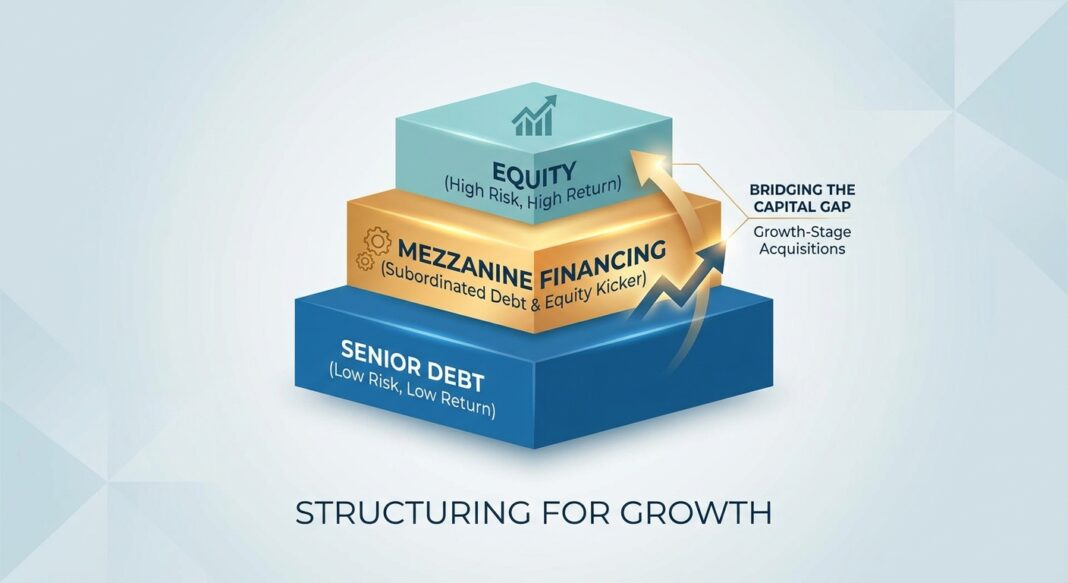
The Growth-Stage Acquisition Gap: When Senior Debt Runs Out and Equity Costs Too Much
A growth-stage company (say, a founder-owned specialty services business generating $8M in EBITDA) has identified a bolt-on acquisition that would push combined EBITDA to $14M and meaningfully re-rate its valuation multiple. The math works. The strategic logic is clear. The problem is the capital stack.
The senior lender, a regional bank with a 3.0x EBITDA leverage ceiling, will advance $24M. The acquisition costs $70M at a 5.0x purchase multiple. Equity from the existing sponsor covers $20M. That leaves a $26M structural gap sitting between the senior debt ceiling and the available equity: too large to bridge with cash, too junior for the bank, and too expensive to fill entirely with new equity.
This is the mezzanine moment. Subordinated debt, sitting between senior secured lenders and common equity in the capital stack, exists precisely to monetize this gap. When structured correctly, it preserves equity ownership, provides the seller with a clean exit, and keeps the blended cost of capital below the return threshold of the acquired business. When structured poorly (with punitive PIK escalators, uncapped warrants, or aggressive covenants) it becomes a value transfer from the borrower to the lender.
Understanding the mechanics separates operators and investors who use mezzanine as a tool from those who accept it as a last resort.
Mezzanine Structure Breakdown: Components, Mechanics, and a Live Example
Mezzanine financing is structurally defined by three characteristics: its position in the capital stack (subordinated to senior secured debt, senior to equity), its blended return mechanism (cash interest plus PIK plus equity participation), and its covenant architecture (typically incurrence-based rather than maintenance-based).
The Component Layer
- Cash Interest: The base coupon paid currently, typically ranging from 7% to 10% in 2025–2026 market conditions for sponsored middle-market transactions. This is the contractual floor on the lender’s return.
- PIK (Payment-in-Kind) Interest: Deferred interest that accrues to principal rather than being paid in cash. PIK components of 2%–4% are common, allowing borrowers to preserve liquidity during integration periods. PIK can be structured as mandatory, optional (borrower-elected), or toggle (lender-elected under defined conditions).
- Equity Kicker / Warrant Coverage: Mezzanine lenders routinely require warrants or an equity co-investment right representing 3%–10% of the fully diluted equity. This equity participation is how mezzanine lenders target total returns in the 14%–18% range when cash and PIK coupons alone deliver 10%–13%.
- Subordination: Governed by an intercreditor agreement with the senior lender. This agreement defines payment blockage periods, standstill rights, and the conditions under which the mezzanine lender can enforce its position.
Illustrative Term Sheet: $26M Mezzanine Tranche
Returning to the $70M acquisition scenario above:
- Structure: $24M senior secured term loan (3.0x EBITDA) + $26M mezzanine (combined 6.25x EBITDA) + $20M sponsor equity
- Mezzanine Coupon: 8.5% cash pay + 3.0% PIK = 11.5% blended current yield
- Warrant Coverage: Warrants for 6% of fully diluted equity, struck at the deal’s implied equity value, exercisable at exit
- Maturity: 6 years, with a 12-month cash interest holiday option in Year 1 (full PIK toggle)
- Call Protection: Non-call 2 years, 103 in Year 3, 101 in Year 4, par thereafter
- Covenants: Incurrence-based; no maintenance financial covenants; negative pledge, restricted payments basket, and M&A consent threshold at $5M
- Lender Target Return: ~16% IRR (blended cash + PIK + warrant proceeds at 7.0x exit multiple)
Mezzanine vs. Alternatives: Navigating the Cost-of-Capital Spectrum
Mezzanine does not exist in isolation. Every capital structure decision involves trade-offs across the cost-of-capital spectrum, and the right instrument depends on three variables: the borrower’s leverage tolerance, the dilution sensitivity of existing equity holders, and the operational flexibility required post-close.
| Instrument | All-in Cost | Dilution | Covenants | Best For |
|---|---|---|---|---|
| Senior Bank Debt | 7%–9% (SOFR + 250–350 bps) | None | Maintenance (tight) | Stable, asset-rich borrowers |
| Unitranche (Direct Lending) | 9%–12% (SOFR + 450–650 bps) | None | Incurrence-based | Sponsored LBOs, speed of execution |
| Mezzanine | 14%–18% (blended with equity) | 3%–10% (warrants) | Incurrence-based | Gap capital, higher leverage, flexible cash |
| Preferred Equity | 15%–22% (cash or accruing) | Moderate to high | None (governance rights) | Sponsor-backed recaps, pre-IPO rounds |
| Common Equity | 20%+ (IRR expectation) | Significant | None (control provisions) | High-growth, loss-making businesses |
Mezzanine is optimal when: (1) the senior debt ceiling has been reached and additional secured leverage is unavailable; (2) the borrower is equity-dilution sensitive and cannot absorb a large preferred or common raise at current valuations; and (3) the acquired or expanded business generates sufficient cash flow to service the cash coupon component, even if PIK is used in Year 1.
Mezzanine becomes structurally inferior when the business carries cyclical cash flows (PIK compounding risk is acute), when the equity kicker terms are uncapped, or when the intercreditor agreement with the senior lender is so restrictive that the mezzanine lender’s enforcement rights are effectively subordinated beyond their economic position.
Current Market Terms: What the 2025–2026 Mezzanine Market Is Pricing
The mezzanine market in 2025–2026 reflects a recalibrated rate environment following the Federal Reserve’s rate normalization cycle and a meaningful recovery in middle-market deal activity. According to S&P Global LCD, private credit spreads in the subordinated debt segment have tightened modestly from their 2023 peaks but remain structurally wider than pre-2022 levels, reflecting lender discipline and higher base rates.
- All-in mezzanine yields: 13.5%–17.5% for sponsored middle-market transactions ($20M–$75M tranche sizes), per PitchBook’s 2025 Private Credit Report.
- Cash/PIK split: The market standard has shifted slightly toward higher cash pay components (8%–10% cash, 2%–3% PIK) as lenders price in refinancing risk at current rates.
- Warrant coverage: Compressed in the 4%–8% range for sponsored deals; wider (7%–12%) for non-sponsored or founder-owned businesses where information asymmetry and governance risk are higher.
- Leverage ceilings: Most mezzanine lenders are underwriting to 5.5x–6.5x total leverage for service businesses, with up to 7.0x for SaaS and recurring-revenue models, according to Debtwire’s Mid-Market Monitor (Q1 2026).
- OID and fees: Origination fees of 1.5%–2.5% and OID of 1%–2% remain standard, adding 50–80 basis points to the effective all-in cost.
The Gap Capital Playbook: Quantifying, Preparing, Running, and Negotiating the Mezzanine Process
Step 1: Quantify the Gap with Precision
Before approaching any mezzanine lender, the borrower must produce a sources-and-uses table that is internally stress-tested. Map the senior debt ceiling (in EBITDA turns, not dollars), the equity available (existing cash, sponsor dry powder, seller rollover), and the resulting gap. Run three scenarios: base, downside, and acquisition synergy delay. The mezzanine tranche size should be sized to the downside scenario’s gap, not the base case, to avoid a return to market within 18 months.
Step 2: Prepare the Mezzanine Information Package
Mezzanine lenders underwrite on free cash flow, not asset coverage. The information memorandum must lead with a trailing and forward EBITDA bridge, clearly separating recurring from non-recurring items. Include a debt service coverage analysis showing cash interest coverage at minimum 1.5x in the base case and 1.1x in the downside. Attach the intercreditor term sheet from the senior lender early, mezzanine lenders will not price without it.
Step 3: Run a Focused, Time-Bounded Process
Target 4–7 mezzanine lenders simultaneously. Prioritize lenders with a mandate in your sector and transaction size, a $26M mezzanine tranche is too small for some institutional funds and too large for most family office lenders. Set a 3-week indication deadline and a 5-week term sheet deadline. Use competing term sheets as negotiating leverage on warrant coverage and call protection, not on coupon (lenders will not move meaningfully on coupon in a 2-lender final).
Step 4: Negotiate the Three Structural Levers
- Warrant Coverage and Strike Price: Push for a fixed-percentage cap (not a floating formula) and a strike price set at the deal’s closing equity value, not at a discount. A 30-day exercise window post-exit is preferable to an open-ended call right.
- PIK Toggle Optionality: Negotiate a borrower-elected PIK toggle for Years 1–2, not a mandatory PIK structure. This preserves optionality during integration without permanently increasing the lender’s equity-equivalent return.
- Call Protection: Non-call periods of 2 years are market standard; push back on any lender requesting 3-year non-call, particularly if the business is likely to refinance following a rating improvement or EBITDA step-up at 24 months.
Key Takeaways
- Mezzanine fills the leverage gap between the senior debt ceiling and available equity; it is most valuable when dilution sensitivity is high and cash flow is predictable enough to service the cash coupon component.
- The blended cost is the number that matters. Cash coupon + PIK + warrant dilution must be modeled together against the post-acquisition EBITDA and projected exit multiple to confirm the structure is accretive to equity returns.
- Warrant coverage is the primary negotiation battlefield. A 2%–3% difference in warrant percentage at a 6.0x exit can represent millions of dollars in equity value transfer. Cap it, fix the strike, and define the exercise mechanics precisely.
- Incurrence covenants are a material advantage over maintenance covenants. Ensure the mezzanine term sheet explicitly confirms incurrence-only covenant architecture, maintenance covenants in a subordinated position create an asymmetric default risk that benefits only the lender.
- Size the tranche to the downside scenario and model PIK compounding at full accrual through the expected hold period. A PIK component that appears manageable at closing can become a structural overhang if exit is delayed by 18–24 months.


