
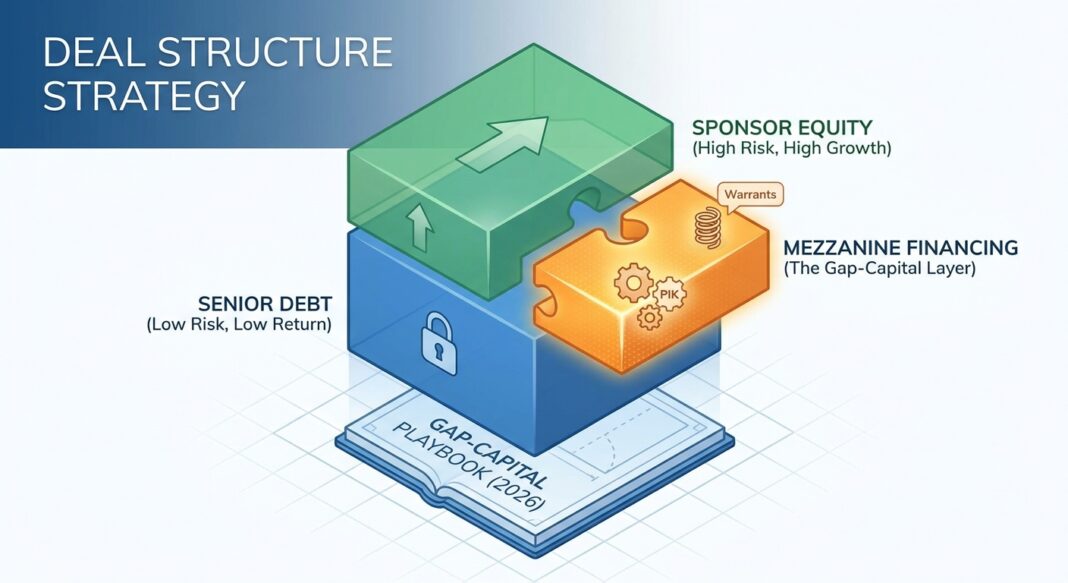
The Capital Gap That Kills Deals
Picture a sponsor-led buyout of a $60M enterprise-value business services platform generating $7M EBITDA. The deal pencils at roughly 8.6x. Senior lenders, comfortable at 3.5x–4.0x EBITDA, will provide $24.5M to $28M. Sponsor equity, targeting a 20%–25% IRR, covers another $25M–$30M. That leaves a structural hole of $5M–$10M that is too risky for the senior lender, too expensive to fill with pure equity, and too large to bridge with a seller note alone. This is the mezzanine moment.
Mezzanine financing is the hybrid layer of the capital stack that sits between senior secured debt and common equity. It is neither a bank loan nor an equity check. It is the instrument that makes many lower-middle-market acquisitions mathematically executable, and, when structured poorly, the one that can trap a business in a debt-service spiral for years.
In 2026, with senior lenders remaining conservative on leverage and sponsor equity checks running at 40%–55% of enterprise value, the pressure on mezzanine capital to fill structural gaps is intensifying. Understanding how to size it, price it, and negotiate it is no longer optional for serious deal participants.
Component Breakdown: The Four Levers of Mezzanine Economics
A mezzanine facility is not a single instrument; it is a bundled set of return components that, combined, produce a targeted gross IRR for the lender. According to PipelineRoad, mezzanine funds generally target gross returns of 12%–18%, blending current cash interest (typically 10%–14%) with additional return from PIK interest and equity kickers such as warrants or conversion rights. Each lever serves a distinct function:
- Cash Coupon (8%–12%): The base interest rate paid quarterly in cash. On a $10M mezzanine facility at 10%, this produces $1M per year in hard-dollar debt service. This is the predictable, underwritable portion of the facility from a borrower cash-flow perspective.
- PIK Interest (2%–4%): Payment-in-kind interest accrues on the outstanding principal balance rather than being paid in cash, compounding over the life of the facility. As Cummings & Cummings Law notes, borrowers favor PIK mechanics primarily to conserve cash during integration periods, capex cycles, or market downturns, while mezzanine providers accommodate PIK to achieve a targeted yield. The trade-off is explicit: near-term liquidity is preserved at the cost of an increasing principal balance. A $10M facility with 3% PIK grows to $10.3M after year one, $10.61M after year two, the compounding effect that The VC Corner notes does not feel expensive until you model it year-over-year.
- Equity Kicker, Warrants (1%–5% of fully diluted equity): Nearly every mezzanine deal includes equity warrants, options to purchase common stock at a nominal strike price. According to Ryan O’Connell, CFA, the warrant compensates the lender for subordination risk that the cash coupon alone does not fully price. If the company exits at a high multiple, warrants convert into meaningful equity proceeds, lifting the lender’s blended IRR from the coupon range (10%–16%) into the 15%–20% target range. Every warrant granted to a mezzanine lender dilutes existing common equity, a cost that must be weighed against the benefit of reduced upfront equity contribution.
- Origination & Arrangement Fees (1%–3%): Paid upfront at close, these fees contribute the least return but cover administrative costs and serve as deal-commitment signals. They also factor into the all-in effective cost of capital from the borrower’s perspective.
Worked Example: $10M Mezzanine on a $60M EV Business Services Acquisition
Consider a $60M enterprise value acquisition at 8.6x EBITDA ($7M). The capital stack is constructed as follows:
- Senior Term Loan: $25M (3.57x EBITDA) at SOFR + 475 bps. Per CT Acquisitions, a standard senior term loan for LMM acquisitions in 2026 prices at SOFR + 400–500 bps with 1.5%–2.5% OID from lenders including Twin Brook Capital, Antares, and Churchill.
- Mezzanine Tranche: $10M (1.43x EBITDA) at 10% cash + 3% PIK + warrants covering 3% of fully diluted equity. Per CT Acquisitions, 2026 all-in mezzanine cost runs 10%–14% (cash coupon 8%–11% + PIK 2%–4% + warrants), targeting a 16%–22% all-in IRR for the lender. Top providers include BDCs (Ares Capital, Blue Owl), specialty mezz funds (Audax Mezzanine, Madison Capital, NewSpring), and family offices doing direct deals.
- Sponsor Equity: $25M (~41.7% of EV). Targeting 20%–25% IRR over a 4–7 year hold.
Year-one cash interest on the mezzanine facility: $1.0M. Year-one PIK accrual: $300K added to principal. By year five, the PIK balance on a $10M facility compounding at 3% annually has grown to approximately $11.59M, before any exits or prepayments. This compounding effect is why Finlens argues that a mezzanine facility advertised at 14% interest is not a 14% cost of capital; it is the stated rate plus PIK compounding, warrants, and upfront fees, a combination whose all-in cost frequently exceeds the cost of a well-priced equity round when calculated correctly.
Mezzanine vs. Unitranche vs. Equity: Three Structures, Three Use Cases
Understanding when to deploy mezzanine capital requires direct comparison to its two main substitutes: the unitranche facility and additional sponsor equity.
Mezzanine vs. Unitranche
A unitranche facility collapses the senior and mezzanine tranches into a single loan instrument, simplifying documentation and lender relationships. Per CT Acquisitions, unitranche pricing in 2026 runs SOFR + 550–700 bps, with spreads for premium credits compressing to SOFR + 450–550 bps in H2 2026 as direct lender AUM competition intensifies. With SOFR at approximately 3.7% (per the Capstone Partners Q1 2026 Middle Market Leveraged Finance Update), the all-in blended cost on a unitranche for a quality LMM credit runs roughly 9.5%–11%.
Unitranche wins on simplicity and speed, Private Capital Global notes that private credit can close within four weeks while bank-led deals may require 6–8 weeks for syndication. But unitranche typically caps leverage at 4.0x–5.0x EBITDA. When the deal requires total leverage above that threshold (for large bolt-ons, highly seasonal businesses, or transactions where the senior lender is conservative) a structured senior/mezz split may access more total leverage than a single unitranche lender will extend.
Mezzanine wins when: (a) the borrower needs a leverage quantum that exceeds the unitranche box; (b) the business has highly predictable cash flows that can service two separate instruments; or (c) the intercreditor structure enables more flexible covenant terms on the senior tranche by clearly subordinating the mezz.
Mezzanine vs. Incremental Sponsor Equity
Replacing $10M of mezzanine with $10M of additional sponsor equity eliminates the compounding PIK balance and the warrant dilution, but it reduces the equity IRR by diluting the sponsor’s upside across a larger equity check. As PipelineRoad explains, the mezzanine tranche’s primary strategic value is that it allows sponsors to execute larger deals or maintain target return profiles without over-equitizing transactions. In an environment where the all-in LMM acquisition financing stack blends to roughly 11%–14% pre-tax (per CT Acquisitions), preserving equity capacity for follow-on bolt-ons is often the more efficient capital allocation decision.
Current Market Terms: What 2026 Mezzanine Looks Like in Practice
Five structural data points define the current mezzanine market for LMM transactions:
- Pricing Range: CT Acquisitions pegs 2026 all-in mezzanine cost at 10%–14% (8%–12% cash + 2%–4% PIK + warrants), targeting a 16%–22% all-in IRR. Carta notes a typical performing company mezzanine yield expectation of 12.5%–14% for the lender.
- Warrant Coverage: Most structures grant warrants representing 2%–5% of the company’s fully diluted equity, per PipelineRoad. The equity kicker adds approximately 200–300 basis points of blended IRR lift for the lender; borrowers should model warrant value under multiple exit scenarios, not just the base case.
- Covenant Package: Private Capital Global reports that at least one financial maintenance covenant is standard in private credit deals under $50M EBITDA, most commonly a total leverage ratio test with cushions above closing leverage. By contrast, CT Acquisitions notes that syndicated term loan B structures remain largely covenant-lite, while private credit unitranches typically retain a maintenance debt-to-EBITDA covenant. Mezzanine agreements layer a second set of incurrence-based protections on top of whatever maintenance covenants the senior instrument carries.
- PIK Toggle Trend: With Intelligence flags a rising use of payment-in-kind toggles in direct lending as a sign of mounting stress in the 2026 credit environment. Effective PIK structures should include performance-based triggers that constrain or condition PIK elections, such as minimum liquidity thresholds or maximum leverage ratios before permitting cash-pay toggling, as detailed by Cummings & Cummings Law.
- Market Context: The broader private credit market has exceeded $2 trillion in AUM in 2026, according to PwC’s Global Private Credit Survey 2026. Meanwhile, TorreBlanc observes that lower leverage levels in buyouts have made mezzanine capital less of a luxury and more of a necessity, as M&A activity gradually recovers, mezzanine financing is increasingly deal-critical rather than optional.
The Gap-Capital Playbook: Quantify, Prepare, Run the Process, Negotiate
Structuring a mezzanine tranche is a four-step process. Skipping any step lengthens timelines, weakens negotiating leverage, or produces a structure the business cannot service.
Step 1: Quantify the Gap
Start with the total acquisition price, subtract committed senior debt capacity (tested at the senior lender’s maximum leverage covenant, typically 3.5x–4.0x EBITDA), and subtract sponsor equity (back-calculated from the target IRR and projected exit multiple). The residual is the mezzanine requirement. Stress-test it: at a 15%–20% EBITDA decline, does total debt service on both the senior and mezzanine layers remain within 60%–80% of EBITDA? CT Acquisitions flags debt service over 60%–80% of EBITDA as the over-leverage trap to avoid. If the gap exceeds what mezzanine can safely fill, the deal likely requires re-pricing, additional equity, or a seller note to close the stack.
Step 2: Prepare the Materials
Mezzanine lenders underwrite on cash flow, not collateral. The lender presentation must anchor on: (a) trailing 12-month and LTM EBITDA with add-backs clearly documented; (b) a quality-of-earnings report from a credible firm; (c) customer concentration data showing top-customer revenue below 25%; (d) a downside case demonstrating debt service coverage at a meaningful revenue decline; and (e) a management equity plan that aligns operator incentives with lender recovery. Per CT Acquisitions, the underwriting process runs 60–90 days from term sheet to close, with lender diligence covering financial review, customer concentration, industry analysis, and management team assessment.
Step 3: Run a Competitive Process
Approach three to five mezzanine providers simultaneously. The provider universe includes BDCs (Ares Capital, Blue Owl, Main Street Capital, Owl Rock), specialty mezz funds (Audax Mezzanine, NewSpring Mezzanine, Peninsula Capital, Madison Capital), and family offices doing direct mezz. The competitive dynamic is critical: lenders offering the most attractive cash coupon / smallest warrant package should be separated from those offering the most favorable covenant terms. These are not the same provider. TorreBlanc notes that in 2026, structuring, documentation, vintage exposure, and intercreditor terms matter more than ever, meaning the selection of a mezzanine lender is as much a legal and structural decision as it is a pricing negotiation.
Step 4: Negotiate the Structure
The four highest-leverage negotiation points in any mezzanine term sheet are:
- Warrant Coverage Percentage: Push from the lender’s opening 5%–7% toward the 2%–3% range. The warrant is the most optically inexpensive but economically significant concession a borrower makes at close.
- PIK Toggle Triggers: Negotiate performance-based conditions (minimum liquidity threshold, maximum leverage ratio) before PIK can be elected. This prevents the facility from compounding into a default scenario if performance is soft.
- Call Protection / Prepayment Premium: Standard structure is 102/101/par over years one through three. As Cummings & Cummings Law notes, if the borrower prepays, the agreement must clarify whether make-whole or call protection applies to both the debt and the warrant value, and how capitalized PIK is factored into any premium calculation, failure to define these aspects precisely is a frequent source of post-closing disputes.
- Covenant Headroom: Model the leverage covenant at a 20%–25% EBITDA cushion above the expected run-rate. Negotiate a step-down schedule that gives the business time to integrate before tightening. Private Capital Global notes that lenders argue maintenance covenants benefit both parties by identifying issues early and forcing engagement, but for borrowers, an inadequately cushioned leverage test is the single most common source of post-close technical defaults.
Key Takeaways
- Mezzanine is a bundled instrument, not a line item. The all-in cost includes cash coupon, PIK compounding, warrant dilution, and origination fees. A facility priced at 11% cash is not an 11% cost of capital once warrants and PIK are modeled over a five-year hold.
- PIK compounds silently. A $10M facility with 3% PIK grows to approximately $11.6M by year five without a single dollar of additional borrowing. Always model the PIK balance at exit alongside projected enterprise value, the math changes the deal economics materially.
- Warrants are the most negotiable feature. Lenders open at 5%–7% warrant coverage. The market range for strong credits is 2%–5%. Reducing warrant coverage by even 100 basis points of equity at a 7x exit multiple on a $60M business represents hundreds of thousands of dollars of retained sponsor value.
- Covenant design matters more than spread. In 2026, maintenance covenants are standard in LMM private credit deals. Negotiate the leverage cushion and step-down schedule rigorously, insufficient headroom is more operationally damaging than 50 basis points of incremental spread.
- Mezzanine is increasingly deal-critical, not optional. With private credit AUM exceeding $2 trillion and senior lenders maintaining conservative leverage constraints, the structural gap between 4.0x senior debt and the total leverage a deal requires is being filled by mezzanine capital in an expanding share of LMM transactions. Operators and sponsors who understand how to size, structure, and negotiate this layer will close more deals at better returns.


