
Deal Structures & Strategy
Mezzanine Financing for Growth-Stage Companies: Structuring the Gap Between Senior Debt and Equity
The Growth-Stage Financing Problem
A profitable, founder-led business with $8 million in EBITDA wants to execute a $40 million bolt-on acquisition. The company’s senior bank will lend comfortably to 3.5–4.0x EBITDA, call it $28–32 million. That leaves a $8–12 million gap between what the bank will fund and what the deal actually costs once you layer in transaction fees, integration reserves, and a modest working capital buffer. The two obvious paths (dilutive equity or walking away from the deal) are rarely the right answer.
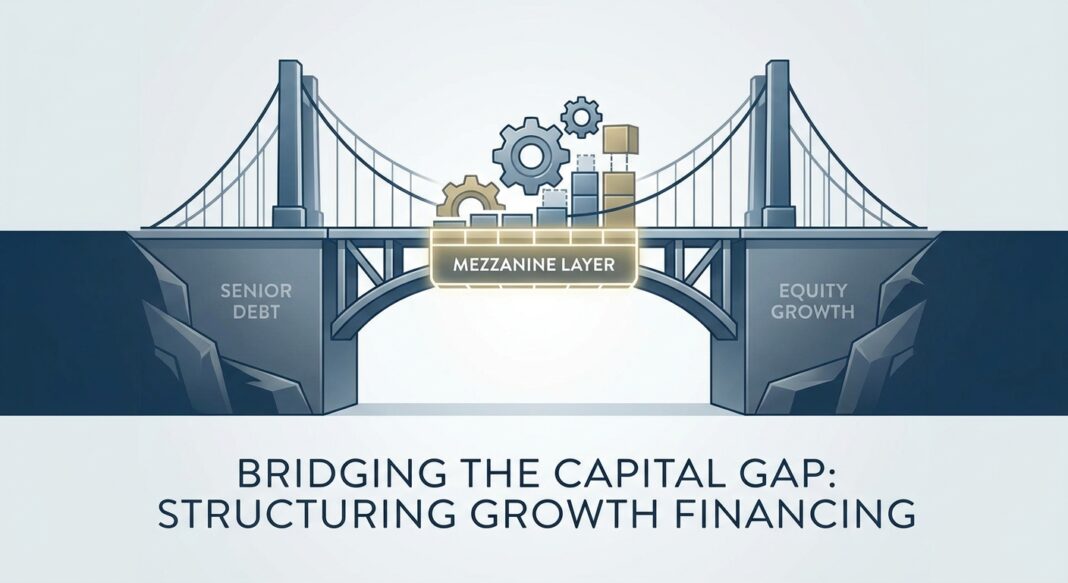
This is the classic gap capital problem, and it sits at the heart of growth-stage financing. It is the moment when a company has outgrown what a conventional lender will provide on asset-backed or conservatively underwritten cash flow terms, but has not yet reached the scale, leverage tolerance, or strategic rationale to justify a full equity raise. Between those two poles sits the mezzanine layer: subordinated debt that fills the structural gap, preserves ownership, and prices the incremental risk through a blend of current cash interest, deferred PIK (payment-in-kind) interest, and an equity kicker.
In the current market, mezzanine is neither an exotic instrument nor a lender of last resort. It is a deliberately engineered layer of the capital stack, purpose-built for exactly this scenario, and understanding how to structure, price, and negotiate it is a core competency for any operator, CFO, or advisor working in the growth and lower middle market.
Mapping the Cost of Capital: From Banks to Equity
Before sizing any gap layer, a CFO must map the full cost-of-capital spectrum available for the specific business stage and use-of-proceeds. For a growth-stage company with $5–20 million EBITDA, the ladder looks like this:
| Layer | Typical Pricing (2025–2026) | Max Leverage | Key Feature |
|---|---|---|---|
| Senior Bank / ABL | SOFR + 175–275 bps | 3.0–4.0x EBITDA | Lowest cost; asset or cash flow secured; maintenance covenants |
| Unitranche (Direct Lending) | SOFR + 475–575 bps | 4.5–5.5x EBITDA | Single facility; speed; blended senior/sub risk |
| Mezzanine | 12–16% all-in (cash + PIK + kicker) | 5.0–6.0x EBITDA | Subordinated; PIK toggle; equity kicker; bullet maturity |
| Preferred Equity | 15–20%+ | N/A (equity instrument) | Non-dilutive to common; liquidation preference; PIK dividend |
| Common / Growth Equity | 25–35%+ IRR target | N/A | Permanent capital; most dilutive; no fixed repayment |
The critical insight is that mezzanine sits precisely where senior appetite ends and equity dilution begins. It is more expensive than senior debt in absolute coupon terms, but it preserves equity ownership at a stage when valuations are often still compressed relative to what the business will be worth at exit. For a management team that owns the business and intends to capture that upside, paying 13–15% all-in on a subordinated tranche to avoid giving up 20–30% of equity at a sub-optimal valuation is frequently the right economic trade.
Unitranche has emerged as a powerful alternative at the lower-middle-market level, particularly for sponsor-backed deals. Upper-middle-market unitranche facilities typically price at SOFR + 425–475 bps, with core middle market credits commanding an additional 50–100 bps premium. For non-sponsored or owner-operated businesses, however, the mezzanine route often remains the more accessible path, particularly when the borrower cannot satisfy the unitranche lender’s sponsor relationship or management equity requirements.
How the Mezzanine Layer Works: Components and Mechanics
The Three-Part Return Architecture
Mezzanine financing generates returns through two contractual channels and one contingent channel. Understanding how they interact is essential to negotiating a fair structure:
- Current Cash Interest: A periodic cash coupon, typically paid monthly or quarterly. This is the “senior-like” component that provides the lender with regular income and the borrower with predictable debt service. Rates are significantly higher than senior debt to compensate for subordination risk.
- PIK (Payment-in-Kind) Interest: Rather than receiving cash, the lender’s interest accrues to the outstanding principal balance. A $10 million mezzanine tranche carrying 2% PIK grows to $10.2 million after Year 1, compounding into an increasingly larger repayment obligation at maturity. PIK preserves near-term cash flow for the borrower at the cost of a larger balloon payment and an accelerating principal balance over the loan’s 5–7 year life.
- Equity Kicker (Warrants): The lender receives the right to purchase a percentage of the company’s equity, typically 1–5%, at a pre-negotiated strike price, usually set at or near current enterprise value. The kicker compensates the lender for the subordinated risk position and the absence of collateral-backed security, and it aligns lender interests with long-term business performance.
The number of warrants issued is inversely proportional to the coupon rate: a higher cash coupon means fewer warrants are needed to achieve the lender’s target blended yield, and vice versa. Mezzanine providers generally target a blended all-in yield of 15–20%+, combining cash interest, PIK accrual, and the expected value of warrant proceeds at exit.
Worked Example: A $10M Mezzanine Tranche for a $40M Acquisition
Business Profile: Manufacturing and distribution company; $8M EBITDA; $45M enterprise value; pursuing a $40M bolt-on acquisition.
Capital Structure:
- Senior Bank Term Loan: $28M @ SOFR + 250 bps (3.5x EBITDA), Revolving Credit Facility: $5M
- Mezzanine Tranche: $10M (fills the gap to $38M of debt + $7M equity rollover)
- Management Equity: $7M (existing rollover equity)
Illustrative Mezzanine Term Sheet:
- Principal: $10,000,000
- Maturity: 6 years (bullet repayment)
- Cash Interest: 11% per annum, paid quarterly
- PIK Interest: 2% per annum, compounding into principal
- All-In Cash Yield: 13% (before kicker)
- Equity Kicker: Warrants to purchase 3% of fully diluted equity at $45M enterprise value strike
- Blended Target Return (Lender): ~16–18% IRR (assuming 6x exit multiple on $10M–12M combined EBITDA)
- Call Protection: 103% in Year 1, 102% in Year 2, 101% in Year 3, par thereafter
- Amortization: None (bullet)
- Security: Second lien on all assets; pledge of equity; subordinated to senior bank
- Intercreditor Agreement: Standard subordination; 90-day payment standstill during senior default cure period
- Financial Covenants: Maximum Total Leverage (6.0x initially, stepping down to 5.0x by Year 3); Minimum Fixed Charge Coverage (1.10x)
Outcome for Management: The company completes the acquisition using $38M of debt and $7M of existing equity. Management retains full ownership, avoids issuing new equity at a $45M valuation, and services only $1.1M per year in PIK additions (versus ~$2.8M annual mezzanine cash interest). If the combined entity exits at 7x EBITDA on $12M EBITDA in Year 5 ($84M EV), the warrant holder collects approximately $2.5M, a meaningful but bounded cost of preserving management’s equity upside.
Mezzanine vs. Alternatives: Structural Trade-offs
Mezzanine vs. Unitranche
Unitranche is a powerful competitor to the senior/mezzanine split. By collapsing the entire debt layer into a single first-lien instrument, it eliminates the need for an intercreditor agreement, reduces documentation complexity, and typically closes 30–45 days faster than a layered structure. For a sponsor-backed deal where time-to-close is critical, such as a competitive auction, unitranche often wins on execution certainty alone. However, for non-sponsored, founder-led companies, mezzanine remains the more accessible tool. Unitranche lenders generally require a private equity sponsor relationship and are less comfortable with the owner-operator dynamic. Furthermore, the blended cost of a unitranche at SOFR + 475–575 bps all-in may actually exceed the weighted cost of a senior/mezzanine split for borrowers who can access cheap senior bank debt and pair it with a smaller subordinated tranche.
Mezzanine vs. Dilutive Equity
This is the most consequential comparison for management teams. Growth equity investors, funds targeting 25–35%+ IRR, will demand a meaningful equity stake at a valuation discount to expected exit. For a business worth $45M today that is likely worth $80–90M at exit in five years, issuing $10M of equity at current value is an extremely expensive source of capital in hindsight. Mezzanine, at 13–15% all-in, is more expensive than senior debt in the near term but dramatically cheaper than equity on a total-cost-of-capital basis over a five-year hold period. The key qualifier: the business must generate sufficient cash flow to service the senior and mezzanine layers concurrently without impairing operations.
When Each Structure Makes Sense
- Senior-only / ABL: Asset-heavy businesses (manufacturing, distribution) with strong collateral coverage and predictable cash flows; working capital needs; smaller quantum.
- Unitranche: Sponsor-backed deals; time-sensitive transactions; asset-light businesses where senior capacity is limited; $20M–$500M deal sizes.
- Senior + Mezzanine: Non-sponsored growth-stage companies; acquisition financing where senior appetite caps out at 3.5–4.5x; management teams unwilling to issue equity at compressed valuations; businesses with $3–$20M EBITDA.
- Preferred Equity: Where debt service capacity is insufficient to support mezzanine cash interest; pre-cash-flow businesses; more equity-like risk profile.
Current Market Terms and Standards (2025–2026)
The mezzanine and private credit markets have undergone significant structural evolution. Five data points define today’s landscape:
- PIK Prevalence is Rising: PIK income as a percentage of private credit returns has climbed materially. According to PitchBook, PIK interest income for the top 15 BDCs surpassed $1 billion in March 2025, a 20% year-over-year increase. Approximately 11–12% of BDC-held loans carry PIK provisions, with lenders selectively charging an additional 100–200 bps when PIK toggles are elected.
- Leverage Discipline Has Returned: Total leverage in sponsored middle-market deals averaged approximately 4.9–5.0x EBITDA in 2024–2025, retreating from the 6.0x+ levels prevalent in 2018–2019. Lenders generally resist total leverage beyond 5.5x, reserving 6.0x+ structures for recurring-revenue businesses with net retention above 90%, primarily software and tech-enabled services.
- Covenant Bifurcation by Deal Size: Maintenance covenants (quarterly tests of leverage or fixed charge coverage) remain standard in the lower and core middle market (EBITDA below $100M). In the upper middle market (EBITDA above $100M), approximately 30% of recent deals are now covenant-lite, up from just 5% a decade ago. For deals exceeding $500M, roughly half lack financial maintenance covenants. For mezzanine specifically, maintenance covenants remain the norm in bilateral or club structures: a maximum total leverage ratio and minimum fixed charge coverage ratio are the most common package.
- Mezzanine All-In Cost: For performing growth-stage companies with $3–$20M EBITDA, the all-in cost of mezzanine (comprising cash interest, PIK, and the economic value of warrants) typically falls in the 13–16% range. A representative structure for a lower middle market company might combine 11% cash interest, 2% PIK, and warrants for 2–4% of equity, targeting a lender IRR of 16–18%.
- New SBIC Mezzanine Capacity: Fresh mezzanine capital is actively entering the market. Multiple dedicated mezzanine SBIC funds closed in 2025, including Centerfield Management’s $257M fund targeting companies with $3–$20M EBITDA, and Tecum Capital’s $234.6M vehicle focused on buyouts, recapitalizations, and growth initiatives. These funds focus precisely on the $3–$15M EBITDA segment where traditional banks cap out and unitranche lenders are less active.
One emerging structural innovation worth noting: a growing share of private credit platforms (including Ares Management, Blue Owl Capital, and Golub Capital) have launched dedicated hybrid capital products that combine first-lien and mezzanine commitments in a single offering, targeting $50–$250M deal sizes. These products compress the execution timeline by consolidating the capital raise to a single counterparty while retaining the economic benefit of multi-tranche architecture.
The Gap Capital Playbook: From Quantification to Close
Step 1: Quantify the Gap Precisely
Do not approach a mezzanine lender with a vague need. Build a clean sources-and-uses schedule. Total acquisition price + fees + integration reserves + working capital buffer = total capital required. Then subtract: available senior debt capacity (conservative case, not aggressive) + management or sponsor equity. The residual is your mezzanine ask. Lenders will scrutinize your gap sizing, and a well-constructed model signals process maturity.
Step 2: Build the Lender Materials
Mezzanine lenders underwrite on EBITDA, free cash flow, and enterprise value: not primarily on hard assets. Your lender package must present: (a) trailing 24 months of audited or reviewed financials; (b) a detailed EBITDA bridge with add-back justification; (c) a pro forma model showing debt capacity and coverage ratios at 1.0x, 1.25x, and 1.5x downside scenarios; (d) a clear use-of-proceeds schedule; (e) management team bios with operating track record; and (f) an explicit exit horizon and valuation framework. Lenders want to see how and when they get paid out: either through a sale, refinancing, or cash-flow paydown. The warrant strike price and equity kicker mechanics hinge on your articulated enterprise value today and at exit.
Step 3: Run a Competitive Process
Even in the lower middle market, competition among mezzanine lenders is genuine. Target 4–6 lenders simultaneously across three categories: (1) SBIC-licensed mezzanine funds with deployment mandates in your EBITDA range; (2) non-bank specialty finance platforms focused on your sector; (3) BDCs with dedicated lower-middle-market programs. Request term sheets within a defined window (10–14 business days) and use competing offers to drive down warrant coverage and tighten call protection timelines.
Step 4: Negotiate the Structure
The key negotiation points, in order of economic importance:
- Warrant Coverage (Size of the Equity Kicker): This is the highest-value negotiation point for management. Push for 1–3% rather than 4–5%. Offer a higher cash coupon in exchange for fewer warrants if you have the cash flow to support it. Also negotiate anti-dilution protections carefully, full-ratchet provisions can dramatically expand warrant coverage on a down-round, while weighted-average adjustments are more balanced.
- PIK Toggle Triggers: Negotiate the conditions under which you can elect PIK. Performance-based triggers (minimum liquidity thresholds, maximum leverage ratios) are preferable to unconditional toggle rights. Ensure the agreement specifies whether cash sweeps reduce PIK principal first or original principal, as this affects total repayment economics significantly.
- Call Protection Schedule: Shorter call protection periods (1–2 years at premium, par thereafter) give you refinancing flexibility if your business outperforms and cheaper capital becomes available. Lenders will resist, but if you’re offering a higher coupon, use that as leverage.
- Covenant Headroom: Negotiate initial leverage covenant levels with at least 20–25% cushion above your base-case Year 1 pro forma. Covenant headroom of 30–35% is increasingly standard in middle-market private credit documentation. A tight covenant set at 5.5x on a company modelling 5.3x gives you no room for integration variance.
- Intercreditor Terms: If pairing mezzanine with a senior bank, the payment standstill period, the window during which mezzanine lenders are blocked from enforcing remedies after a senior default, is typically 90–180 days. Borrowers should ensure the intercreditor agreement does not grant the senior lender indefinite blocking rights that could paralyse a workout.
Key Takeaways
- Mezzanine is purpose-built for the gap. When senior debt capacity is exhausted and equity issuance is dilutively expensive, subordinated debt with PIK and equity kicker mechanics bridges the structural gap, preserving management ownership while enabling transformative capital events.
- The blended cost is three-dimensional. Price mezzanine on its full all-in IRR, cash interest plus PIK compounding plus warrant economics, not just the stated coupon. A 13% cash rate with a 4% warrant kicker costs materially more than a 15% cash rate with a 1% kicker on a 6-year hold.
- Covenant design is as important as pricing. Maintenance covenants with insufficient headroom can trap a business in technical default during integration or downturn periods. Negotiate initial covenant levels conservatively, model multiple scenarios, and insist on equity cure rights limited to no more than two per rolling four quarters.
- PIK is a cash flow tool, not a cost-free gift. Electing PIK preserves near-term liquidity but compounds the principal balance and deepens the equity hole in a downside scenario. Use it deliberately (for integration periods, capex cycles, or specific growth investments) and model the terminal balance at maturity before agreeing to the structure.
- Run a competitive process, always. The mezzanine market has deepened significantly, with a fresh cohort of SBIC funds, specialty platforms, and hybrid capital products actively targeting the $3–$20M EBITDA segment. Four to six competing term sheets meaningfully improve warrant coverage, call protection, and covenant headroom. A bilateral negotiation with a single lender surrenders most of the structural upside available to a prepared borrower.


