
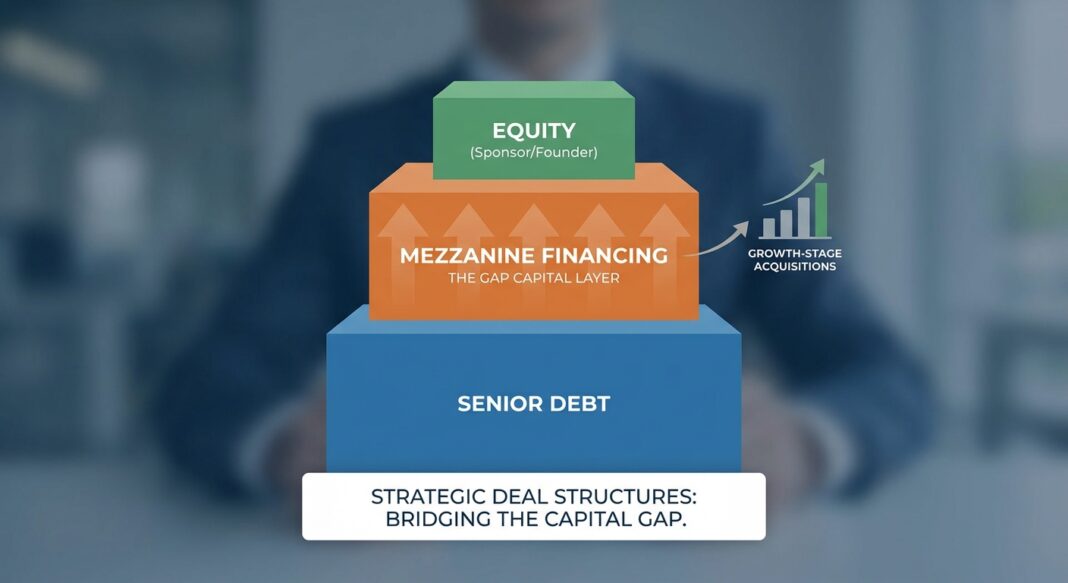
The Gap That Kills Otherwise Fundable Deals
A growth-stage company has found its bolt-on acquisition. The target is clean, the synergies are real, and the seller is motivated. There is only one structural problem: the capital doesn’t stack.
Senior lenders (banks and direct lenders alike) will extend leverage against the combined entity’s EBITDA, but that ceiling lands several million dollars short of the purchase price. The equity sponsor or founder, meanwhile, wants to limit the dilutive equity contribution to protect returns. Between the senior debt ceiling and the equity check, there is a layer that conventional lenders will not touch and that equity providers price at 25%–35% IRR. That layer is the gap. Mezzanine financing exists specifically to fill it.
In 2026, that gap is structural, not cyclical. The global private credit market reached USD 2.1 trillion in 2025 and is expected to grow at a 10.7% CAGR through 2035, but capital abundance does not eliminate the stack architecture problem. Senior lenders optimize for safety of principal; equity investors optimize for terminal value. The mezzanine tranche exists precisely because these two constituencies can never fully close the spread between them. For the operator or sponsor sitting at the deal table, understanding the mechanics of that middle layer (its cost, its covenants, its negotiation points) is the difference between a deal that closes and one that dies in the data room.
The Capital Stack at the Growth Stage: From Banks to Equity
Before pricing the gap, operators must internalize the full cost-of-capital spectrum. Every layer of the stack serves a different master and prices accordingly.
Layer 1: Senior Secured Debt (Lowest Cost, Most Restrictive)
Senior secured debt, whether from a bank or direct lender, sits at the top of the priority waterfall. It is typically priced at SOFR plus 250–450 basis points for bank facilities or SOFR plus 500–700 basis points for direct lending, sized at 2.5×–4.0× EBITDA depending on business quality and sector. Senior lenders require first-lien collateral and the most restrictive covenant packages.
For lower-middle-market businesses, debt financing typically runs SOFR plus 500 to 700 basis points for senior cash-flow loans. Senior leverage averages 3.4× EBITDA and total leverage 4.2× EBITDA for LMM buyouts in the $10M–$50M enterprise value range, according to GF Data’s Q1 2026 middle-market monitor.
Layer 2, Direct Lending / Unitranche (Mid-Tier: Speed + Leverage)
A unitranche is a single-facility debt structure that combines what would traditionally be separate senior and subordinated debt layers into one loan with one set of documents, one interest rate, and one lender relationship. The interest rate is a “blended” rate, often higher than traditional senior debt but lower than traditional second-lien or subordinated debt. For sponsors that need speed and a single counterparty, unitranche removes intercreditor negotiation entirely. Median all-in coupons on unitranche facilities in the $5M–$50M band are now clearing at approximately 10.2%, per S&P LCD’s US Loan Comparable data from June 2026.
Layer 3: Mezzanine / Subordinated Debt (The Gap Capital Layer)
Mezzanine debt is a subordinated instrument sitting below senior loans and above common equity. It targets 12–20% total returns by combining a cash coupon of 8–12%, PIK accretion of 2–4%, equity warrant upside of 2–8%, and origination fees of 1–3%.
Mezzanine debt financing sits between senior credit and equity, priced today at roughly 11% to 14% cash coupon plus 1% to 4% PIK plus warrants of 1% to 5% of the fully diluted cap table. By mid-2026, the all-in cash coupon midpoint sits at approximately 12.25%. A decade ago, cash-plus-PIK yields on mezzanine ran 14–16%; competition has compressed that to roughly 12–14% today, according to CT Acquisitions’ 2026 pricing data.
Layer 4: Preferred and Growth Equity (Most Expensive on a Dilution Basis)
Senior debt typically costs 6%–10%, mezzanine 12%–20% all-in (cash + PIK), while equity targets a 25%–40%+ IRR, the highest cost of capital in the stack, with significant dilution to founders. Growth equity is the last resort instrument, not the first call.
Mezzanine Mechanics: PIK, Equity Kickers, and the Return Equation
PIK Interest: Preserving Liquidity, Growing the Balance
Payment-in-kind interest is the feature that makes mezzanine viable for growth-stage borrowers whose free cash flow does not yet support the full coupon in cash. PIK interest is paid by increasing the outstanding principal balance of the debt rather than making cash payments. A $100 million note with 5% PIK grows to $105 million after one year; the interest compounds each period, so the total payoff at maturity is higher than the original principal. This preserves company cash flow for operations and senior debt service.
Most mezzanine in 2026 carries a cash coupon plus a PIK toggle. A typical structure is 10% cash plus 2% to 4% PIK, where the PIK can be deferred and capitalized into principal during the early years. The PIK feature is what makes mezzanine attractive to growth-stage borrowers whose free cash flow does not yet support the full coupon.
Equity Kickers and Warrants
Most mezzanine lenders negotiate warrants or conversion features that give them the right to purchase equity at a fixed price. If the company increases in value, the warrants become valuable. In a typical structure, warrants might represent 2–5% of the company’s fully diluted equity.
Equity kickers are warrants or options attached to mezzanine debt that give the lender the right to purchase equity in the company, typically at a nominal strike price ($0.01 per share). The warrant usually entitles the lender to 1–5% of equity on a fully diluted basis, allowing mezzanine lenders to participate in the company upside beyond their fixed interest return, potentially adding 200–300+ basis points to total yield.
Worked Example: $50M Enterprise Value Software Business
Consider a growth-stage B2B SaaS business with $3M EBITDA being acquired at a $50M enterprise value (approximately 10×). The capital stack must be assembled to close the deal.
- Senior Secured / Unitranche: $12M at SOFR + 575 bps (~10.3% all-in), sized at 4.0× EBITDA. Collateral: first lien on all assets.
- Mezzanine Note: $8M at 12% cash coupon + 2.5% PIK + warrants for 3.5% of fully diluted equity. Bullet maturity at year 7. Non-call period: 2 years.
- Sponsor Equity: $30M (60% of the purchase price). Residual claim, no coupon.
The blended cost of a senior-plus-mezz LMM package in mid-2026 sits at 11.5%–13% pre-tax, versus roughly 22% required return for growth equity. In this example, the mezzanine layer saves the sponsor from issuing additional equity that would have cost an implicit 22%–30% IRR. The PIK toggle also preserves working capital during the integration phase, when free cash flow is most constrained.
Covenant Architecture: What You Agree to Matters as Much as What You Borrow
Covenant design is not boilerplate. It governs the borrower’s operating freedom for the entire life of the loan.
Maintenance vs. Incurrence
Maintenance covenants require periodic, typically quarterly, compliance with specified financial metrics. Regular testing reinforces financial discipline and provides lenders with visibility into credit deterioration well before a payment default or insolvency event.
Incurrence tests operate differently. They are tested only when a borrower seeks to undertake a specified action, such as incurring additional indebtedness, making an acquisition, or paying a dividend. Incurrence tests are typically embedded in negative covenant “baskets”; to access a basket, the borrower must demonstrate compliance with the relevant financial test after giving pro forma effect to the proposed transaction.
Where the Market Sits in 2026
By 2026, more than 85% of new institutional term loans are issued as covenant-lite, with no ongoing financial maintenance tests. Private credit, however, is a different ecosystem. Private credit has adopted features of syndicated loans but with less stringent covenant structures. Many facilities are now described as “covenant loose,” often retaining a single maintenance covenant with generous cushions.
Covenant use shifts with borrower size. Maintenance covenants are more prevalent with smaller borrowers, while incurrence covenants are the primary guardrails as companies grow. For a growth-stage borrower raising its first institutional mezzanine tranche, expect the lender to negotiate at least one maintenance covenant, typically a maximum total leverage ratio or minimum fixed-charge coverage ratio tested quarterly.
Negotiation Priorities for Borrowers on Covenant Terms
- Headroom cushion: Push for at least 20%–25% headroom above the projected leverage ratio at closing, so that a single quarter of underperformance does not trigger a technical default.
- EBITDA add-backs: Negotiate defined add-backs for one-time transaction costs, restructuring charges, and synergies, but understand that lenders are scrutinizing add-back creep more carefully in 2026.
- Equity cure rights: Secure the right to inject equity to cure a covenant breach, ideally with no more than two consecutive cures and no permanent ratchet effect on the covenant level.
- PIK toggle control: If PIK is available, clarify whether the election is at the borrower’s or lender’s discretion, and for how many interest periods in succession.
The Gap Capital Playbook: Four Execution Steps
Step 1: Quantify the Gap with Precision
Before approaching any provider, build the use-of-proceeds schedule. Map the total acquisition cost (purchase price + transaction fees + integration capex + working capital reserve) against the senior debt ceiling and the equity commitment. The residual is your mezzanine ask. Size it conservatively: ask for slightly more than the modeled gap to create operational buffer, but not so much that the debt service burden constrains the growth plan.
The test is simple: can the combined entity service the full cash coupon, senior plus mezzanine, through a 20% EBITDA drawdown without tripping a fixed-charge coverage ratio of 1.10×–1.25×? Debt only makes sense when a business can service the coupon through a 20% EBITDA drawdown without tripping a fixed-charge coverage covenant of 1.10× to 1.25×. If the answer is no, the equity contribution must increase before approaching lenders.
Step 2: Build the Three-Year Integrated Financial Model
Mezzanine providers are yield investors underwriting to a 14%–18% gross IRR. They need to see three things in the model: (1) a clear path to free cash flow generation sufficient to service the cash coupon; (2) a terminal valuation scenario that makes the equity kicker meaningful; and (3) a downside case where the borrower can still service debt without triggering covenants. Model the PIK balance accrual explicitly: a $50M mezz facility with 3% PIK grows to $51.5M after one year, $53.05M after two years, and so on. The borrower does not pay PIK in cash during the loan term; it comes due at maturity or refinancing.
Step 3: Run a Competitive Provider Process
The mezzanine market is not monolithic. Typical LMM tranche sizes run $5M to $75M, with SBIC-licensed funds like Plexus Capital and Falcon Investment Advisors handling smaller checks down to $2M. Named institutional players include Audax Mezzanine, NewSpring Mezzanine, Peninsula Capital Partners, Northstar Mezzanine, Star Mountain Capital, and Twin Brook Capital Partners. Running a competitive process across four to six providers with a well-prepared CIM and financial model typically compresses pricing by 75–150 basis points on the cash coupon and reduces warrant coverage by 1%–2% of fully diluted equity.
Twin Brook Capital Partners and Antares Capital have both grown their independent-sponsor LMM books meaningfully between 2024 and 2026, meaning non-sponsored operators now have a broader provider universe than they did three years ago.
Step 4: Negotiate the Structure, Not Just the Rate
First-time mezzanine borrowers anchor negotiation on the headline coupon. Experienced operators focus on the structural terms that govern the next five to seven years of operating freedom: the covenant basket sizes, the PIK toggle mechanics, the call protection schedule, and the warrant strike price. A deal with a 12.5% cash coupon and a 25% headroom covenant cushion is structurally superior to a deal at 11.5% with a tight 1.10× FCCR covenant tested monthly on a trailing three-month basis.
Mezzanine vs. the Alternatives: When Each Option Makes Sense
| Instrument | Typical All-In Cost (2026) | Dilution | Best Fit |
|---|---|---|---|
| Senior Bank Debt | SOFR + 250–450 bps | None | Stable cash flows, hard assets, conservative leverage (≤3.5× EBITDA) |
| Unitranche (Direct Lending) | ~10.2%–11% all-in | None | Single-counterparty preference, $5M–$150M deals, sponsor-backed |
| Mezzanine / Sub Debt | 12%–16% all-in (cash + PIK) | Minimal (warrant kicker 1–5%) | Leverage gap above senior ceiling; growth-stage with constrained near-term cash flow |
| Preferred Equity | 8%–12% dividend + liquidation preference | Moderate | Avoid additional debt covenants; flexibility on payment timing |
| Growth / Minority Equity | 25%–40%+ IRR hurdle | Significant | Pre-profit companies; no debt capacity; control sale acceptable |
The reason to use mezzanine is consistent across buyouts, growth capital, development, and recaps: fill the funding gap without diluting the owner. But it is not a default choice. Mezzanine is best for later-stage companies with $5M–$20M revenue funding acquisitions, major infrastructure builds, or international expansion. Most companies never touch it; it is the domain of growth-stage businesses making the final push before exit or public markets.
Current Market Terms: 2026 Data Points
- The capital stack for a typical 2026 acquisition puts senior debt at 5–6.5× EBITDA (SOFR + 300–500 bps), mezzanine filling the 1–2× gap at 10%–14%, and equity absorbing the rest.
- Mezzanine debt financing today is a hybrid capital layer that combines a fixed cash coupon of roughly 11%–14% with a PIK interest accrual of 1%–4% and an equity kicker in the form of warrants or a small co-invest.
- The note usually has a five-to-seven-year bullet maturity and a non-call period of one to two years.
- The global private credit market sits at approximately USD 1.96 trillion in 2026, growing at a 12.13% CAGR toward USD 3.48 trillion by 2031. Increased competition among providers is structurally compressing spreads.
- Senior Lender Quarterly’s Q1 2026 reading puts senior debt at SOFR plus 425–500 bps (effective ~9.5%–10.0%), mezzanine at 12%–14%, and total leverage at 4.5×–5.5× EBITDA for sponsor deals.
Key Takeaways
- The gap is structural, not a pricing error. Senior debt ceilings and equity IRR hurdles create a permanent layer that only subordinated capital can fill. Operators who understand this negotiate from a position of structural clarity, not desperation.
- PIK is a liquidity tool, not a sign of weakness. The ability to accrete interest to principal during early integration periods is a legitimate cash flow management lever, but model the compounding balance to maturity before electing PIK at close.
- Equity kickers are the lender’s upside, not a gift. Warrant coverage of 2%–5% of fully diluted equity is the standard. Negotiate the strike price, the expiration, and any drag-along provisions with the same rigor you apply to the coupon.
- Covenant architecture governs your operating freedom for seven years. A 20%–25% headroom cushion on the maintenance leverage covenant, a defined equity cure right, and a borrower-elected PIK toggle are structural priorities that matter more than 50 basis points on the cash coupon.
- Run a competitive process. The mezzanine market in 2026 has more providers than at any point in the asset class’s history. Four to six competitive term sheets will move pricing, compress warrant coverage, and improve covenant terms in ways that a sole-source process never will.


