
The Growth-Stage Gap: When Senior Debt Runs Out and Equity Is Too Expensive
Picture a lower-middle-market services company generating $4.5M in EBITDA and targeting a bolt-on acquisition at a 7x multiple, a $31.5M deal. The company’s bank will stretch to 3.0x leverage, providing roughly $13.5M in senior secured debt. The sponsor or owner can bring $8M in equity, leaving a $10M hole in the capital structure. That hole is the mezzanine opportunity, and in 2026, structuring it correctly is more consequential than ever.
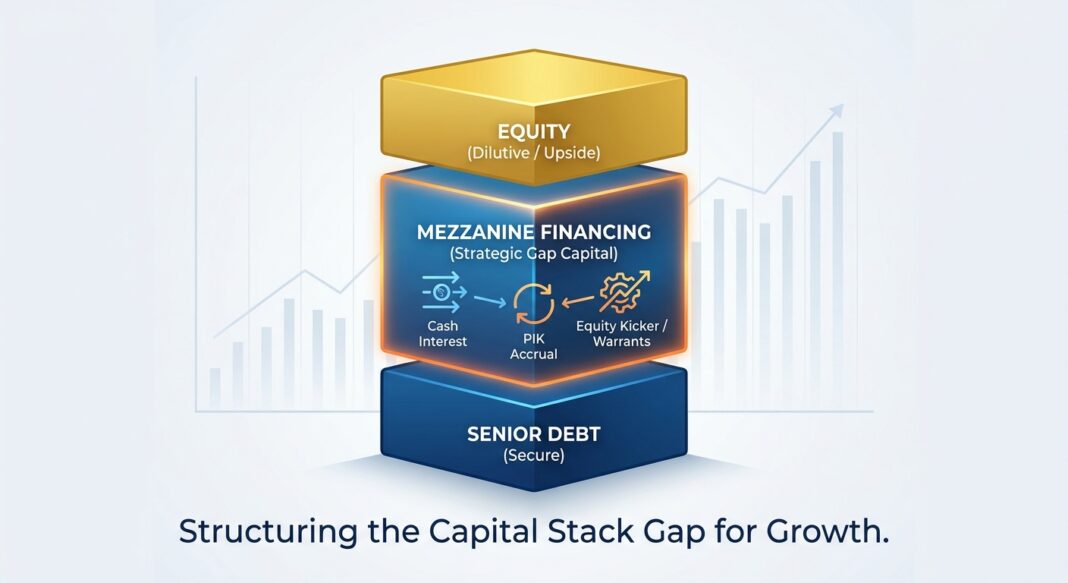
Mezzanine financing occupies the floor between senior debt and equity in the capital stack. It is subordinated, typically unsecured, and carries higher rates that reflect its junior position. But its defining feature is flexibility: it can be structured as subordinated debt with cash interest, payment-in-kind (PIK) accruals, equity warrants, or some combination of all three. That flexibility is precisely what makes it the right instrument for a growth-stage acquisition where senior capacity is exhausted but equity dilution would be value-destructive.
The 2026 market context sharpens this decision. Private credit assets under management grew to approximately $2.1 trillion in 2025, and the direct lending ecosystem now competes directly with banks and the broadly syndicated loan market for middle-market mandates. Mezzanine fundraising rebounded approximately 26% in 2025 after a sharp decline the prior year, signaling renewed institutional appetite for the subordinated credit return profile. Operators and sponsors who understand mezzanine structure (and know how to negotiate it) will close better deals with less dilution.
Structure Breakdown: Components, Mechanics, and a Worked Example
Where Mezzanine Sits in the Capital Stack
The capital stack for a leveraged acquisition moves from lowest to highest risk, and from lowest to highest cost. A well-structured middle-market deal in 2026 typically layers as follows:
- Senior Secured Debt (Bank or Unitranche): First lien, secured by all assets. Banks price at roughly SOFR + 250–400bps; unitranche direct lenders currently price at SOFR + 500–700bps on an all-in blended basis, with total leverage reaching 4–6x EBITDA in a single facility.
- Mezzanine Debt: Subordinated, typically unsecured, sitting above equity. All-in cost in 2026 runs 10–14% annually, composed of 8–12% cash interest plus 2–4% PIK that accrues to principal, plus warrants or equity co-investment representing 1–5% of the company.
- Preferred or Common Equity: Highest cost, no fixed repayment obligation, but the most dilutive layer for existing shareholders.
Mezzanine debt sits in the middle of the capital structure, just as the architectural “mezzanine” level sits between a building’s ground floor and first floor. Senior lenders get paid first in any liquidation; mezzanine lenders follow; equity investors absorb residual value, or residual loss.
The Three Components of a Mezzanine Instrument
1. Cash Interest
The base coupon, paid monthly or quarterly in cash. In 2026, this typically runs 8–12% per annum depending on business risk, leverage, and market conditions. This is the floor of the mezzanine lender’s return, the contractual yield regardless of business outcome.
2. Payment-in-Kind (PIK) Interest
PIK interest accrues on the principal balance instead of being paid in cash, compounding over the life of the facility and increasing the total amount owed at maturity. A $10M mezzanine note with 2% PIK interest grows to $10.2M after year one, and the compounding effect accelerates. Borrowers favor PIK mechanics primarily to conserve cash during integration periods, capex cycles, or market downturns. Mezzanine providers accommodate PIK to achieve a targeted yield, often in combination with warrants or other equity-linked upside. The trade-off is explicit: the borrower preserves near-term liquidity at the cost of increased principal obligations and potentially higher all-in pricing measured by the internal rate of return. A critical operator caution: a mezzanine facility advertised at 14% interest is not a 14% cost of capital; it is 14% plus PIK interest that compounds over a three-to-five year term, plus warrants that give the lender 5% to 15% of the company, plus 2% upfront fees.
3. The Equity Kicker (Warrants or Conversion Rights)
Most mezzanine structures include an equity kicker, warrants or conversion rights that allow the lender to participate in the company’s upside. Warrants are a call option issued by the borrower on its own equity, giving the mezzanine lender the right to purchase a fixed percentage of shares at a predetermined strike price. Equity kickers typically represent 1–5% of fully diluted equity in the lower middle market, though the equity component can reach 5–20% of outstanding equity in more aggressive structures. The number of warrants is inversely proportional to the coupon rate: the higher the cash coupon, the fewer warrants need to be issued to achieve the lender’s target IRR.
The warrant’s value (and thus the lender’s total return) is highly sensitive to exit assumptions. Warrant coverage set as a percentage of principal, combined with exit-equity values defined for low, base, and high scenarios, means lender returns are calculated across the full range of outcomes. This is where mezzanine instruments become functionally equity-like: while carrying debt priority in the capital stack, the equity kicker aligns the lender’s return with enterprise value growth, not just interest accrual.
Worked Example: $10M Mezzanine for a $31.5M Acquisition
Using our earlier scenario, a $31.5M acquisition at 7x EBITDA on a $4.5M EBITDA business:
- Sources: $13.5M senior secured (3.0x EBITDA) + $10M mezzanine (2.2x EBITDA) + $8M equity
- Total Leverage: 5.2x EBITDA, within the 4–6x range typical of 2026 middle-market structures
- Mezzanine Terms: 10% cash interest + 3% PIK + warrants covering 3% of fully diluted equity; 6-year bullet maturity; 2% origination fee; call protection: 103/102/101/par declining schedule
- All-In Lender IRR: Approximately 17–20% in a base exit scenario (4–5x MOIC at a 5-year hold)
- Borrower Cash Savings: The PIK component defers approximately $300K/year in cash interest, improving DSCR in the critical post-acquisition integration period
The mezzanine lender earns a current return plus potential equity upside through warrants. Management retains meaningful ownership and avoids the full dilution that raising the $10M gap as equity would require, particularly important if the company is growing and the next valuation mark is expected to be substantially higher.
Mezzanine vs. Alternatives: Access, Cost, and Control Trade-Offs
Mezzanine vs. Unitranche
The rise of unitranche direct lending has compressed the traditional mezzanine market for smaller transactions. A unitranche facility combines senior and subordinated debt into a single instrument with one lender, one credit agreement, and one blended rate. Current 2026 unitranche pricing runs SOFR + 500–700bps, with all-in blended cost of roughly 9.5–11% for a typical 5x leverage deal, compared to a traditional senior + mezzanine structure where senior prices at SOFR + 350–450bps (7–8.5% all-in) and mezzanine at 11–13% cash + 2–3% PIK. On a 50/50 senior/subordinated split, the traditional structure prices only marginally cheaper than unitranche, with materially more execution complexity. For deals in the $25M–$200M enterprise value range, unitranche wins on speed (45–90 day close vs. 90–150 days for bifurcated structures) and simplicity. However, traditional mezzanine remains relevant in several contexts: very large transactions where unitranche lenders cannot provide the full quantum of debt needed, situations where the borrower wants to minimize total cost by maximizing cheaper senior debt separately, and deals where existing senior credit agreements restrict additional senior leverage.
Mezzanine vs. Preferred Equity
Preferred equity sits junior to all debt but senior to common equity. Unlike mezzanine, it carries no fixed interest obligation and typically features a PIK dividend that compounds. The trade-off: preferred equity is more expensive on an all-in basis (target returns of 15–20%+ IRR) but adds no fixed debt service burden, making it more suitable for businesses with volatile or unpredictable free cash flow. For a business with stable recurring revenue and predictable EBITDA margins, mezzanine’s lower all-in cost, offset by fixed service obligations, is generally superior.
Mezzanine vs. Growth Equity
Growth equity avoids fixed repayment entirely and carries no default risk for the borrower. But it is the most dilutive option in the stack. In 2025, median dilution ran approximately 19.5% for seed rounds and 18% for Series A rounds. For a profitable middle-market business financing an acquisition, issuing equity at current multiples, when the acquisition itself is expected to create value, means selling ownership at the cheapest moment. Mezzanine preserves that upside for existing shareholders, at the cost of higher fixed charges and the equity kicker. The break-even question is straightforward: if the equity kicker grants the mezzanine lender 3% of the company, is that less dilutive than the equity round that would replace the $10M? In most growth scenarios, the answer is yes.
Current Market Terms: 2025–2026 Standards and Key Data Points
The following data points reflect current market conditions as of mid-2026, drawn from published market research and direct lending surveys:
- Mezzanine All-In Cost (2026): Cash coupon of 8–12% plus PIK of 2–4% plus warrants or equity co-investment of 1–5%, producing a lender IRR of 16–22% in base scenarios. This compares to a unitranche all-in blended rate of 9.5–11%, demonstrating that mezzanine remains more expensive than unitranche but cheaper than pure equity.
- Maturity and Repayment: Mezzanine loans typically mature in 5–7 years, often aligning with expected exit timelines. Repayment is usually structured as a single bullet payment at maturity. Call protection typically features declining premiums over the first several years of the loan, discouraging early repayment during value-creation periods.
- BDC PIK Prevalence: In 2025, public Business Development Companies (BDCs) received an average of 8% of their investment income through PIK interest, reflecting the growing prevalence of PIK structures across private credit, a meaningful signal of how frequently borrowers are electing the cash-preservation toggle.
- Covenant Landscape, Private Credit vs. BSL: Covenant-lite transactions rose to 21% of direct lending deals in 2025, up from just 4% in 2023. However, this still stands in sharp contrast to the broadly syndicated loan market, where approximately 90% of new loans in 2024 remained covenant-lite. Most middle-market unitranche and mezzanine facilities retain at least one financial maintenance covenant (typically a maximum total leverage ratio and a minimum fixed charge coverage ratio) giving lenders an early seat at the table if performance deteriorates. Maintenance covenants require borrowers to pass financial tests every quarter regardless of any action taken, while incurrence covenants only apply when the borrower takes a specific action like incurring new debt or paying a dividend.
- Market Scale: Mezzanine fundraising rebounded approximately 26% in 2025 after a sharp 80% decline in 2024. The private credit market overall reached approximately $2.1 trillion in AUM globally in 2025, with the five largest managers (Apollo, Blackstone, Ares, KKR, and Carlyle) holding over $2.0 trillion in credit AUM as of Q3 2025, more than double their combined 2020 position.
The Gap Capital Playbook: Quantifying, Preparing, Running the Process
Step 1: Quantify the Gap
Start with a sources-and-uses waterfall for the target transaction. Determine maximum senior debt capacity (typically 2.5–3.5x EBITDA from a bank, or up to 5–6x EBITDA from a unitranche direct lender). Subtract available equity. The remainder is your mezzanine quantum. Then stress-test: can the business service both senior and mezzanine interest payments, including the cash coupon on the mezz, under a 15–20% EBITDA haircut scenario? If debt service consumes more than 60–80% of EBITDA under stress, the structure is too aggressive.
Step 2: Prepare the Lender Package
Mezzanine underwriting is cash-flow-driven, not asset-based. Lenders evaluate historical and projected EBITDA, free cash flow conversion, customer concentration, revenue predictability, management track record, and industry dynamics. The materials required typically include: audited financial statements (3 years), management-prepared financial projections (3–5 years), a quality of earnings report, an information memorandum describing the acquisition thesis, a current cap table, and documentation on the intended use of proceeds. Mezzanine lenders also conduct their own lender diligence: financial review, customer concentration analysis, industry analysis, and management team assessment. Total process time from term sheet to close typically runs 60–90 days.
Step 3: Run a Competitive Process
Mezzanine is a relationship-driven market, but a competitive process, approaching three to five providers simultaneously, materially improves terms. Leading providers in 2026 include BDCs such as Ares Capital, Blue Owl, Main Street Capital, and FS KKR; specialty mezzanine funds such as Audax Mezzanine, Madison Capital, Twin Brook, Babson, Brookfield, and Golub Capital; and family offices doing direct deals. Approaching multiple lenders simultaneously creates pricing tension and forces lenders to sharpen warrants, call protection schedules, and covenant packages. Document the process: a clear timeline, draft term sheet from counsel, and identified closing conditions before lender engagement.
Step 4: Evaluate Term Sheets on Total Cost, Not Coupon
The stated interest rate is not the cost of capital. Build a complete lender return model: funded amount, cash interest received annually, PIK compounding on principal, exit fees, prepayment premiums, and warrant value at exit across low, base, and high scenarios. The lender’s IRR and MOIC across scenarios is the correct comparison metric. This discipline also protects borrowers from structures that appear cheap on coupon but expensive on total economics once warrants and compounding PIK are modeled correctly.
Negotiation Guidance: Where to Push, What to Protect
For Operators and Borrowers
- Cash vs. PIK Toggle: Negotiate a cash/PIK toggle, the right to elect PIK during defined periods (typically the first 24–36 months post-close) rather than a mandatory PIK structure. Performance-based triggers that require a minimum liquidity threshold or maximum leverage ratio before permitting PIK elections give the borrower flexibility while providing the lender protection against compounding into distress.
- Warrant Strike Price and Coverage: Push for a higher strike price (at or above current equity fair value) and lower coverage percentage (1–3% vs. 4–5%). The total warrant cost is a function of both: a 3% coverage at a meaningful strike is cheaper than 1.5% coverage at a nominal $0.01 strike that immediately has intrinsic value.
- Call Protection Schedule: Negotiate a soft call protection schedule, 103/102/101/par, rather than a fixed make-whole. In a growth scenario where refinancing is possible within three years, hard make-wholes can be prohibitively expensive.
- Covenant Headroom: If maintenance covenants are included (as they typically are in private credit mezzanine deals), negotiate 20–30% cushion to EBITDA covenant thresholds to survive integration volatility. Negotiate annual step-downs in leverage covenants that are achievable on base-case projections, not management upside.
- Prepayment and Equity Kicker Interaction: Clarify whether make-whole or call protection applies to both the debt principal and the warrant value upon prepayment. Failure to define these aspects with specificity is a frequent source of post-closing disputes, especially when the company outperforms and the equity kicker becomes valuable.
For Investors and Lenders
Ensure PIK compounding is visible in all covenant calculations, covenants must be calibrated to avoid a borrower PIKing into covenant compliance rather than actual financial improvement. Require quarterly reporting with EBITDA and cash flow reconciliation. In bifurcated structures where mezzanine sits behind a unitranche, review the intercreditor agreement carefully: standstill periods, enforcement rights, and payment blockage provisions determine the practical ability to intervene if the senior lender acts.
Key Takeaways
- Mezzanine fills the structural gap between maximum senior debt capacity and available equity; it is the instrument of choice for growth-stage acquisitions where senior leverage is exhausted but equity dilution is strategically unattractive at current valuations.
- The true all-in cost is always higher than the stated coupon. A mezzanine facility running 14% cash interest plus 3% PIK plus 3% warrant coverage produces a lender IRR well above the headline rate once compounding and exit proceeds are modeled. Borrowers must run the full return model before accepting a term sheet.
- PIK toggles preserve near-term liquidity at the cost of principal growth. For integration-stage acquisitions, PIK can be the right tool, but only with performance-based triggers, not open-ended elections, to prevent compounding into distress.
- Covenant design is a negotiation lever, not boilerplate. Private credit mezzanine retains maintenance covenants far more frequently than the broadly syndicated loan market, with 2025 data showing approximately 90% of large-cap syndicated loans remaining covenant-lite while most middle-market private credit deals retain at least one financial maintenance test. Borrowers should negotiate headroom; lenders should demand early-warning triggers.
- A competitive lender process materially improves terms. Running three to five mezzanine providers simultaneously creates tension on warrants, call protection, and covenant packages: the difference between a 3% and 5% equity kicker, compounded over a 5-year hold at a high exit multiple, can represent millions of dollars in shareholder value at exit.


