
The Financing Problem No One Talks About Clearly Enough
Picture a lower-middle-market manufacturing business with $4.5M in EBITDA looking to fund a $22M bolt-on acquisition. Its senior bank will lend against a 3.5x leverage multiple, roughly $15.75M. The remaining $6.25M sits in a no-man’s land. It is too small for most growth equity funds to consider, too junior for the senior lender to absorb, and too expensive to fund purely from the balance sheet. This is the gap capital problem, and it sits at the intersection of nearly every growth-stage transaction.
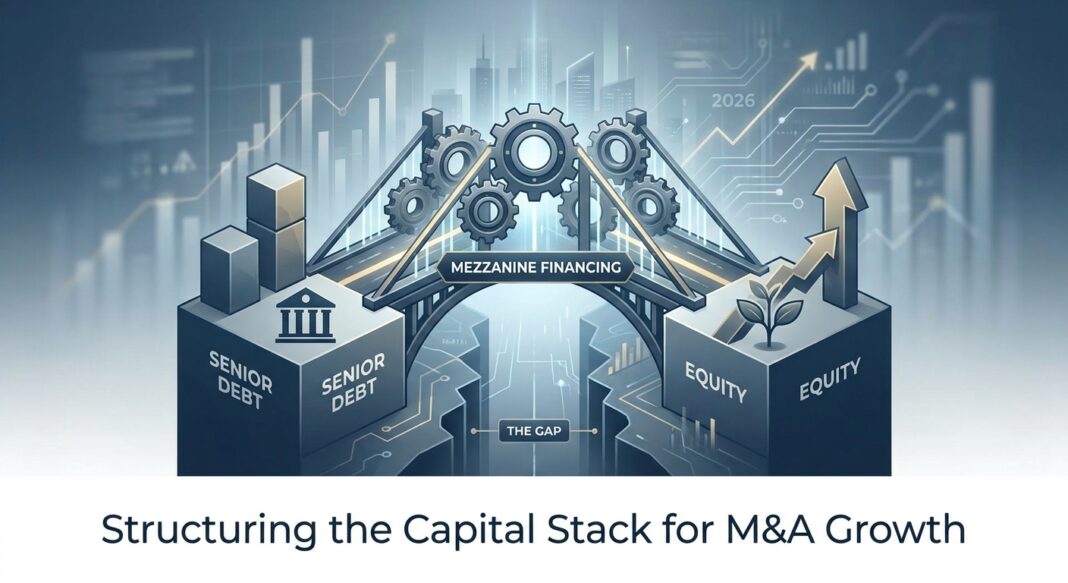
Mezzanine financing is the structural answer to that problem. It is a hybrid form of capital that combines features of both debt financing and equity financing, functioning as a funding bridge that fills the gap between the amount a traditional bank will lend and the firm’s existing equity base. In 2026, with deal volumes recovering and sponsor-backed M&A activity accelerating, understanding how to structure mezzanine capital (and when to use it versus alternatives) is a core competency for operators, CFOs, and deal teams alike.
This article walks through the mechanics of mezzanine, the full cost-of-capital spectrum from senior bank to equity, current market terms, and a step-by-step gap capital playbook for quantifying the need, running the process, and negotiating the structure.
Structure Breakdown: How Mezzanine Capital Works
Position in the Capital Stack
Mezzanine debt has three defining structural features that distinguish it from senior debt: its subordinated and unsecured position, its option for Payment-in-Kind (PIK) interest, and its equity kicker, almost always in the form of stock warrants. It sits below all senior creditors in the payment waterfall, but above common equity, which is precisely why it carries a higher yield than senior debt while remaining less dilutive than a straight equity raise.
The Three Components of a Mezzanine Deal
1. Cash Interest + PIK Toggle
Mezzanine loans often include two types of interest payments. Current cash interest is a straightforward, periodic cash payment, much like the interest on a standard loan, paid regularly (typically monthly or quarterly) which can impact the company’s operating budget. Payment-in-kind (PIK) interest works differently, the interest amount is added to the total loan balance, causing the principal to grow over time.
PIK interest is commonly structured as a “toggle,” meaning the borrower can decide whether and when to use PIK. Typically, some portion of the interest still has to be paid in cash, and using PIK comes at an additional premium on top of the interest rate, as risk for lenders increases, though on the flip side, so does yield.
For operators, the PIK toggle is a liquidity management tool. Borrowers favor PIK mechanics primarily to conserve cash during integration periods, capex cycles, or market downturns. Mezzanine providers accommodate PIK to achieve a targeted yield, often in combination with warrants. The trade-off is explicit: the borrower preserves near-term liquidity at the cost of increased principal obligations and potentially higher all-in pricing.
A critical risk to model carefully: when borrowers elect PIK interest, the outstanding balance compounds, increasing total debt burden. If the anticipated liquidity event is delayed, the growing PIK balance creates a larger refinancing burden at bullet maturity, a risk that can become severe in deteriorating markets.
2. Equity Kickers: Warrants and Conversion Rights
An equity kicker is a feature commonly associated with mezzanine financing, serving as a sweetener that allows lenders to participate in the company’s success, typically in the form of warrants or options. These equity components come in several forms: warrants or options to buy between 1% and 5% of the borrower’s equity; conversion rights that let debt change into equity under specific conditions; profit participation rights giving a share of performance metrics like net sales or EBITDA; and co-investment rights alongside the controlling stockholder or private equity sponsor.
The warrant compensates the lender for subordination risk that the cash coupon alone does not fully price. If the company exits at a high multiple, the warrants convert into meaningful equity proceeds, lifting the lender’s blended IRR from the coupon range of 10%–16% into the target range of 15%–20%.
For borrowers, warrants add cap table complexity. The true complexity comes from the warrants. These equity kickers can complicate the capital structure, add layers to future financing rounds, and create challenging negotiations in a potential exit scenario. Once a company accepts mezzanine debt with warrants, the cap table instantly becomes too complex for a simple spreadsheet, requiring dedicated cap table management.
3. Subordination and Intercreditor Structure
Mezzanine debt is subordinated to senior debt, meaning it is repaid after all senior claims have been satisfied in the event of a default. Intercreditor agreements define the terms of this subordination and the rights of mezzanine lenders relative to senior lenders. If senior covenants are breached, mezzanine payments can be blocked entirely until the senior default is cured, creating uncertainty for both borrower and mezzanine lender.
Illustrative Structure: $22M Acquisition, $4.5M EBITDA Manufacturing Business
Here is how the capital stack might look on a $22M acquisition (4.9x EBITDA purchase price):
| Tranche | Amount | Pricing (2026) | Features |
|---|---|---|---|
| Senior Bank Term Loan (3.5x EBITDA) | $15.75M | SOFR + 275–350 bps (~7.0–7.5% all-in) | 1st lien, quarterly amortization, maintenance covenants |
| Mezzanine (1.5x EBITDA) | $6.25M | 10–12% cash + 2–4% PIK; 16–20% target IRR | Unsecured / 2nd lien, bullet maturity, warrant coverage 2–5% |
| Equity (Sponsor / Management) | $5.0M (seller note + cash) | Residual return (20%+ target) | Common equity, full upside, last in waterfall |
Total leverage: 4.9x EBITDA. Total debt: $22M. Equity check: $5M (23%). The mezzanine layer is what makes this deal financeable without requiring the acquirer to contribute significantly more equity or accept equity dilution from a minority growth investor.
The Cost-of-Capital Spectrum: From Senior Bank to Equity
Before selecting a structure, operators and CFOs must map the full spectrum of capital available at each layer of the stack and understand the access-versus-cost trade-offs at each level.
| Capital Layer | Typical All-In Cost (2026) | Access Constraints | Dilution Risk |
|---|---|---|---|
| Senior Bank (SBA / Commercial) | 7.0–8.5% | 3.0–4.0x EBITDA; strong collateral required | None |
| Unitranche (Private Credit) | 9.5–11.5% | 4.0–6.0x EBITDA; $25M–$200M EV sweet spot | None |
| Mezzanine | 10–14% cash + PIK; 16–22% all-in IRR | Subordinated; requires senior debt above | Low–Moderate (warrants only) |
| Preferred Equity | 12–18% | Flexible; often used in recaps or transitions | Moderate (liquidation preference) |
| Growth Equity / Minority PE | 20%+ IRR target | $5M–$20M ARR or $3M+ EBITDA required | High (15–30% ownership) |
The key insight is this: sponsors use mezzanine to reduce equity contribution because even at 15–20% yields, mezzanine is cheaper than the 20%+ returns expected on equity. The private credit market in 2025–2026 has shifted the landscape, with direct lenders offering unitranche facilities that compete with and often replace traditional senior-plus-mezzanine structures. Mezzanine debt and preferred equity occupy a specialized but important position; they exist because senior lenders have limits on how much risk they will accept, and PE sponsors have limits on how much equity they want to contribute.
Mezzanine vs. Unitranche: When Each Wins
The rise of unitranche direct lending has compressed the use cases for standalone mezzanine. Unitranche debt is a single-tranche acquisition loan that combines what would otherwise be senior debt and mezzanine/subordinated debt into one instrument with one lender and one credit agreement. Total leverage typically 4–6x EBITDA, blended interest rate 8–11% (SOFR + 500–700 bps in 2026), with a single covenant package and single intercreditor relationship.
Yet despite the unitranche’s rise, traditional mezzanine debt has not disappeared. It remains relevant in several contexts: very large transactions where unitranche lenders cannot provide the full quantum of debt needed; situations where the borrower wants to minimize total cost by maximizing cheap senior debt separately; deals where the sponsor or management team wants equity kickers to align lender incentives; and portfolio company add-on financings where existing credit agreements restrict additional senior debt.
The practical rule: use unitranche when speed, simplicity, and a single lender relationship are paramount. Use a senior-plus-mezzanine split when preserving the cheapest possible senior debt cost and minimizing total cash interest burden matters more than documentation simplicity.
Current Market Terms: Mezzanine and Private Credit in 2026
Pricing and Structure
In 2026, all-in cost for mezzanine is 10–14% (cash coupon 8–11% + PIK 2–4% + warrants). For comparison, for a strong middle-market credit in 2025–2026, unitranche pricing typically runs SOFR + 500 to 700 basis points (approximately 10–12% all-in), compared to SOFR + 350–475 basis points for traditional senior debt.
In terms of market scale: global private credit assets under management reached approximately $2.1 trillion in 2025, up from $1.5 trillion a year earlier. The private credit market has reached a pivotal stage in its growth, with direct lending now matching the broadly syndicated loan market at $1.5–2 trillion in size and forecast to reach $3 trillion by 2028.
Covenant Trends: The Shift Back Toward Protection
One of the most significant structural developments in 2025–2026 is a reversal in covenant leniency for private credit. The portion of U.S. respondents that will not do deals without financial maintenance covenants grew dramatically to 46%, climbing 11 percentage points from 2025, pointing to an increased desire on the part of lenders to seek credit deterioration protection.
This matters for borrowers choosing between structures. Maintenance covenants require borrowers to pass financial tests every quarter regardless of any action taken, while incurrence covenants only apply when the borrower takes a specific action like incurring new debt or paying a dividend. Most syndicated leveraged loans today are covenant-lite (incurrence only), though private credit deals typically retain maintenance covenants for earlier lender intervention.
The financial covenant in a typical private credit deal is a single net first-lien or total net leverage covenant with an initial cushion of 25 to 35 percent over the base case plan, stepping down as cash flow grows. For borrowers, this cushion calibration is a primary negotiation lever, and it directly affects how much operational flexibility survives post-close.
The data on why covenants matter is stark: the importance of covenants to recovery outcomes is supported by data. In a September 2025 report, Moody’s found that lenders recovered an average of 57% on first-lien covenant-lite loans between 2023 and mid-2025, compared to 66% on loans that included financial maintenance covenants. Lenders have noticed, and are repricing their willingness to waive these protections accordingly.
PIK Usage Trending Higher
A series of high-profile leveraged loan defaults in late 2025 and the rising use of payment-in-kind toggles in direct lending point to mounting stress. In 2025, public BDCs received an average of 8% of their investment income through PIK interest, reflecting the growing prevalence of PIK structures across the private credit market. This is not purely a credit-stress signal, PIK toggles remain a structural tool for cash flow management in growth-stage deals, but deal teams should model compounding PIK balances through multiple scenarios, not just the base case.
Equity Capital Markets Context
For teams weighing mezzanine versus a growth equity raise, the equity market backdrop is relevant. The median pre-money valuation for North American growth equity transactions reached $314 million in Q1 2026, compared to $260 million in Q1 2025, reflecting robust investor sentiment and continued demand for high-growth opportunities, particularly in AI-driven sectors. However, with financing costs remaining elevated and ongoing trade policy and geopolitical uncertainty continuing to impact certain sectors, there remains a need for creative structuring between capital raisers and providers. Equity investments with more bespoke terms, structured equity, can be a compelling solution for companies in performance transitions or sectors with secular headwinds.
The Gap Capital Playbook: From Quantification to Close
Step 1: Quantify the Gap
Before approaching any capital provider, operators must define the gap with precision. Three questions anchor this work:
- What is the total capital need? (Acquisition price + transaction costs + working capital adjustment + integration reserve)
- What will senior lenders provide? (Typically 3.0–4.0x EBITDA from a commercial bank; 4.0–6.0x via unitranche for strong credits)
- What equity is available, and at what dilution threshold is equity unacceptable?
The answer to question three defines the mezzanine quantum. If the sponsor is willing to accept up to 3% warrant coverage but not 20% equity dilution, the mezzanine structure should be sized accordingly.
Step 2: Build the CIM and Financial Package
Mezzanine lenders underwrite differently from equity investors. Mezzanine debt providers evaluate historical and projected cash flow, growth potential, and ability to service both existing senior debt and the new mezzanine layer. Expect lenders to review EBITDA, coverage ratios, and management track record.
The data room for a mezzanine process should include: three years of audited financials, trailing-twelve-month management accounts, a detailed LTM EBITDA bridge, customer concentration analysis, a five-year financial model with debt service schedules under base and downside scenarios, and a clear description of use of proceeds and deleveraging path.
Step 3: Run a Targeted Process
Top mezzanine providers include BDCs (Ares Capital, Blue Owl, Main Street, Owl Rock, FS KKR, Hercules), specialty mezzanine funds (Audax Mezzanine, Madison Capital, Twin Brook, Babson, Brookfield, NXT, GoldenTree, Maranon, Antares), and family offices and HNW pooled mezzanine.
The timeline is predictable. The underwriting process runs 60–90 days from term sheet to close. Lender diligence covers financial review, customer concentration, industry analysis, and management team assessment, concluding with approval through credit committee.
A competitive process targeting four to six mezzanine providers simultaneously typically yields two to three executable term sheets, creating meaningful negotiating leverage.
Step 4: Negotiate the Structure
The five highest-leverage negotiation points in a mezzanine deal:
- Warrant coverage size and strike price. Market range is 1–5% of fully diluted equity. Push for the lower end (1–2%) and negotiate a fixed-price strike tied to closing enterprise value rather than a nominal $0.01 strike. The difference at a 5x exit is material.
- PIK toggle mechanics and step-up margin. Negotiate for a full cash-pay toggle without automatic step-up for the first 12–18 months, limiting the compounding burden during post-acquisition integration.
- Covenant cushion. The financial covenant is typically a single net leverage covenant with an initial cushion of 25–35% over the base case plan. Operators should push the initial cushion above 30% and negotiate for the covenant to step down only after 24 months of demonstrated performance, not on a fixed calendar schedule.
- Call protection and prepayment premiums. Origination fees and prepayment penalties are common. Call protection often discourages early repayment, with declining premiums over the first few years of the loan. Negotiate for a soft call (not make-whole) structure, declining from 103/102/101/par, with a carve-out for change-of-control events that allows clean exit without punitive prepayment charges.
- Information rights and board observation. Mezzanine lenders routinely request observer rights. Where possible, structure observation rights to exclude sensitive strategic discussions and limit them to formal board meetings, not committee meetings.
Structuring Guidance: For Operators and Investors
For Operators and CFOs
Mezzanine is a high-cost instrument that is justified when it enables a value-creating transaction that could not otherwise close. The discipline is in the model: run the deal with the mezzanine coupon fully cash-paid (do not assume PIK election in the base case), model the PIK compounding through a two-year delay in exit, and confirm DSCR clears 1.25x after full debt service across the stack. If the deal only works on an optimistic base case, the structure is wrong: either the acquisition price is too high, the equity contribution is too low, or the business does not generate enough free cash flow to justify the leverage.
Used correctly, mezzanine amplifies returns and stretches equity capacity. Used incorrectly, it traps the business in a debt service spiral that constrains growth and risks default.
For Investors Evaluating Mezzanine Exposure
When reviewing a capital stack that includes mezzanine, three signals warrant close scrutiny:
- PIK toggle elections post-close. The rising use of payment-in-kind toggles in direct lending can point to mounting stress. A company electing PIK within 12 months of close warrants immediate covenant and liquidity review.
- Warrant dilution modeling. Every warrant granted to a mezzanine lender dilutes existing common equity. In a successful exit, the mezzanine lender’s equity kicker reduces the return available to the PE sponsor and management team, a cost that must be weighed against the benefit of reduced upfront equity contribution.
- Covenant cushion erosion. Monitor the quarterly leverage ratio cushion relative to the maintenance covenant. When headroom compresses below 15%, re-underwrite the exit timeline and refinancing path before a technical breach forces a defensive amendment.
Key Takeaways
- Mezzanine solves a structural problem, not a pricing one. When the gap between what senior lenders will provide and what equity investors require is too costly to fill with equity alone, mezzanine is the instrument designed to bridge it, at a defined, time-limited cost rather than permanent dilution.
- The all-in cost in 2026 is 10–14% cash/PIK plus warrants, targeting 16–22% lender IRR. That blended cost must clear the hurdle: the acquisition must generate a post-mezzanine equity IRR that exceeds the mezzanine cost, typically by a factor of 1.5–2x, to justify the structure.
- PIK interest compounds the risk of a delayed exit. Model it conservatively: assume full cash-pay in the base case, PIK election in the downside, and stress-test the resulting principal balance against enterprise value at maturity.
- Covenant design is a primary negotiation point, not boilerplate. Private credit lenders increasingly require maintenance covenants, and the cushion set at closing directly determines how much operational flexibility survives post-acquisition. Push for 30%+ initial headroom and a performance-linked step-down schedule.
- The gap capital playbook follows a defined sequence. Quantify the gap precisely, build a mezzanine-grade data room (EBITDA bridge, DSCR model, concentration analysis), run a competitive four-to-six-lender process, and negotiate the five structural leverage points (warrant size, PIK mechanics, covenant cushion, call protection, and board rights) before the term sheet is signed.


