
The Financing Gap That Kills Good Deals
A growth-stage company (say, $8M EBITDA, proven unit economics, and a bolt-on acquisition target in hand) runs into a wall. The senior lender will go to 3.5x leverage. The acquisition requires 6x. The equity sponsor doesn’t want to write a check that buries the return. The deal sits in no-man’s land: too big for the bank, too small for a syndicated market, and too leveraged for a clean senior structure.
This is the classic mezzanine gap, and it is one of the most structurally interesting problems in middle-market finance. For operators and deal teams navigating growth-stage acquisitions, understanding how to design the capital stack around this gap is the difference between closing and walking away. According to frameworks outlined by capital stack practitioners at lendity.com and alvren.com, every layer of the stack introduces distinct rights, obligations, and downstream leverage, and the sequencing of those layers is a strategic decision, not an administrative one.
Mapping the Capital Stack: From Banks to Equity
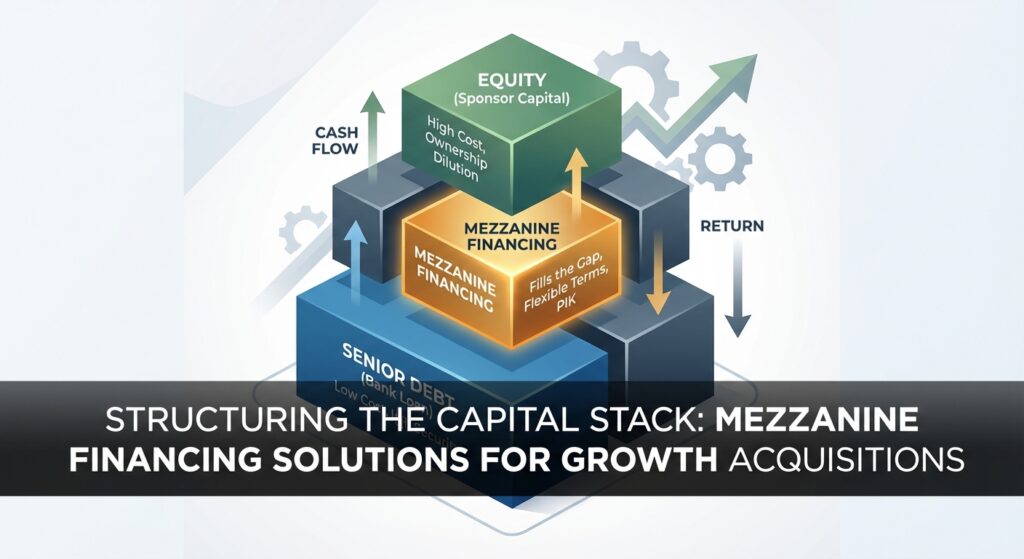
Before structuring anything, operators need to map where each funding source sits on the cost-of-capital spectrum. For a growth-stage acquisition at roughly $50M–$100M enterprise value, the stack typically looks like this, from cheapest to most expensive:
- Senior Secured (Bank / BDC): 1st-lien term loan or revolving credit facility. Pricing in the current market runs SOFR + 275–375 bps for investment-grade-adjacent credits, wider for leveraged middle market. Leverage ceiling: 3.0x–4.0x EBITDA depending on sector. Covenant-heavy: typically includes a maintenance leverage test.
- Unitranche (Direct Lending): A blended first-out / last-out structure that can stretch to 5.0x–5.5x for software or recurring-revenue businesses. Pricing runs SOFR + 500–650 bps all-in. Fewer lenders, faster execution, incurrence-based covenants. Increasingly the default for sponsored middle-market deals.
- Mezzanine / Subordinated Debt: Sits behind senior or unitranche. Pricing: fixed cash coupon of 10%–13% plus PIK (payment-in-kind) of 2%–4%, often paired with an equity kicker via warrants or a success fee. Total return target: 15%–18% IRR. Extends total leverage to 5.5x–6.5x EBITDA.
- Preferred Equity: Quasi-equity with a liquidation preference and a preferred return (8%–12% cumulative). Less restrictive than mezz in covenant terms; more dilutive in economics. Common in sponsor-backed recapitalizations and minority growth rounds.
- Common Equity / Sponsor Equity: Most expensive capital on a risk-adjusted basis. Target return: 20%–30% IRR. Contributes 30%–45% of the capital stack in a leveraged acquisition.
The Mezzanine Layer: A Structural Deep Dive
For the growth-stage acquisition scenario, mezzanine financing is the most tactical instrument to fill the leverage gap. Here is how it works in practice.
Illustrative Example: A $100M enterprise value specialty services business is being acquired. Senior lender commits $35M (3.5x EBITDA on $10M pro forma EBITDA). Sponsor equity covers $30M (30% of EV). That leaves a $35M gap. Mezzanine fills $20M–$25M of that gap, with the remainder bridged by seller notes or earnouts.
Key term sheet elements for the mezzanine tranche:
- Principal: $22M
- Coupon: 11.0% cash pay + 3.0% PIK (accruing to principal)
- Maturity: 6 years (6 months after senior maturity)
- Warrant Coverage: 3%–5% fully diluted equity at a nominal strike price
- Call Protection: Non-call 2, then 103, 102, 101 in years 3–5
- Covenants: Incurrence-based (leverage cap on new debt, restricted payments test); no maintenance covenants in current market
- Intercreditor: Subordinated via a customary subordination agreement; typically 90–180 day standstill on enforcement
The PIK component is critical for cash flow management in early post-acquisition integration periods. Rather than requiring full cash interest service, PIK allows the company to accrue a portion of the interest, preserving liquidity for operational needs. As noted in capital structure sequencing guides at moonshotnx.com, instrument layering must anticipate conversion and servicing events, the same principle applies here: model the PIK accrual carefully against projected free cash flow before the mezzanine matures.
Mezzanine vs. Alternatives: The Trade-Off Matrix
Why choose mezzanine over simply stretching the unitranche or issuing more equity?
- vs. Stretched Unitranche: A unitranche at 5.5x pricing at SOFR + 600 bps on the entire debt quantum is cheaper in all-in cost than mezz, but only if the direct lender will go there. For cyclical or asset-light businesses, many direct lenders cap at 4.5x. Mezz provides access where unitranche doesn’t.
- vs. More Equity: Issuing an additional $20M in sponsor equity dilutes ownership proportionally and reduces IRR. At a 25% equity return target, mezz at 15%–16% total cost is accretive to the equity return as long as the business generates returns above the cost of the mezz, i.e., EBITDA yield on deployed capital exceeds the blended debt cost.
- vs. Preferred Equity: Preferred has no fixed maturity obligation and is softer on covenants, but it sits inside the equity layer on governance terms and may carry anti-dilution rights that complicate future rounds. Mezz is cleaner for a defined-maturity acquisition financing.
The Gap Capital Playbook: Running the Process
For operators and CFOs preparing to raise the mezzanine tranche, the process has four stages:
- Quantify the Gap Precisely. Build a sources-and-uses table anchored to the acquisition price, transaction costs, and minimum cash at close. The mezzanine quantum should be the residual after senior debt and equity, not a round number picked for convenience. Lenders will stress-test your leverage math.
- Prepare the Materials. Mezzanine lenders underwrite to a blended cash flow and collateral coverage test. Your information memorandum must include: (a) a 5-year integrated financial model with a PIK accrual schedule, (b) a detailed use-of-proceeds with post-close EBITDA build, (c) management’s acquisition integration thesis, and (d) a clear intercreditor framework showing where the mezz sits relative to senior.
- Run a Targeted Process. Unlike broadly syndicated markets, mezzanine is a bilateral or club market. Target 5–8 specialist mezzanine funds and BDCs with demonstrated activity in your sector and deal size. As capital stack sequencing frameworks at alvren.com emphasize: negotiate debt only after you have equity interest anchored. The same logic applies here, lock senior and equity commitments before finalizing mezz terms.
- Model Downside Scenarios. Mezzanine providers will run a stress case. Run it yourself first. At 20% EBITDA decline, can you still service the cash coupon? If not, negotiate a higher PIK ratio and lower cash pay. Lenders will respect preparedness; they will price uncertainty against you if you haven’t done the work.
Negotiation Guidance: What to Push On
When term sheets arrive, focus negotiation energy on three variables:
- Warrant Coverage: The standard range is 3%–7% of diluted equity. Push toward the lower end by offering a slightly higher cash coupon, mezzanine lenders who are return-target-driven will often trade warrant size for current yield certainty.
- Call Protection: A non-call 2 with a 103/102/101 step-down is market standard as of early 2026. If you have high refinancing confidence at year 3, negotiate for a make-whole provision that converts to a fixed penalty rather than full yield maintenance, materially cheaper if rates move.
- PIK Toggle vs. Mandatory PIK: A PIK toggle (borrower’s option to elect PIK vs. cash) is significantly more flexible than mandatory PIK, which accrues regardless of cash position. Push hard for toggle optionality; it preserves optionality without costing lenders economic return.
Key Takeaways
- Mezzanine fills the structural gap between senior debt capacity and equity contribution in growth-stage acquisitions, typically extending total leverage from 3.5x to 5.5x–6.5x EBITDA.
- PIK components preserve liquidity during integration periods, but must be modeled carefully against the mezz maturity schedule to avoid a refinancing cliff.
- Warrant coverage is negotiable: trade higher cash coupon for lower equity dilution when cash flow visibility is strong.
- Process sequencing matters: anchor senior debt and equity commitments before running the mezzanine process, leverage competition, not desperation.
- The access vs. cost trade-off is real: mezzanine is more expensive than senior debt but cheaper than equity; it is the right tool precisely when the senior ceiling has been reached and equity dilution is the only alternative.


