
The Growth-Stage Financing Gap: When the Bank Says No to the Second Tranche
Here is the scenario Bond Capital sees repeatedly: a founder-owned or sponsor-backed company with $8M–$15M in EBITDA wants to execute a bolt-on acquisition or a material organic expansion. The company already carries a senior secured term loan at 4.5–5.0x leverage. The bank (or the BDC providing the unitranche) will not stretch beyond that ceiling. The equity check required to close the gap would mean surrendering 25–40% of the business at a mid-cycle valuation. The owner is not interested in either option.
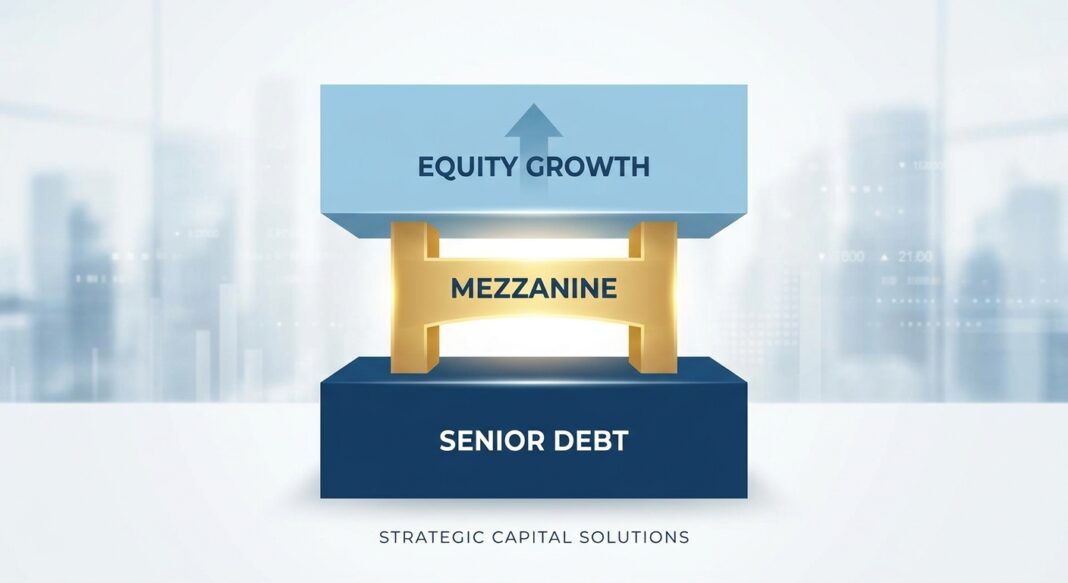
This is precisely the scenario mezzanine financing was designed to solve. Mezzanine financing bridges the gap between what senior lenders provide and your total capital needs. It is subordinated debt that occupies the middle layer of the capital stack (junior to every secured creditor, senior to common equity) and it is priced accordingly. The instrument gives growth-stage operators access to an additional 1.0–2.0 turns of leverage beyond what senior lenders will provide, in exchange for a higher coupon, possible PIK accrual, and a modest equity kicker.
Understanding how to size, structure, and negotiate that mezzanine layer is one of the most practical skills a CFO, operator, or deal principal can develop. The following is a practitioner’s guide to doing exactly that.
Structure Breakdown: Components, Mechanics, and a Worked Example
The Three Defining Features of Mezzanine Debt
Mezzanine debt has three defining structural features that distinguish it from senior debt: its subordinated and unsecured position, its option for Payment-in-Kind (PIK) interest, and its equity kicker, almost always in the form of stock warrants. Each of those features interacts with the others, and understanding the trade-offs across all three is where negotiation leverage lives.
1. Subordination
Mezzanine debt sits between senior debt and equity in a company’s capital stack. If things go south, senior lenders get paid first, equity gets paid last, and mezzanine waits patiently in the middle. This subordinated position creates the primary source of mezzanine risk, which is why it prices significantly above senior paper. An intercreditor agreement governs the relationship between the senior lender and the mezzanine provider, defining standstill periods, cure rights, and the conditions under which the mezzanine holder can act against the borrower.
2. PIK Interest
You pay interest, often with deferred or payment-in-kind (PIK) options, throughout the loan term and repay the principal at maturity. PIK is the mechanism that makes mezzanine viable for companies whose free cash flow cannot simultaneously service senior debt and a high-coupon subordinated layer in cash. Rather than paying, say, a 13% coupon in full each quarter, the borrower accrues a portion, typically 2–4%, onto the outstanding principal balance. When borrowers elect PIK interest, the outstanding balance compounds, increasing total debt burden. If the anticipated liquidity event is delayed, the growing PIK balance creates a larger refinancing burden at bullet maturity, a risk that can become severe in deteriorating markets. Borrowers must model this compounding carefully before electing PIK at close.
3. Equity Kicker (Warrants)
A warrant is a security that gives the holder the right to purchase a company’s stock at a set price in the future. In mezzanine financing, warrants act as an equity kicker, letting lenders share in the company’s upside value if it grows. Current market warrant coverage for lower-middle-market deals typically runs 2–5% of the fully diluted equity base at current valuation. The true complexity, however, comes from the warrants. These equity kickers can complicate the capital structure, add layers to future financing rounds, and create challenging negotiations in a potential exit scenario.
Worked Example: A $75M Acquisition for a $100M EV Business Services Platform
Consider a business services roll-up platform generating $12M EBITDA, targeting a $75M enterprise value acquisition. The pro forma combined entity is projected at $22M EBITDA at a $165M combined EV. Here is how the capital stack might be assembled:
| Tranche | Amount | % of Total Cap | Pricing / Structure | Key Features |
|---|---|---|---|---|
| Senior Secured Term Loan (First Lien) | $55M | 33% | SOFR + 450–475 bps (~9.3% all-in) | 5.0x EBITDA; 1% OID; 6-year term; maintenance covenant |
| Revolving Credit Facility | $10M (undrawn) | – | SOFR + 375 bps | Working capital; 50 bps commitment fee |
| Mezzanine / Subordinated Note | $25M | 15% | 11% cash + 2% PIK = 13% all-in; 5-year bullet | 3% warrant coverage; no amortization; bullet maturity |
| Sponsor / Management Equity | $75M | 45% | Common equity | Includes rollover from target management |
| Seller Note | $10M | 6% | 6% cash pay; 3-year term | Subordinated to mezzanine; deferred for 12 months |
Illustrative structure only. Terms vary by lender, sector, and credit quality. Not a projection or recommendation.
In this stack, the $25M mezzanine note fills the gap between the senior secured ceiling (~$55M at 5.0x pro forma EBITDA of $11M) and the equity check the sponsor is willing to write. The 2% PIK component preserves roughly $500K per year in cash at a time when the business is integrating the acquisition. The 3% warrant coverage grants the mezz provider the right to acquire approximately $4.95M in equity value at today’s valuation, meaningful upside for the lender, modest dilution for the sponsor on a $165M EV platform.
How Mezzanine Compares to the Alternatives on the Cost of Capital Spectrum
Every financing decision is a trade-off between cost, dilution, control, and flexibility. Mezzanine occupies a specific and important position on that spectrum.
Mezzanine vs. Unitranche (Direct Lending)
For deals in the $25M–$200M EV range, the middle market lending landscape has experienced a decisive shift toward simplified debt structures, with unitranche facilities increasingly becoming the financing solution of choice, and this consolidation of senior and subordinated debt into a single facility has materially impacted deal execution timelines and documentation complexity. A unitranche at SOFR + 450–475 bps (approximately 9.0–9.5% all-in as of mid-2026) is cheaper than mezzanine in isolation, and involves a single lender relationship. The trade-off: unitranche lenders generally cap leverage at 5.0–5.5x EBITDA, and given its flexible nature and unique structure, unitranche debt is one of the more attractive funding options for startups interested in acquiring another business. When the borrower needs capital beyond what a unitranche provider will stretch to (whether due to leverage constraints or deal size) mezzanine becomes the bridge.
Mezzanine vs. Preferred Equity / Growth Equity
Mezzanine costs 12% to 15% but dilutes only 1% to 5% via warrants, versus growth equity at 20% to 40% dilution or SBA loans at 11% to 13% with personal guarantees. For operators who want capital without surrendering meaningful control or board seats, mezzanine is frequently the more rational instrument. Preferred equity provides similar subordination protections to lenders but behaves more like equity from a tax and accounting perspective, and often carries governance rights that mezzanine notes do not.
Mezzanine vs. Senior Bank Debt (Commercial Banking)
Commercial bank term loans remain the cheapest form of growth capital, typically SOFR + 200–300 bps for investment-grade-adjacent credits, but they are constrained by regulated leverage limits, collateral requirements, and personal guarantee expectations for smaller operators. Mezzanine remains relevant in several contexts: very large transactions where unitranche lenders cannot provide the full quantum of debt needed, situations where the borrower wants to minimize total cost by maximizing cheap senior debt separately, deals where the sponsor or management team wants equity kickers to align lender incentives, and portfolio company add-on financings where existing credit agreements restrict additional senior debt.
When Mezzanine Is the Right Tool
- Senior debt capacity is fully utilized (4.5–5.5x EBITDA) and equity dilution is unacceptable
- The company has stable, predictable free cash flow to service a cash-pay coupon
- A liquidity event (recap, sale, or IPO) is reasonably expected within the 4–6 year mezzanine tenor
- The operator can absorb PIK compounding without impairing the refinance capacity at maturity
Current Market Terms: What Mezzanine Looks Like in September 2026
The mezzanine market has normalized considerably after the rate-hike cycle of 2022–2024. Here are the key structural and pricing benchmarks practitioners should know:
Pricing
Interest rates stabilized in 2025–2026 after the Fed pause. Mezzanine rates that hit 15–18% in 2023 came back down to 10–13% for quality credits. More specifically, mezzanine current-pay rates stand at 11%–15% in May 2026, often with an additional 1–3% PIK for total yields of 13–18%. For the largest, most creditworthy middle-market borrowers, new-issue yields on direct lending facilities averaged approximately 9.3 percent on an all-in basis in 2025, down from 10.5 percent in 2024, reflecting the combination of lower SOFR and continued spread compression.
PIK Penetration
Lincoln International’s Q4 2025 data provides a precise measure of PIK penetration: 11 percent of all loans in its proprietary private market database paid some component of PIK interest in 2025, up from 7 percent in 2021. This increase reflects both the availability of PIK as a cash-preservation tool and the growing sophistication of borrowers in negotiating toggle provisions at origination.
Warrant Coverage
Market warrant coverage for lower-middle-market mezzanine sits at 2–5% of fully diluted equity, with higher coverage typically demanded on smaller deals or earlier-stage credits. You will also give up 2–5% equity through warrants at your current valuation. The strike price is typically set at the current fair market value of equity at closing, though some providers negotiate a slight discount to incentivize the relationship.
Leverage and Deal Size
Mezzanine debt for LMM acquisitions in 2026: senior-plus-sub combined, 4–6x EBITDA leverage, 9–11% blended rate. Mezzanine typically adds 1.0–1.5 turns of leverage above the senior secured ceiling. Most deals have 3–5 year terms with minimal amortization until maturity.
Covenant Architecture
Mezzanine documentation has followed the broader market’s migration toward incurrence-style protections in the upper middle market. Cov-lite deals rose to 21% of private credit transactions in 2025, up from just 4% in 2023. However, lower-middle-market mezzanine, sub-$50M note sizes, continues to carry financial maintenance covenants, which are used to proactively address materially adverse changes in a portfolio company’s financial performance. Borrowers should understand that covenant-lite loans provide borrower companies more freedom to negatively impact lenders because their covenants are incurrence-based, which means they are only tested and can only be breached following an affirmative action of the borrower, rather than by a deterioration in the borrower’s financial condition. For mezzanine borrowers, maintenance covenants serve as both a constraint and an early-warning system; they create structured dialogue before problems become defaults.
Market Size and Provider Landscape
Mezzanine financing is gaining momentum globally, with the market projected to grow from $212.58 billion in 2025 to $420.79 billion by 2034, reflecting a compound annual growth rate of nearly 8 percent. Active 2026 providers in the lower middle market include Golub Capital, Monroe Capital, Audax Private Debt, Churchill Asset Management, NewSpring Mezzanine, and Plexus Capital, among others.
The Gap Capital Playbook: Quantifying, Preparing, Running, and Closing the Process
Step 1: Quantify the Gap Precisely
Before approaching any mezzanine provider, operators must calculate the precise capital gap with rigor. The formula is straightforward: (Total Use of Capital) minus (Senior Debt Capacity at Lender’s Max Leverage Multiple) minus (Available Equity) = Mezzanine Quantum. Be conservative on the senior debt ceiling, use the lender’s stated maximum, not their advertised flexibility. Model three scenarios: base, downside, and stress. Mezzanine providers will run all three. If the downside scenario shows a coverage ratio below 1.0x on the cash-pay coupon, the structure is too aggressive and will not close.
Step 2: Prepare a Mezz-Ready Information Package
Mezzanine debt providers evaluate your historical and projected cash flow, growth potential, and ability to service both existing senior debt and the new mezzanine layer. The information package for a mezzanine process is materially more detailed than a senior loan presentation. It must include: (a) three years of audited or reviewed financials; (b) a detailed LTM EBITDA bridge with add-back justifications; (c) a 5-year integrated P&L, balance sheet, and cash flow model showing debt service coverage under multiple rate and growth scenarios; (d) a detailed description of the use of proceeds mapped to the acquisition or growth plan; and (e) a capitalization table pre- and post-transaction showing fully diluted equity, including warrant dilution from the proposed mezz layer.
Step 3: Run a Focused, Competitive Process
The mezzanine market is specialized. Approach 4–6 targeted providers based on: check size compatibility (avoid providers whose minimum is above or maximum is below your need), sector expertise, and existing senior lender relationships. Mezz providers increasingly specialize by sector: healthcare-focused mezz, software-focused mezz, industrials-focused, consumer. Specialization improves underwriting quality and lender comfort with sector-specific risks. A sector-aligned mezz provider will close faster, require fewer information requests, and provide more favorable covenant terms because they understand the business model.
Step 4: Negotiate the Structure Before Accepting a Term Sheet
The term sheet is the most important document in the mezzanine process. Once signed, the leverage shifts decisively to the lender. Key negotiation points include:
- PIK Toggle vs. Mandatory PIK: Push for a PIK toggle, the option to pay in kind, not the obligation. Mandatory PIK accelerates compounding regardless of cash position.
- Warrant Coverage Percentage: A 5% warrant request is a starting position, not a floor. Quality credits with strong EBITDA profiles and a defined exit timeline can negotiate this to 1.5–2.5%.
- Warrant Strike Price: Insist on current fair market value. Resist discounted strike prices aggressively, a discount of even 15% to current value dramatically increases lender dilution at a high exit multiple.
- Prepayment Premium: Mezzanine typically carries a step-down prepayment premium (e.g., 3%/2%/1%/par for years 1 through 4). If you anticipate an early exit or refinancing, push for a shorter premium period or soft call protection only.
- Covenant Headroom: Negotiate at least 20–25% of headroom on the leverage covenant relative to the base case model. Forty percent headroom is common in aggressive large-cap documentation, use that as a negotiating reference point even in the middle market.
- Equity Cure Rights: Ensure the credit agreement includes equity cure rights, allowing the sponsor to inject equity to cure a covenant breach. This is standard but must be explicitly documented.
Key Takeaways
- Mezzanine fills a precise capital stack gap: It is the instrument of choice when senior debt capacity is exhausted and equity dilution is unacceptable: subordinated, PIK-capable, and warrant-enhanced to compensate lenders for their position.
- Current pricing has normalized: After peaking at 15–18% in 2023, mezzanine rates for quality credits have returned to 10–13% cash-pay, with 1–3% PIK components and 2–5% warrant coverage as the 2026 market standard.
- PIK compounding is a silent risk: Every quarter of PIK accrual increases the bullet maturity balance. Operators must model the compounded payoff amount under a delayed-exit scenario before electing PIK at origination, not after.
- The intercreditor agreement is as important as the note: The standstill period, cure rights, and enforcement restrictions in the intercreditor document govern what happens in a stress scenario. Negotiate this document as carefully as the pricing.
- Run a competitive process with sector-specialist providers: Mezzanine pricing and covenant flexibility vary materially by provider type. A sector-aligned lender will deliver better terms, faster execution, and fewer surprises in diligence than a generalist approached cold.


