
Deal Structures & Strategy | Bond Capital
Mezzanine Financing for Growth-Stage Acquisitions: Structuring PIK, Equity Kickers & the Capital Stack Gap
The Growth-Stage Financing Gap: When Senior Debt Runs Out
Picture a growth-stage manufacturing or services company with $8–12M in EBITDA, a clear platform acquisition target in sight, and a bank that will lend up to 3.5× EBITDA, roughly $35–42M. The total deal requires $60M. The equity sponsor or founding team does not want to hand over the additional $18–25M as pure equity at an unfavorable valuation. They need a solution that sits between the bank and the equity check: something flexible, non-dilutive in the near term, and sized to bridge a specific capital gap.
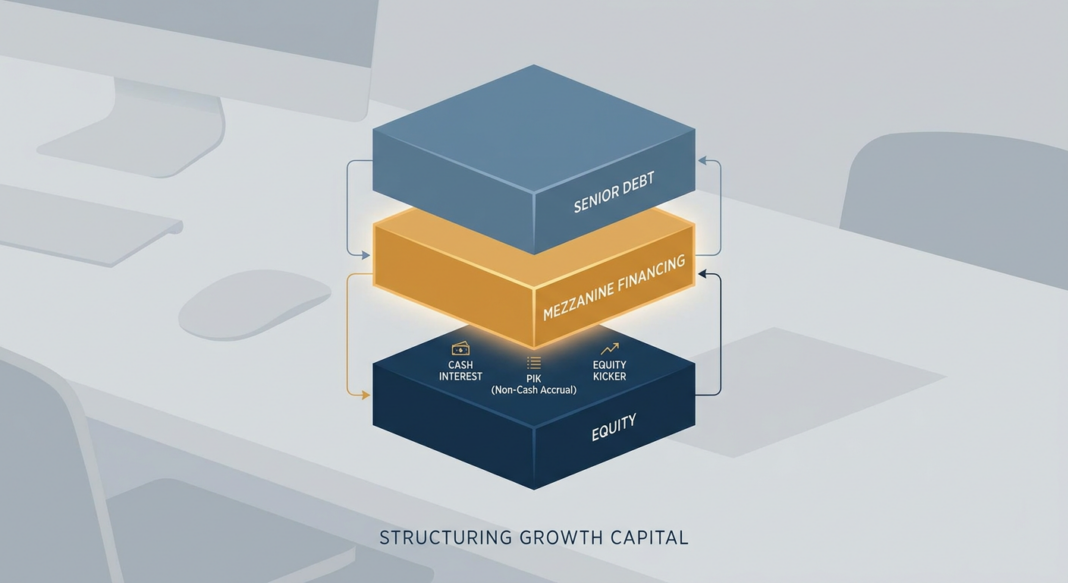
That solution is mezzanine financing: subordinated capital that occupies the layer between senior secured debt and common equity in the capital stack. It is neither the cheapest money on the table nor the most dilutive, but it is precisely engineered for the moment when a business has outgrown its senior borrowing base and is not yet ready to give up ownership at the enterprise value implied by an equity raise.
In 2026, this gap appears with regularity in three scenarios: (1) sponsor-led middle-market platform acquisitions where senior leverage caps leave a funding hole; (2) founder-owned businesses executing bolt-on M&A without a PE sponsor to write a larger equity check; and (3) recapitalizations where owners want partial liquidity without a full business sale. In each case, the structuring challenge is identical: quantify the gap, price the mezzanine layer accurately, and negotiate terms that protect operating flexibility.
Structure Breakdown: How Mezzanine Financing Is Engineered
Position in the Capital Stack
Mezzanine debt is a hybrid instrument that blends the features of debt financing and equity financing. It sits below senior secured debt and above common equity in the repayment waterfall. As one practitioner framing puts it, “mezzanine debt sits in the middle of the capital structure, just as a theater’s mezzanine level sits between the main floor and balcony.” Senior lenders are repaid first; mezzanine lenders follow; equity holders come last.
This subordinated position is why mezzanine is expensive. The lender bears more risk than a senior secured creditor, and that risk must be compensated, typically through a combination of three economic levers working in parallel.
The Three Economic Levers
1. Cash Interest
The cash-pay coupon is a current, periodic payment, usually quarterly, calculated as a percentage of the outstanding principal. It functions like traditional interest and impacts the borrower’s operating cash flow immediately. This component is straightforward to model but must be stress-tested against the combined debt service coverage of both the senior facility and the mezzanine layer.
2. Payment-in-Kind (PIK) Interest
PIK interest is a non-cash accrual mechanism that adds the interest amount to the outstanding principal balance rather than requiring immediate payment. A $10M mezzanine loan accruing at 2% PIK becomes $10.2M after year one, with the compounding difference due at bullet maturity. Borrowers favor PIK mechanics primarily to conserve cash during integration periods, capex cycles, or market downturns, while mezzanine providers accommodate PIK to achieve a targeted yield, often in combination with warrants or other equity-linked upside. The trade-off is explicit: the borrower preserves near-term liquidity at the cost of a growing principal balance and a higher all-in IRR for the lender.
Most deals are structured as a cash/PIK blend. A representative 2025–2026 term might carry 12% cash interest plus 2% PIK, producing a stated 14% running yield before the equity kicker is layered in.
3. The Equity Kicker (Warrants or Conversion Rights)
The equity kicker is the feature that transforms mezzanine from a pure debt instrument into a hybrid security. Structured as warrants or options, equity kickers grant the lender the right to purchase a percentage of the borrower’s equity at a predetermined price, typically 1%–5% of fully diluted ownership. If the company’s value increases materially before exit, the lender exercises the warrant and captures upside alongside equity holders.
When equity kickers exist, the valuation mechanics at exercise must be coordinated carefully with prepayment terms to avoid double-counting economics, a frequent source of post-closing disputes when the company outperforms and the kicker becomes valuable. Effective agreements include explicit strike prices, coverage defined as a percentage of principal, and scenario-based dilution calculations so all parties understand true cost of capital before signing.
Illustrative Term Sheet: $20M Mezzanine for a $60M Acquisition
| Term Sheet Element | Illustrative Terms (2026 Market) |
|---|---|
| Instrument | Subordinated Mezzanine Note |
| Principal Amount | $20,000,000 |
| Use of Proceeds | Partially fund $60M platform acquisition alongside $35M senior unitranche and $5M sponsor equity |
| Cash Interest Rate | 12.0% per annum, quarterly cash-pay |
| PIK Interest Rate | 2.0% per annum, compounding into principal |
| Total Running Yield | 14.0% (cash + PIK) |
| Maturity | 6 years (bullet repayment) |
| Amortization | Interest-only; principal due at maturity |
| Equity Kicker | Warrants for 3.0% of fully diluted equity at current enterprise valuation strike |
| Origination Fee | 2.0% of principal ($400K) |
| Call Protection | Year 1: 3%; Year 2: 2%; Year 3: 1%; thereafter: par |
| Security | Second lien on all assets; subordinate to senior facility via intercreditor agreement |
| Covenants | Maintenance: max leverage ratio (tested quarterly) + minimum fixed charge coverage ratio |
| All-in Effective IRR (base case) | ~20–25% (including warrants at base-case exit multiple) |
When you factor in all components (cash interest, PIK compounding, origination fees, and the equity kicker) the total effective return to the mezzanine lender in successful exits often reaches 20–30% annually. This is the number borrowers must internalize as their true cost of capital, not just the headline coupon.
How Mezzanine Compares: The Cost-of-Capital Spectrum
Mezzanine does not exist in isolation; it competes against adjacent capital sources and works alongside others. Understanding where it sits on the cost-of-capital spectrum is fundamental to structuring decisions.
| Capital Layer | Typical 2026 Cost | Max Leverage | Key Trade-off |
|---|---|---|---|
| Senior Bank Debt (ABL / Revolver) | SOFR + 150–300 bps (~7–9% all-in) | 2.5–3.5× EBITDA | Cheapest money; limited size; maintenance covenants |
| Unitranche (Direct Lending) | SOFR + 500–700 bps (~9–11% all-in) | 4.0–6.0× EBITDA | Speed & simplicity; higher cost than senior; no mezz layer needed |
| Mezzanine | 12–20% total (cash + PIK + kicker) | Fills gap to ~6–7× EBITDA total stack | Preserves ownership vs. equity; expensive; equity kicker dilutes at exit |
| Preferred Equity | 14–18% cash or PIK | Not leverage-based | No lender default rights; more expensive than mezz in distress scenarios |
| Growth / Private Equity | 20–30%+ target IRR | None, equity is uncapped | Immediate dilution; board rights; alignment on exit |
Mezzanine vs. Unitranche: The Real Trade-off in 2026
The most important structural comparison for middle-market acquirers today is mezzanine versus unitranche. A unitranche collapses the entire debt stack (senior and subordinated) into a single facility priced at a blended rate, governed by one credit agreement, with one lender to manage post-close. For acquisitions in the $25M–$200M enterprise value range, unitranche has become the dominant structure, favored for its speed and execution simplicity. However, when total leverage required pushes beyond 5–6× EBITDA, or when a deal is too large for a single direct lender to hold, a mezzanine tranche behind a senior or unitranche first lien may be the only way to close the gap without an equity raise. The mezzanine layer also allows the equity holder to preserve a cleaner intercreditor negotiation, trading higher cost for greater leverage in the stack.
When to Choose Mezzanine Over Alternatives
- Choose mezzanine when: total leverage required exceeds unitranche capacity; founders want to minimize equity dilution; deal timeline allows 4–12 weeks for mezzanine diligence; the business has strong, predictable cash flow to service a blended debt load.
- Choose unitranche when: speed to close is paramount; deal size fits the $25M–$200M EV range; borrower prefers simplicity over last-basis-point cost optimization.
- Choose preferred equity when: debt capacity is fully exhausted; operational flexibility is the priority and lender default rights are unacceptable.
Current Market Terms: Mezzanine in 2025–2026
The mezzanine market does not publish daily pricing like the broadly syndicated loan market, but practitioner consensus on current terms is clear. The following data points reflect market conditions as of mid-2026:
Five Key Market Data Points
- All-in Yield: 12–20% per annum. Mezzanine debt for a performing company carries a typical lender yield of 12.5–14% in cash and PIK combined, excluding the equity kicker. For early-stage or higher-risk credits, rates climb toward 20%. The equity component, warrants covering 1–5% of equity, can push effective IRR materially above the stated coupon in successful exits.
- Maturity: 5–7 years, bullet repayment. Mezzanine loans typically mature in 5 to 7 years, often aligning with expected exit timelines. Repayment is structured as a single bullet payment at maturity, preserving cash flow during the growth phase but compounding the principal obligation when PIK is toggled on.
- Origination Fees: 1–3% of principal. Arrangement fees of 1–3% of the loan amount are standard at close, plus legal and due diligence costs that can range from $25,000 to $100,000 on larger transactions. These are upfront costs that factor into the true cost of the capital before a single interest payment is made.
- Covenant Package: Maintenance covenants retained. Unlike the broadly syndicated loan market, where approximately 90% of new institutional loans in 2024 carried no financial maintenance covenants, private credit and mezzanine lenders have maintained firmer positions on covenant inclusion, particularly for mid-market transactions. Maintenance covenants, tested quarterly against leverage or fixed charge coverage ratios, are standard in mezzanine deals. Importantly, incurrence covenants layered on top of maintenance tests also govern specific borrower actions: taking on new debt, making an acquisition, or paying a dividend are each tested against a pro forma compliance threshold before the action can proceed.
- Call Protection: Declining prepayment premiums over 24–36 months. Most mezzanine deals include call protection of 2–4% in year one, stepping down to par by year three or four. Borrowers negotiating for an earlier exit path, particularly if EBITDA growth is expected to support refinancing into cheaper senior debt, should prioritize negotiating the call schedule as aggressively as the coupon itself.
Market Context: Private Credit’s Compression of Traditional Mezz
The growth of direct lending has structurally compressed the traditional mezzanine market. With global private credit assets under management reaching approximately $2.1 trillion in 2025, unitranche structures now handle much of what mezzanine historically funded. Traditional mezzanine providers have responded by pivoting toward preferred equity structures sitting behind unitranche debt, or by concentrating on larger, more complex transactions where unitranche clubs cannot efficiently hold the full stack. For borrowers, this competitive dynamic has created modest pricing pressure on standalone mezzanine, making it worth running a parallel process against unitranche alternatives to establish the true cost differential before committing to a bifurcated structure.
The Gap Capital Playbook: Quantifying, Prepping & Running the Mezzanine Process
Step 1: Quantify the Gap Precisely
Start with the acquisition price or total capital need and work backward from senior debt capacity. Apply the senior lender’s maximum leverage multiple to trailing or projected EBITDA, add available equity, and identify the funding shortfall. This is your mezzanine sizing target. Layering in conservative PIK compounding projections will show what the principal balance looks like at your expected exit date, a number that directly affects exit equity value and should be stress-tested before any lender conversation begins.
Step 2: Build the Materials Package
Mezzanine diligence is qualitative as well as quantitative. Lenders evaluate historical and projected cash flow, growth potential, and the company’s ability to service both the senior facility and the new mezzanine layer on top of it. Expect lenders to scrutinize EBITDA, coverage ratios, and management track record in depth. Prepare a CIM or investment memorandum, three-year financial model with covenant headroom analysis, and a clear use-of-proceeds narrative tied directly to enterprise value creation. A financing process that takes 4–12 weeks from initial discussion to funding can be compressed significantly when documentation is clean and organized at the outset.
Step 3: Run a Competitive Process
Contact three to five mezzanine funds simultaneously, ideally alongside the unitranche conversation. The market is competitive enough that receiving multiple term sheets is achievable for quality credits. Use competing term sheets to benchmark the equity kicker: warrant coverage percentage, strike price, and exercise mechanics are as negotiable as the coupon. Mezzanine lenders also differ on PIK toggle flexibility, change-of-control provisions, and the treatment of capitalized PIK in prepayment premium calculations. Structure the process to receive term sheets before committing to any single lender, and negotiate all economic components together rather than accepting coupon and kicker as separate, non-negotiable packages.
Step 4: Model the True Cost of Capital
Before accepting any mezzanine term sheet, build a full debt schedule that shows the PIK compounding year by year. PIK does not feel expensive in the abstract; it becomes viscerally real when you see the principal balance at year five or six, immediately before a bullet repayment is due. Add the equity kicker value at your base-case and downside exit multiples. Calculate the lender’s IRR and MOIC across exit scenarios. Only when you see the full return profile can you judge whether the mezzanine layer is priced fairly relative to alternatives, and whether the company’s projected exit equity value is sufficient after the mezzanine payoff to justify the dilution and cost.
Negotiation Guidance: What to Push For and What to Concede
For Operators and Borrowers
- PIK Toggle Triggers: Negotiate performance-based PIK triggers rather than an unconditional toggle. The most borrower-favorable structures allow PIK election only during periods of low liquidity (below a minimum threshold) or high leverage, with automatic reversion to cash-pay when performance improves. Avoid open-ended PIK elections that allow the principal to compound without constraint.
- Warrant Coverage and Strike Price: Negotiate the equity kicker separately from the coupon. Lower warrant coverage (1–2% vs. 3–5%) at a higher cash coupon will reduce dilution at exit, which matters most when the business outperforms. Confirm the strike price is set at current fair market value, not a discount, and that the exercise mechanics are clearly defined and not subject to discretionary valuation disputes.
- Call Protection Schedule: Push for a compressed call protection window, ideally no call premium after 24 to 30 months. This preserves refinancing optionality if EBITDA growth supports a refinancing into cheaper senior debt before the mezzanine matures.
- Covenant Headroom: Model the maintenance covenant at least 20–25% of cushion versus the initial test level. Private credit lenders underwrite with 1–2 turns of leverage cushion to the covenant at close. Demand the same cushion for yourself, a maintenance covenant breach gives the lender intervention rights and can constrain operational flexibility well before a payment default occurs.
- Change-of-Control Provisions: Ensure the change-of-control clause does not treat a refinancing event or recap as a triggering event without adequate notice and cure rights. Lenders’ change-of-control protections are standard, but borrower-friendly drafting preserves flexibility for future transactions.
For Investors and Structuring Professionals
- Confirm that PIK compounding mechanics are explicitly reflected in the financial model before close, not just disclosed in legal documents.
- Validate that intercreditor terms with the senior lender are negotiated before the mezzanine term sheet is signed, the standstill period and enforcement rights in an intercreditor agreement are as important as the mezzanine economic terms themselves.
- Ensure the equity kicker valuation (and how it interacts with future financing rounds or exit proceeds) is stress-tested across downside scenarios where the warrant is out of the money.
Key Takeaways
- Mezzanine fills the capital stack gap where senior capacity ends and equity dilution is unacceptable. It is purpose-built for growth-stage acquisitions, bolt-on M&A, and partial owner recapitalizations, situations where a well-defined funding shortfall exists and the business generates sufficient cash flow to service a blended debt load.
- The three economic levers (cash interest, PIK, and equity kicker) must be evaluated together, not in isolation. The headline coupon is not the cost of the capital; the all-in lender IRR, incorporating compounded PIK and warrant economics, is the true price. Model all three components across exit scenarios before signing a term sheet.
- Maintenance covenants are standard in mezzanine deals and require careful headroom management. Unlike broadly syndicated loans where covenant-lite has become dominant, private credit and mezzanine lenders retain quarterly financial maintenance tests. A covenant breach triggers lender intervention rights long before any payment default, giving lenders control over strategic decisions at a moment when management least wants it.
- PIK interest compounds silently until it becomes a large bullet obligation. Borrowers who focus only on near-term cash flow preservation miss the compounding effect that inflates the principal balance at maturity. PIK is a cash management tool, not a cost reduction tool: its true cost is higher, not lower, than cash-pay interest at the same rate.
- Run a competitive process across mezzanine funds and unitranche providers simultaneously. The price differential between a well-negotiated mezzanine structure and a full unitranche solution can be narrow on an all-in basis. Sponsors and operators who surface competing term sheets before committing consistently extract better economics: on the coupon, the kicker, the call protection, and the covenant package.


