
The Growth-Stage Financing Gap: When Senior Debt Runs Out and Equity Is Too Expensive
A growth-stage company with $4M in EBITDA, 30% year-over-year revenue expansion, and a target acquisition priced at $35M faces a structural financing problem. Its senior lender (a regional bank or even a direct lender) will advance 3.5x to 4.0x EBITDA, producing roughly $14M to $16M in senior capacity. The founders and management team can contribute $8M to $10M in equity. That leaves a $9M to $11M hole in the capital structure, the gap that sits between what senior lenders will provide and what the equity base can absorb.
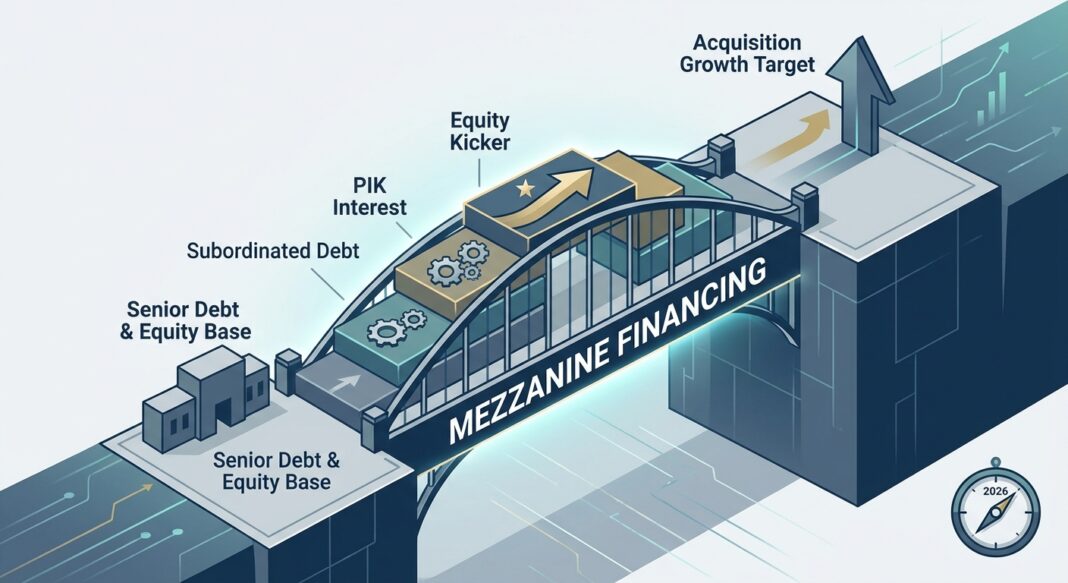
This gap is precisely where mezzanine financing was designed to live. Mezzanine debt is a hybrid form of capital that combines features of both debt and equity financing, functioning as a funding bridge that fills the gap between the amount a traditional bank will lend, senior debt, and a firm’s existing equity base. It is not the cheapest layer in the stack, and it is not the most expensive. It is the most structurally complex, and for growth-stage operators running acquisitions or platform builds, often the most strategically decisive.
Understanding how to design, price, and negotiate this layer is not optional for deal-focused operators. It is a core competency.
Structure Breakdown: The Three Components of a Mezzanine Facility
Mezzanine debt has three defining structural features that distinguish it from senior debt: its subordinated and unsecured position, its option for Payment-in-Kind (PIK) interest, and its equity kicker, almost always in the form of stock warrants. Each element serves a specific function in the capital structure, and each carries distinct economic consequences for the borrower.
Component 1: Subordinated Position and Intercreditor Mechanics
Mezzanine debt is subordinated to senior debt, meaning it is repaid after all senior claims have been satisfied in the event of a default. In practice, this means the mezz lender executes an intercreditor agreement or subordination agreement with the senior lender, ceding both payment priority and enforcement rights in a restructuring scenario. The senior lender typically holds a first lien on all assets; the mezz lender may hold a second lien or remain unsecured. Mezzanine investments function as a tier in a company’s capital structure between senior debt and equity, and can take the form of subordinated unsecured debt, second lien debt, or preferred stock.
Component 2: Cash Pay + PIK Interest
A mezzanine facility typically includes cash interest, PIK interest that compounds on the principal, an equity kicker in the form of warrants or conversion rights, and upfront origination fees, a combination that makes the all-in cost of capital higher than the stated interest rate.
The PIK toggle is particularly important for cash-constrained operators. PIK stands for payment-in-kind. PIK interest accrues on the principal balance instead of being paid in cash, compounding over the life of the facility and increasing the effective cost of borrowing over time. The strategic value is clear: a company deploying capital into a growing acquisition doesn’t bleed cash on debt service during the integration period. The economic cost is equally clear: when borrowers elect PIK interest, the outstanding balance compounds, increasing total debt burden. If the anticipated liquidity event is delayed, the growing PIK balance creates a larger refinancing burden at bullet maturity, a risk that can become severe in deteriorating markets.
Component 3: Equity Kicker, Warrants and Conversion Rights
An equity kicker is the ownership participation component of a mezzanine structure, typically warrants or conversion rights that allow the lender to participate in the company’s upside, and this is what makes mezzanine dilutive despite being structured as debt.
Every warrant granted to a mezzanine lender dilutes existing common equity. In a successful exit, the mezzanine lender’s equity kicker reduces the return available to the PE sponsor and management team, a cost that must be weighed against the benefit of reduced upfront equity contribution. Warrant coverage is typically expressed as a percentage of the total loan amount and is priced off the company’s last equity valuation or a negotiated enterprise value floor.
Worked Example: $11M Mezzanine on a $35M Acquisition
Returning to our growth-stage operator: here is how a representative $11M mezzanine facility might be structured in 2026:
- Facility size: $11M subordinated term loan
- Position in stack: Second lien or unsecured, behind $15M senior unitranche
- Cash interest: 9.5% per annum, paid quarterly
- PIK component: 3.0% per annum, accruing to principal (toggle option to pay cash if coverage permits)
- Equity kicker: Warrants covering 3.0% of fully diluted equity, struck at current equity value
- Maturity: 5 years, bullet repayment
- Origination fee: 2.0% upfront
- All-in lender IRR target: ~17% to 19%, inclusive of warrant participation
Current market cost structure for mezzanine runs 8–12% cash interest plus 2–4% PIK accruing to principal, plus warrants or equity co-investment of 1–5% of equity, creating a 16–22% all-in IRR for the lender. For the borrower, this is expensive capital, but it is cheaper than issuing additional equity at current valuation multiples, and it preserves operating control.
How Mezzanine Compares: The Three Alternatives
Before committing to a mezzanine layer, a growth-stage operator should evaluate three structural alternatives with precision.
Option A: Unitranche (Single-Tranche Direct Lending)
A unitranche merges senior and junior debt into one credit agreement with a single blended rate; the risk split lives in a private Agreement Among Lenders as a first-out/last-out (FOLO) structure the borrower never sees. Total leverage on a unitranche typically runs 4–6x EBITDA with a blended interest rate of 8–11% (SOFR + 500–700 bps in 2026), under a single covenant package with a single intercreditor relationship. Unitranche works when the total quantum of debt required falls within what a single direct lender can hold. It does not work when leverage requirements exceed 5.5x–6.0x EBITDA, because the lender will not stretch further, and that is precisely when the mezz layer becomes necessary.
Despite the unitranche’s rise, traditional mezzanine debt has not disappeared. It remains relevant in several contexts: very large transactions where unitranche lenders cannot provide the full quantum of debt needed; situations where the borrower wants to minimize total cost by maximizing cheap senior debt separately; deals where the sponsor or management team wants equity kickers to align lender incentives; and portfolio company add-on financings where existing credit agreements restrict additional senior debt.
Option B: Additional Equity Round
For a growth-stage company that has already raised seed and Series A capital, the marginal cost of a new dilutive round is frequently misunderstood. The fully-loaded dilution cost of a single growth-stage priced round, measured at exit, typically runs 30 to 35 percent of the pre-money founder position, versus an 8 to 10 percent after-tax cost of senior secured debt. Smart CFOs do not think in terms of “debt or equity”; they think in terms of blended cost of capital. Even when equity is available, the all-in cost of debt is often dramatically lower, particularly for companies with strong revenue growth. Mezzanine, even at 17–19% lender IRR, is structurally cheaper than giving up 25–35% of exit proceeds to a new equity investor at a compressed current valuation.
Option C: Preferred Equity
Preferred equity sits above common equity but below all debt in the capital stack. It offers no tax deduction on distributions, carries no mandatory repayment schedule, and typically includes protective provisions: anti-dilution ratchets, liquidation preferences, participation rights. For operators who want absolute protection against a debt covenant default, preferred equity removes the risk of lender acceleration. The trade-off: preferred distributions are not tax-deductible and the governance provisions that preferred investors negotiate (board seats, consent rights, veto powers) can meaningfully constrain operator decision-making. Mezzanine debt, structured as subordinated debt, provides capital without board-level governance intrusion, which many operators prefer.
When Mezzanine Wins
Mezzanine is optimal when senior debt capacity is exhausted, the company does not want to raise equity at current market multiples, and the business has stable recurring cash flows that can service the interest payments. A business with 8%+ revenue growth, recurring contract revenue, and EBITDA margins above 20% is the ideal mezzanine borrower, cash flow is reliable enough to service current interest, and growth trajectory justifies the warrant dilution at exit.
Current Market Terms: Mezzanine and the Subordinated Debt Layer in Mid-2026
Five data points define the current market for growth-stage mezzanine financing:
- Pricing anchor: Mezzanine debt for a performing company is typically expected to yield 12.5–14% for the lender. All-in lender IRR inclusive of equity participation runs 16–22%, per current market structures.
- Unitranche competition compressing the floor: KBRA’s direct lending data, cited by Brinley Partners, put the average private unitranche coupon at roughly 9.00% at the end of 2025, up 250 basis points from four years earlier and running about 160 basis points above comparable broadly syndicated loans. This has forced mezzanine lenders to sharpen pricing on pure-cash-pay facilities to compete, but the warrant component remains standard.
- Covenant design: Unitranche loans are maintenance-covenant instruments with at least one leverage covenant tested quarterly. In the first half of 2024, the vast majority of private credit deals contained a maintenance covenant; only a small minority were covenant-lite and those skewed to large-cap credits with strong sponsors. The financial covenant is typically a single net first-lien or total net leverage covenant with an initial cushion of 25 to 35 percent over the base case plan, stepping down as cash flow grows. Mezzanine credit agreements tend to carry lighter covenant packages than senior facilities, often only incurrence-based tests, but subordination agreements may grant the senior lender standstill rights that effectively neutralize mezz lender enforcement during a default period.
- Cov-lite trend at the top: Proskauer’s Private Credit Insights Report found that cov-lite deals rose to 21% of private credit transactions in 2025, up from just 4% in 2023. This trend is concentrated in large-cap and sponsor-backed deals; lower-middle-market mezzanine still carries maintenance covenants. “Covenant-lite” loans do not have a complete set of financial maintenance covenants: their covenants are incurrence-based, meaning they are only tested and can only be breached following an affirmative action of the borrower, rather than by a deterioration in the borrower’s financial condition.
- Default risk context: Fitch reported the U.S. private credit default rate hit a record 9.2% in 2025, up from 8.1% in 2024. For mezzanine lenders underwriting junior positions in a higher-default environment, covenant discipline and equity kicker sizing have become more conservative, expect tighter warrant strike prices and larger PIK cushions relative to 2021–2022 vintages.
The Gap Capital Playbook: Quantifying the Need, Prepping the Package, Running the Process
Step 1: Quantify the Gap with Precision
The gap capital calculation is not a residual; it is the starting point. Build a fully loaded sources-and-uses table: total transaction cost (acquisition price plus transaction fees plus integration reserve) minus senior debt capacity (run at 3.5x–4.5x EBITDA depending on business quality) minus equity contribution (including rollover equity if applicable). The remainder is your mezzanine quantum. Then stress-test the debt service coverage ratio (DSCR) at 1.25x with the full PIK component accruing. If coverage breaks below 1.10x under a downside case, the mezz quantum is too large and the equity check must increase.
Step 2: Prepare the Information Package
Mezzanine lenders underwrite to a 5-year exit thesis, not a 12-month liquidity event. Your package must include: three years of audited or reviewed financials; a detailed LTM EBITDA bridge with addback justification; a 5-year financial model with downside case; a customer concentration analysis (lenders flag any single customer above 20% of revenue); a competitive positioning memo; and management bios with ownership table. The equity kicker negotiation will be anchored to your last equity round valuation or a current enterprise value assessment, have a defensible EV analysis ready.
Step 3: Run a Parallel Process
Top mezzanine providers span BDCs (Ares Capital, Blue Owl, Main Street, FS KKR), specialty mezz funds (Audax Mezzanine, Madison Capital, Twin Brook, Brookfield, Maranon, Antares), and family office mezzanine pools. Run a minimum of six to eight simultaneous conversations. Mezz lenders are less price-sensitive to competition than senior lenders, their differentiation is structural flexibility and speed. Creating competitive tension on warrant coverage and PIK toggle terms, rather than headline rate, produces the most material economic improvements. Expect the underwriting process to run 60–90 days from term sheet to close.
Negotiation Guidance: What to Push On and What to Concede
For Operators
Push on warrant coverage percentage and strike price. The difference between 2% and 5% warrant coverage can represent millions of dollars at exit. Negotiate coverage down by offering a higher cash interest rate, lenders will often trade warrant coverage for current yield certainty. Negotiate the strike price up (i.e., at a meaningful premium to current EV) to reduce exit dilution if the company performs.
Negotiate the PIK toggle aggressively. A fully discretionary PIK toggle (where the borrower elects cash or PIK each interest period) provides maximum operating flexibility during integration. Lenders often want a mandatory cash-pay minimum (e.g., 50% of coupon must be cash). The negotiated outcome: a PIK toggle at the borrower’s election for the first 18 months, reverting to cash-pay thereafter, with a PIK continuation right if leverage exceeds a defined threshold.
Limit covenant scope. Mezzanine credit agreements should carry incurrence-only covenants: tested only on acquisition, additional debt, or distribution events. Incurrence covenants are tested only when a borrower seeks to undertake a specified action, such as incurring additional indebtedness, making an acquisition, or paying a dividend. Resist any maintenance covenant in the mezz agreement if the senior facility already carries one, double-covenant maintenance testing creates two trip wires for the same credit event.
Negotiate prepayment flexibility. A standard mezz facility carries a no-call period (often two years) followed by a declining prepayment premium (e.g., 3%-2%-1% schedule). Negotiate the no-call period to 12–18 months if an exit or refinancing is anticipated within the hold period.
For Investors Evaluating Mezzanine in a Portfolio
ABF Journal’s March 2026 analysis of the covenant divide confirms that restructurings initiated at the covenant-breach stage, before a payment default, produce materially higher recoveries than those triggered by missed payments. The early-warning function is not a documentation formality. Investors underwriting to a mezzanine position should assess: (1) the quality and conservatism of the PIK accrual modeling; (2) the enforceability of their intercreditor rights relative to the senior lender; (3) the strike price and vesting mechanics of any warrant position; and (4) whether the covenant package provides actionable early-warning signals or merely incurrence-based protection that activates too late.
Key Takeaways
- Mezzanine fills the structural gap between senior debt capacity (3.5x–4.5x EBITDA) and total leverage required for a growth acquisition; it is not a last resort; it is a deliberate capital stack layer when unitranche lenders cannot provide the full quantum.
- The all-in cost is higher than the headline rate. Cash interest, PIK accrual, warrant dilution, and origination fees combine to produce a 16–22% lender IRR. The correct comparison is not mezz vs. senior debt, it is mezz vs. equity dilution at current exit multiples.
- PIK interest preserves operating cash flow but compounds leverage. Model the PIK accrual under a delayed-exit scenario at every stage of deal underwriting. A 3% PIK toggle on an $11M facility compounding over five years adds meaningful principal at maturity; this must be stress-tested against terminal EBITDA and exit multiple assumptions.
- Warrant coverage is the highest-leverage negotiating variable. A 1% reduction in warrant coverage on a business that exits at 7x EBITDA is worth more to the equity holders than a 50 bps reduction in the cash interest rate. Prioritize warrant terms over rate in every mezz negotiation.
- Covenant design in the mezz agreement must be coordinated with the senior facility. Double maintenance covenant testing creates unnecessary binary risk. Negotiate for incurrence-only covenants in the mezzanine credit agreement and ensure intercreditor terms provide an adequate standstill period, 180 days is the current market standard, before the mezz lender can exercise independent enforcement rights.


