
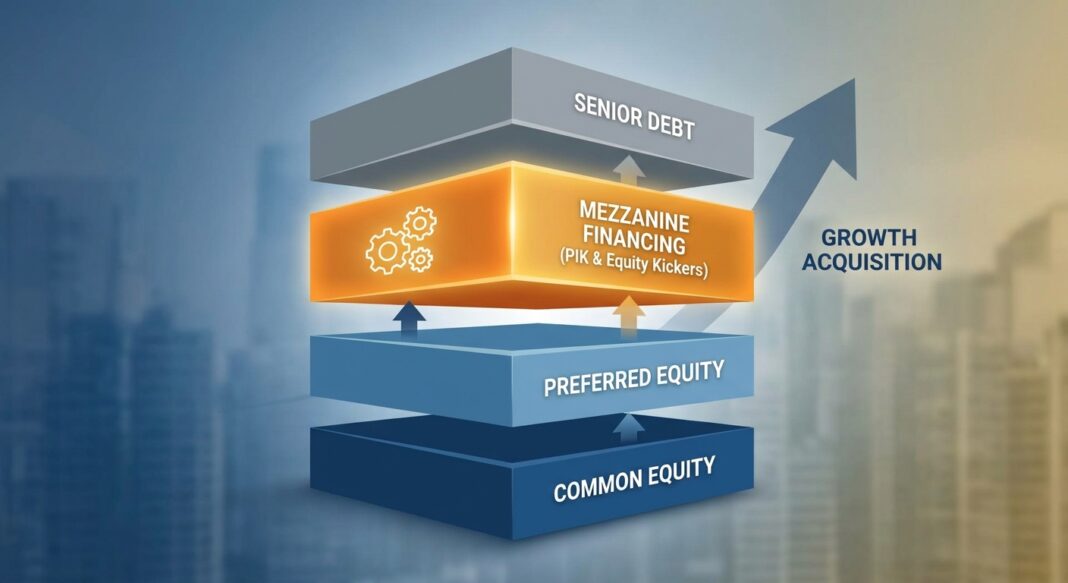
The Growth-Stage Gap: When Senior Debt Ends and Equity Begins
A growth-stage operator running $4M in EBITDA and targeting a $25M bolt-on acquisition faces a capital arithmetic problem that a single bank loan cannot solve. The senior lender will extend to roughly 3.5x EBITDA, call it $14M. The buyer wants to write a $7M equity check, not $11M. That middle $4M to $7M is the gap, and mezzanine financing exists precisely to fill it.
At the growth stage, the use-of-proceeds question is almost always one of three things: funding an acquisition that stretches beyond senior capacity, recapitalising equity without a full sale, or financing an organic expansion (new locations, new product lines, new geographies) that a revolving credit line cannot carry. In all three scenarios, the operator is cash-flow-positive, has demonstrated a track record, but cannot access the full quantum of capital needed from a bank alone, and does not want to surrender the ownership percentage that a growth equity round would demand.
Mezzanine debt (subordinated, typically unsecured, priced to reflect its junior position, and often stapled to a modest equity kicker) sits structurally between senior debt and common equity. Understanding how to design, price, and negotiate it is among the most consequential financing skills a growth-stage operator or their capital advisor can carry into a deal.
The Capital Stack, Layer by Layer
Before structuring mezzanine, the full stack must be mapped. Each layer carries a distinct cost, a distinct set of rights, and a distinct use-of-proceeds logic.
Layer 1: Senior Secured Debt (Bank or Non-Bank)
Senior secured debt is the cheapest layer in cash-pay terms, typically priced at SOFR plus a credit spread, with a first lien on operating assets, and sized to 2.0x–3.5x EBITDA depending on the lender’s appetite and the company’s revenue quality. In 2026, a solid lower-middle-market credit can access senior bank debt at roughly 7% all-in on a 5-year amortising term. This is the foundation of any acquisition stack, maximise it first, because every dollar here is cheaper than every dollar below it.
Layer 2: Mezzanine / Subordinated Debt
Mezzanine debt financing sits between the senior lender and the equity in a lower-middle-market capital stack, priced today at roughly 11% to 14% cash coupon plus 1% to 4% PIK, and often stapled to warrant coverage of 1% to 5% of the fully diluted equity. Mechanically, a mezzanine note is documented as a subordinated promissory note with a subordination agreement running in favour of the senior lender. The note usually has a five-to-seven-year bullet maturity, a non-call period of one to two years, and step-down call premiums after that. Payment terms typically require quarterly cash interest, with PIK interest capitalising into the outstanding balance and paid at maturity or at refinance.
Layer 3: Preferred Equity or Seller Notes
Preferred equity or seller notes serve as a bridge layer used when the debt stack is fully stretched but the equity check would be prohibitively dilutive. Preferred equity is a hybrid that sits below all debt but above common equity, often with a fixed dividend (cash or PIK) and a liquidation preference. It is used heavily in growth equity and minority recapitalisations. A single tranche of preferred at 8% to 12% can replace a layer of mezzanine when the sponsor wants to avoid additional debt covenants.
Layer 4: Common Equity
Common equity sits at the bottom of the stack, first-loss capital, uncapped upside. In a growth acquisition, sponsor equity and management rollover together are typically sized to satisfy lender comfort with the deal’s loan-to-value, not to minimise the equity check for its own sake. In the lower middle market, a typical $50M enterprise value platform in 2026 would be funded with roughly 40% senior debt, 10% mezzanine, 45% sponsor equity, and 5% seller rollover, per GF Data H1 2026 averages.
Worked Example: A $25M Growth Acquisition
Consider a business services operator with $4M EBITDA acquiring a complementary platform at $25M enterprise value (6.25x EBITDA). The stack:
- Senior bank term loan: $14M (3.5x EBITDA) at 7.0% all-in; 5-year term; first lien.
- Mezzanine debt: $5M (1.25x EBITDA) at 12.5% cash + 2.5% PIK; 6-year bullet; warrant coverage of 3% fully diluted equity.
- Seller note: $2M at 7.0%; 5-year; subordinated behind mezz.
- Buyer equity: $4M (16% of deal value).
- Total: $25M at 5.0x total leverage on $4M EBITDA.
Year 1 debt service on a comparable stack runs approximately $1.2M–$1.5M on senior interest and amortisation, plus $600K–$900K on the mezzanine cash coupon, meaning the business needs stable EBITDA conversion to remain serviceable in year one. The PIK component accrues to principal rather than drawing cash, which is precisely why if a mezzanine note carries a 2.5% PIK rate on a $5M principal, after one year the outstanding principal grows to $5.125M without any cash leaving the company, preserving cash flow for operations and service on senior facilities.
Mezzanine vs. the Alternatives: Trade-Offs and Fit
No structure is universally superior. The correct framework is to evaluate the total cost of constraint, not just the headline coupon, across each option on the capital spectrum.
Mezzanine vs. Unitranche
A unitranche loan combines what would otherwise be senior debt and mezzanine into one instrument with one lender and one credit agreement. Total leverage typically runs 4–6x EBITDA, with a blended interest rate of 8–11% (SOFR + 500–700bps in 2026), a single covenant package, and a single intercreditor relationship. For PE-sponsored deals with clean documentation timelines, unitranche wins on simplicity and execution speed. For founder-led or non-sponsored operators who lack sponsor infrastructure, a bifurcated senior-plus-mezz stack often accesses more leverage at a lower blended cost, because the senior bank is kept at its cheapest-possible tranche. Unitranche yields range between approximately 9.00% and 9.75% in mid-2026, representing a decline of roughly 250 basis points from late-2023 peak levels.
Mezzanine vs. Preferred Equity
Senior debt typically costs 6%–10%; mezzanine financing 12%–20% all-in (cash + PIK); and equity targets a 25%–40%+ IRR, requires no repayment, but demands significant dilution. Preferred equity sits between the latter two; it avoids the hard payment obligation of mezz debt (dividends can often be deferred without triggering a default) but is structurally equity on the balance sheet, which can complicate subsequent senior lender covenants. Mezzanine debt is tax-deductible; preferred dividends are not.
When Mezzanine Is the Right Tool
Mezzanine debt financing is the correct tool for LMM operators with $3M to $50M in EBITDA who need capital for an acquisition, a partner buyout, a dividend recapitalisation, or an organic growth push that senior debt alone will not fully fund. It fails when the business is pre-profitability, when cash flow cannot cover the cash-pay coupon, or when the ownership dilution from warrants cannot be tolerated.
Current Market Terms: What Operators Are Actually Seeing in 2026
Five data points define the current mezzanine market for growth-stage borrowers:
- Cash coupon: Lower-middle-market mezzanine is priced today at roughly 11% to 14% cash coupon plus 1% to 4% PIK. Tighter for well-sponsored deals with clean coverage; wider for non-sponsored or cyclical credits.
- Warrant coverage: Equity kickers (warrants) give mezzanine lenders 1%–5% equity ownership, aligning their incentives with equity holders and boosting total return beyond the interest yield. If the company exits at a high multiple, the warrant converts into meaningful equity proceeds, lifting the blended IRR from the coupon range (10%–16%) into the target range (15%–20%).
- Target lender returns: Mezzanine funds generally target gross returns of 12%–18%, blending current cash interest (typically 10%–14%) with additional return from PIK interest and equity kickers. Net returns to LPs usually fall in the 10%–15% range.
- Covenant packages: Covenant packages for mezzanine debt are negotiated, some mezz providers accept incurrence-only covenants; others require maintenance tests. Maintenance covenants require the borrower to satisfy specified financial tests (typically leverage ratios, interest coverage ratios, or fixed-charge coverage ratios) at regular intervals, usually quarterly. A maintenance covenant violation occurs automatically when the borrower’s financial performance deteriorates below the threshold, regardless of whether any other other event has occurred. For operators, incurrence-only covenant packages are meaningfully more flexible because they only test the ratio when the borrower takes an affirmative action (issuing new debt, making an acquisition, or paying a dividend) meaning a borrower can sit on deteriorating financials for quarters without triggering lender intervention rights.
- Lower-middle-market covenant retention: In the lower middle market, approximately 98% of deals retain maintenance covenants, in sharp contrast to the broadly syndicated market where over 85% of institutional leveraged loans now lack the quarterly testing that gives lenders early warning of trouble. Operators should negotiate headroom of at least 25%–30% over the maintenance test threshold in year-one projections.
The 2024–2026 mezzanine market for business acquisitions is defined by three forces: private credit AUM growth to $1.7 trillion per Preqin, senior bank retrenchment leaving a 1.0x to 1.5x EBITDA gap in the middle market, and PE dry powder of $955 billion per Bain & Co’s estimates, all of which have pushed mezzanine from a niche instrument to a mainstream fixture of growth-stage deal financing.
The Gap Capital Playbook: Quantify, Prepare, Process, Negotiate
Step 1: Quantify the Gap
Start from the acquisition price or capital need and work downward. Map what senior debt will provide at the lender’s maximum leverage multiple (typically 3.0x–4.0x EBITDA for a bank, up to 4.5x for a non-bank senior lender). Map what equity you are prepared to write. The residual is your gap, and that gap determines whether mezzanine, preferred equity, a seller note, or a combination of all three is the structuring solution. Mezzanine fills a specific gap in the capital stack: between where senior debt stops and where sponsor equity becomes uneconomic to inject more.
Step 2: Build the Materials
Mezzanine lenders underwrite differently from banks. They focus on enterprise value durability (what is the business worth at exit under a stress scenario?), free cash flow after senior service (is there enough to pay cash interest?), and management quality. The CIM must present a five-year base case and a stress case, with explicit debt-service coverage analysis on the proposed stack, not just EBITDA projections. Include a sources-and-uses table that shows the full capital structure, not just the mezz tranche in isolation.
Step 3: Run the Process
Typical LMM mezzanine tranche sizes run $5M to $75M, with SBIC-licensed funds like Plexus Capital and Falcon Investment Advisors handling smaller checks down to $2M. For non-sponsored deals, target independent mezzanine funds: NewSpring Mezzanine, Peninsula Capital Partners, Northstar Mezzanine, and Balance Point Capital are all active in the lower middle market. Running three to five competitive term sheets is standard and produces meaningful pricing dispersion. Build the refinancing path into the process: if the business grows EBITDA from $3M to $4.5M over five years, total leverage drops from 5x–7x to 3.5x–5x at constant principal, enabling a senior bank refinancing of the mezz at 7% versus the original 13%–15%, generating savings of $400K–$600K per year.
Step 4: Negotiate the Structure
The four highest-value negotiation points for borrowers are:
- PIK toggle vs. mandatory cash pay: A PIK toggle, the right to elect PIK interest in periods of cash stress, is significantly more valuable than a fixed PIK component. Push for it at the term sheet stage, not the documentation stage.
- Warrant coverage and strike price: Warrants are the most dilutive element of mezzanine. Negotiate the percentage down (1%–3% is reasonable for established credits) and ensure the strike is set at current fair market value, not at a nominal price that gives the lender a free ride on existing equity.
- Covenant headroom: Maintenance covenants require enhanced focus on realistic covenant cushions and headroom in financial models. Negotiate an opening leverage covenant set no tighter than 10%–15% below your base-case projection, with step-downs tied to debt paydown rather than to aggressive EBITDA growth assumptions.
- Call protection and prepayment schedule: Mezzanine lenders typically impose a non-call period of 12–24 months followed by step-down premiums (e.g., 103/102/101/par). If you anticipate a refinancing event within three years (either through a sale or organic EBITDA growth) push the call protection window down and the step-downs steeper to accelerate the path to par.
Key Takeaways
- Map the gap before selecting the instrument. Mezzanine is not the default answer to a financing shortfall; it is the answer when the gap exists specifically between the senior debt ceiling and the equity floor, and when the business generates sufficient free cash flow to service a cash-pay coupon.
- Total cost of constraint matters more than total cost of coupon. A 13% mezzanine note with incurrence-only covenants and a PIK toggle is structurally superior for a growing business than a 12% note with quarterly maintenance tests set close to projected performance and mandatory cash pay.
- PIK interest preserves cash but compounds into principal. The PIK toggle is a liquidity management tool, not a subsidy. Model the compounding effect at maturity and ensure the refinancing or exit event adequately covers the accreted principal balance.
- Warrants are a negotiation lever, not a fixed price. Coverage of 1%–5% is the market range; the appropriate number for a well-run, cash-generative LMM business with multiple lender options is toward the low end of that range. Run a competitive process to establish this.
- Build the refinancing path on day one. Mezzanine is rarely meant to be permanent capital. If EBITDA growth is real, the senior lender will eventually refinance the mezz tranche at a materially lower cost. Price that optionality into the call schedule negotiation from the outset.


