
The Financing Gap That Kills Good Deals
The scenario is familiar to any growth-stage operator running an acquisition strategy: your senior lender will stretch to 3.5x EBITDA, your equity check covers another 30–35% of the purchase price, and there is still a meaningful gap between those two figures and the enterprise value you need to fund. That gap, often 10–20% of total deal value, is where most transactions stall, and where the wrong financing decision can define the next five years of your capital structure.
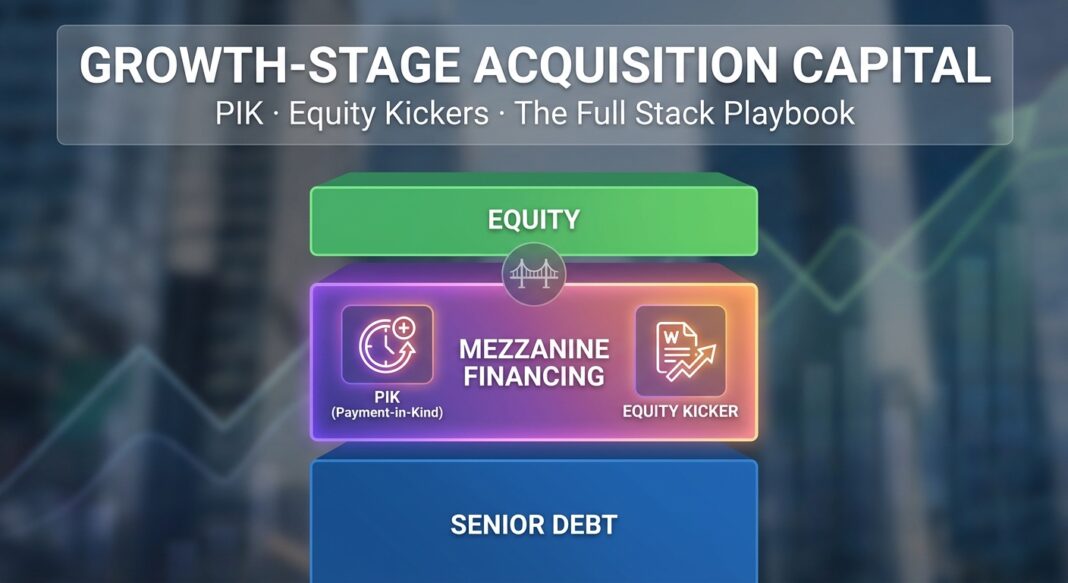
Mezzanine debt exists precisely to fill this space. It is a hybrid form of capital that combines features of both debt and equity financing, functioning as a bridge that fills the gap between the amount a traditional bank will lend and the firm’s existing equity base. At the growth stage (where a company has proven unit economics, recurring cash flow, and an acquisition or expansion thesis) mezzanine is often the most capital-efficient tool available, provided operators understand exactly what they are buying and what it truly costs.
This article maps the full mezzanine structure, walks through a live term sheet example, compares it against the alternatives on the cost-of-capital spectrum, and delivers a step-by-step playbook for quantifying the need, running the process, and negotiating the final structure.
Structure Breakdown: The Three Layers of a Mezzanine Facility
Mezzanine debt has three defining structural features that distinguish it from senior debt: its subordinated and unsecured position, its option for Payment-in-Kind (PIK) interest, and its equity kicker, almost always in the form of stock warrants. Understanding how each layer interacts is the foundation of any mezzanine analysis.
Layer 1: Subordinated Position
Mezzanine debt is subordinated to senior debt, meaning it is repaid after all senior claims have been satisfied in the event of a default. This structural seniority gap is precisely why mezzanine commands a higher coupon than senior facilities. The lender is accepting last-out risk on a first-in basis for the growth thesis, and prices accordingly.
Layer 2: PIK Interest
PIK stands for payment-in-kind. PIK interest accrues on the principal balance instead of being paid in cash, compounding over the life of the facility and increasing the effective cost of borrowing over time. For the borrower, PIK preserves working capital in the near term. The operational trade-off is compounding leverage: when borrowers elect PIK interest, the outstanding balance compounds, increasing total debt burden. If the anticipated liquidity event is delayed, the growing PIK balance creates a larger refinancing burden at bullet maturity, a risk that can become severe in deteriorating markets.
Layer 3: Equity Kicker (Warrants)
An equity kicker is the ownership participation component of a mezzanine structure, typically warrants or conversion rights that allow the lender to participate in the company’s upside. This is what makes mezzanine dilutive despite being structured as debt. Warrant coverage is the primary negotiating lever on the equity side, and its dilutive impact is frequently underestimated by borrowers. Every warrant granted to a mezzanine lender dilutes existing common equity. In a successful exit, the mezzanine lender’s equity kicker reduces the return available to the PE sponsor and management team, a cost that must be weighed against the benefit of reduced upfront equity contribution.
Illustrative Term Sheet: $15M Mezzanine Tranche, Growth-Stage Software Acquirer
Consider a lower-middle-market SaaS company with $8M EBITDA acquiring a complementary platform at a 7x multiple ($56M enterprise value). The senior lender commits $28M (3.5x EBITDA). The owner contributes $13M in equity (23% of EV). The $15M mezzanine tranche closes the gap. A representative term sheet might look like this:
| Term | Detail |
|---|---|
| Facility Size | $15,000,000 |
| Tranche Type | Subordinated unsecured note |
| Maturity | 5 years, bullet repayment |
| Cash Interest | 9.5% per annum, paid quarterly |
| PIK Interest | 3.0% per annum, accruing to principal |
| All-In Coupon | 12.5% (cash + PIK) |
| Equity Kicker | Warrants covering 3.5% of fully diluted equity at a strike price equal to current fair market value |
| All-In IRR (Lender) | ~17–19% including warrant upside |
| Covenant Package | Minimum EBITDA maintenance covenant (quarterly); max total leverage 5.5x; restricted payments basket |
| Intercreditor | Standstill agreement with senior lender; no acceleration without senior consent for 180 days |
| Prepayment Premium | 3% in year 1, 2% in year 2, 1% in year 3, par thereafter |
| OID / Origination Fee | 1.5% upfront |
This structure reflects current market pricing. The cost structure for mezzanine in the lower middle market runs to 8–12% cash interest plus 2–4% PIK accruing to principal, plus warrants or equity co-investment of 1–5%, creating a 16–22% all-in IRR for the lender.
How It Compares: Mezzanine vs. the Alternatives
The choice between mezzanine and its alternatives is not a pricing exercise alone; it is a structural decision with long-term implications for covenant constraints, dilution, and operational flexibility. Here is how mezzanine sits against the three most relevant alternatives for a growth-stage acquirer.
vs. Unitranche (Direct Lending)
A unitranche combines what would otherwise be senior debt and mezzanine debt into one instrument with one lender and one credit agreement. Total leverage typically runs 4–6x EBITDA, with a blended interest rate of 8–11% (SOFR + 500–700 bps in 2026), a single covenant package, and a single intercreditor relationship. Unitranche is simpler and faster to execute. It is optimal when total leverage needs do not exceed 5x and when the borrower prioritises speed and relationship simplicity over minimising coupon. Unitranche dominates the lower middle-market direct lending channel in 2026. Where unitranche loses to a senior-plus-mezzanine split is in quantum: for deals requiring 5.5–6.5x leverage, a dedicated mezzanine tranche can provide incremental capital that a single unitranche lender may not absorb.
vs. Traditional Senior-Plus-Mezz Split
Despite the unitranche’s rise, traditional mezzanine debt has not disappeared. It remains relevant in several contexts: very large transactions where unitranche lenders cannot provide the full quantum of debt needed, situations where the borrower wants to minimise total cost by maximising cheap senior debt separately, deals where the sponsor or management team wants equity kickers to align lender incentives, and portfolio company add-on financings where existing credit agreements restrict additional senior debt.
vs. Minority Equity (Growth Capital)
Growth equity avoids the fixed charge burden entirely. Lower middle-market growth capital raises in 2024, 2025, and 2026 have increasingly stacked minority equity with a senior credit facility and sometimes a mezzanine layer to keep dilution below 30% while still funding the acquisition or growth plan. If dilution below 20% is a firm constraint, mezzanine wins over equity. If cash flow is volatile or the growth thesis is speculative rather than proven, equity wins over mezzanine, the absence of fixed charges gives the business the operational runway to execute without a debt-service spiral.
vs. Venture Debt (Pre-Profitability Stage)
Venture debt is a form of term debt designed specifically for growth-stage companies, typically structured as a senior secured loan with interest-only payments and a small tranche of warrants. Unlike traditional bank lending, it does not require hard assets as collateral, personal guarantees, or the strict covenant packages that banks impose. Venture debt is appropriate pre-EBITDA. Mezzanine requires an established cash flow base to service the coupon component.
Current Market Terms: What the Data Says in 2026
Five data points define the mezzanine market as of mid-2026:
- All-In Cost: Current mezzanine cost structure runs 12–15% cash plus PIK, with 16–22% all-in IRR for the lender, according to deal-level data compiled across lower middle-market acquisition transactions.
- Mezzanine vs. Unitranche Spread: Unitranche coupon spreads are generally ranging from 4.75% to 5.50% over benchmark for standard transactions as of Q2 2026. Mezzanine commands 400–600 basis points above comparable unitranche spreads to compensate for subordination.
- Private Credit AUM Backdrop: Direct lender AUM continues growing, with private credit AUM having reached $1.7 trillion in 2024 and expected to reach $2.5 trillion by 2027. This capital abundance is compressing unitranche spreads but is also creating renewed appetite for mezzanine as managers seek differentiated yield. In 2025–2026, mezzanine funds have seen renewed interest as investors seek strategies with built-in cash yields in a higher-rate environment.
- Average Deal Size Expanding: The average LBO deal size for direct lending rose by 29%, reaching approximately $380 million, compared with about $295 million in 2024 and $200 million in 2020. As deal sizes grow, the quantum of the mezzanine tranche has scaled proportionally, and subordinated issuance is returning for larger transactions.
- Covenant Landscape: Private credit managers in the lower middle market maintain covenant-rich portfolios, in contrast to the broadly syndicated loan market where covenant-lite institutional leveraged loans represented 91.7% of large corporate new-issue institutional loans in the United States in 2024. Mezzanine documents typically carry the strongest covenant packages in the stack, including EBITDA maintenance tests, leverage caps, and restricted payments baskets that are tested quarterly.
The Gap Capital Playbook: Quantify, Prepare, Run, Negotiate
Step 1: Quantify the Need Precisely
Before approaching any mezzanine provider, build a sources-and-uses table that isolates the exact gap. Map total consideration (purchase price plus transaction costs plus day-one capex) against senior debt capacity (typically expressed as a multiple of trailing or forward EBITDA) and available equity. The residual is your mezzanine quantum. Mezzanine fills the gap between the amount a traditional bank will lend and the firm’s existing equity base. Sizing it precisely prevents over-leveraging, mezzanine use cases require recurring revenue that supports debt service, and the structure should be avoided when margins are declining or cash flow is volatile or when total debt service would exceed 60–80% of EBITDA.
Step 2: Prepare the Credit Package
Mezzanine providers underwrite business quality, not just collateral. The package should include: (a) three years of audited financials plus current period management accounts; (b) a bottoms-up EBITDA bridge from reported to adjusted; (c) a customer concentration and revenue retention analysis; (d) a detailed pro forma showing post-acquisition leverage, DSCR, and free cash flow after all debt service, including the fully-loaded mezzanine coupon with PIK compounding modelled to maturity; and (e) a management presentation outlining the growth thesis and exit pathway. The underwriting process runs 60–90 days from term sheet to close, with lender diligence covering financial review, customer concentration, industry analysis, and management team assessment.
Step 3: Run a Competitive Process
Contact a minimum of four to six mezzanine providers simultaneously. Leading mezzanine capital providers include BDCs such as Ares Capital, Blue Owl, Main Street Capital, and FS KKR, alongside specialty mezzanine funds including Audax Mezzanine, Madison Capital, Twin Brook, Babson, Brookfield, Maranon, and Antares, as well as family offices and high-net-worth pooled mezzanine vehicles. A competitive process is the single most effective tool for compressing cash interest, reducing warrant coverage, and shortening call protection periods.
Step 4: Negotiate the Structure, Not Just the Rate
Most operators focus on the cash coupon. The experienced negotiating practitioner focuses on four structural levers with greater long-term impact:
- PIK Toggle: Negotiate the right to elect PIK on a period-by-period basis rather than accepting a fixed PIK component. This preserves cash optionality in high-growth quarters without locking in permanent compounding.
- Warrant Coverage and Strike Price: Push for warrant coverage below 3% of fully diluted equity and insist on a strike price equal to the current fair market value rather than a discounted nominal strike. Equity kickers add significant negotiation complexity, as they need to align with both the lender’s return expectations and the borrower’s future plans for the company.
- Call Protection Schedule: Standard call protection runs 3%/2%/1% in years 1–3. Borrowers with high refinancing probability within 24 months should push for a 2%/1%/par schedule to reduce prepayment cost if rates fall or the business outperforms.
- Covenant Headroom: Financial covenants function as early-warning mechanisms intended to prompt dialogue while corrective action remains viable. The covenant package shapes not only legal rights but also the practical dynamics of lender-borrower engagement over time. Negotiate 20–25% headroom on EBITDA maintenance covenants relative to base case projections, with clearly defined cure rights and equity cure mechanisms.
Key Takeaways
- Mezzanine fills the structural gap, not just the pricing gap: It exists because senior lenders have hard leverage limits and equity investors require minimum ownership thresholds. The mezzanine tranche bridges both constraints simultaneously without requiring a full sale of the business.
- All-in cost is 16–22% IRR, model the full picture: Cash coupon alone understates the true cost of capital. PIK compounding, warrant dilution, OID, and prepayment premiums must all be incorporated into the DSCR model and the equity return analysis before accepting a term sheet.
- The covenant package is a feature, not a burden: Mezzanine documents typically carry maintenance covenants tested quarterly. For borrowers, strong covenant headroom (20–25% above base case) combined with defined cure rights makes these covenants a tool for early dialogue rather than a trigger for default.
- Unitranche has displaced mezzanine for deals below 5x leverage, but not above it: For acquisitions requiring 5.5–6.5x total leverage, a dedicated mezzanine tranche from a specialist provider can deliver incremental capital that a single unitranche facility cannot absorb, particularly in the lower middle market.
- Process discipline drives structure quality: Running a competitive process across four to six providers, not just accepting the first term sheet from a relationship lender, is the most reliably effective way to compress warrant coverage, reduce cash coupon, and improve covenant flexibility before signing.


