
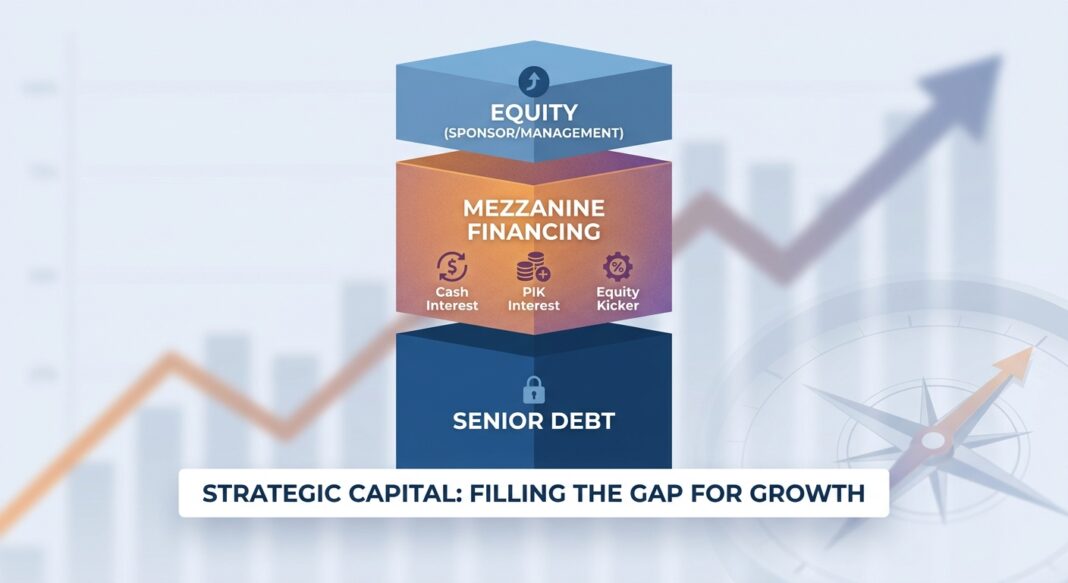
The Capital Stack Gap: When Senior Debt Runs Out and Equity Costs Too Much
You have found a bolt-on acquisition. The target generates $4M of EBITDA. The purchase price is $28M, seven turns. Your senior lender will stretch to 4.0x, which yields $16M. Sponsor equity fills another $8M. That still leaves a $4M gap sitting between the top of your senior facility and the bottom of your equity check. This is the zone that mezzanine financing was purpose-built to occupy.
For growth-stage and lower-middle-market operators, this gap is not an edge case; it is the rule. In 2026, a lower-middle-market business can typically raise 3.0x to 5.5x TTM EBITDA in senior debt, another 1.0x to 2.0x in mezzanine, and equity capacity is limited only by how much of the company the owner is willing to sell. The question is never whether the gap exists. The question is how to fill it at the lowest blended cost while preserving enough operational control to execute the strategy.
While headlines on private credit have focused on high-profile defaults and concerns about late-cycle excess, the companies making capital decisions in this segment are leaning in, engaging with private capital partners, blending it with traditional bank financing, and using it to fund growth rather than to patch the balance sheet. Understanding how to structure that blend (and where mezzanine fits) is the core practitioner skill this article develops.
Structure Breakdown: The Three Components of a Mezzanine Facility
Mezzanine financing is subordinated debt that ranks below senior loans and above equity in a company’s capital structure. That positional definition understates what mezzanine actually delivers. In practice, it is a three-component instrument, and each component carries a distinct cost.
Component 1: Cash Interest
A mezzanine facility is typically structured as a subordinated loan with a base interest rate paid monthly or quarterly, typically 8% to 14% per year depending on the company’s risk profile and market conditions. This is the current-pay coupon, the cash that leaves your account each quarter.
Component 2: Payment-in-Kind (PIK) Interest
Under a PIK arrangement, the borrower pays part or all of the interest by issuing additional debt notes rather than cash. The outstanding balance compounds each period, and the investor receives cash only when the PIK portion is repaid at bullet. PIK is the structure’s most misunderstood feature. PIK interest accrues on the principal balance instead of being paid in cash and compounds over the life of the facility, increasing the effective cost of borrowing over time. For an operator managing tight post-close cash flows, PIK is valuable liquidity preservation. For an operator who delays exit, it becomes a compounding liability.
Effective PIK structures include carefully tailored triggers that constrain or condition PIK elections. Performance-based triggers might require a minimum liquidity threshold, a maximum leverage ratio, or positive free cash flow before permitting cash-pay toggling. Alternatively, time-based triggers may allow PIK for an initial period, with a step-down to partial cash-pay thereafter. Negotiate these triggers explicitly; they define your cash flexibility window.
Component 3: The Equity Kicker
The equity kicker (warrants, conversion rights, or a direct equity stake) allows the mezzanine lender to participate in the company’s upside. This is the component that makes mezzanine dilutive even though it is structured as debt. Warrant coverage typically targets 1–5% of fully diluted equity. Every warrant granted to a mezzanine lender dilutes existing common equity. In a successful exit, the mezzanine lender’s equity kicker reduces the return available to the PE sponsor and management team, a cost that must be weighed against the benefit of reduced upfront equity contribution.
A Worked Example: $28M Acquisition at 7.0x EBITDA
Consider a growth-stage services business with $4M EBITDA acquiring a $28M target:
- Senior Unitranche: $16M at SOFR + 550 bps (all-in ~10.8%), 4.0x leverage, single maintenance covenant (net leverage < 5.5x tested quarterly)
- Mezzanine Tranche: $4M at 10% cash + 3% PIK + warrants covering 3% of equity, delivering the lender a target all-in IRR of 18–20%
- Sponsor Equity: $8M (29% of enterprise value)
- Total Stack: $28M | Blended cost of debt: ~11.5%
In 2026, the all-in cost of mezzanine capital runs 10–14% (cash coupon 8–11% + PIK 2–4% + warrants). Upfront fees add another layer: origination and arrangement fees of 1% to 3% of the facility size are paid at closing. On a $4M facility, that is $40K–$120K in day-one costs before any interest accrues.
Mezzanine vs. Alternatives: Trade-offs Across the Capital Stack
Mezzanine does not exist in isolation. Every operator filling the gap must evaluate it against two primary alternatives: unitranche debt (which collapses senior and mezz into a single instrument) and additional equity (which eliminates the gap by expanding the equity contribution).
Mezzanine vs. Unitranche
Unitranche debt is a single-tranche term loan that combines what would otherwise be a senior secured loan and a subordinated or mezzanine loan into one instrument. From the borrower’s perspective, there is one loan document, one lender or one lender-led syndicate, one set of covenants, one interest rate, and one prepayment schedule. The simplicity premium is real. Speed advantage: 45–90 day unitranche close vs. 90–150 days for traditional senior plus mezz syndication; this matters most for buyers running roll-up platforms with frequent add-ons. However, unitranche wins on execution, not necessarily on cost. Traditional senior plus mezzanine can achieve a lower weighted cost of capital if mezz carries equity kickers, but intercreditor complexity slows execution and reduces flexibility.
Mezzanine vs. Additional Equity
The equity alternative eliminates debt service and covenant pressure but carries a much higher implicit cost. Sponsors use mezzanine to reduce equity contribution because even at 15–20% yields, mezzanine is cheaper than the 20%+ returns expected on equity. The structural logic is clear: if your sponsor targets a 22% IRR on equity but a mezzanine fund will take the same risk layer at 18% all-in, the spread funds real returns for common holders.
When Mezzanine Wins
Mezz wins when the deal is too large for SBA, equity capacity is limited, and the target generates predictable free cash flow. Despite the unitranche’s rise, traditional mezzanine debt has not disappeared. It remains relevant in very large transactions where unitranche lenders cannot provide the full quantum of debt needed, situations where the borrower wants to minimize total cost by maximizing cheap senior debt separately, deals where the sponsor or management team wants equity kickers to align lender incentives, and portfolio company add-on financings where existing credit agreements restrict additional senior debt.
When Mezzanine Loses
Mezzanine underperforms in three scenarios: when the business has cyclical revenue that makes PIK compounding risky; when the deal size falls below $10M (the economics do not justify the intercreditor negotiation); and when the exit timeline is uncertain. When borrowers elect PIK interest, the outstanding balance compounds, increasing total debt burden. If the anticipated liquidity event is delayed, the growing PIK balance creates a larger refinancing burden at bullet maturity, a risk that can become severe in deteriorating markets.
Current Market Terms: What the 2026 Mezzanine Market Actually Looks Like
In 2025–2026, mezzanine funds have seen renewed interest as investors seek strategies with built-in cash yields in a higher-rate environment. Several structural features define the current market:
Pricing Benchmarks
The cost structure for mezzanine in 2026 is: 8–12% cash interest + 2–4% PIK (paid-in-kind, accrues to principal) + warrants or equity co-investment (1–5% equity) creating 16–22% all-in IRR. For senior debt beneath it, unitranche from major direct lenders prices at SOFR + 550–700 bps for LMM deals, with the blended acquisition stack running approximately 11–14% pre-tax when sponsor equity, senior debt, and mezzanine are weighted together.
Leverage Capacity
The choice becomes: senior bank loan (limited to 3–4x leverage typically) plus seller financing, or unitranche at 4–5x leverage. Adding a mezzanine tranche extends that to 5.5–6.5x in the lower middle market for businesses with stable, recurring revenue profiles.
Covenant Architecture
The covenant environment has bifurcated sharply between large corporate and middle-market deals. Covenant-lite institutional leveraged loans represented 91.7% of large corporate new-issue institutional loans in the United States in 2024, according to PitchBook LCD. But in private credit mezzanine, the story is different. Not all private credit is covenant-lite. Middle-market direct loans often still include at least one maintenance covenant, such as a leverage ratio, reflecting the tighter documentation in bilateral or club deals.
The distinction matters practically. A maintenance covenant requires the borrower to meet certain financial metrics on a regular basis, such as quarterly. An incurrence covenant is only tested if the borrower takes a specific action, like attempting to take on more debt. Unlike incurrence covenants which only trigger when borrowers attempt restricted activities, maintenance covenants create ongoing compliance obligations tied directly to financial performance. Maintenance covenants serve as early warning systems for lenders, triggering defaults 12–18 months before payment failures when companies can still be restructured. For middle-market mezz borrowers, expect a single maintenance covenant, typically a net leverage ratio, tested quarterly at a 20–25% cushion to closing levels.
Private Credit AUM and Lender Universe
Global private credit assets under management reached about $2.1 trillion in 2025, up from $1.5 trillion a year earlier. That dry powder is competing for the same LMM deal flow, which means: lenders continue to hold substantial dry powder, while new issuance remains limited and lender demand is high, keeping terms competitive for regular-way credits. Borrowers with clean financials, recurring revenue, and a credible growth plan are negotiating from a position of relative strength.
The Gap Capital Playbook: Quantifying, Preparing, and Negotiating Your Mezzanine Raise
Step 1: Quantify the Gap Precisely
You raise capital by identifying a specific dollar need tied to a specific use of proceeds, matching that need to the cheapest instrument that will not compromise operational control, and then running a structured process to source that capital from qualified investors or lenders. The gap calculation is: (Purchase Price + Transaction Costs) − Senior Debt Capacity − Equity Available = Mezzanine Quantum. Do not round up. Excess mezzanine is expensive capital you are paying PIK on every quarter.
Step 2: Prepare Lender-Ready Materials
Mezzanine financing is typically reserved for high-growth, established middle-market businesses. Lenders in this segment commonly require demonstrated, stable EBITDA of at least $2.5M and an annual revenue growth rate of 15% or more. At minimum, prepare: three years of audited financials, a quality-of-earnings report, a detailed LTM management EBITDA bridge, a 5-year operating model with three scenarios, and a clear use-of-proceeds narrative. The narrative matters. Mezzanine lenders are not just underwriting your current cash flow; they are underwriting the exit multiple that will repay their PIK balance and make their equity kicker valuable.
Step 3: Run the Process Concurrently
Most mezzanine closings take 30–60 days from term sheet to funding. The intercreditor agreement negotiation with the senior lender is typically the longest step. Starting both processes simultaneously can shave weeks off the timeline. Engage your senior lender and mezzanine provider in parallel from the outset. Do not wait for a signed senior term sheet before approaching mezz funds, the intercreditor negotiation is substantial and delay is costly.
Step 4: Negotiate Structure, Not Just Rate
The rate is the headline. The structure is what governs you for five years. Four terms that operators must negotiate hard on:
- Warrant Coverage and Strike Price: Push for warrants struck at current enterprise value (not a discount), with a clear buyback right at a defined formula price, typically a fixed IRR floor. If the borrower elects to prepay the mezzanine instrument, the agreement should clarify whether make-whole or call protection applies to both the debt and the warrant value, and how capitalized PIK is factored into any premium calculation. Failure to define these aspects with specificity is a frequent source of post-closing disputes, especially when the company outperforms and the equity kicker becomes valuable.
- PIK Toggle Triggers: Insist on a PIK toggle that allows you to elect PIK when free cash flow falls below a defined threshold, not as a permanent feature. This protects cash in lean periods without permanently increasing your debt burden.
- Call Protection Windows: Standard mezz carries no-call periods of 12–24 months followed by declining prepayment premiums (typically 3-2-1). Negotiate a shorter no-call window if you expect a near-term refinancing catalyst.
- Covenant Headroom: Covenant erosion through aggressive EBITDA add-backs, large grower baskets, and ratio-based exceptions can weaken protections. In 2024, market caps on pro forma cost savings add-backs clustered around 25–35% of EBITDA. As a borrower, push for maximum add-back flexibility in the maintenance covenant definition; this is where deals live or die after a slow quarter.
Key Takeaways
- The gap is structural, not situational. Senior debt caps at 3.5–5.5x EBITDA for most LMM deals. Mezzanine’s 1.0–2.0x incremental capacity is often the only way to close a 6–7x purchase price without over-equitizing.
- All-in cost requires a three-component calculation. Cash coupon (8–12%) + PIK accrual (2–4%) + equity kicker dilution = a true all-in cost that frequently exceeds headline rate by 400–600 bps. Model all three before accepting a term sheet.
- PIK is a liquidity tool, not a free lunch. Compounding PIK on a 5-year facility at 3% turns $4M of initial principal into ~$4.6M at maturity, before the equity kicker activates. Understand the exit math before electing PIK as a default.
- Covenant architecture is the governance question. Middle-market mezzanine retains maintenance covenants where large-cap syndicated markets have gone cov-lite. Negotiate headroom at close, the leverage test cushion you agree to is the ceiling on operational flexibility for years.
- Run senior and mezz processes in parallel. The intercreditor agreement between senior and mezzanine lenders is the critical path item. Starting it late is the single most common cause of delayed closings on layered capital stack transactions.


