
The Growth-Stage Financing Gap: When Senior Debt Runs Out and Equity Costs Too Much
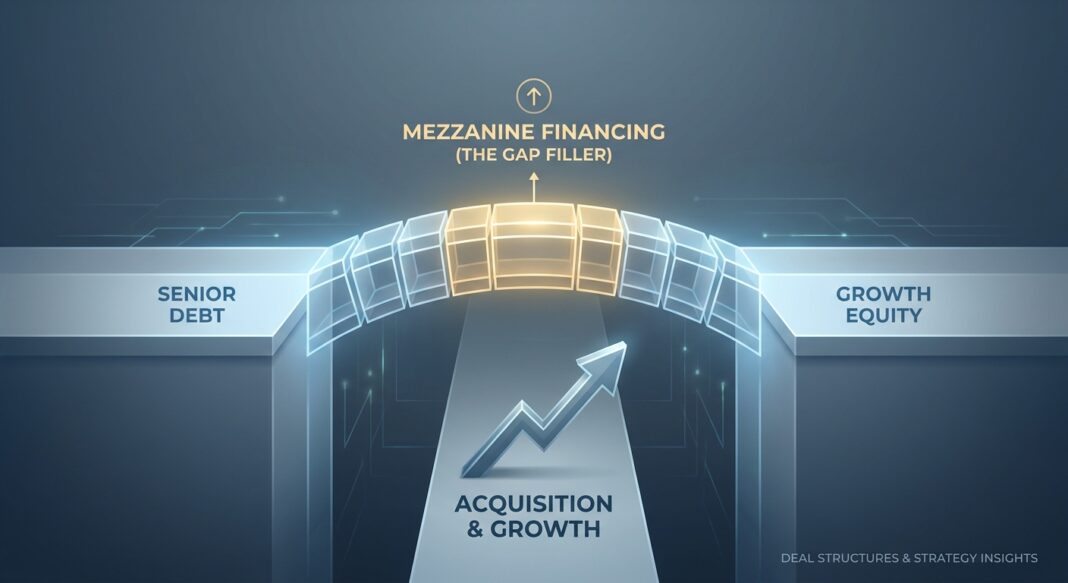
You have found the acquisition target. The enterprise value is $40M. Your senior lender will stretch to 3.5x EBITDA, call it $17.5M on a $5M EBITDA business. You are bringing $10M in equity. That leaves a $12.5M gap between what the bank provides and what the deal requires. This is the defining capital structure challenge for growth-stage operators and independent sponsors in 2026: the financing is partially fundable at bank rates, but not fully. The residual need sits in a layer of the capital stack that is neither cheap enough to ignore nor expensive enough to abandon the deal.
That layer is mezzanine debt, the subordinated, hybrid instrument positioned between senior secured debt and equity, carrying cash interest, payment-in-kind (PIK) accretion, and often an equity kicker in the form of warrants. Used correctly, it closes acquisition financing gaps, preserves sponsor equity, and enables deals that a pure senior debt structure cannot support. Used incorrectly, it over-levers the business and transfers value to the lender through warrant dilution at exit.
This article maps the use-of-proceeds logic that makes mezzanine the rational choice, breaks down the instrument’s mechanics at current 2026 market terms, compares it structurally against unitranche and growth equity alternatives, and walks operators through the process of quantifying the gap, preparing materials, running the process, and negotiating the structure.
Mapping the Cost of Capital: From Bank Debt to Equity
Every financing decision for a growth-stage company starts in the same place: a cost-of-capital spectrum that runs from the cheapest, most restrictive source (senior secured bank debt) to the most expensive, most flexible source (common equity). Understanding where each layer sits (and what access criteria each layer demands) is the prerequisite to filling any capital gap intelligently.
| Capital Layer | 2026 All-In Cost | Typical Leverage | Key Access Criteria |
|---|---|---|---|
| SBA 7(a) / Conventional Bank | 10–11% (Prime + 2.25–3.25%) | 3.0–3.5x EBITDA | Personal guarantee, 1.25x DSCR, sub-$5M SBA cap |
| Unitranche (Direct Lending) | 9.5–11% blended (SOFR + 500–700 bps) | 4.0–6.0x EBITDA | $10M+ EBITDA, sponsor-backed preferred, single covenant |
| Mezzanine Debt | 12–15% cash + PIK + warrants (16–22% all-in IRR) | 1.0–1.5x EBITDA incremental (layers over 3.0–3.5x senior) | Stable FCF, definable exit, subordination to senior lender |
| Preferred Equity / Growth Equity | 18–25% IRR target | N/A (equity, not leverage) | Minority ownership, board or information rights, growth thesis |
| Common Equity (Sponsor / Management) | 20–30%+ IRR expected | N/A | Full dilution risk, residual claim only |
The practical implication of this spectrum is straightforward: every dollar you fund with senior debt instead of mezzanine, and every dollar you fund with mezzanine instead of equity, reduces your weighted average cost of capital and preserves sponsor returns. The discipline of the gap capital playbook is to use the cheapest available dollar first, then layer up the stack only as much as the business’s cash flow can service.
Mezzanine Financing: Component Breakdown and 2026 Market Terms
What Mezzanine Actually Is
Mezzanine debt is a hybrid instrument that combines features of both debt and equity. It is subordinated to senior secured lenders in the capital stack but sits ahead of common equity in the event of default or liquidation. In its most common form, it includes three economic components that together determine the lender’s all-in return:
- Cash Interest: A current-pay coupon, typically 8–12% in 2026, paid quarterly or semi-annually from the company’s operating cash flow. This is the primary yield component and represents the borrower’s most visible cash cost.
- PIK (Payment-in-Kind) Interest: A deferred interest component that accrues to the outstanding principal balance rather than being paid in cash, typically 1–3% in 2026. PIK is designed to preserve working capital in the near term but compounds over the life of the instrument, meaningfully increasing the effective cost of borrowing at maturity. Borrowers must model PIK accretion carefully: a $10M mezzanine note at 2% PIK over five years becomes approximately $11.1M of principal at repayment before any cash interest consideration.
- Equity Kicker (Warrants): Warrants or conversion rights that allow the mezzanine lender to purchase a percentage of the company’s equity at a pre-agreed strike price, typically representing 1–5% of the fully diluted capitalization. This is what elevates the lender’s target IRR from the 12–15% all-in debt yield to the 16–22% all-in return target that characterizes institutional mezzanine underwriting. The equity kicker is the most heavily negotiated term in any mezzanine transaction.
2026 Market Pricing: Where the Numbers Actually Land
Current market data provides a clear benchmark for growth-stage operators entering the mezzanine market in 2026:
- All-in yield on LMM mezzanine: 12–15%, split between a 10–12% cash coupon, 1–3% PIK, and 1–2% of equity warrant coverage, per recent investor call disclosures from Golub Capital, Monroe Capital, and Twin Brook.
- Leverage incremental to senior: Mezzanine typically adds 1.0–1.5x EBITDA of leverage on top of a senior debt position of 3.0–3.5x, taking total leverage to 4.0–5.0x EBITDA for LMM acquisition financings.
- Capital supply context: Preqin data through Q1 2026 records global private debt AUM at approximately $2.1 trillion, up from $1.5 trillion at end-2023, with ongoing capital formation creating a supply-demand dynamic that, at the $50M–$150M EV size range, is producing modest coupon compression and warrant compression for quality credits.
- Independent sponsor premium: Independent-sponsor transactions typically price 50–100 basis points wider than PE-sponsor deals of comparable size, reflecting the absence of a sponsor guarantee of follow-on equity.
Illustrative Structure: $40M Acquisition of a $5M EBITDA Distribution Business
Target: Regional distribution company, $5M EBITDA, stable FCF, low capex intensity
Enterprise Value: $40M (8.0x EBITDA)
Capital Stack:
Senior Secured (Conventional Bank / Unitranche): $17.5M @ 3.5x EBITDA, SOFR + 575 bps (~10.5% all-in)
Mezzanine Tranche: $12.5M @ 2.5x EBITDA incremental leverage, 11% cash + 2% PIK + 3% warrant coverage (1.5% fully diluted equity)
Sponsor Equity: $10M (25% of EV)
Total Leverage: 6.0x EBITDA
Cash Interest Burden (Year 1): ~$3.2M (~64% of EBITDA, with remaining FCF for amortization and operations)
Mezz Note Maturity: 6 years, bullet repayment, subordinated to senior via intercreditor agreement
Covenant Package: Maximum leverage of 6.5x at close stepping to 5.5x by year 3; minimum fixed charge coverage of 1.15x, tested quarterly
This structure is illustrative of the access-versus-cost trade-off that defines mezzanine use in growth-stage acquisition financing: the $12.5M mezzanine tranche is more expensive than senior debt, but it is the only instrument that closes the financing gap without surrendering material equity to a third-party growth investor.
Mezzanine vs. Unitranche vs. Growth Equity: The Structural Trade-Off
Mezzanine vs. Unitranche
The most common structural question in the middle market today is whether to use a unitranche facility (a single-tranche instrument from one direct lender combining what would otherwise be senior and subordinated debt) or a traditional senior-plus-mezzanine split. The unitranche has largely displaced the senior-plus-mezz structure for acquisitions in the $25M–$200M EV range, with roughly 70–80% of deals in that band now using at least partial unitranche funding from lenders such as Ares, Blue Owl, Antares, Twin Brook, and Apollo.
The unitranche wins on simplicity: one lender, one credit agreement, one covenant package, no intercreditor negotiation. The execution advantage is real, unitranche deals can close 30–45 days faster than a bifurcated senior-plus-mezz structure, and sponsors routinely justify 50–100 basis points of extra spread for certainty of close. The unitranche is the right tool when the deal size and leverage quantum fall within a single direct lender’s underwriting capacity.
Traditional mezzanine remains relevant in three specific scenarios: (1) deals where the borrower wants to maximize cheaper senior debt separately and layer in subordinated capital at minimum warrant dilution; (2) very large transactions where no single direct lender can fund the full quantum; and (3) add-on acquisitions where the existing credit agreement restricts additional pari passu senior debt. In those situations, a discrete mezzanine tranche from a BDC or specialty fund fills the gap without disturbing the primary senior credit relationship.
Mezzanine vs. Growth Equity
The comparison against growth equity is fundamentally a dilution versus leverage question. A growth equity minority investor targeting 18–25% IRR will take 15–25% of the company’s equity. A mezzanine lender targeting 16–22% all-in IRR via cash interest, PIK, and warrants will take 1–5% fully diluted equity via the kicker. For a founder or operator who believes the business will sell at 8–10x EBITDA in five to seven years, the mezzanine lender is almost always the cheaper source of gap capital on a dilution-adjusted basis, assuming the business can service the cash interest.
The failure mode of mezzanine over growth equity is over-leverage: if the business encounters revenue softness or margin compression, the cash interest and PIK burden can create a debt service spiral that a growth equity investor with no fixed interest obligation would not create. The selection rule is therefore cash-flow-dependent: mezzanine is optimal when the business generates stable, predictable free cash flow with a coverage ratio of at least 1.5x on the total debt service at closing leverage.
Current Market Terms and Structural Standards: Mid-2026
The mezzanine and direct lending market in mid-2026 reflects a competitive but disciplined environment for borrowers with quality assets and defined exit paths. Key structural benchmarks include:
- Pricing band: All-in yields on 2026 LMM mezzanine paper typically run 12–15%, split between a 10–12% cash coupon, 1–3% PIK, and 1–2% of equity warrant coverage. Independent-sponsor deals price 50–100 basis points wider than PE-sponsored transactions of comparable size.
- Leverage capacity: Mezzanine adds 1.0–1.5x EBITDA incremental leverage over a senior base of 3.0–3.5x, taking total leverage to 4.5–5.0x for most LMM acquisition financings.
- Covenant design: Middle-market mezzanine maintains quarterly-tested maintenance covenants as a structural standard, unlike the broadly syndicated loan market where covenant-lite (incurrence-only) structures represent over 85–90% of institutional issuance. In the lower middle market (EBITDA below $50M), the vast majority of loans retain full financial maintenance covenant packages including maximum leverage and minimum fixed charge coverage, tested quarterly. Maintenance covenants require borrowers to pass financial tests every period regardless of any action taken, whereas incurrence covenants only apply when the borrower takes a specific action such as incurring new debt or paying a dividend. This distinction matters for lender intervention rights and restructuring leverage.
- Warrant compression at scale: The aggregate supply-demand dynamic in 2025–2026, with Preqin recording $312B of private credit fundraising in 2025, is producing warrant compression and modest coupon compression at the upper end of the LMM deal size range ($50M–$150M EV), while sub-$25M EV deals have seen sticky pricing.
- Lender negotiating posture: The market for debt financing remains highly competitive, meaning borrowers retain meaningful negotiating leverage, particularly on covenant headroom, PIK toggle mechanics, and warrant strike prices. Lenders in the lower middle market will often drop most-favored-nation provisions entirely if presented with a competitive term sheet process.
The Gap Capital Playbook: Quantifying the Need, Preparing Materials, Running the Process
The mezzanine raise is not a passive exercise. It is a structured process with a defined sequence of steps, each of which either compresses or extends your timeline and either improves or degrades your ultimate terms. Here is the practitioner’s playbook for a growth-stage operator entering the mezzanine market to fund an acquisition.
Step 1: Quantify the Gap with Precision
The gap is not “the difference between what I need and what the bank gives me.” The gap is a precisely modeled number derived from a sources-and-uses table that ties every dollar of the acquisition consideration (purchase price, closing fees, working capital adjustments, transaction expenses) to a specific funding source. Before approaching any capital provider, you must be able to answer: What is the total financing need? What will senior debt cover at the highest responsible leverage? What equity are you contributing? What remains? That residual is the gap, and the precision of its quantification determines whether a mezzanine provider takes you seriously in the first meeting.
Step 2: Build the Materials Package
A complete mezzanine materials package has four components. First, a use-of-proceeds memo: a precise, one-page document mapping every dollar from sources to uses and demonstrating how the acquisition creates EBITDA accretion. This is not a narrative; it is a schedule with line items. Second, a three-year integrated financial model: revenue, EBITDA, debt service, and free cash flow with sensitivity tables on two variables (revenue growth rate and EBITDA margin compression) to show how much degradation your structure can absorb before covenants trip or cash runs short. Third, a management presentation covering the strategic rationale, competitive moat, customer concentration risk, and a clearly articulated exit pathway, since mezzanine providers hold for five to seven years and need to underwrite your eventual refinancing or sale. Fourth, a clean cap table showing pre- and post-transaction ownership, fully diluted, any ambiguity here extends diligence timelines significantly.
Step 3: Curate the Right Lender Universe
The mezzanine market is not homogeneous. BDCs such as Ares Capital, Blue Owl, Main Street, and FS KKR operate across the size spectrum but tend to concentrate at $10M+ EBITDA. Specialty mezzanine funds such as Audax Mezzanine, Madison Capital, Maranon Capital, and Twin Brook have defined size preferences and sector concentrations. Family offices doing direct mezzanine can be more flexible on warrant terms but require longer diligence. Matching your deal size, industry, and risk profile to the right segment of this universe determines whether you run a competitive process or a bilateral negotiation, and competitive processes almost always produce better economics.
Step 4: Run the Process with Discipline
A well-run mezzanine process follows a defined arc: confidential information memorandum and management presentation distributed under NDA to 15–25 targeted providers; management calls within two weeks; term sheets collected within 30 days of launch; preferred term sheet selected and exclusivity granted for diligence; credit committee approval and final documentation executed within 45–60 days of exclusivity. The critical discipline is running the process in parallel with the senior debt process, not sequentially, mezzanine providers need to see a senior term sheet to understand their intercreditor position, but waiting for senior approval before approaching mezz adds six to eight weeks to an already compressed acquisition timeline.
Structuring Guidance: What to Negotiate and Where the Value Is
For Operators and Borrowers
The most important negotiation in a mezzanine term sheet is not the interest rate; it is the warrant strike price, the warrant coverage percentage, and the definition of equity value for purposes of warrant exercise. These three variables together determine how much of your exit proceeds the mezzanine lender captures. A 3% warrant position at a $40M strike is a very different economic outcome than a 3% warrant position at a $30M strike on a business you intend to sell for $80M in five years. Negotiate the strike price at or above the current enterprise value, push for a defined call right allowing you to repurchase warrants at a formula-based price before exit, and resist any provision that allows the lender to convert warrants into a board observer seat.
On covenant headroom, insist on an EBITDA cushion of at least 20–25% between projected performance and the initial maintenance covenant level. Lenders will model to 10%; you should negotiate to 20–25%. The cushion is not about expecting to miss; it is about preserving operational flexibility during integration, seasonality, or market disruption without triggering a technical default and the associated fee and amendment process.
On PIK mechanics, negotiate a PIK toggle rather than mandatory PIK: the ability to elect cash or PIK payment on a period-by-period basis, subject to a liquidity test. This preserves flexibility to service the instrument in cash when cash flow is strong, reducing total compounding cost, while protecting against forced cash payment during periods of stress.
For Investors and Lenders
The underwriting discipline that matters most in LMM mezzanine is not the entry multiple; it is the exit scenario analysis. Model three scenarios: a base case at the acquisition thesis, a downside at 20% EBITDA compression, and a stress case at 35% EBITDA compression. In each scenario, stress-test the coverage ratio, the PIK accretion rate, and the warrant value at exit. The warrant kicker that looks attractive in a base case can destroy IRR in a stress case if it forces a restructuring conversation before your recovery on the debt itself is fully protected.
Covenant calibration is the lender’s primary risk management tool. A maximum leverage maintenance covenant tested quarterly gives you 90-day early-warning windows into borrower deterioration, a structural advantage that covenant-lite unitranche lenders in the upper middle market have traded away for deal flow. In the lower middle market, insist on maintaining the full covenant package. Regular testing reinforces financial discipline and provides lenders with visibility into credit deterioration well before a payment default or insolvency event.
Key Takeaways
- Mezzanine fills the gap that senior debt cannot and equity should not: When a deal’s financing need exceeds senior leverage capacity but full equity dilution would destroy sponsor returns, mezzanine is the structurally rational instrument, provided the business generates stable free cash flow sufficient to service the combined interest burden at 1.5x coverage or better.
- The all-in cost is 16–22% IRR, not the stated coupon: The 10–12% cash coupon understates the true cost of mezzanine capital. PIK accretion compounds principal, and warrant coverage transfers equity value to the lender at exit. Model all three components together, stress-test the warrant dilution at multiple exit multiples, and compare that total cost against the dilution cost of a growth equity alternative before selecting the instrument.
- Covenant design is a risk management variable, not a boilerplate: In the lower middle market, quarterly-tested maintenance covenants remain the standard and provide the lender with critical early-warning intervention rights. Borrowers should negotiate headroom of 20–25% over projected performance; lenders should treat any erosion of this package as a pricing event.
- The process determines the terms: A competitive mezzanine raise (15–25 targeted providers, parallel execution with the senior debt process, term sheets collected within 30 days of launch) produces materially better warrant terms and covenant headroom than a bilateral negotiation with a single known provider. The work to curate a precise lender universe pays for itself in the first negotiation round.
- The PIK toggle is the most underutilized borrower protection in the term sheet: Mandatory PIK locks you into compounding principal regardless of cash flow performance. A PIK toggle (electable period by period, subject to a liquidity test) gives you the flexibility to service the instrument in cash when the business performs, reducing total exit proceeds owed to the mezzanine lender while retaining protection against forced cash payment during integration stress.


