
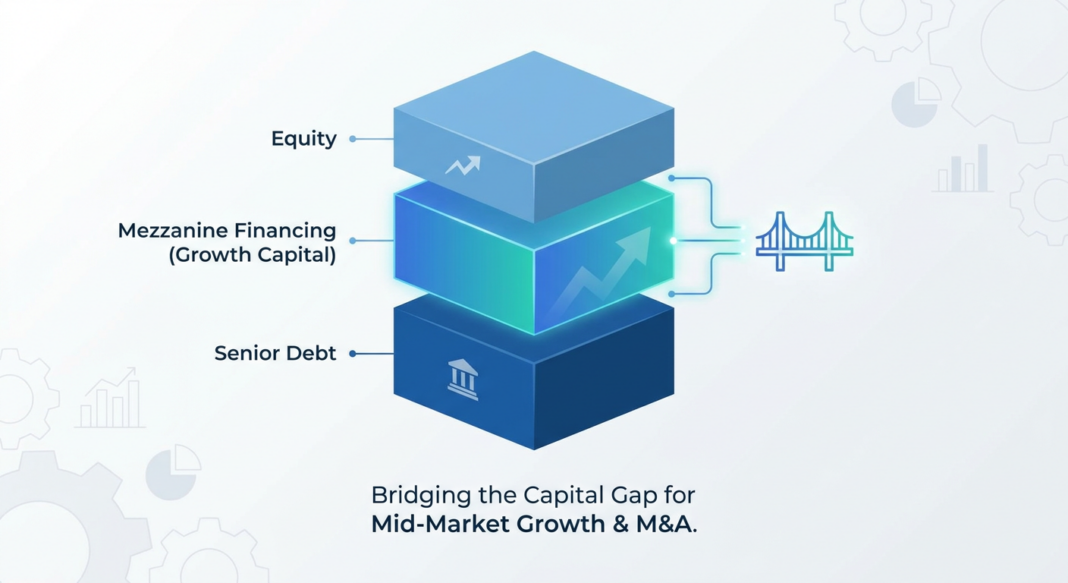
The Acquisition Financing Gap That Senior Debt Won't Cover
You've built $6M in EBITDA. Your bank will lend you 3.0x, maybe 3.5x on a great day. That gets you to a $21M facility. But the acquisition you're targeting is a $55M enterprise value. The equity you want to commit is $15M. The math leaves an $18M–$19M hole in your capital structure. That hole is the domain of mezzanine financing.
For growth-stage and mature mid-market operators (companies with $3M–$20M in EBITDA pursuing bolt-on acquisitions, platform roll-ups, or ownership transitions) mezzanine debt is the structural instrument that unlocks deals which senior lenders won't fully finance and which equity investors would price at a level that destroys founder economics. Understanding where it sits in the capital stack, how it's priced, and how to negotiate its terms is not optional for any practitioner working in growth-stage M&A or private capital deployment in 2026.
This article is a deep structural breakdown of mezzanine financing: its components, mechanics, comparative trade-offs against unitranche and senior-only structures, current market terms, and a tactical playbook for operators and capital advisors navigating the process.
Structure Breakdown: Components and Mechanics
Where it sits: Mezzanine debt is a hybrid form of capital that combines features of both debt financing and equity financing. It sits between senior secured debt and common equity in the capital stack, subordinated to the senior lender's claims in any recovery scenario, but senior to all equity. That structural subordination is precisely why it commands a premium return: a typical performing mezzanine loan is expected to yield 12.5–14% for the lender, compared to senior bank debt in the 7–8.5% all-in range today.
The Three Core Economic Components
1. Cash Interest + PIK Toggle. Mezzanine loans often include two types of interest payments, giving the borrower flexibility in managing cash flow. Cash interest is paid periodically (monthly or quarterly) while Payment-in-Kind (PIK) interest is capitalized and added to the principal balance, deferring the cash outflow. A typical split: 8% cash pay + 4% PIK, yielding a 12% total coupon to the lender while preserving near-term liquidity for the borrower. Borrowers favor PIK mechanics primarily to conserve cash during integration periods, capex cycles, or market downturns.
2. Equity Kicker (Warrants). Warrants act as an equity kicker, letting lenders share in the company's upside value if it grows. Warrant coverage typically ranges from 3–8% of the loan amount, granting the lender the right to acquire equity at a pre-negotiated strike price. This equity participation is the mechanism that allows mezzanine providers to target total returns of 15–20%+ on a successful exit, while accepting a below-market coupon on the cash pay component. In successful exits, the equity kicker can significantly increase the lender's overall return, which effectively raises the cost for the borrower.
3. Subordination and Intercreditor Mechanics. Mezzanine lenders are structurally last among debt holders in any liquidation or restructuring scenario. If your senior covenants are breached, mezzanine payments can be blocked entirely until the senior default is cured, a feature called a "standstill" that the intercreditor agreement codifies. Operators must model this scenario explicitly: in a credit-stress environment, the mezz tranche is not merely expensive; it is structurally silenced.
Illustrative Example: A $55M Acquisition by a $6M EBITDA Platform
Consider a regional professional services platform with $6M EBITDA acquiring a competitor for $55M (9.2x EV/EBITDA). The sponsor contributes $15M equity (~27%). The senior lender extends $22M (3.7x leverage) at SOFR + 375bps (~9.0% all-in). That leaves a $18M gap.
- Mezzanine tranche: $18M at 13% total coupon (9% cash + 4% PIK), 5-year maturity, bullet repayment
- Warrant coverage: 5% of loan amount, exercisable at a $50M equity valuation strike
- Origination fee: 2% upfront ($360K)
- OID: 1.5% ($270K amortized over 5 years)
- Call protection: 3% / 2% / 1% declining prepayment premium in years 1–3
The borrower's all-in blended cost across senior + mezz: approximately 10.5–11% cash pay on funded debt. When you factor in all components, the total effective return to the lender (and cost to the borrower) is often 20–30% annually when warrants are exercised at a strong exit multiple. This is the deal a sophisticated operator accepts when the alternative is giving up 25–30% of the business to a growth equity fund at a compressed entry valuation.
Mezzanine vs. the Alternatives: Trade-Offs and When Each Structure Wins
vs. Unitranche
Unitranche debt combines senior and subordinated debt into a single tranche from one direct lender, typically offering 4x to 6x leverage at blended rates of 8–11% in the lower middle market. The core appeal is execution: unitranche wins on speed (45–90 day close vs. 90–150 days for broadly syndicated loans) and structural simplicity. One credit agreement, one set of covenants, no intercreditor negotiation.
The comparison on all-in pricing is closer than borrowers expect. A traditional senior + sub structure priced at SOFR + 350–450 for senior plus 11–13% cash + 2–3% PIK for sub, on a 50/50 split, comes in at approximately 9–10.5% all-in, only marginally cheaper than unitranche, with materially more execution complexity. Mezz makes structural sense when the deal requires leverage above what a single unitranche provider will stretch to, when the borrower wants to preserve an existing senior banking relationship, or when the mezz provider's warrant structure offers strategic flexibility that a pure debt product won't.
vs. Growth Equity
According to Carta's State of Private Markets data, median dilution in 2025 sits at approximately 19.5% for seed rounds and 18% for Series A rounds, with Series A investors generally targeting 15–30% ownership. For a profitable mid-market operator using equity to fill a $18M financing gap, the dilution math is severe relative to a mezzanine instrument with 3–5% warrant coverage. Mezzanine preserves more of the cap table, the core trade-off is cash flow burden versus ownership retention.
vs. Second Lien
Second lien debt is a close structural cousin (also subordinated, also higher-yield) but typically lacks the PIK toggle flexibility and equity upside that define mezzanine. Second lien lenders hold a secured lien on assets (priority below the first lien), while mezzanine is typically unsecured or structurally subordinated. In practice, second lien has compressed in size and availability as unitranche displaced it from most middle-market capital structures.
Decision Matrix
| Criterion | Senior Only | Unitranche | Senior + Mezzanine | Growth Equity |
|---|---|---|---|---|
| Leverage Available | 3.0–3.5x | 4.0–6.0x | 5.0–7.0x | No limit |
| Dilution | None | None | Minimal (warrants) | High (15–30%+) |
| Execution Complexity | Low | Low | Moderate–High | High |
| Cash Flow Burden | Moderate | Moderate–High | High | None (until exit) |
| Optimal Use Case | Conservative recap | Mid-market LBO | High-leverage acquisition | High-growth, pre-profit |
Current Market Terms: What the Data Shows in 2025–2026
Understanding where market terms have settled is essential before entering any process. Here is what current deal activity and published benchmarks indicate:
- Mezzanine Coupon Range: Investors can typically target 12–20% total returns from mezzanine debt, comprising 8–12% annual cash coupon, 2–4% PIK accretion, 2–8% equity participation from warrants, and 1–3% fee income. For a performing lower-middle-market company, 12–14% blended (cash + PIK) is the baseline; distressed credits or earlier-stage operators can see 16–18% total yield demands.
- Unitranche Spread for Context: Unitranche facilities typically price at SOFR + 425–475 basis points for sponsored upper middle market transactions, with core middle market credits commanding 50–100 basis points higher, per Capstone Partners' Winter 2025 Leveraged Finance Report. This provides a useful reference floor for structuring the senior leg of a senior + mezz structure.
- Leverage Multiples: Average total leverage in sponsored middle-market deals hovered around 5.0x EBITDA in mid-2024 as lenders focused on free cash flow and covenant headroom. In a traditional senior + mezz structure, senior at 3.0–3.5x and mezz at 1.5–2.0x achieves a 4.5–5.5x total leverage package, the current market ceiling for most sub-$20M EBITDA credits.
- OID and Fees: Average OID on private credit deals ran around 2–3% of funded principal in the first half of 2024. Expect origination fees on the mezzanine tranche of 1–2% in addition to OID. Origination fees of 1–3% of the loan amount, plus legal and due diligence costs ranging from $25,000 to $100,000 on larger deals, are standard transaction costs to model.
- Covenant Structure, A Diverging Market: Over 85% of institutional leveraged loans now lack the quarterly testing that gives lenders early warning of trouble. But private credit (and mezzanine in particular) runs differently: private credit lenders have maintained firmer positions on covenant inclusion, particularly for mid-market transactions, with maintenance covenants returning to many PE-backed deals financed by non-bank lenders. Borrowers should expect a maximum leverage covenant (tested quarterly) and a minimum fixed charge coverage ratio (FCCR) of 1.10–1.25x as standard mezzanine package terms.
- Private Credit AUM Context: Global private credit assets under management reached about $2.1 trillion in 2025, up from $1.5 trillion a year earlier, a competitive lender market that, at the margin, benefits well-prepared borrowers in terms of negotiating leverage and process optionality.
The Gap Capital Playbook: Quantifying, Preparing, Running the Process
Step 1: Quantify the Gap
Before approaching any mezzanine provider, build a sources-and-uses waterfall. Map your acquisition price, transaction costs, and working capital needs against senior debt capacity (typically 3.0–3.5x TTM EBITDA with a conservative bank). The difference between your total funding need and senior capacity plus equity commitment is your "gap." This number drives the mezzanine ask. Undersize it, and you run out of room post-close. Oversize it, and you accept unnecessary dilution through excess warrant coverage.
Step 2: Prepare the Credit Package
Mezzanine debt providers evaluate historical and projected cash flow, growth potential, and ability to service both existing senior debt and the new mezzanine layer: expecting lenders to review EBITDA, coverage ratios, and management track record. Your credit package should include: 3 years of audited financials, a trailing-twelve-months P&L, an integrated acquisition model (combined entity with debt-service waterfall), management bios, and a clear articulation of the post-close deleveraging path. The mezzanine lender is underwriting their exit (either refinancing or sale) so your model must project a credible path to sub-4.0x leverage within 24–36 months.
Step 3: Run a Competitive Process
Mezzanine financing typically takes 4–12 weeks from initial discussion to funding, moving through initial screening and term sheet (1–2 weeks), due diligence including financial review and management interviews (4–8 weeks), and final documentation and closing (1–2 weeks). Approach 4–6 mezzanine providers simultaneously. The competitive tension is your most valuable negotiating tool, both on pricing (cash vs. PIK split, total coupon) and on structural terms (warrant coverage percentage, call protection, covenant cushion).
Step 4: Negotiate the Structure
Key negotiation levers for borrowers in 2026:
- PIK vs. Cash Split: Push for maximum PIK allocation in years 1–2 post-close when integration costs are highest. A 60/40 PIK/cash split in Year 1 shifting to 30/70 in Years 3–5 preserves near-term cash flow while reducing total interest capitalization over the life of the loan.
- Warrant Coverage & Strike Price: Negotiate warrant coverage as a percentage of loan principal, not equity value; this bounds dilution to a fixed economic claim. Push for a strike price pegged to the acquisition EV, not a discount to it. Where equity kickers exist, coordinate valuation mechanics with prepayment terms to avoid double-counting economics.
- Call Protection: Minimize the no-call period and negotiate declining premiums. A 3/2/1 schedule over 3 years is market standard; push for a 2/1/0 schedule if your business plan targets a refinancing event at 24 months post-close (post-deleveraging).
- Covenant Cushion: For sponsors and operators, covenant packages require enhanced focus on realistic covenant cushions and headroom in financial models. Negotiate a minimum 20–25% headroom between your projected leverage and the covenant test level. In a post-acquisition integration year, EBITDA can miss plan, you do not want a covenant breach driving a lender to the table in Year 1.
- PIK Toggle Triggers: Performance-based triggers might require a minimum liquidity threshold, a maximum leverage ratio, or positive free cash flow before permitting cash-pay toggling. Ensure PIK election rights are contractual and not subject to lender consent, lender-discretion PIK is a trap.
Key Takeaways
- Mezzanine fills the structural gap between senior debt capacity (3.0–3.5x EBITDA) and total acquisition leverage needed (4.5–5.5x), making it the critical instrument for mid-market acquisitions above $30M enterprise value where equity alone cannot bridge the gap without excessive dilution.
- The blended cost is 12–14% on a cash + PIK basis, with total lender returns of 20–30% when warrants are exercised at exit, operators must model the full warrant dilution scenario at multiple exit multiples before accepting any term sheet.
- PIK mechanics are a borrower's cash flow lifeline post-acquisition, but compound principal materially over a 5-year term. Model the PIK-accreted principal balance at maturity, not the original principal, when assessing refinancing risk.
- Covenant architecture is bifurcated by market: broadly syndicated loans are 85%+ covenant-lite, while private credit and mezzanine retain quarterly maintenance tests. Borrowers must stress-test covenant headroom against a 15–20% EBITDA miss scenario before signing.
- Run a competitive process with 4–6 providers simultaneously: the private credit AUM at $2.1 trillion in 2025 means capital supply is ample, lender competition on structure and pricing is real, and an uncontested single-lender process leaves economics on the table.


