
Deal Structures & Strategy, Bond Capital
Mezzanine Financing for Growth-Stage Acquisitions: Filling the Capital Stack Gap Without Forced Dilution
Published: September 7, 2026, Bond Capital Editorial Desk
The Capital Stack Challenge at the Growth Stage
A growth-stage operator with $8M–$15M of EBITDA faces a structural ceiling that is rarely discussed plainly: senior debt capacity runs out before the deal is fully funded. Banks and direct lenders will extend senior or unitranche facilities to roughly 3–5x EBITDA, and for a $10M EBITDA business targeting a $90M acquisition at 9x, that buys $45M–$50M of debt. The remainder, call it $20M–$30M, must come from somewhere. The instinct is to reach for equity. The problem is that equity at this stage, with valuations still roughly 40% below their 2021 peaks per late-stage market data, is expensive in dilution terms.
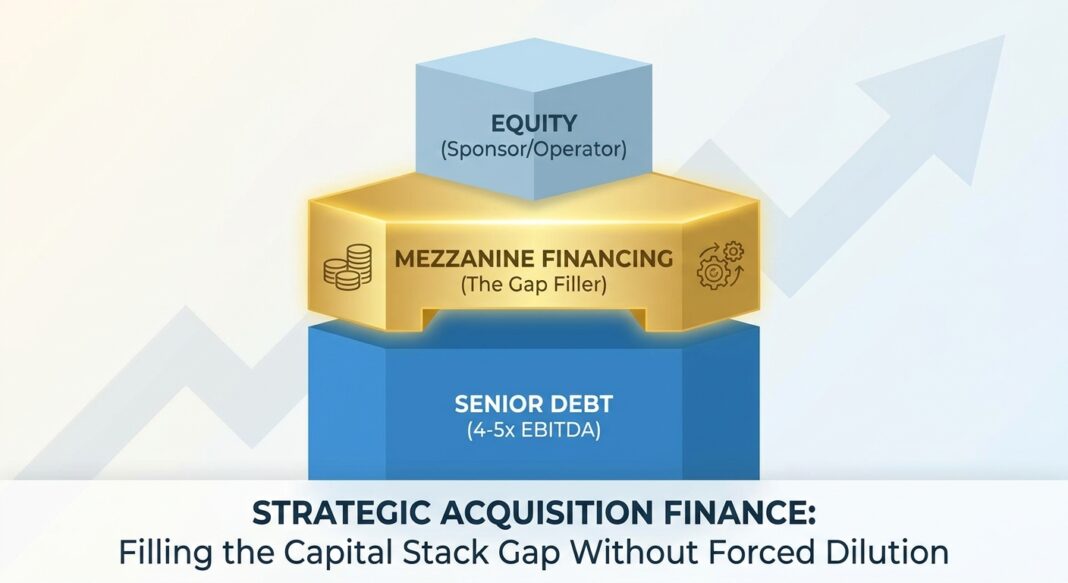
That gap between what senior lenders will fund and what the deal requires is precisely where mezzanine financing operates. Mezzanine is not a fallback or a last resort. Used with discipline, it is a precision instrument: it extends total leverage by 2–3 additional turns, preserves management and sponsor ownership, and structures the incremental cost as a blend of cash interest, deferred PIK, and a bounded equity kicker. The operator keeps control; the mezzanine lender captures a structured return. Understanding how that bargain is priced, covenanted, and negotiated is what separates operators who use mezz as a tool from those who stumble into it as a trap.
Structure Breakdown: Components, Mechanics, and a Worked Example
The Three-Part Mezzanine Return Stack
Mezzanine debt has three defining structural features that distinguish it from senior debt: its subordinated and unsecured position in the capital structure, its Payment-in-Kind (PIK) interest optionality, and its equity kicker, almost always in the form of stock warrants. Each component serves a different economic function in the lender’s return model and a different strategic function in the borrower’s capital stack.
- Cash Interest (8–12%): The base coupon, paid quarterly or semi-annually in cash. This is the current-yield component that funds the mezzanine manager’s own investor distributions. It is non-negotiable and must be modeled as a hard cash outflow from Day 1.
- PIK Interest (2–4%): Payment-in-Kind interest accrues onto the principal balance rather than being paid in cash, compounding over the life of the facility. PIK does not provide current cash income; it accrues as additional principal and is received only at bullet maturity or exit. For the borrower, PIK preserves cash in the early years of the hold; the trade-off is a growing debt balance that creates a larger refinancing burden at maturity if the anticipated liquidity event is delayed.
- Equity Kicker (Warrants, 1–5% of fully diluted equity): Warrants give the mezzanine lender the right to purchase company stock at a predetermined price, allowing participation in upside value creation. This is what makes mezzanine dilutive despite being structured as debt. Every warrant granted dilutes existing common equity, a cost that must be weighed at underwriting against the benefit of avoiding a full priced equity round.
Combined, these three layers produce an all-in IRR for the mezzanine lender of 16–22% including the equity component, expensive by senior debt standards, but materially cheaper than the 20%+ returns demanded on pure equity.
Worked Example: $90M Software Acquisition, $10M EBITDA Borrower
Consider a bootstrapped B2B SaaS operator with $10M of EBITDA acquiring a complementary platform at a 9.0x multiple ($90M enterprise value). The capital stack is constructed as follows:
| Layer | Amount | % of EV | Leverage (x EBITDA) | Pricing / Cost | Provider Type |
|---|---|---|---|---|---|
| Unitranche (Senior) | $45M | 50% | 4.5x | SOFR + 550 bps (~10.0% all-in) | Direct lender (e.g., Ares, Blue Owl, Antares) |
| Mezzanine Note | $18M | 20% | 2.0x incremental (6.5x total) | 10% cash + 3% PIK + warrants (3% equity) | Mezzanine fund / BDC |
| Sponsor / Operator Equity | $27M | 30% | – | Common equity | PE sponsor or family office |
| Total | $90M | 100% | 6.3x blended | – | – |
In this construction, the mezzanine note adds 2.0 turns of leverage that the senior lender would not extend, reducing the equity check by $18M, a material preservation of operator ownership. The cash interest on the mezzanine ($1.8M annually) is serviceable against $10M EBITDA; the PIK accrual ($540K annually) defers to exit; and the 3% warrant coverage is bounded and negotiable.
Key term sheet mechanics for the mezzanine note in this example:
- Maturity: 6–7 years (typically 12–18 months longer than the senior facility)
- Amortization: Bullet repayment at maturity; no scheduled amortization
- OID: 1–2% original issue discount
- Prepayment Protection: 2–3 year no-call or make-whole, declining schedule thereafter
- Security: Second lien on assets or unsecured; subordinated to senior via intercreditor agreement
- Covenants: Single maintenance leverage covenant (typically total net leverage tested quarterly) plus incurrence-based restrictions on additional debt, dividends, and material asset sales
How It Compares: Mezzanine vs. Unitranche vs. Preferred Equity
The choice between mezzanine, a larger unitranche, and a preferred equity round is not purely a cost-of-capital question. It is a question of what the business can service, what dilution the operator will accept, and what the exit horizon looks like.
Mezzanine vs. Oversized Unitranche
Unitranche facilities have become the dominant financing solution for the $25M–$200M enterprise value acquisition market, offering 4–5x leverage, single-document simplicity, and 45–90 day execution. For many operators, a unitranche alone solves the equation. The structural distinction is that a unitranche combines senior and junior risk into a single blended rate within one credit agreement, typically SOFR + 500–625 bps for a core middle-market borrower in mid-2026, without requiring a separate subordinated creditor or intercreditor negotiation.
However, unitranche providers have leverage limits. High-quality recurring-revenue businesses (SaaS, healthcare services) may access 7x, but most core middle-market borrowers are capped at 5–5.5x. When the deal requires 6–7x total leverage, mezzanine fills the gap that a single unitranche cannot. The trade-off is documentation complexity: adding a mezzanine lender introduces a second creditor relationship, an intercreditor agreement, and a more layered covenant package.
Mezzanine vs. Preferred Equity
Structured minority preferred equity, offered by investors such as Main Street Capital and Northleaf Capital, sits between debt and common equity with a stated dividend and a liquidation preference, and can preserve 82–88% of common ownership while still cashing out material equity. Preferred equity does not appear as debt on the balance sheet, which can simplify senior lender underwriting. The cost is comparable to mezzanine on a cash basis, but preferred equity typically lacks the hard maturity and call mechanics that discipline a mezzanine note, meaning the operator may carry a more permanent capital layer longer than planned. For an operator with a defined exit horizon of 3–5 years, a mezzanine note with a clear bullet maturity is often a cleaner instrument than an open-ended preferred stack.
When Each Option Makes Sense
| Scenario | Preferred Structure | Rationale |
|---|---|---|
| $25M–$150M EV, clean cash flows, 4.5–5x leverage sufficient | Unitranche only | Single lender, fastest execution, lowest documentation friction |
| $75M–$200M EV, requires 5.5–7x leverage, sponsor with defined exit | Unitranche + Mezzanine | Extends leverage without additional equity; bounded dilution via warrants |
| Volatile cash flows, near-term equity event likely | Preferred Equity | No hard maturity risk; flexible dividend mechanics; off-balance-sheet treatment possible |
| Large transaction (>$300M EV), senior syndication feasible | First Lien + Mezzanine | Maximize senior at lower cost; use mezz to fill structural gap efficiently |
Current Market Terms: What Mezzanine Looks Like in Mid-2026
Mezzanine financing has experienced a bifurcated market over the past 24 months. The rise of unitranche as the dominant middle-market structure displaced traditional mezzanine for the bulk of sub-5x leverage transactions. However, traditional mezzanine has found renewed relevance in 2025–2026 as investors seek strategies with built-in cash yields in a higher-rate environment, and as operators push leverage requirements beyond what single-lender unitranche providers will deploy.
The following data points reflect verified current market conditions:
- All-in Mezzanine Cost (2026): In 2026, all-in mezzanine pricing for acquisition financing typically runs between 10 and 14 percent, incorporating a cash interest component of 8–12% plus PIK interest of 2–4%, plus warrants or equity co-investment that can push the effective IRR for the lender to 16–22%. (Source: ABF Journal / CT Acquisitions, May 2026)
- Unitranche Blended Pricing (Benchmark): For comparison, unitranche facilities for lower-middle-market borrowers are clearing at approximately SOFR + 500–625 bps in Q2 2026, with SOFR settling in the 4.30–4.60% range following the Fed’s March cut, implying all-in coupons of approximately 9–10.5% for a $15M EBITDA borrower. (Source: CT Acquisitions, July 2026; S&P LCD via Bond Capital, June 2026)
- Leverage Multiples: Total leverage for LMM acquisitions in 2026 typically runs 4–6x EBITDA on a blended basis, with unitranche capacity topping at 5–5.5x and mezzanine adding an incremental 1–2x beyond that ceiling. High-quality recurring-revenue businesses can access up to 7x. (Source: CT Acquisitions, June 2026)
- Covenant Standards (Private Credit): Unlike the broadly syndicated loan market where over 90% of new institutional loans remained covenant-lite in 2024, most middle-market mezzanine and unitranche facilities retain at least one financial maintenance covenant, typically a single net leverage test with 25–35% initial headroom above the base case, tested quarterly. Covenant-lite structures reached just 21% of direct lending transactions in 2025, up from 4% in 2023, with the loosest documentation skewing to large-cap credits. (Source: Proskauer Private Credit Insights via Reuters, February 2026; ABF Journal, August 2025)
- Market Scale: The global private credit market reached an estimated $3.5 trillion in AUM, with $592.8 billion deployed in 2024 alone, up 78% on 2023, according to the Alternative Credit Council and AIMA’s Financing the Economy 2025 report. Traditional mezzanine has contracted as a share of that total but remains the instrument of choice for transactions requiring leverage beyond the unitranche ceiling. (Source: AIMA / Houlihan Lokey, December 2025)
Covenant architecture in mezzanine transactions follows a consistent pattern in 2026: a single maintenance leverage covenant (total net debt / EBITDA) with quarterly testing, layered over incurrence-based negative covenants that gate additional debt, dividends, and material asset disposals. The maintenance covenant functions as an early-warning mechanism, designed to prompt dialogue while corrective action remains viable, whereas incurrence covenants assess risk only at the moment a specific credit-negative action is proposed.
The Gap Capital Playbook: Quantifying, Preparing, and Running the Mezzanine Process
For a growth-stage operator who has identified that mezzanine fills the structural gap in their acquisition financing, the execution question is operational. Here is the step-by-step process from gap quantification to signed term sheet.
Step 1: Quantify the Gap Precisely
Before approaching any capital provider, the operator must know the exact size and shape of the gap. The calculation is straightforward: (Total Sources Required) − (Senior Debt Capacity at Maximum Leverage) − (Available Equity) = Mezzanine Requirement. For the worked example above, that calculation is $90M − $45M (unitranche at 4.5x) − $27M (equity) = $18M of mezzanine. The output should be presented as a precise dollar amount with sensitivity analysis at ±0.5x leverage turns, showing lenders you have pressure-tested the structure.
Step 2: Prepare the Materials
Mezzanine lenders underwrite business quality, not just collateral coverage. The standard diligence package includes: (a) 3–5 years of audited or reviewed financials; (b) a detailed LTM EBITDA bridge with add-back justification; (c) customer concentration analysis and revenue cohort data; (d) a management-prepared integrated financial model with covenant compliance projections; and (e) a clearly articulated use-of-proceeds narrative tying the acquisition thesis to EBITDA accretion and exit optionality. Lenders will scrutinize the debt service coverage ratio under downside scenarios, the standard test is whether the business can service total debt (including PIK accrual) at 70–80% of projected EBITDA.
Step 3: Run a Competitive Process
Mezzanine term sheets are highly negotiable when the process is structured as a competitive auction. Engage 4–6 mezzanine providers simultaneously, including BDCs (Ares Capital, Blue Owl, Main Street), specialty mezzanine funds (Audax Mezzanine, Madison Capital, Maranon), and relevant family office mezz. The standard process runs 60–90 days from initial outreach to close. Set a term sheet deadline 3–4 weeks from first meeting to create decision urgency without sacrificing diligence quality. A competitive process typically compresses warrant coverage by 1–2 percentage points and can reduce the PIK component by 0.5–1.0% versus a single-lender bilateral negotiation.
Step 4: Coordinate with the Senior Lender
The senior lender must approve the intercreditor agreement with the mezzanine provider before any term sheet is finalized. Surface this coordination early, ideally before mezzanine outreach begins. The intercreditor agreement governs standstill periods, enforcement rights, and payment blockage triggers in a distress scenario. Most senior direct lenders have standard intercreditor forms they require; knowing these parameters in advance prevents surprises late in the process.
Structuring Guidance: How to Negotiate the Mezzanine Term Sheet
For Operators: The four highest-leverage negotiation points in a mezzanine term sheet are: (1) warrant coverage percentage, push to limit to 1–3% of fully diluted equity rather than the 3–5% that lenders will initially request; (2) strike price, negotiate warrants struck at current fair market value rather than a discount, materially reducing the lender’s expected equity economics; (3) PIK/cash ratio, request a PIK toggle that allows the operator to elect PIK in any period, preserving cash flow flexibility without a fixed split; and (4) prepayment flexibility, negotiate a declining prepayment schedule (e.g., 3%/2%/1%) rather than a multi-year no-call or make-whole, which can become expensive if the business refinances earlier than expected.
On covenants, the most important operator protection is adequate cushion on the maintenance leverage covenant. The standard ask is 25–35% headroom above the base case; push for step-down mechanics tied to actual EBITDA performance rather than a static schedule, and negotiate an equity cure right that allows a sponsor capital injection to remedy a covenant breach without triggering a technical default. Warrant dilution warrants careful cap table modeling, once accepted, the mezzanine lender’s equity kicker complicates all future financing rounds and exit negotiations.
For Investors Evaluating Mezzanine-Backed Transactions: Scrutinize the PIK proportion relative to free cash flow. When a business elects PIK interest, the outstanding balance compounds, increasing total debt burden. If the anticipated liquidity event is delayed, the growing PIK balance creates a larger refinancing burden at bullet maturity. Model the base case, a 20% EBITDA miss, and a two-year hold extension to stress the capital structure against the full PIK accrual. Look for intercreditor agreements that preserve adequate standstill periods and validate that the warrant strike price represents genuine fair market value rather than a discounted entry that enriches the lender at exit at the common equity’s expense.
Key Takeaways
- Mezzanine fills the structural leverage gap. When unitranche capacity tops at 4–5x EBITDA and the deal requires 6–7x, mezzanine adds the incremental 1–2 turns without forced equity dilution. In 2026, that gap layer costs 10–14% all-in (cash + PIK + warrants) versus the 16%–22% effective IRR charged to pure equity providers.
- PIK is deferred cost, not free cost. PIK interest preserves cash in the near term but compounds onto the principal balance, increasing the refinancing burden at maturity. Operators must model PIK accrual under a delayed-exit scenario before committing to any PIK component above 2%.
- Warrant coverage is the most negotiable structural variable. A competitive process with 4–6 mezzanine lenders typically compresses initial warrant requests by 1–2 percentage points, a direct preservation of common equity economics at exit.
- Covenant design is a lender-monitoring tool, not just a legal constraint. The distinction between maintenance covenants (quarterly financial tests) and incurrence covenants (triggered only by specific borrower actions) determines when a lender can intervene. Most middle-market mezzanine retains at least one maintenance covenant; negotiate for adequate cushion and an equity cure right to manage breach risk without triggering default.
- Coordination with the senior lender is non-negotiable and time-sensitive. The intercreditor agreement between the mezzanine provider and the senior lender governs the entire enforcement framework in a downside scenario. Surface this coordination before term sheet outreach begins, late-stage intercreditor surprises are one of the most common sources of deal failure in two-tranche capital structures.


