
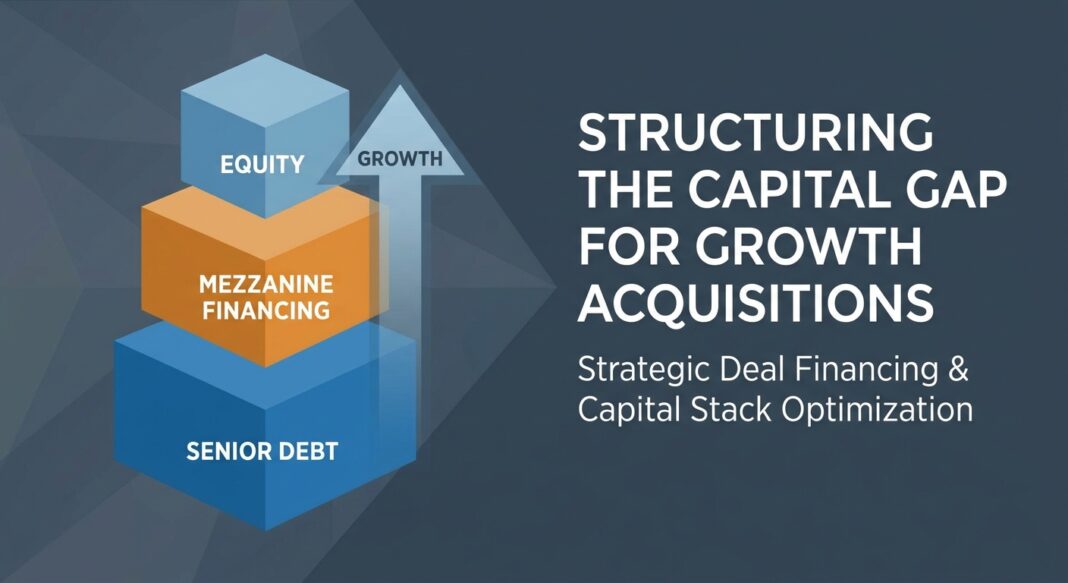
The Gap That Kills Growth Deals
A profitable lower-middle-market software business ($6M EBITDA, 85% recurring revenue, $60M enterprise value) decides to acquire a complementary platform for $25M. The math is straightforward. The financing is not.
A senior bank or direct lender will extend credit to roughly 3.0x–4.5x EBITDA, meaning the business can support somewhere between $18M and $27M in senior debt on a standalone basis. After accounting for existing leverage, the acquirer might unlock $10M–$15M in incremental senior capacity. The acquisition requires $25M. The equity contribution the founder is willing to make is $5M. That leaves a gap, call it $8M to $10M, that sits above what a senior lender will touch and below the dilution threshold where an equity round makes economic sense.
This gap is where mezzanine financing lives. It is not a product of last resort. It is a precision instrument that lets growth-stage operators close acquisitions, fund capital-intensive expansions, and execute recapitalizations without surrendering ownership at a discount. Understanding how to structure it, price it honestly, and negotiate it intelligently is one of the highest-leverage skills a growth-stage operator or their adviser can develop.
This article walks through the full mechanics: how mezzanine is structured, what it actually costs, how it compares to unitranche and equity alternatives, what the current market looks like in mid-2026, and how to negotiate the terms that matter most.
Structure Breakdown: The Components of a Mezzanine Facility
Mezzanine debt occupies a structurally subordinated position in the capital stack, sitting below all senior creditors in the payment waterfall. It is typically unsecured, carries a second or third lien at best, and is repaid only after senior obligations are satisfied in a liquidation scenario. This subordination is the defining risk that drives its pricing premium over senior debt.
A mezzanine facility typically has four cost-of-capital components that must all be modeled to understand the true all-in cost:
1. Cash-Pay Interest
The base coupon paid quarterly or monthly in cash. In the current market, cash-pay rates on mezzanine facilities range from 8% to 14% per year, depending on the borrower’s risk profile, sector, and leverage. This is the component operators most commonly focus on, and it is the least important component to optimize in isolation.
2. Payment-in-Kind (PIK) Interest
PIK interest does not require a cash outflow; instead, the accrued interest is added to the outstanding principal balance, compounding the borrower’s debt load over the life of the facility. This is operationally attractive, it preserves cash during the integration period, but it is structurally expensive. PIK compounds, meaning a $10M mezzanine tranche with a 4% PIK component becomes an $11.7M obligation after four years before any cash interest or principal repayment. Operators who treat PIK as effectively free capital are misreading the instrument.
3. Equity Kicker (Warrants or Conversion Rights)
Mezzanine lenders almost universally require an equity participation component in the form of warrants or conversion rights. Warrants give the lender the right to purchase equity at a predetermined strike price, allowing them to participate in the company’s upside if the business grows. This is the mechanism that makes the all-in IRR on mezzanine competitive for lenders despite the deferred cash-pay structure. From the borrower’s perspective, every warrant granted dilutes existing common equity, a cost that compounds materially in a high-multiple exit scenario.
4. Origination Fees
Upfront fees of 1%–3% of committed capital, paid at close. These reduce the effective proceeds received while increasing the lender’s effective yield.
Illustrative Term Sheet: $10M Mezzanine Tranche for a $25M Software Acquisition
| Term | Structure |
|---|---|
| Facility Size | $10,000,000 |
| Instrument | Subordinated term loan, unsecured |
| Maturity | 5 years (bullet) |
| Cash-Pay Coupon | 10.0% per annum, paid quarterly |
| PIK Component | 3.0% per annum, accrued to principal |
| Stated Rate | 13.0% (cash + PIK combined) |
| Warrant Coverage | 5%–8% of fully diluted equity at a nominal strike |
| Origination Fee | 2.0% of commitment ($200K) |
| All-In IRR to Lender | ~16%–20%, inclusive of warrant value at exit |
| Covenant Package | Single maintenance leverage covenant (tested quarterly), 25%–30% headroom, equity cure right |
| Prepayment | No-call 2 years; 102/101 thereafter (call premium) |
| Position in Stack | Below $15M senior unitranche; above $5M equity contribution |
For illustration purposes only. Terms vary by borrower profile, sector, and market conditions.
The full capital stack for this acquisition would be: $15M senior unitranche (SOFR + ~500 bps, approximately 9.3%–9.8% all-in) + $10M mezzanine + $5M equity = $30M sources against a $25M purchase price and $5M of transaction costs and integration reserve.
Mezzanine vs. Alternatives: When Each Option Wins
The decision to deploy mezzanine versus a unitranche structure or a priced equity round is not primarily about which option is cheapest on its face. It is about which option is cheapest after accounting for the operator’s specific leverage capacity, dilution tolerance, cash flow profile, and exit timeline.
Mezzanine vs. Unitranche
Unitranche consolidates senior and subordinated debt into a single facility with a single blended rate, single agent, and single documentation set. This structural simplicity delivers execution speed and relationship efficiency, sponsors frequently justify paying a 50–100 basis point premium over a bifurcated senior/mezz structure specifically to avoid multi-party negotiations and documentation complexity. For the $25M–$200M enterprise value acquisition market, unitranche has become the dominant financing structure precisely because it delivers 4x–5x leverage with single-document simplicity and reliable 45–90 day execution timelines.
Where unitranche breaks down is leverage ceiling. When a transaction requires leverage that exceeds what a single unitranche provider will deploy (typically 5.0x–5.5x EBITDA for software, less for capital-intensive industrials) mezzanine fills the structural gap that the unitranche won’t bridge. Unitranche is the default choice when leverage needs fit within its ceiling; mezzanine is the structural necessity when they don’t.
Mezzanine vs. Equity
This is the comparison that most operators get wrong. The intuition is that mezzanine is expensive debt and equity is dilutive ownership, and therefore mezzanine must be the less painful option because it’s “just debt.” But the all-in cost of a mezzanine facility, including fees, PIK compounding, and warrant dilution at a high exit multiple, frequently exceeds the effective cost of an equity round when modeled correctly. The correct framework is not “debt vs. equity” but “leverage capacity vs. dilution threshold vs. cash flow durability.” Mezzanine wins when (a) the business has strong, predictable cash flows to service the cash-pay component, (b) the expected exit multiple is moderate (limiting warrant upside value), and (c) the operator places high value on preserving ownership percentage.
Decision Framework
- Use unitranche when leverage needs fit within 4.5x–5.5x EBITDA and execution speed is a priority.
- Use mezzanine when you need to bridge a structural gap above the senior ceiling without issuing equity at a discount.
- Use equity when cash flows are unpredictable, leverage would create covenant risk in a downturn, or the business requires capital for a transformation that cannot be monetized quickly enough to service debt.
Current Market Terms: Mid-2026 Benchmarks
The private credit market has undergone significant evolution over the past 24 months. Here are five data points that define the current financing environment for growth-stage operators navigating the capital stack:
- Mezzanine all-in cost (2026): The combined cost of mezzanine capital, cash coupon of 8%–11% plus PIK of 2%–4% plus warrant coverage, produces a total facility cost in the 10%–14% range on a stated basis, with lender IRR targets of 16%–22% inclusive of equity participation. Operators should model the IRR impact, not just the stated coupon.
- Unitranche spread compression: Direct lending spreads to growth-stage borrowers in the $5M–$50M ticket band have compressed, with median all-in coupons on unitranche facilities now clearing at approximately 10.2%, down materially from 2024 peaks, per S&P LCD US Loan Comparable data from June 2026. For operators with strong profiles, unitranche has rarely been more accessible.
- Senior secured baseline: As of Q2 2026, senior secured lending for lower-middle-market businesses runs SOFR plus 400–550 basis points, putting all-in coupons in the 9%–10% range. The Federal Reserve Bank of New York reported SOFR averaging 4.33% in July 2026, meaning a SOFR + 550 unitranche prices at approximately 9.83% all-in.
- Covenant architecture shift: The share of private credit lenders requiring financial maintenance covenants has grown sharply, a 2026 market survey found that 46% of private credit lenders will not transact without maintenance covenant protection, an 11 percentage point increase from 2025. For the sub-$100M transaction market, maintenance covenants remain the norm, in stark contrast to the broadly syndicated loan market, where approximately 90% of new institutional loans in 2024 were covenant-lite. This divergence is operationally significant: borrowers in the private credit market must actively negotiate covenant headroom and cure rights, not assume them.
- PIK prevalence in BDC portfolios: Public Business Development Companies (major providers of mezzanine and subordinated financing) received an average of 8% of their investment income through PIK interest in 2025, reflecting the growing prevalence of PIK structures across private credit. This creates a lender constituency that is structurally oriented toward PIK-inclusive mezzanine, making PIK toggle features more negotiable than they were in prior cycles.
The Gap Capital Playbook: Four Steps from Quantification to Close
Step 1: Map the Gap Before Approaching Any Lender
Quantify the delta between your senior debt capacity (3.0x–4.5x EBITDA for most sectors) and your total capital requirement. Do this with precision, not approximation. A $6M EBITDA business with 3.5x senior capacity has $21M of senior debt availability. A $30M acquisition with $4M of transaction costs requires $34M total. After a $5M equity contribution, the gap is $8M: a specific, modelable number, not a vague financing shortfall. Lenders will ask you this question in the first conversation. Operators who cannot answer it quantitatively signal that they are not ready to run a process.
Step 2: Prepare the Financing Package
Mezzanine lenders are underwriting two things simultaneously: the credit (can this business service the cash-pay component?) and the equity story (does warrant coverage provide meaningful upside?). Your package must address both. Essential materials include: trailing-twelve-month and projected income statements with a clean EBITDA definition (addbacks documented, not asserted), a proforma leverage model showing post-close debt service coverage at 1.2x minimum, a cap table showing pre- and post-warrant dilution scenarios at multiple exit multiples, and a use-of-proceeds narrative that maps each dollar of mezzanine capital to a specific, revenue-generating deployment.
Step 3: Run a Parallel Process
Do not approach a single mezzanine provider in sequence. Run a simultaneous process across three to five lenders (including BDCs, mezzanine funds, and direct lenders with mezz mandates) to create competitive tension. The leverage differential between the best and median terms in a competitive mezzanine process is typically 50–100 basis points on the cash coupon and 2%–4% on warrant coverage. That delta is not trivial at exit: on a $60M business sold at 8x EBITDA in five years, a 3% warrant coverage difference is $1.4M of equity value at stake.
Step 4: Negotiate the Structure, Not Just the Rate
Operators consistently over-negotiate the stated coupon and under-negotiate the terms that matter most to long-run economics. The four highest-leverage negotiation points in a mezzanine term sheet are:
- Warrant coverage percentage and strike price: Push for the lowest coverage percentage and a strike price that reflects current fair market value, not a nominal penny strike.
- Covenant architecture: Negotiate for a single maintenance leverage covenant with 25%–30% initial headroom, a step-down schedule tied to debt paydown (not arbitrary time), and a full equity cure right that allows you to inject equity capital to cure a covenant breach without triggering an event of default.
- PIK toggle vs. mandatory PIK: A PIK toggle gives the borrower the option to elect PIK or cash-pay quarterly; mandatory PIK removes that optionality. Toggle structures are materially better; they preserve cash flexibility in a downturn without permanently compounding the principal balance in periods when the business can service cash interest.
- Call protection period: Standard mezzanine includes a 2-year no-call followed by 102/101 call premiums. If you have high conviction in near-term refinancing (rate drop, improved credit profile), push for a 1-year no-call or a yield maintenance cap that limits the economic penalty of early prepayment.
Structuring Guidance: What Operators and Investors Should Watch
For Operators
The most dangerous mezzanine structure is not the one with the highest coupon; it is the one with mandatory PIK, a nominal warrant strike, and a tight covenant with no cure right. That structure compounds your debt load in exactly the periods when your business is under pressure, transfers the most equity value at exit to the lender, and removes your ability to negotiate through a covenant breach constructively. Prioritize structural flexibility over rate optimization.
Also model the true all-in cost before deciding between mezzanine and an equity round. The stated coupon understates the economic cost of the facility. Run the IRR to the lender at your expected exit multiple, if that number exceeds the dilution cost of a priced minority equity round, you may be paying more for the appearance of control than for actual control.
For Investors and Advisers
In a mezzanine portfolio, covenant architecture is not a documentation formality; it is the primary risk management instrument. Maintenance covenants function as early warning signals; they give lenders intervention rights before a credit deteriorates to the point of payment default. Analysis from ABF Journal’s March 2026 review of the covenant divide found that restructurings initiated at the covenant-breach stage produce materially higher recoveries than those triggered by missed payments. A cov-lite mezzanine position can look clean for quarters while the underlying business erodes, only surfacing at the worst possible moment for recovery.
Evaluate PIK accrual balances quarterly. A growing PIK balance in a business that is also underperforming its base case is a compounding risk, not a benign accounting treatment. The combination of a large PIK balance and a deteriorating EBITDA trajectory is the characteristic signature of a mezzanine credit that will require restructuring before maturity.
Key Takeaways
- 🔑 Map the gap precisely before approaching lenders. Quantify the delta between your senior debt capacity (3.0x–4.5x EBITDA) and total capital required, then size the mezzanine tranche to exactly fill that gap, not reflexively round it up.
- 🔑 Model the all-in IRR, not the stated coupon. The true cost of mezzanine, cash coupon + PIK compounding + warrant dilution at exit, frequently runs 16%–22% IRR to the lender. Compare this against the dilution cost of equity before committing to the structure.
- 🔑 Negotiate the structure, not just the rate. Warrant coverage, PIK toggle optionality, covenant headroom, and call protection have more long-run economic impact than a 50 basis point coupon reduction.
- 🔑 Covenant architecture is a negotiation, not a standard. Push for a single maintenance leverage covenant with 25%–30% headroom, a clear EBITDA definition that captures integration synergies and non-recurring costs, and a full equity cure right.
- 🔑 Run a competitive process. A parallel three-to-five lender mezzanine process creates 50–100 bps of coupon compression and 2%–4% of warrant coverage improvement, translating to meaningful equity value at exit in high-multiple outcomes.


