
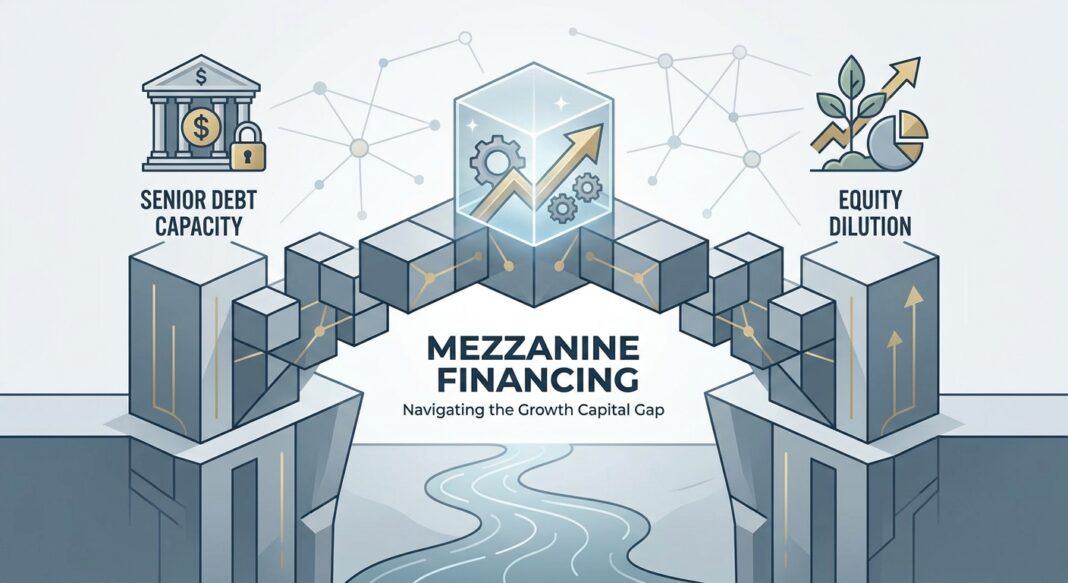
The Growth-Stage Gap: Too Much Company for the Bank, Too Much Dilution for Equity
The moment arrives in almost every high-growth company’s life cycle: the business has outrun what a commercial bank will lend against, yet raising another equity round at the current multiple feels punishingly dilutive. Senior lenders are capped at 3.0–3.5x EBITDA. Equity investors want 20-30% ownership for the check size needed. The arithmetic does not reconcile.
That structural gap (the space between the last dollar of senior debt capacity and the first dollar of equity a founder or sponsor wants to give up) is precisely where mezzanine financing operates. Mezzanine debt is a hybrid form of capital that combines features of both debt financing and equity financing, filling the gap between the amount a traditional bank will lend and the firm’s existing equity base.
Used correctly, mezzanine stretches capital capacity, preserves equity ownership, and funds the specific use-of-proceeds (an acquisition, an expansion into new markets, a recapitalisation) that senior lenders cannot fully support. Used incorrectly, it loads the balance sheet with compounding obligations that constrain future optionality. The difference lies entirely in whether the structure is matched deliberately to the business stage and use-of-proceeds, or simply accepted as the only term sheet on the table.
This article builds the practitioner framework: how to size the instrument, map the components, benchmark current market terms, and negotiate the structure.
Structure Breakdown: The Three-Layer Mezzanine Architecture
Layer 1: Cash-Pay Interest
The cash coupon is the base cost of the facility, paid periodically (typically quarterly). Current market pricing for mezzanine debt to performing companies runs 8–12% cash interest, plus a 2–4% PIK component, plus warrant or equity co-investment coverage of 1–5% of equity, targeting an all-in lender IRR of 16–22%. The cash-pay portion services like conventional debt and is deductible; it is the component most directly stress-tested in underwriting.
Layer 2: PIK Interest (Payment-in-Kind)
PIK stands for payment-in-kind. PIK interest accrues on the principal balance instead of being paid in cash, compounding over the life of the facility and increasing the effective cost of borrowing over time. PIK is the structural release valve that makes mezzanine usable for growth companies with temporarily constrained free cash flow: the company preserves liquidity during the investment phase, but the compounding balance creates a larger bullet at maturity. When borrowers elect PIK interest, the outstanding balance compounds, increasing total debt burden; if the anticipated liquidity event is delayed, the growing PIK balance creates a larger refinancing burden, a risk that can become severe in deteriorating markets. Negotiating the PIK toggle carefully, the right to elect PIK at the borrower’s discretion versus a fixed PIK structure, is one of the highest-value points in any term sheet discussion.
Layer 3: The Equity Kicker
An equity kicker is the ownership participation component of a mezzanine structure, typically warrants or conversion rights that allow the lender to participate in the company’s upside. This is what makes mezzanine dilutive despite being structured as debt. Warrant coverage typically runs 1–5% of the fully diluted equity base. Every warrant granted to a mezzanine lender dilutes existing common equity; in a successful exit, the mezzanine lender’s equity kicker reduces the return available to the PE sponsor and management team, a cost that must be weighed against the benefit of a reduced upfront equity contribution.
Illustrative Example: $20M Mezzanine for a $60M EV Software Business
Consider a B2B SaaS company with $8M EBITDA, $60M enterprise value, and $20M already drawn under a senior revolving credit facility (2.5x leverage). The owners need $20M to fund a tuck-in acquisition. The bank will not move above 3.0x EBITDA (≈$4M of additional senior capacity). Equity is off the table at the current multiple. The gap is $16M.
| Component | Amount / Rate | Mechanics |
|---|---|---|
| Senior Revolver (Bank) | $20M @ SOFR + 275 bps | First lien, quarterly maintenance covenants |
| Senior Stretch (Bank) | $4M @ SOFR + 325 bps | Max 3.0x total senior leverage |
| Mezzanine Facility | $16M @ 10% cash + 3% PIK | Second lien / unsecured, subordinated to senior |
| Warrant Coverage | 3% of diluted equity | Strike at current 409A, 5-year term |
| Origination Fee | 2.0% OID | Upfront, rolled into effective yield |
Total pro forma leverage: 5.0x EBITDA (2.5x senior, 2.0x stretch, 2.5x mezz). The mezz lender underwrites to a 4–5 year exit at a 7–9x EBITDA multiple. All-in lender IRR target: ≈18% blended (cash yield + PIK accretion + warrant participation).
Mezzanine vs. the Alternatives: Where It Wins and Where It Doesn’t
Versus Unitranche (Direct Lending)
The middle market lending landscape has experienced a decisive shift toward simplified debt structures, with unitranche facilities increasingly becoming the financing solution of choice for transactions ranging from $10M to $500M in enterprise value, consolidating senior and subordinated debt into a single facility with materially reduced documentation complexity. Unitranche facilities typically price at SOFR + 425–475 basis points for sponsored upper-middle-market transactions, with core middle market credits commanding 50–100 basis points higher.
For a sponsor that values execution speed and relationship simplicity above absolute cost, unitranche wins. The speed premium is real: if unitranche financing can close 30–45 days faster than a syndicated alternative, sponsors often justify 50–100 basis points of extra spread by avoiding financing gaps, broken syndications, or delayed closings that jeopardise purchase agreements.
But unitranche is not always available or optimal. Despite the unitranche’s rise, traditional mezzanine debt has not disappeared; it remains relevant in very large transactions where unitranche lenders cannot provide the full quantum needed, situations where the borrower wants to minimise total cost by maximising cheap senior debt separately, and deals where the sponsor or management team wants equity kickers to align lender incentives.
Versus a New Equity Round
According to Carta’s State of Private Markets data, median dilution in 2025 sits at approximately 19.5% for seed rounds and 18% for Series A rounds, with Series A investors generally targeting 15–30% ownership, figures that are actually higher than the peak of 2021, reflecting a market where capital has become more expensive. For a founder retaining 70% pre-round, a $20M equity raise at $60M pre-money costs 25% dilution permanently. A $16M mezzanine facility, even with 3% warrant coverage, costs far less equity, assuming the business can service the coupon and exits within the warrant’s term horizon.
Versus Revenue-Based Financing
Revenue-based financing (RBF) is dilution-free and covenant-light but structurally constrained to companies with predictable recurring revenue and typically caps at $5–10M. In 2025–2026, mezzanine funds have seen renewed interest as investors seek strategies with built-in cash yields in a higher-rate environment, making them aggressive underwriters for larger tickets where RBF cannot compete on quantum.
Decision Rule: Mezzanine is optimal when (1) senior debt is at capacity, (2) equity dilution is prohibitively expensive at the current valuation, (3) the business has stable recurring cash flows to service a blended 10–13% cash coupon, and (4) a clear exit or refinancing event is visible within 4–6 years.
Current Market Terms: What Mezzanine Looks Like in Mid-2026
The mezzanine market is shaped by the broader private credit environment. Global private credit assets under management reached approximately $2.1 trillion in 2025, up from $1.5 trillion a year earlier. That capital overhang has increased competition among mezz providers, modestly tightening all-in yields from their 2023 peaks while keeping structural flexibility elevated for quality borrowers.
Key Data Points (as of H1 2026)
- Cash Coupon: 8–12% cash interest is standard, with 2–4% PIK on top and warrant coverage targeting an all-in lender IRR of 16–22%.
- All-in Cost of Capital: Mezzanine debt for a performing company is expected to yield the lender 12.5–14%, with the warrant kicker lifting effective IRR into the high teens or above depending on exit multiple.
- Covenant Architecture: Mezzanine and unitranche loans are maintenance-covenant instruments with at least one leverage covenant tested quarterly; in H1 2024, the vast majority of private credit deals contained a maintenance covenant, with covenant-lite structures skewing to large-cap credits with strong sponsors.
- Covenant Cushion: The financial covenant is typically a single net first-lien or total net leverage covenant with an initial cushion of 25–35% over the base case plan, stepping down as cash flow grows.
- Broadly Syndicated Divergence: Covenant-lite institutional leveraged loans represented 91.7% of large corporate new-issue institutional loans in the United States in 2024, according to PitchBook LCD, a stark contrast to the maintenance covenant disciplines that private credit mezz lenders maintain in the middle market.
- Venture Debt Comparator: Venture debt has moved from the margins to the mainstream; the global venture debt market reached roughly $49 billion in 2025, and Deloitte projects the asset class could grow to represent 20% of total venture funding by 2027.
The Gap Capital Playbook: Quantifying, Preparing, Running the Process
Step 1: Quantify the Gap Precisely
The gap is not the total capital needed; it is the delta between what senior lenders will extend and what you are willing to give up in equity. Map the following before contacting any lender:
- Senior capacity ceiling: Maximum senior leverage your lead bank will underwrite (typically 2.5–3.5x EBITDA for mid-market businesses).
- Equity floor: Maximum dilution you will accept at the current valuation (and the post-money cap table it implies).
- Use-of-proceeds waterfall: Rank each use (acquisition price, transaction costs, working capital reserve) by amount and time-criticality. Lenders will underwrite each use category differently, acquisition financing is cleaner than “general corporate purposes.”
- Debt service capacity: Project free cash flow post-transaction at a stressed case. A blended mezz coupon of 11–13% on a $15M facility is $1.65–$1.95M per year in cash interest. Can the business service that comfortably at 75% of plan?
Step 2: Prepare the Package
Business owners need clean financials, realistic forecasts, a clear use of funds, and a strong understanding of which funding options align with their business model, growth stage, and long-term goals. For a mezzanine process specifically, the package must include: (1) 3 years of audited or reviewed financials; (2) a 5-year integrated financial model with a levered free cash flow bridge; (3) a clearly articulated use-of-proceeds page: not a paragraph, a table; (4) a management presentation that answers the exit question directly (buyers, comparables, timeline); and (5) a capitalisation table showing pre- and post-financing ownership, including the proposed warrant coverage.
Step 3: Run a Competitive Process
Approach 4–6 mezzanine providers simultaneously, not sequentially. Include a mix of BDCs (which bring scale and repeatability), specialist mezz funds (which bring structural creativity), and any family office mezzanine platforms that are active in your sector. The underwriting process from term sheet to close typically runs 60–90 days. Receive term sheets within 3–4 weeks, use competing terms to negotiate, and select based on total cost (not headline rate), structural flexibility (PIK toggle vs. forced PIK), and covenant headroom relative to your operating plan.
Structuring Guidance: Negotiation Points That Move the Economics
For Operators & Borrowers
- Fight for the PIK Toggle. A PIK toggle (the borrower elects each period whether to pay cash or PIK) is worth more than 50–75 bps of headline rate reduction. It preserves liquidity in the scenarios that matter.
- Cap Warrant Coverage and Negotiate Strike Price. Push warrant coverage below 3% of diluted equity if EBITDA is above $5M. Negotiate a strike at current fair market value, not a nominal exercise price. A $0.01 strike warrant can be very valuable at a high exit multiple, or worthless if the company is sold at a distressed valuation.
- Negotiate Covenant Headroom Explicitly. Maintenance covenants (quarterly tests of leverage or fixed charge coverage) have returned to many PE-backed deals financed by non-bank lenders; sponsors and operators must focus on realistic covenant cushions and headroom in financial models. Seek a 30–35% cushion over your base case, not 15–20%.
- Secure an Equity Cure Right. A contractual right to inject equity to cure a covenant breach, before the lender can accelerate, is a standard ask and worth the negotiation capital to obtain.
- Pre-negotiate Call Protection. Standard mezzanine carries non-call 2 / premium step-down thereafter. If you expect to refinance within 24 months (post-acquisition EBITDA growth, rates moving), push for NC1 or a declining-premium schedule that reaches par by year 3.
For Investors & Lenders
In private credit, covenants serve as functional tools for risk management: maintenance covenants provide early warning signals, and incurrence covenants prevent actions that increase lender risk. Structure the covenant package to include both: a maintenance leverage covenant for quarterly early-warning, and incurrence tests gating any material restricted payments, add-on acquisitions above a defined size, and incremental debt. Underwrite to the stressed case, not the base case, when calibrating the covenant set level.
Key Takeaways
- Mezzanine fills a specific structural gap. It is not a general-purpose financing tool; it is the instrument for when senior debt capacity is exhausted and equity dilution is structurally prohibitive at the current valuation.
- All-in cost runs 16–22% lender IRR. The headline cash coupon (8–12%) understates the true cost. Model the full obligation: cash interest + PIK accretion + warrant dilution + origination fee, all on an IRR basis against your projected exit.
- PIK mechanics are a double-edged tool. PIK preserves near-term liquidity but compounds the bullet at maturity. A PIK toggle is structurally superior to mandatory PIK; negotiate for it as a primary term sheet objective.
- Covenant design determines lender intervention rights. Middle-market mezzanine uses maintenance covenants tested quarterly, unlike the covenant-lite world of broadly syndicated loans. Negotiate initial headroom of 30–35% over your base case and secure an equity cure right as a backstop.
- Run a competitive process, always. The mezzanine market has $2+ trillion of private credit dry powder competing for deals. A properly prepared borrower running a 4–6 lender process will receive materially better terms (on rate, PIK structure, covenant cushion, and warrant coverage) than a borrower accepting the first term sheet received.


