
The Growth-Stage Financing Gap: When Senior Debt Isn’t Enough and Equity Costs Too Much
A founder-owned services business with $8 million in EBITDA is ready to acquire a competitor at a $50 million enterprise value. The strategic rationale is airtight: geographic expansion, revenue synergies, a combined platform worth materially more than the sum of its parts. The problem is purely structural: the company’s senior lender will underwrite to 3.0× EBITDA, providing roughly $24 million. The sponsor equity check covers $20 million. That leaves a $6 million gap between what debt will provide and what equity is sized to absorb, and closing that gap with more equity means dilution the founder is unwilling to accept at this stage of the business.
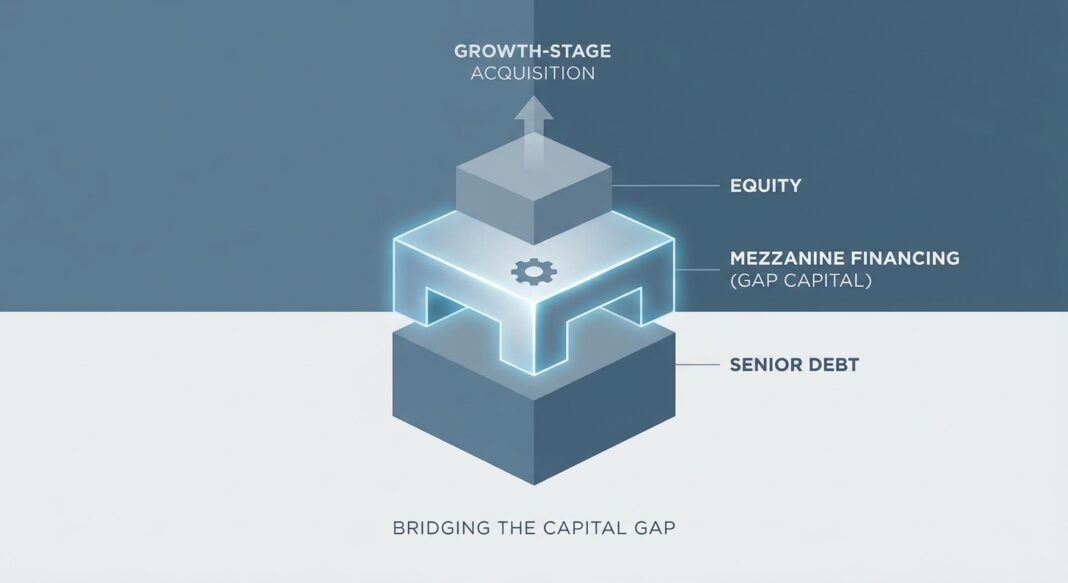
This is the defining capital challenge of the growth stage. The business has real cash flows and proven EBITDA, so it has earned the right to use debt. But it is pursuing an acquisition that stretches leverage beyond what senior lenders will underwrite, and the equity market wants a control position the operator isn’t willing to grant. The answer, in most of these deals, is mezzanine financing: the deliberately underused layer of the capital stack that sits between senior debt and common equity, and which does precise, high-value work when deployed correctly.
This article maps the full capital stack for a growth-stage acquisition, prices each layer using current 2026 market data, and provides a step-by-step playbook for quantifying the gap, preparing materials, running the process, and negotiating the structure.
Mapping the Cost of Capital Spectrum: From Banks to Equity
Before deploying any structure, operators must understand the layered risk logic of the capital stack. Each layer is priced according to where it stands in the repayment waterfall, and the further down the stack, the more expensive the capital, but also the more flexible the terms.
Layer 1: Senior Secured Debt (Banks and Direct Lenders)
Senior secured debt is the cheapest layer in the stack because it holds first-lien priority on all company assets and gets repaid first in any enforcement or liquidation scenario. Senior secured debt is cheapest because it gets paid first and is secured by assets; as of Q2 2026, senior secured lending for lower middle market businesses runs SOFR plus 400 to 550 basis points per S&P Global LCD, which puts all-in coupons in the 9% to 10% range. For cash-flow businesses, senior lenders typically underwrite to 2.5× to 3.5× EBITDA on a standalone basis, leaving meaningful leverage headroom untapped when a transaction requires 5× to 6× total debt.
Layer 2: Unitranche (The One-Stop Alternative)
For operators who want to avoid the complexity of a two-tranche stack, the unitranche blends senior and subordinated debt into a single facility with a single lender and a single credit agreement. Unitranche debt combines what would otherwise be senior debt and mezzanine/sub debt into one instrument with one lender and one credit agreement; total leverage typically runs 4–6× EBITDA with a blended interest rate of 8–11% (SOFR + 500–700bps in 2026), a single covenant package, and a single intercreditor relationship. This structure has become the financing standard for acquisitions valued between $25M and $200M enterprise value, with roughly 70 to 80 percent of deals in that range using at least partial unitranche funding from lenders like Ares, Blue Owl, Antares, Twin Brook, or Apollo.
The trade-off is cost versus control. If unitranche financing can close 30 to 45 days faster than a syndicated alternative, sponsors often justify 50 to 100 basis points of extra spread by avoiding financing gaps, broken syndications, or delayed closings that jeopardize purchase agreements. For deals requiring more precise leverage optimization (or where total leverage requirements exceed 5× EBITDA) a traditional senior-plus-mezzanine stack may produce a lower blended cost and more favorable covenant structure.
Layer 3: Mezzanine / Subordinated Debt, The Gap Capital Layer
Mezzanine/subordinated debt is the gap capital layer, with all-in pricing typically ranging from 13%–18%, often structured as a cash-pay coupon plus a PIK (payment-in-kind) component and warrant coverage of 1%–5% of fully diluted equity, subordinated to senior lenders but senior to all equity. Covenant packages are negotiated; some mezzanine providers accept incurrence-only covenants, while others require maintenance tests.
The PIK component is particularly valuable in acquisition financing. Rather than requiring full cash-pay interest from day one (when integration costs and one-time charges may temporarily depress EBITDA) PIK allows the borrower to accrue interest onto the principal balance and pay it at maturity or at a refinancing event. This preserves cash during the highest-risk period of any acquisition: the first 12–18 months post-close.
Layer 4: Preferred Equity and Seller Notes
Preferred equity or seller notes sit between mezzanine and common equity, a bridge layer used when the debt stack is fully stretched but the equity check would be prohibitively dilutive. Seller notes in particular are underutilized: a motivated seller who accepts 20%–30% of the purchase price as a structured note reduces the buyer’s day-one equity requirement materially.
Layer 5: Sponsor or Founder Equity (Most Expensive, Most Flexible)
Equity capital costs more, with target IRRs of 15% to 30%, but requires no cash service and preserves flexibility. Equity is the residual layer: it absorbs all losses before any creditor is impaired, and it captures all upside above and beyond the debt service waterfall. Minimizing unnecessary equity dilution while maintaining financial flexibility is the core objective of capital stack optimization at the growth stage.
Structure Breakdown: A $50M Acquisition at 6.0× EBITDA
Consider a concrete example: a growth-stage B2B software company with $8M in trailing EBITDA seeks to acquire a competitor for a $50M purchase price (6.25× EBITDA). Here is how the capital stack would be assembled in the current market:
| Tranche | Amount | Leverage Multiple | Pricing / Rate | Key Features |
|---|---|---|---|---|
| Senior Secured | $24M | 3.0× | SOFR + 450–525 bps | First-lien, cash-pay, 1 financial maintenance covenant, 5-year term |
| Mezzanine / Sub Debt | $10M | 1.25× | 12–14% cash coupon + 2–3% PIK; 3% warrant coverage | Second-lien, 5-year bullet, incurrence covenants, equity kicker via penny warrants |
| Seller Note | $5M | 0.625× | 8–9% cash, 5-year amortization | Subordinated to all debt, seller standstill, no covenant package |
| Sponsor Equity | $11M | N/A (22% of EV) | Target IRR: 20–25% | Common equity, board control, management incentive pool carved out |
Total Deal Size: $50M | Total Leverage: 4.3× Senior, 5.55× Total Debt
The mezzanine tranche is doing precise work here. It extends total leverage from the 3.0× that senior lenders will provide to 4.3× total debt financing, reducing the equity check from $21M to $11M and preserving founder/sponsor capital for add-on acquisitions or working capital investment post-close. The mezzanine tranche extends total leverage within range for a high-margin, high-retention SaaS asset, reduces the equity check materially, and preserves cash during integration through the PIK toggle.
The warrant coverage at 3% provides the mezzanine provider equity upside without requiring a formal equity co-investment, and the incurrence covenant structure avoids the quarterly maintenance testing that would create covenant default risk if EBITDA dips during the first year post-close. Common 2026 mezzanine structures for business acquisition include a 5-year note with bullet maturity, incurrence-based leverage covenants, one financial maintenance covenant (typically total leverage), 25% excess cash flow sweep, and a call schedule of NC1–103–102–101.
Unitranche vs. Senior + Mezzanine: When Each Structure Wins
The choice between a unitranche and a bifurcated senior-plus-mezzanine structure is not ideological; it is transactional and driven by four variables: total leverage required, execution timeline, covenant flexibility needs, and blended cost of capital.
Use Unitranche When:
- Speed is the priority. Unitranche financing addresses critical pain points in traditional lending arrangements by offering borrowers simplified documentation, accelerated execution timelines, and flexible covenant packages. For competitive auction processes with tight exclusivity windows, a single-lender execution is structurally superior.
- Total leverage need is 4.0×–5.5× EBITDA. Total leverage in unitranche structures typically runs 4–6× EBITDA at a blended interest rate of 8–11%. For deals in this range, the all-in cost of a unitranche is competitive with a blended senior/mezz stack.
- Intercreditor complexity creates risk. The simplification of a single negotiation, single closing, and single lender to manage post-close, with no agreement-among-lenders to fight over, is a material structural benefit.
Use Senior + Mezzanine When:
- Total leverage requirements exceed 5.5× EBITDA. A bifurcated structure allows operators to stack senior debt at cheaper pricing and deploy mezzanine only for the gap, producing a lower blended cost than a unitranche at high leverage.
- Covenant optimization is critical. Unlike the broadly syndicated loan market where over 90% of senior syndicated loans carry no meaningful maintenance covenants, most middle market unitranche facilities retain at least one financial maintenance covenant. A bespoke mezzanine negotiation can achieve incurrence-only covenant packages that provide materially more headroom than a standard unitranche term sheet.
- The borrower has strong existing banking relationships. Pairing a community bank or regional bank senior facility with a mezzanine layer from a direct lender often produces the lowest all-in cost, particularly for operators with long-standing credit relationships at their primary bank.
Most lower middle market recapitalizations use a stack: senior debt for cheap capital, mezzanine for stretch, and equity for the residual funding gap. The objective is never to choose one structure for its own sake; it is to match each layer of capital to the risk profile it is designed to absorb.
Current Market Terms: 2026 Benchmarks and Structural Standards
The following data points reflect active market conditions as of mid-2026:
- Senior Secured / Unitranche Pricing: SOFR plus 500 to 650 basis points is the working 2026 pricing band for unitranche on a $10 million EBITDA target, per Lincoln International’s Q1 2026 Senior Debt Facility.
- Mezzanine All-In Yield: Mezzanine debt in 2026 prices at an all-in yield of 13 to 17 percent, per the GF Data Q1 2026 Mezzanine Report, and is often the cheapest non-dilutive way to close a gap.
- Warrant Coverage Standard: Warrants in mezzanine structures are typically penny warrants for 1% to 5% of fully diluted equity.
- Covenant Trends: Overall, covenant-lite transactions rose to 21 percent of direct lending deals in 2025, up from 4 percent in 2023, per Proskauer’s 15th Annual Private Credit Insights Report (February 2026). Roughly 65% of 2025 lower middle market deals per PitchBook used a single financial covenant rather than the traditional four-covenant package.
- Typical LMM Deal Stack Composition: A typical $50M enterprise value platform in 2026 would be funded with roughly 40% senior debt, 10% mezzanine, 45% sponsor equity, and 5% seller rollover, per GF Data H1 2026 averages.
- Lender Selectivity is Rising: In early 2026, the middle market declined due to volatility and uncertainty, increasing lender selectivity and putting pressure on deal structures to hold up under scrutiny. Operators running competitive processes must present quality-of-earnings documentation, management presentations, and forward-looking EBITDA bridge analysis before approaching the mezzanine market.
- Private Credit Market Scale: Global private credit assets under management reached about $2.1 trillion in 2025, up from $1.5 trillion a year earlier. This capital depth means mezzanine providers are actively competing for quality growth-stage deals, a dynamic that creates genuine negotiating leverage for well-prepared borrowers.
The Gap Capital Playbook: From Quantification to Close
Identifying the need for mezzanine is straightforward. Executing the process correctly is where most operators leave money on the table or accept unnecessarily restrictive terms. The following four-step playbook applies specifically to growth-stage operators using mezzanine to fund an acquisition or platform expansion.
Step 1: Quantify the Gap Precisely
The gap is not an abstract concept; it is a specific dollar figure derived from the funding waterfall: [Purchase Price + Transaction Costs + Working Capital Reserve] − [Senior Debt Capacity] − [Target Equity Check] = Gap Capital Required.
Operators who arrive at the mezzanine market without a precise gap figure (and instead ask lenders to “tell me what you can do”) signal inexperience and surrender pricing leverage before the first conversation begins. Size the gap to the dollar. Know your senior debt capacity based on your lender’s actual underwriting (not their stated maximum). Know your equity limit based on dilution tolerance or available capital, not a round number.
Step 2: Prepare Institutional-Quality Materials
Mezzanine providers are subordinated lenders; they bear more risk than senior lenders, so their diligence process is correspondingly more rigorous. At minimum, a mezzanine process requires: (a) a quality-of-earnings report from a reputable accounting firm; (b) a five-year financial model with three scenarios (base, downside, stress); (c) a management presentation addressing integration risk, customer concentration, and the revenue quality underlying the EBITDA; and (d) a sources-and-uses statement showing the complete capital stack with every layer identified.
This financing gap has created growing demand for layered capital structures that combine senior debt, mezzanine financing, preferred equity, seller financing, and sponsor capital, structures that allow acquisition buyers to complete transactions while preserving liquidity and optimizing leverage efficiency. Lenders want to see that every layer of the stack is committed before they fund.
Step 3: Run a Competitive Process, Never Bilateral
A bilateral negotiation with a single fund produces one bid, no leverage, and a term sheet drafted entirely by the buyer’s counsel. A curated 20 to 40 investor process produces competitive tension, multiple term sheets, and negotiating room on price, preference, board composition, and secondary. The same logic applies to the mezzanine market. Approach a minimum of six to ten mezzanine providers simultaneously. Set a firm term sheet deadline. Create genuine competition for your deal, because lenders with dry powder are actively competing for quality credits in 2026. The correct sequence is: term sheet negotiation, mutual selection, then exclusivity. A well-run process should have three to five term sheets on the table before any exclusivity discussion.
Step 4: Evaluate Total Cost of Constraint, Not Just Coupon
The most common mistake in mezzanine term sheet evaluation is ranking providers by coupon rate alone. Evaluating total cost of constraint, not just total cost of coupon, is the correct comparison metric when selecting between providers. A mezzanine provider offering 13% cash-pay with a full four-covenant maintenance package is materially more expensive than one offering 15% with incurrence-only covenants, because the covenant package restricts future acquisitions, dividend recaps, and management compensation in ways that have real economic consequences. The single biggest structural swing an advisor can generate is on the covenant package: full four-covenant mezzanine packages (total leverage, senior leverage, fixed charge coverage, and interest coverage) constrain future add-on M&A and dividend recaps.
Negotiation Guidance: The Five Deal Points That Matter Most
Once competitive term sheets are in hand, the following five structural points are where experienced operators and their advisors generate the most value:
1. PIK Toggle vs. Mandatory Cash Pay
Push for a PIK toggle, the right to elect PIK rather than cash-pay interest for some or all accrual periods, at the borrower’s discretion. A mandatory cash-pay structure forces full interest payments during integration periods when EBITDA may be temporarily compressed by one-time costs. A PIK toggle preserves cash at precisely the moment it is most valuable.
2. Incurrence-Only vs. Maintenance Covenants
This is the most consequential structural negotiation in any mezzanine term sheet. Maintenance covenants, tested quarterly, can trigger technical defaults if EBITDA underperforms a forecast even modestly. Incurrence covenants only trigger when the borrower takes a specific action (incurring new debt, making a distribution, executing an acquisition). For growth-stage operators executing an active M&A strategy, incurrence-only covenants are essential to preserving strategic flexibility.
3. Warrant Coverage: Percentage and Exercise Price
The true complexity of mezzanine structures comes from the warrants: equity kickers that can complicate the capital structure, add layers to future financing rounds, and create challenging negotiations in a potential exit scenario. Negotiate the warrant percentage down to the minimum acceptable to the provider (typically 1%–3% for quality credits) and ensure the warrant is structured as a penny warrant (nominal exercise price) rather than a fair-market-value warrant. Also negotiate a call option to repurchase warrants at a pre-agreed formula prior to exit.
4. Call Protection and Prepayment Schedule
A market-standard 2026 mezzanine call schedule is NC1–103–102–101: meaning no-call in year one, 103% of par in year two, declining by one point per year thereafter. Operators who anticipate a refinancing or exit within 24–36 months should push to shorten the no-call period or negotiate a “make-whole” structure that caps the prepayment premium at a defined ceiling.
5. Lender Counsel Fee Caps
Lender counsel at major law firms can bill $600,000 to $1.2 million on a $50 million lower middle market unitranche if left uncapped; a hard cap of $250,000 to $400,000 is negotiable and market. The same dynamic applies in mezzanine documentation. Negotiate a hard cap on lender counsel fees at term sheet stage, not after counsel has already commenced work.
Key Takeaways
- The gap is structural, not a sign of weakness. Senior lenders underwrite to risk-adjusted parameters, not to your growth ambitions. The mezzanine layer exists precisely to bridge this structural gap without requiring the operator to cede equity control.
- Price the whole stack, not just the cheapest tranche. A 9% senior facility paired with 15% mezzanine produces a blended all-in cost that must be evaluated against the total acquisition return. The question is never “is 15% expensive?”; it is “does the incremental leverage justify the incremental cost given the asset’s return profile?”
- Covenant design is a strategic decision. The difference between a maintenance covenant and an incurrence covenant is the difference between a lender who can force a default and a lender who can only object when you take an action. For growth-stage operators with active M&A pipelines, incurrence-only is the non-negotiable standard.
- Competition is your most powerful negotiating tool. Global private credit AUM reached approximately $2.1 trillion in 2025, mezzanine providers have capital to deploy and are competing for quality credits. A well-run multi-party process consistently produces better pricing, tighter warrant coverage, and more favorable covenant packages than any bilateral engagement.
- Evaluate total cost of constraint, not just coupon. The true cost of a mezzanine facility includes the PIK accrual, the warrant dilution, the covenant restrictions on future activity, and the prepayment premium on an early exit. Operators who evaluate only the stated coupon rate routinely accept structures that are materially more expensive than their headline rate suggests.


