
The Acquisition Funding Gap: When Senior Debt Isn’t Enough and Equity Is Too Expensive
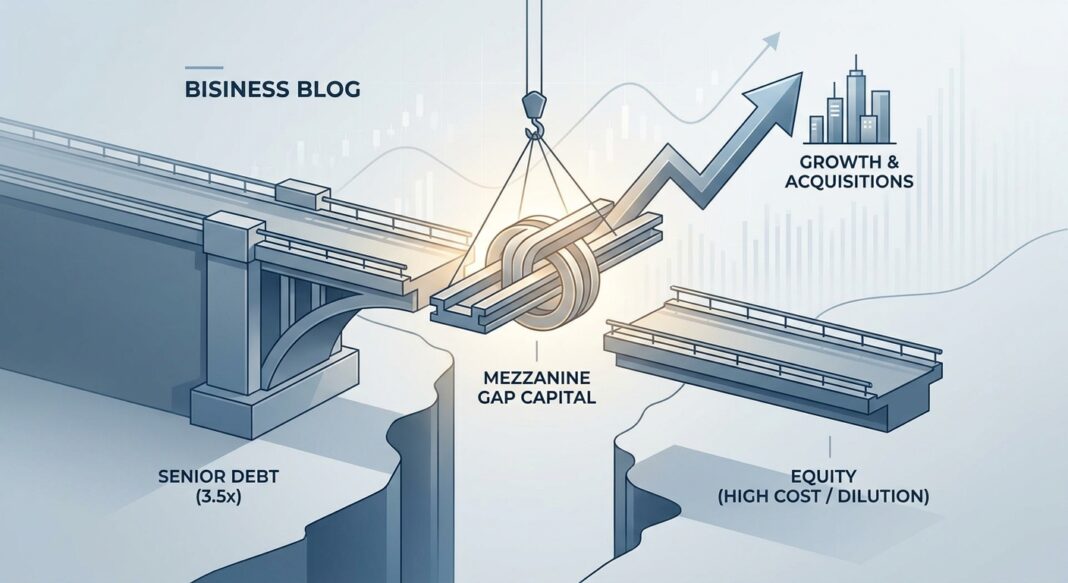
You’ve identified the right acquisition target. Your senior lender will stretch to 3.5x EBITDA. The deal requires 5.5x. That 2x gap, often $5M to $30M on a mid-market transaction, is the moment when capital strategy either wins or loses the deal.
For growth-stage companies generating $5M to $50M in EBITDA and executing a first or second bolt-on acquisition, this is the defining financing challenge of 2026. The broadly syndicated loan market is largely inaccessible at this scale. A traditional equity raise at this stage means board dilution, valuation negotiation, and timelines that blow up competitive auction processes. And yet the acquisition window is real, the target is strategic, and the financial case is sound.
The instrument that fills this gap is mezzanine debt, subordinated capital that sits between senior secured debt and equity in the capital stack. When structured correctly, mezzanine financing lets growth-stage operators close acquisitions, preserve ownership, and manage near-term cash flow simultaneously. But it comes with layered economics (PIK interest, equity kickers, and maintenance covenants) that require disciplined navigation. This article maps the full structure, compares it to alternatives on the cost-of-capital spectrum, and gives operators and investors a tactical playbook for executing it well.
Structure Breakdown: The Three-Layer Mezzanine Deal
Mezzanine financing occupies a specific position in the capital hierarchy. It ranks below senior secured debt and above common equity in repayment priority. In a default scenario, senior lenders are made whole first; mezzanine holders are paid next; equity absorbs any residual loss. That subordinated position is what drives the instrument’s elevated pricing, and its distinctive structural features.
The Core Components
1. Cash Interest. Mezzanine loans typically carry a base cash-pay coupon. Current market rates for performing growth-stage companies sit in the 10%–15% range annually, paid quarterly. This is the component that creates regular cash service obligations and directly impacts near-term free cash flow.
2. PIK Interest (Payment-in-Kind). Many mezzanine deals layer PIK interest on top of the cash coupon or offer a cash/PIK toggle. With PIK, unpaid interest is capitalized, added to the outstanding principal balance rather than paid in cash. A $10M mezzanine loan at 2% PIK becomes $10.2M after year one; by year five, at constant PIK accrual, that balance has compounded materially. PIK is a cash-preservation tool for the borrower, but the total repayment obligation grows every period it is elected. Partial PIK structures (for example, 10% cash plus 3% PIK for a blended 13% total coupon) are common in mid-market deals where operators need breathing room during integration periods.
3. Equity Kicker (Warrants or Options). To compensate for the subordinated risk position, mezzanine lenders typically require an equity participation right. These are most commonly structured as warrants granting the lender the right to purchase 1%–5% of the company’s equity at a fixed strike price, exercisable upon a liquidity event. The equity kicker is not an immediate grant of ownership; it is a contingent right that becomes economically significant only if the company performs. It aligns lender incentives with growth, but creates cap table complexity that must be documented carefully from day one.
Illustrative Deal Example: $75M Enterprise Value Business Services Platform
Consider a business services company with $8M in EBITDA executing a $15M bolt-on acquisition to consolidate a regional competitor. The deal structure might look like this:
- Senior Unitranche Facility: $28M at SOFR + 600bps (approximately 10.5% all-in), representing 3.5x EBITDA. Single lender, bullet maturity in year 5, minimal amortization. OID of 2%.
- Mezzanine Tranche: $16M at 12% cash / 3% PIK, representing 2x incremental leverage. 5-year term, bullet repayment. Equity kicker: warrants for 3% of fully diluted equity at a strike price equal to current enterprise value.
- Equity (Sponsor + Management): $11M, representing ~29% of total capital.
- Total Capitalization: $55M against a pro-forma combined enterprise value of $75M+ post-synergies.
The blended cost of debt capital in this structure runs approximately 11.2% cash-pay, with the full-loaded IRR to the mezzanine lender (including warrant economics) targeting 17%–21% depending on exit multiple. For the borrower, the trade-off is explicit: PIK interest compounds quarterly, the warrant creates minority dilution at exit, but the alternative, a second equity round, would have diluted ownership by 20%+ immediately and at a valuation the management team may not have accepted.
The Cost-of-Capital Spectrum: Mapping Mezzanine Against Alternatives
No structure exists in isolation. Every capital decision for a growth-stage acquisition is a trade-off between four competing variables: access, cost, dilution, and control. Here is how mezzanine compares across the full spectrum available to a $5M–$50M EBITDA company in 2026.
Option 1: Bank Senior Debt Only
A traditional bank term loan offers the lowest nominal cost, typically Prime + 150–250bps for a well-collateralized borrower, but extends leverage only to 2.5x–3.5x EBITDA for acquisition financing. For deals requiring 4.5x–6x, this creates the funding gap that defines the entire conversation. Banks are structurally constrained by regulatory capital requirements and collateral coverage ratios. They are the right layer for the bottom of the stack; they cannot fill it alone.
Option 2: Unitranche (Senior + Junior in One Instrument)
For deals in the $25M–$200M enterprise value range, unitranche direct lending has become the dominant structure. A single lender provides the full debt package (collapsing first-lien and second-lien into one facility) at SOFR + 500–700bps in 2026, delivering 4x–6x EBITDA of leverage with a single covenant package and a single counterparty. The all-in cost runs 9.5%–11% blended for a typical 5x leverage transaction, and the structure closes in 45–90 days versus 90–150 days for a broadly syndicated loan. The trade-off versus a senior-plus-mezz stack: unitranche typically doesn’t offer PIK flexibility, and its blended cost is marginally higher than a bifurcated senior/sub structure in most scenarios, though execution simplicity often justifies the premium.
Option 3: Senior + Mezzanine (Bifurcated Stack)
The traditional two-layer structure pairs a 3x–3.5x senior facility with a 1.5x–2x mezzanine layer to reach total leverage of 4.5x–5.5x. Senior prices at SOFR + 350–450bps (7%–8.5% all-in); mezzanine at 12%–15% cash plus PIK. On a 70/30 senior-to-mezz split, the blended cash cost runs approximately 9%–10.5%, competitive with unitranche on price, but with materially greater documentation complexity and intercreditor negotiation. The clear advantage: PIK toggle flexibility on the mezzanine layer preserves cash during integration periods when unitranche does not.
Option 4: Growth Equity
A minority equity round from a growth PE or family office is the most expensive long-term option despite carrying no contractual interest rate. In 2025, median dilution at growth rounds was running approximately 19.5% for early-stage and up to 30% for institutional rounds. An equity investor demanding a 25%–30% ownership stake at current valuations implies an implied cost of capital well above the 12%–17% all-in cost of mezzanine debt, particularly for a business that management intends to exit or recapitalize within 5 years. Equity is the right tool when leverage capacity is exhausted, the business has unpredictable cash flows, or the investor brings strategic value beyond capital.
When Mezzanine Wins
Mezzanine is the optimal structure when: (1) the deal size exceeds senior-only leverage capacity; (2) the company has stable, predictable cash flows to service at least partial cash-pay interest; (3) ownership dilution is a high-priority concern for the management team or existing shareholders; and (4) the acquisition thesis depends on speed of execution rather than optimizing the last 50bps of cost. For growth-stage operators with proven EBITDA who are executing a strategic bolt-on, it is often the most efficient path from term sheet to closing.
Current Market Terms: What Mezzanine Looks Like in 2026
The mezzanine and private credit markets in 2026 are navigating a nuanced environment. Deal activity accelerated through 2025, with global M&A volumes surpassing the 2021 peak, and early 2026 data shows continued strength in deal values. However, the competitive dynamic has shifted meaningfully. Increased M&A supply combined with more selective capital providers has improved lender negotiating leverage compared to 2024, when tight spreads and borrower-friendly terms were the norm.
Key market terms for mezzanine deals as of mid-2026:
- Cash Interest Rate: 11%–15% per annum for corporate mezzanine in growth and acquisition contexts; performing lower-middle-market companies with $5M–$15M EBITDA should expect 12.5%–14%.
- PIK Toggle: Common in 40%–60% of current mezzanine structures; partial PIK (50% cash / 50% PIK) is frequent during integration periods, with step-ups to full cash-pay post-stabilization. PIK usage has increased since 2021–2022 as higher base rates compressed interest coverage ratios, making full cash-pay harder to sustain at higher leverage multiples.
- Equity Kicker / Warrant Coverage: Warrants covering 1%–5% of fully diluted equity at a strike price set to current or entry enterprise value are standard. The lender’s target total IRR (debt + equity kicker) is typically 17%–22% on performing deals. Warrant coverage is the primary negotiation variable, operators should focus their negotiation here, as this is where the real long-term dilution cost resides.
- Maturity: 5–7 years for corporate mezzanine, consistent with private equity hold periods and aligned to the expected refinancing or exit horizon.
- Covenants: Unlike the broadly syndicated loan market, where over 85% of institutional leveraged loans now lack meaningful maintenance covenants, most middle-market mezzanine and private credit facilities retain at least one financial maintenance covenant, typically a maximum total leverage ratio tested quarterly. However, covenant loosening has been a clear trend: many 2025–2026 deals are being written with 35%–40% headroom to closing leverage, making the covenant a distant tripwire rather than an active monitoring mechanism. For borrowers, this headroom is operationally valuable but should not create false confidence; it is set by competitive market dynamics, not by the lender’s fundamental risk tolerance.
- Origination Fees: 1%–3% of committed principal, paid at closing. Factor this into the all-in cost calculation alongside OID on any accompanying senior facility (2%–3% on private credit deals in 2024–2025).
The macro context matters: private credit assets under management have reached approximately $2.1 trillion in 2025, creating a large pool of capital actively seeking deployment. For borrowers, this competitive supply dynamic, with lenders eager to put capital to work, remains a structural advantage in negotiation, even as credit selection has become more rigorous heading into potential late-cycle conditions.
The Gap Capital Playbook: Quantifying, Preparing, Running the Process
Knowing the structure is only half the battle. Executing successfully requires a disciplined process from the moment you identify the acquisition target through the day you close the mezzanine facility. Here is the four-step operating playbook.
Step 1: Quantify the Gap Precisely
Before approaching any capital provider, build a detailed sources-and-uses model that maps the exact gap between what your senior lender will provide and what the total acquisition requires. Input variables: deal enterprise value, expected senior leverage (3x–4x EBITDA is standard for a stable cash-flow business), required equity contribution (typically 25%–35% of total deal value for PE-backed transactions, 30%–40% for founder-led), and target leverage ceiling (total debt-to-EBITDA should generally stay below 6x for business services and below 5x for more cyclical sectors). The gap between senior capacity and total required capital, net of equity, is your mezzanine ask. Be precise. Lenders price on leverage multiples, so a $1M variance in your EBITDA estimate can shift the deal economics by 25–50bps in either direction.
Step 2: Prepare the Credit Package
Mezzanine lenders are cash-flow underwriters, not asset-based lenders. They will underwrite your business on EBITDA quality, recurring revenue characteristics, customer concentration, and management team depth, not on collateral. Your credit package must include: (a) 3 years of audited or reviewed financial statements; (b) a detailed LTM and pro-forma EBITDA bridge, with clear add-back support; (c) a 5-year integrated financial model with three scenarios (base, downside, stress); (d) a management presentation covering the acquisition thesis, integration plan, and synergy case; and (e) a capitalization table before and after the transaction, showing all stakeholders and warrant dilution scenarios. Clean, well-organized documentation compresses due diligence timelines, from the typical 4–12 weeks, and signals the operational maturity that mezzanine lenders are underwriting for.
Step 3: Run a Competitive Process
Approach 4–6 mezzanine providers simultaneously. The market in 2026 includes dedicated mezzanine funds, BDCs (business development companies), family office credit desks, and the subordinated debt arms of major direct lenders. Running a competitive process, even with a preferred counterparty already identified, creates pricing discipline and leverage on structural terms. Request term sheets within a defined window (typically 2–3 weeks). The terms to compare across submissions: cash coupon, PIK toggle mechanics, warrant coverage percentage, strike price, prepayment penalties, covenant package, and any board observation rights.
Step 4: Negotiate the Structure Intelligently
The hierarchy of negotiation priorities for a mezzanine borrower should be: (1) Warrant coverage and strike price, this is the real long-term equity cost of the instrument and deserves the most attention; (2) PIK toggle flexibility, the ability to elect PIK during integration periods without triggering defaults or step-ups is operationally critical; (3) Prepayment mechanics, understand exactly how capitalized PIK is treated if you elect early repayment, and whether make-whole provisions apply to the warrant value; (4) Covenant headroom, negotiate leverage covenant thresholds to provide 25%–35% cushion to your base-case projections, not just to closing leverage; (5) EBITDA definition, the definition used for covenant testing drives your entire compliance profile, and add-back treatment for one-time integration costs deserves careful documentation from day one.
Structuring Guidance: What Operators and Investors Need to Know
For Operators and Management Teams
Mezzanine financing is not inherently expensive capital; it is appropriately priced capital for a specific risk position in the stack. The all-in cost is meaningful (12%–17% IRR to the lender), but compared to the alternative of giving up 20%–30% equity at current growth valuations, it is often the cheaper long-term choice. The discipline is in the EBITDA model: before accepting any PIK toggle, build the compounding schedule in your model and stress-test your exit-year repayment obligation under a 20% EBITDA miss. PIK does not feel expensive until it compounds across four or five years, a point that consistently surprises operators who focus only on the cash coupon. Manage the warrant carefully: negotiate warrant coverage as a percentage of primary shares, not fully diluted, and build a right of first refusal or call option on the warrant position into the instrument at a pre-agreed formula.
For Investors Evaluating Mezzanine Structures
When reviewing a portfolio company using mezzanine to fund an acquisition, the analytical priority is integration risk layered on leverage. Mezzanine works when integration executes: synergies materialize, revenue retention holds, and EBITDA grows to support the combined leverage. The stress case is a flat or declining EBITDA scenario with full PIK election and a balloon repayment at maturity that creates a refinancing cliff. Evaluate: the quality and defensibility of the EBITDA bridge; the specificity of the integration plan; whether PIK triggers are performance-based (the right structure) or unconditional (a red flag); and whether maintenance covenants have sufficient teeth to provide early warning before the equity position is impaired.
Key Takeaways
- Mezzanine fills the leverage gap banks won’t. Senior debt typically extends to 3x–3.5x EBITDA for acquisition financing. Mezzanine adds 1.5x–2x more, enabling total leverage of 5x–5.5x without requiring an equity round.
- The true cost has three components. Cash interest, PIK compounding, and warrant dilution must all be modeled together. All-in economics to the lender typically target 17%–22% IRR, compare this directly against the implied cost of a growth equity round before selecting the structure.
- PIK is a cash management tool, not a free lunch. PIK interest preserves near-term liquidity but compounds quarterly, building toward a larger balloon repayment. Model the exit-year payoff under stress scenarios before electing PIK mechanics.
- Covenant design is a negotiation, not a standard. Most middle-market mezzanine facilities include maintenance covenants, but headroom thresholds are increasingly wide in 2026. Borrowers should negotiate for 25%–35% cushion to base-case projections; investors should watch that covenant looseness doesn’t eliminate early-warning functionality.
- Process discipline drives structural outcomes. Running a competitive process across 4–6 mezzanine providers (with a complete, well-organized credit package) is the single highest-leverage action a borrower can take to improve pricing and structural terms. Lender competition in a market with $2.1 trillion in private credit AUM is real and exploitable.


