
The Growth-Stage Financing Gap: When the Bank Says No and Equity Costs Too Much
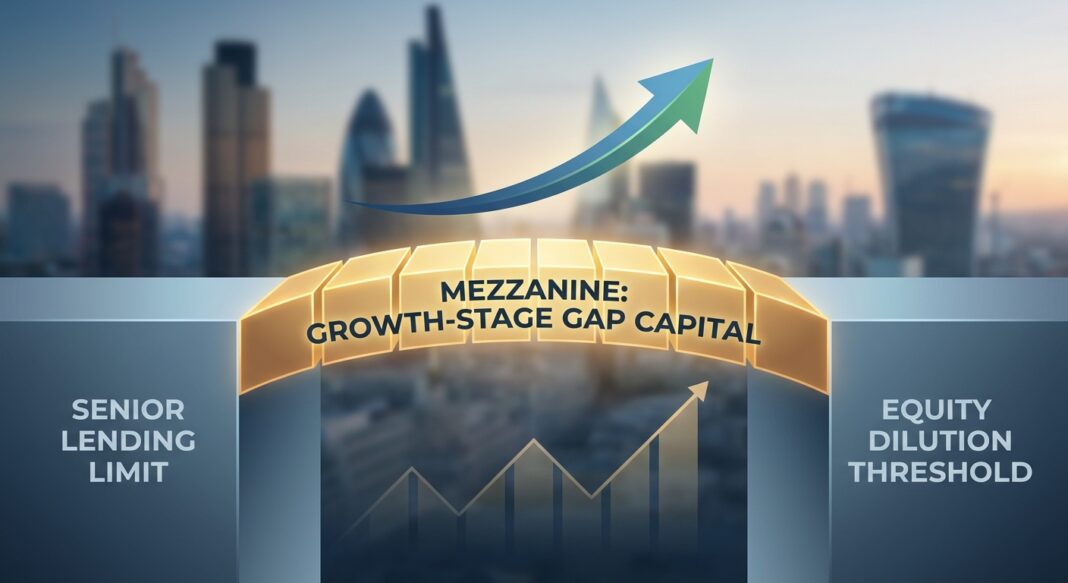
A business generating $8M in EBITDA wants to acquire a regional competitor for $40M. Its senior bank lender will stretch to 3.0x leverage, roughly $24M. The private equity sponsor or founder does not want to issue new equity at a valuation that implies 35% dilution. That leaves a $16M gap sitting squarely in the middle of the capital stack, between senior debt and common equity. This is the structural problem that mezzanine financing was built to solve.
Growth-stage companies (typically post-product-market fit, generating predictable cash flows, but not yet mature enough for investment-grade credit) routinely encounter this gap. The use-of-proceeds context matters enormously here. Whether the capital is funding an acquisition, a recapitalization, a management buyout, or an organic expansion into a new market, the right instrument, its pricing, and its structural features shift significantly. Mezzanine debt is not a one-size-fits-all solution; it is a precision tool, and knowing when and how to deploy it is the operational edge that separates well-structured deals from expensive ones.
Mapping the Cost of Capital Spectrum: Where Mezzanine Sits and Why It Matters
To understand mezzanine’s role, you must first anchor it on the full cost-of-capital spectrum that runs from secured senior debt to common equity:
- Senior secured bank debt: Lowest cost (typically SOFR + 200–350 bps for investment-grade borrowers; higher for leveraged credits), but constrained by collateral requirements, leverage limits, and maintenance covenants.
- Unitranche / private credit: Blended all-in pricing in the 9–12% range (as of mid-2026), providing more leverage and fewer structural constraints than bank debt, but with a single lender or club taking the whole senior position.
- Mezzanine debt: Subordinated to all senior debt; priced in the 13–18% range on a blended basis, often combining cash-pay interest (10–14%) with PIK (payment-in-kind) accrual and an equity kicker via warrants or a co-investment right. This is the layer that fills the gap between what senior lenders will fund and what equity investors will accept.
- Preferred equity: Sits above common equity but below debt in liquidation priority; typically return expectations of 18–25%, often with cumulative dividends and conversion features.
- Common equity (private or public): Highest cost in terms of dilution and return expectation (25%+ IRR for growth equity sponsors), but carries no fixed repayment obligation.
For a growth-stage company with stable cash flows and a defined use-of-proceeds (an acquisition, for example) mezzanine occupies the structurally logical slot: it provides leverage beyond what senior lenders will extend, without the dilution that an equity round demands at a punishing valuation. The trade-off is cost and structural complexity, both of which are negotiable.
As capital stack frameworks from practitioners like those at re-cap.com and alvren.com emphasize, stack position determines not just cost but governance leverage, repayment priority, and the downstream consequences for every other capital holder in a transaction.
Structural Breakdown: What a Growth-Stage Mezzanine Facility Actually Looks Like
Consider a concrete example. A $40M acquisition of a regional services competitor by a $8M EBITDA platform company:
- Senior secured term loan: $24M at SOFR + 325 bps (all-in ~8.7%), 5-year maturity, 1% annual amortization, maintenance covenants including Total Leverage < 4.5x and Interest Coverage > 2.0x.
- Mezzanine tranche: $14M at 13.5% blended (11% cash-pay + 2.5% PIK), 6-year maturity, bullet repayment, subordinated to senior via an intercreditor agreement. Warrant coverage of 3–5% of fully diluted equity, exercisable at a nominal strike.
- Equity contribution: $2M sponsor or management rollover, preserving control and capping dilution.
The PIK feature is critical here. Cash-pay interest is deductible and manageable given the company’s $8M EBITDA, but PIK preserves liquidity during the integration period, typically the first 12–18 months post-acquisition, when cash flows may be temporarily compressed. The warrant kicker gives the mezzanine lender participation in the upside if the combined entity grows into a higher exit multiple, which is why mezzanine pricing appears lower than pure preferred equity: the lender is compensating with an equity option, not just a yield.
The intercreditor agreement (the legal document governing the relationship between senior and mezzanine lenders) will specify standstill periods (typically 90–180 days during which the mezz lender cannot accelerate), payment blockage rights, and enforcement rights on collateral. This document is frequently underweighted in negotiations and is a primary source of post-close disputes.
The Gap Capital Playbook: Quantify, Prepare, Run the Process
Executing a mezzanine raise is not simply approaching a lender with a deal. It is a structured process with four discrete phases:
1. Quantify the Gap
Begin with the sources-and-uses table. Define the total transaction value, then model senior leverage at the lender’s stated limit (often 3.0–4.0x EBITDA for cash-flow lending, lower for asset-light businesses). The gap between senior capacity and total need, net of equity, is the mezzanine quantum. Then stress-test: what does the mezzanine debt service cost at the stated blended rate, and does the business generate sufficient free cash flow to service it under a downside scenario (say, a 15% EBITDA haircut in year one)?
2. Prepare the Materials
Mezzanine lenders are underwriting subordinated risk. Their diligence is more intensive than senior lenders because they have fewer enforcement rights and no first-lien collateral. Your information package must include: three years of audited financials, a detailed quality-of-earnings analysis, a management-prepared integration plan with synergy quantification, a debt capacity model showing covenant headroom, and a clear articulation of the exit path (strategic sale, sponsor recap, or IPO).
3. Run a Competitive Process
Do not accept the first mezzanine term sheet. The mezzanine market in 2026 includes dedicated mezzanine funds, BDCs (Business Development Companies), family offices, and insurance company credit platforms. A competitive process across four to six credible counterparties can compress pricing by 100–150 bps and reduce warrant coverage from 5% to 2–3%. The sponsor or CFO should run this process in parallel with, but slightly behind, the senior debt process, you need the senior terms anchored before mezz lenders will finalize pricing.
4. Structure the Covenant Package
Mezzanine covenants are typically incurrence-based (triggered only when the borrower takes a specific action, such as issuing additional debt or paying a dividend) rather than maintenance-based (tested quarterly regardless of action). Push for incurrence covenants in the mezz tranche; they provide far greater operational flexibility. If maintenance covenants are unavoidable, negotiate wide headroom (at least 25–30% cushion over base-case projections) and cure mechanisms.
Negotiation Guidance: The Five Points That Move the Economics
Once you have competing term sheets, the negotiation concentrates on five structural levers:
- PIK vs. cash-pay split: Every percentage point shifted from cash-pay to PIK preserves liquidity during integration. Push for the highest PIK proportion permissible under the senior intercreditor, typically capped at 3–4% PIK.
- Warrant coverage and strike price: Warrants are the mezz lender’s equity upside. A lower warrant percentage (2% vs. 5%) or a higher strike price (fair market value vs. nominal) materially changes your fully diluted cap table at exit. Model this at your target exit multiple before agreeing.
- Call protection: Mezzanine lenders typically require hard no-call periods of 2–3 years, followed by a declining call premium (e.g., 103, 102, 101, par). Negotiate the shortest possible hard no-call and the fastest possible step-down; this matters if you plan to refinance following a successful integration.
- Equity co-investment rights: Some mezz lenders request the right to co-invest in the equity alongside the sponsor. This can be advantageous (aligned incentives, faster close) or dilutive. Evaluate it against the warrant alternative.
- Intercreditor terms: The standstill period, payment blockage triggers, and enforcement rights in the intercreditor agreement are negotiated directly between the senior and mezz lenders, but borrowers can and should advocate for borrower-friendly terms during the process, particularly shorter standstill periods and narrow payment blockage triggers.
As frameworks from firstratefunding.net and lendity.com underscore, the optimal capital structure is not the one with the lowest stated interest rate; it is the one that preserves operational flexibility, maintains founder or sponsor control, and creates the cleanest path to the next value inflection point.
Key Takeaways
- Mezzanine debt occupies the structural gap between senior leverage limits and equity dilution thresholds; it is most powerful in acquisition financing and recapitalizations where cash flows are predictable.
- PIK interest preserves integration-period liquidity but accretes the principal balance; model the compounding effect across the full term before accepting a high PIK proportion.
- Warrant coverage is the hidden cost of mezzanine, always model warrant dilution at your expected exit multiple, not just the interest rate.
- A competitive process across four to six mezz providers is the single highest-leverage action a borrower can take, capable of compressing pricing by 100–150 bps and significantly reducing warrant coverage.
- The intercreditor agreement governs real-world enforcement: borrowers should engage counsel to review standstill periods, payment blockage rights, and cure mechanisms before execution, not after.


