
The Financing Gap That Banks Won’t Close, and Equity Shouldn’t Have To
The scenario is common at the growth stage: you have $4M in EBITDA, a target acquisition priced at $15M, and a senior lender willing to advance $8M at 3.5x leverage. That leaves a $7M hole. Filling it with common equity dilutes ownership at exactly the wrong moment, before the acquisition has proven its accretive value. Raising a new equity round at a pre-synergy valuation hands a significant share of the upside to investors who took none of the integration risk.
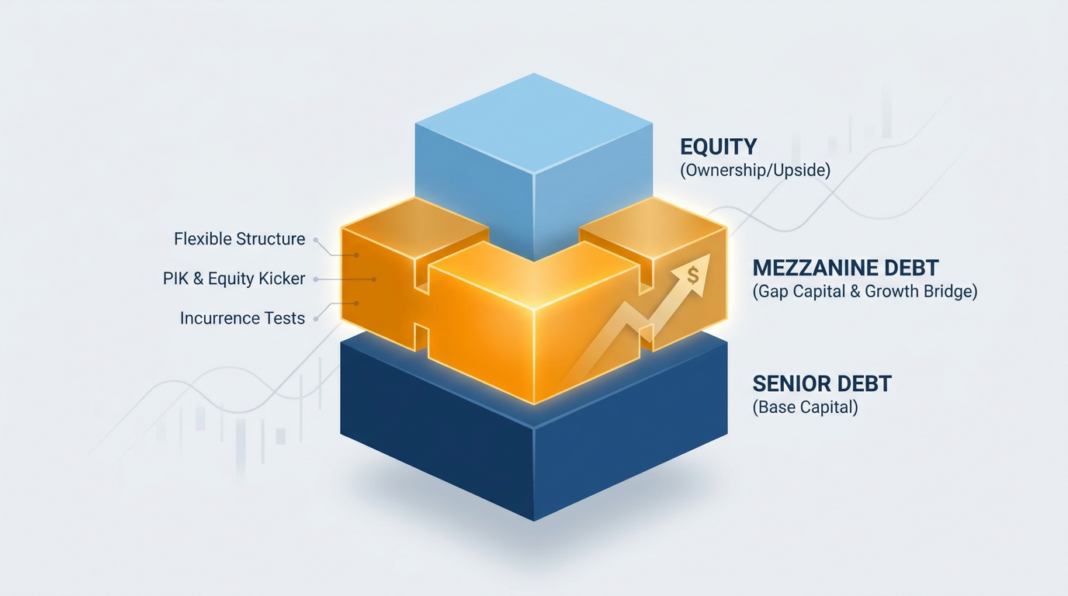
Mezzanine debt exists precisely for this moment. It is the layer of the capital stack engineered to bridge the gap between what senior lenders will advance and what equity providers should fund: absorbing more risk than senior debt, priced accordingly, and structured with features that align the lender’s return with the borrower’s growth trajectory. For growth-stage operators executing acquisitions, understanding how mezzanine capital is structured, priced, and negotiated is not a theoretical exercise. It is a prerequisite for keeping the cap table intact.
The Capital Stack in a $15M Growth-Stage Acquisition
A well-designed capital stack for a $15M acquisition typically assembles three to four distinct layers, each priced to its risk position in the repayment waterfall. Working from the bottom up:
Layer 1, Senior Debt: The Cheapest Capital with the Most Strings Attached
Senior bank debt or a direct lending facility secured by the company’s assets and cash flows forms the foundation. For a software or services business generating $3M–$5M in EBITDA, senior lenders will typically advance 2.5x–3.5x leverage. In the current rate environment, all-in pricing sits in the SOFR + 250–400 bps range for bank facilities, or SOFR + 450–600 bps for direct lending unitranche structures. This layer provides the lowest-cost capital but carries the most structural restriction: financial maintenance covenants on leverage ratio and fixed charge coverage, negative covenants limiting additional indebtedness, and hard collateral requirements. As documented in growth-stage acquisition financing frameworks, senior debt sits at the bottom of the repayment waterfall precisely because it carries the highest priority, and lenders price the lower risk accordingly. See: bondtv.vaultai.ca.
Layer 2, Mezzanine Debt: The Gap Capital Layer
Mezzanine capital fills the structural gap between the senior debt ceiling and the equity contribution. It is subordinated to senior debt in the repayment waterfall, which means it absorbs more risk, and demands higher returns. Typical all-in pricing ranges from 12%–18%, structured as a combination of:
- Cash pay interest: 8%–12%, paid currently, reducing the cash-to-equity gap
- PIK interest: 2%–6%, accruing to the principal balance rather than paid in cash, preserving liquidity during the integration phase when operational risk is highest
- Equity kicker: Warrants or co-investment rights representing 1%–5% of fully diluted equity, providing the lender with participation in upside beyond the coupon
Critically, mezzanine covenants are structured differently from senior debt. Most mezz facilities use incurrence-based tests rather than maintenance covenants: meaning the covenant is only triggered when the borrower takes a specific action (incurring additional debt, making a restricted payment, or effecting a change of control), not simply by operating below a financial threshold on a quarterly test date. This distinction materially changes the operational flexibility available to management during integration. As the bondtv.vaultai.ca framework notes, this covenant-lite characteristic relative to senior debt is a defining feature of well-structured mezzanine capital.
Layer 3, Preferred Equity: When Debt Capacity Is Exhausted
Where total leverage would exceed 5.0x EBITDA or debt service coverage would fall below 1.20x FCCR, preferred equity steps in. Preferred instruments sit above common equity in the liquidation waterfall but below all debt. Returns are delivered via a preferred dividend (often 8%–14%, sometimes PIK) a 1x liquidation preference, and participation rights. The key trade-off: preferred equity carries no scheduled repayment and no maintenance covenants, but its annualized cost exceeds mezzanine debt on a fully loaded basis when dilution and governance rights are modeled correctly.
The Gap Capital Playbook: Four Steps from Quantification to Close
Step 1: Quantify the Gap with Precision
Start with the acquisition price and work backward. For a $15M target: senior debt capacity at 3.5x EBITDA on $3M EBITDA equals $10.5M, but covenant cushion, working capital reserves, and fee load typically reduce the usable advance to $8M. A seller note may contribute $1M if the seller is motivated and structured carefully. The remaining $6M is the gap capital quantum, the specific number that requires a structured solution. Model three scenarios before approaching any capital provider: (a) fill entirely with mezzanine debt; (b) fill with preferred equity; (c) blend both. For each, calculate post-close leverage ratio, annual cash debt service, and pro-forma equity dilution. The optimal scenario maintains fixed charge coverage above 1.20x, keeps total leverage below 5.0x EBITDA, and limits equity dilution below 15% of common. As noted in sponsor-led deal frameworks, the goal is a stack that matches cash flow durability to lender appetite, not maximum leverage. See: vcbeast.com.
Step 2: Prepare the Materials Gap Capital Providers Require
Mezzanine funds, BDCs, family offices, and credit opportunity funds underwrite to a different thesis than senior lenders. They require four documents before engaging substantively: (1) a use-of-proceeds memo showing how the acquisition creates EBITDA accretion and by what mechanism; (2) a three-year integrated financial model with sensitivity tables on revenue growth and margin compression; (3) a management presentation articulating the strategic rationale, competitive moat, and exit pathway; and (4) a clean cap table showing pre- and post-transaction ownership under each capital scenario. A clear capital plan materially shortens due diligence timelines with institutional providers.
Step 3: Run a Parallel Process, Not a Sequential One
Approach four to six gap capital providers simultaneously. Create competitive tension. Send a structured term sheet request with a defined response deadline. Require each provider to specify: coupon structure (cash pay vs. PIK split), warrant coverage or equity participation percentage, covenant package (maintenance vs. incurrence), board observer rights, and change-of-control provisions. A 14% all-in mezzanine facility with a 3% warrant coverage and maintenance covenants may be more operationally restrictive than a 16% preferred equity instrument with no covenants and no scheduled repayment. Evaluate responses across all five dimensions, not just the headline rate.
Step 4: Negotiate the Structure, Not Just the Price
The most negotiable terms in a gap capital structure are not the headline coupon. They are:
- PIK vs. cash pay split: Push for maximum PIK in years one and two to preserve cash flow during integration. A 4% cash / 10% PIK structure in year one meaningfully reduces cash debt service during the period of highest operational risk.
- Warrant coverage quantum: Negotiate coverage as a percentage of fully diluted equity at the time of issuance, not as a fixed share count that becomes disproportionately dilutive after future financing rounds.
- EBITDA definition in covenant calculations: Ensure the definition includes pro-forma synergies from the acquisition and excludes non-recurring transaction costs. This single negotiation point can be the difference between a covenant that provides headroom and one that triggers immediately post-close.
- Call protection step-down: A 2%/1%/0% premium schedule over three years is market-standard, but a no-call period in year one can often be negotiated away for borrowers with strong EBITDA visibility and a credible refinancing path. As the growth-stage acquisition financing framework observes, every term on the term sheet has downstream cap table consequences, model all warrant and dilution impacts at three exit scenarios before execution. See: bondtv.vaultai.ca.
Key Takeaways
- Match capital to risk layer: Senior debt funds collateralizable cash flows at the lowest cost; mezzanine funds the acquisition gap at a premium for subordination; preferred equity fills residual capacity where debt service cannot be supported. Each layer has a distinct structural role, conflating them produces either over-levered or over-diluted outcomes.
- Incurrence vs. maintenance covenants define operational freedom: Mezzanine facilities structured on incurrence-based tests give management genuine flexibility to operate through integration without quarterly covenant test anxiety, a structural advantage that justifies the higher coupon relative to senior debt.
- PIK interest is an integration-phase cash flow tool: Negotiating a PIK toggle on mezzanine debt for years one and two meaningfully reduces cash debt service during the period of highest operational execution risk. Model the PIK accrual carefully against exit valuation to ensure the compounding cost is justified by the flexibility gained.
- Equity kickers must be modeled across exit scenarios: A 3% warrant at a $15M post-money valuation produces a materially different dilution outcome at a $60M exit than at a $20M exit. Always stress-test warrant coverage across three exit multiples before agreeing to coverage terms.
- Competitive process is a structural tool: Running parallel outreach to four to six gap capital providers, not a single bilateral conversation, is the most reliable mechanism for compressing pricing, improving covenant terms, and shortening the timeline to a signed term sheet.


