
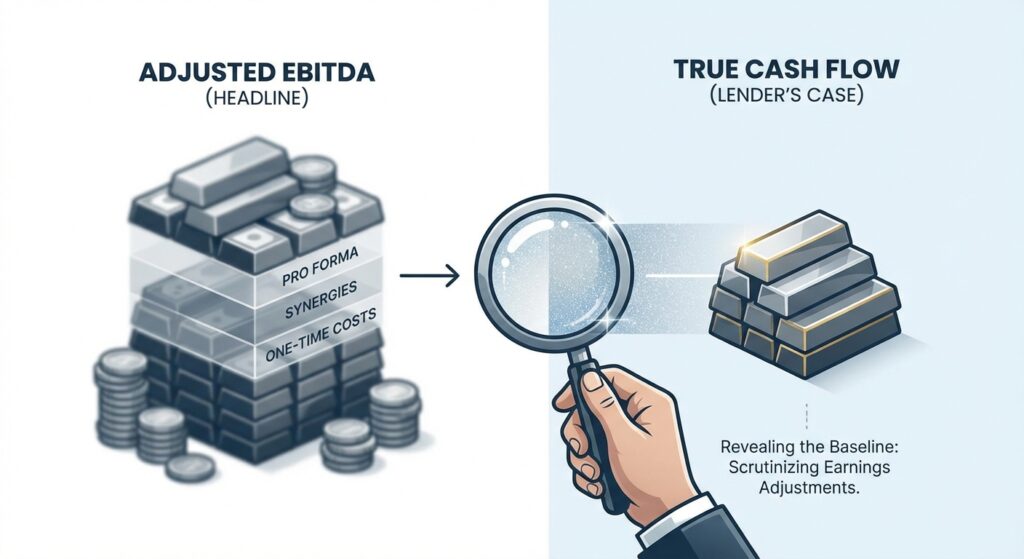
The Underwriting Challenge: determining True Cash Flow
In leveraged finance, EBITDA (Earnings Before Interest, Taxes, Depreciation, and Amortization) serves as the primary proxy for operating cash flow and constitutes the denominator in the all-important leverage ratio (Debt/EBITDA). However, the distance between reported GAAP earnings and the “Adjusted EBITDA” presented in a Confidential Information Memorandum (CIM) can be vast. For credit underwriters, the critical task is not merely verifying the math, but assessing the quality and sustainability of these adjustments.
According to the 2025 Principles for the Management of Credit Risk released by the Basel Committee, a sound credit-granting process requires an accurate measurement of the borrower’s capacity to repay under varying conditions. When adjustments for “one-time” expenses, pro-forma synergies, or “run-rate” normalizations are overly aggressive, they artificially deflate leverage ratios and mask the true risk profile of a borrower. Mastering the art of EBITDA normalization is therefore a defensive necessity.
The Framework: A Ladder of Adjustments
To rigorously analyze EBITDA, underwriters should visualize adjustments as a “ladder” of increasing risk and subjectivity. The goal is to move from management’s optimistic view to a “Lender’s Case” that reflects a highly probable cash flow baseline.
- Tier 1: Standard Non-Cash & Non-Recurring (Low Risk). These are objective, verifiable add-backs. Examples include non-cash stock compensation, gains/losses on asset sales, and clearly defined transaction expenses (e.g., M&A legal fees).
- Tier 2: Operational Normalizations (Medium Risk). These involve judgment calls. Examples include “excess” owner compensation (normalizing to market rates) or expenses related to discontinued product lines. The risk here is confirming that the costs are truly gone.
- Tier 3: Pro Forma & Synergies (High Risk). These are future-looking estimates. Examples include “expected” savings from a plant closure or “run-rate” adjustments for a contract signed mid-year. These are the most common source of credit deterioration post-close.
The Analysis: Walking Through the Math
Let’s analyze a hypothetical manufacturing borrower, “IndustrialCo,” with $50 million in reported revenue and a reported EBITDA of $8.0 million. The borrower is seeking a loan based on $12.5 million in Adjusted EBITDA. The gap is $4.5 million, a 56% increase over the reported number.
1. The “One-Time” Expense Test
IndustrialCo claims $1.5 million in “one-time ERP implementation costs.”
Underwriting Action: Check the history. Did they have similar IT costs in the prior two years? If a company is constantly “upgrading” its systems, these costs are arguably recurring maintenance capex, not one-time add-backs.
Lender Adjustment: If history shows $500k/year in average IT upgrades, only add back the delta ($1.0 million), not the full $1.5 million.
2. The Pro Forma Contract
Management adds $2.0 million for a “full-year impact” of a new customer contract signed in October.
Underwriting Action: Verify the contract terms. Is there a ramp-up period? Are there offsetting costs (e.g., new hires required to service the contract) that haven’t been netted out?
Lender Adjustment: Apply a gross margin percentage to the annualized revenue, but deduct estimated variable overhead. Often, this reduces the add-back by 20-30%.
3. Synergies
The sponsor includes $1.0 million in “headcount rationalization.”
Underwriting Action: Request a specific list of positions to be eliminated. If the names aren’t identified, the savings aren’t real.
Lender Adjustment: Standard practice is to exclude purely aspirational synergies or cap them (e.g., at 10% of EBITDA) until realized.
Industry Standards and Red Flags
Institutional lenders and rating agencies have tightened their scrutiny on add-backs following the credit cycles of the 2020s. Research indicates that realization rates for “future synergies” often fall below 60% of projections.
Common Red Flags in Credit Analysis:
- ” restructuring” charges every year: If a company is in a perpetual state of restructuring, those costs are operating expenses.
- Covenant Definitions: Borrowers often negotiate “EBITDA” definitions in credit agreements that allow uncapped add-backs for future cost savings. A disciplined term sheet should cap these (often 20-25% of EBITDA) and limit the look-forward period (e.g., 12-18 months).
- Cash Conversion: Compare Adjusted EBITDA to Operating Cash Flow (OCF). If Adjusted EBITDA is $12.5M but OCF is $4M, the add-backs are likely non-cash or the company has a massive working capital drain. As noted in credit risk analytics guides, isolated metrics can be misleading; EBITDA must always be cross-referenced with cash flow statements.
Underwriting Checklist: Validating the Quality of Earnings
When reviewing a Quality of Earnings (QoE) report or building the CIM financial model, use this checklist to scrub the numbers:
- Source Verification: Is the add-back supported by a third-party QoE report, or is it a “Management Adjustment”? Management adjustments require double the diligence.
- Cash Proof: For expense add-backs, trace the line item to the general ledger. Verify the expense actually occurred and was paid.
- Contra-Revenue Check: Ensure that “marketing expenses” added back aren’t actually contra-revenue items (like customer rebates) which should remain above the line.
- The “But-For” Test: Ask, “But for this expense, would the business have operated normally?” If the answer is no (e.g., repair costs for essential machinery), it is not an add-back.
- Capex vs. Opex: Ensure that capitalized software or development costs aren’t also being added back as “project costs,” effectively double-counting earnings.
Key Takeaways
- EBITDA is a construct, not a fact: It is largely defined by the credit agreement, not GAAP.
- Adjustments inflate leverage: A 5x leverage ratio on “Adjusted” EBITDA might be 7x on a reported basis. Know the difference.
- Beware of “Future” Savings: Synergies and pro forma savings are the highest-risk category of adjustments; hair-cut them aggressively.
- Cash is King: Always reconcile Adjusted EBITDA to Net Cash Provided by Operating Activities.
- Definition Discipline: In legal documentation, fight for caps on add-backs and strict time limits on realization.


