
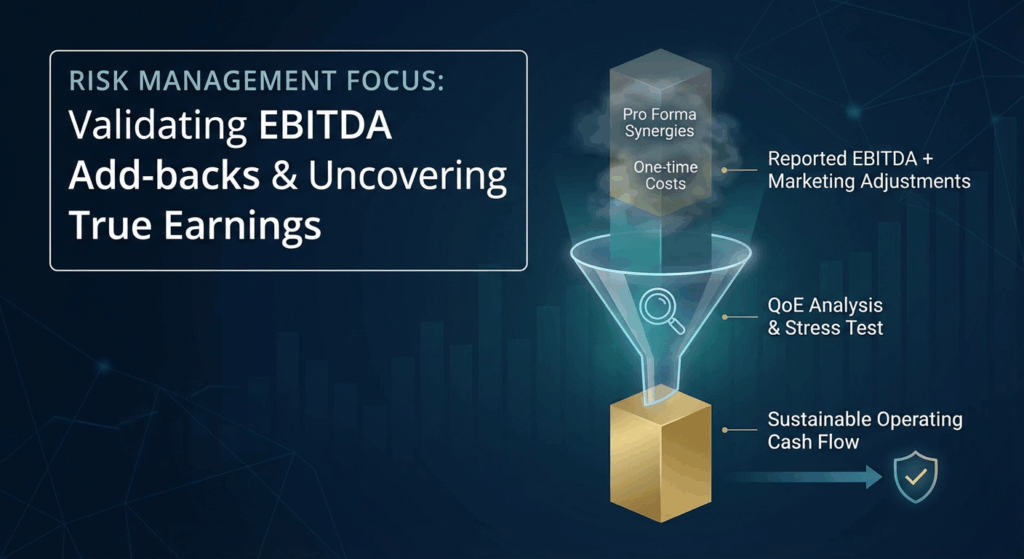
The Underwriting Challenge: Reported vs. Sustainable EBITDA
In middle-market credit underwriting, the distance between "Reported EBITDA" and "Adjusted EBITDA" is often where credit risk hides. For lenders, the primary objective is not merely to validate an accounting metric, but to ascertain the borrower’s recurring cash flow available for debt service. As credit markets tighten, the discipline of validating EBITDA addbacks (normalizations, pro forma synergies, and one-time expenses) becomes critical to preventing covenant leakage and ensuring accurate leverage reporting.
A rigorous underwriting framework distinguishes between "hard" adjustments (verifiable, historical expenses that will not recur) and "soft" adjustments (projected savings or theoretical optimizations). This article outlines a practitioner's approach to Quality of Earnings (QoE) analysis, focusing on normalization techniques used to strip out noise and reveal the true sustainable cash flow of a business.
The Framework: Normalization Methodology
The core tenet of sound credit-granting processes, as outlined in the BIS Principles for the Management of Credit Risk, is the establishment of an appropriate credit risk environment that thoroughly assesses a borrower’s repayment capacity. In the context of EBITDA analysis, this requires a three-step normalization framework:
- Identify Non-Recurring Items: Isolate expenses that are truly one-time in nature (e.g., a massive litigation settlement or disaster repair) versus those that occur sporadically but operationally (e.g., machine maintenance cycles).
- Adjust for Ownership/Structure: Normalize compensation for private owners to market rates and remove personal expenses run through the business.
- Validate Pro Forma Synergies: Scrutinize forward-looking cost savings that have not yet been realized.
Example: The $10M EBITDA Manufacturing Case
Consider a specialized manufacturing borrower seeking a refinance. The company reports Last Twelve Months (LTM) EBITDA of $10.0 million. However, the sponsor is requesting credit for $4.0 million in adjustments, bringing "Marketing EBITDA" to $14.0 million. If the lender applies a 4.0x leverage multiple:
- Based on Reported ($10M): Loan amount = $40M.
- Based on Adjusted ($14M): Loan amount = $56M.
Underwriting the full adjusted amount increases the loan size by 40%. If those adjustments fail to materialize as cash flow, effective leverage skyrockets to 5.6x immediately upon closing, significantly increasing the probability of default.
The Analysis: Stress Testing the "Add-Backs"
To mitigate this risk, underwriters must perform a line-item stress test of the proposed adjustments. Here is how a disciplined credit team analyzes the $4.0 million proposal from the example above:
1. Management Fees & Owner Compensation ($1.0M)
The Claim: The previous owner paid themselves $1.5M; the new professional CEO will cost $500k. Adjustment = +$1.0M.
The Verdict: Acceptable (Hard Adjustment). This is verifiable and contractual. Using market rates for executive compensation is a standard analytical model in credit assessment.
2. Systems Implementation Costs ($1.5M)
The Claim: The company spent $1.5M installing a new ERP system. This is a one-time non-recurring cost.
The Verdict: Scrutinize (Mixed). while the installation is one-time, does the new ERP require higher ongoing licensing fees? Underwriters should add back the implementation cost but deduct the new annual recurring software expense (e.g., $300k/year), resulting in a net adjustment of +$1.2M rather than $1.5M.
3. Pro Forma Synergies ($1.5M)
The Claim: Consolidating two warehouses will save $1.5M annually in rent and labor starting next year.
The Verdict: High Risk (Soft Adjustment). In Corporate Credit markets, lenders often cap these adjustments. A prudent approach is to credit only actions taken (e.g., lease actually terminated) or cap synergies at 10-15% of EBITDA. For this example, an underwriter might discount this by 50% to account for integration risks, allowing only $750k.
Industry Standards and Red Flags
Institutional lenders and rating agencies maintain skepticism toward aggressive addbacks. According to CFA Institute guidelines on Credit Analysis Models, the probability of default is a function of actual cash flow coverage, not theoretical earnings. When structuring covenants, lenders often insert specific language to limit "Creative Accounting":
- Look-back Periods: Adjustments are often valid only if the event occurred within the LTM period.
- Capped Synergies: Credit agreements frequently cap synergy addbacks at 15% or 20% of Adjusted EBITDA to ensure the leverage ratio remains tethered to reality.
- Time Limits: Savings must be realizable within 12 to 18 months.
Common Red Flags
Watch for "Lost Contract Normalization" (adding back profit from a lost customer under the guise that it was an anomaly) or "Consulting Fees" that appear every year despite being labeled one-time. If non-recurring expenses happen every year, they are recurring expenses.
Underwriting Checklist: Due Diligence on Earnings
Before validating an Adjusted EBITDA figure for a credit memo, underwriters should complete the following checks:
- Proof of Cash Flow: Can you trace the add-back to a specific bank statement or contract?
- Third-Party Validation: Has a reputable accounting firm produced a Quality of Earnings (QoE) report supporting these numbers?
- Recurring vs. Non-Recurring: Review the GL detail for the "one-time" expense accounts over the last 3 years. If the account is active every year, reject the adjustment.
- Covenant Definitions: Ensure the credit agreement definition of "Consolidated EBITDA" strictly limits the borrower’s ability to add back undefined "future savings" without lender consent.
Key Takeaways
- Cash is King: EBITDA is a proxy for cash flow, not cash flow itself. Adjustments do not pay interest; cash does.
- Bifurcate Adjustments: Separate "Hard" (contractual) from "Soft" (theoretical) adjustments.
- Cap the Upside: Limit pro forma synergies to a percentage of EBITDA to control leverage creep.
- Verify Expenses: If a "one-time" expense appears in financials for three consecutive years, it is an operating cost.
- Stress Test Leverage: Always calculate leverage on both Reported and Adjusted EBITDA to understand the full risk spectrum.


