
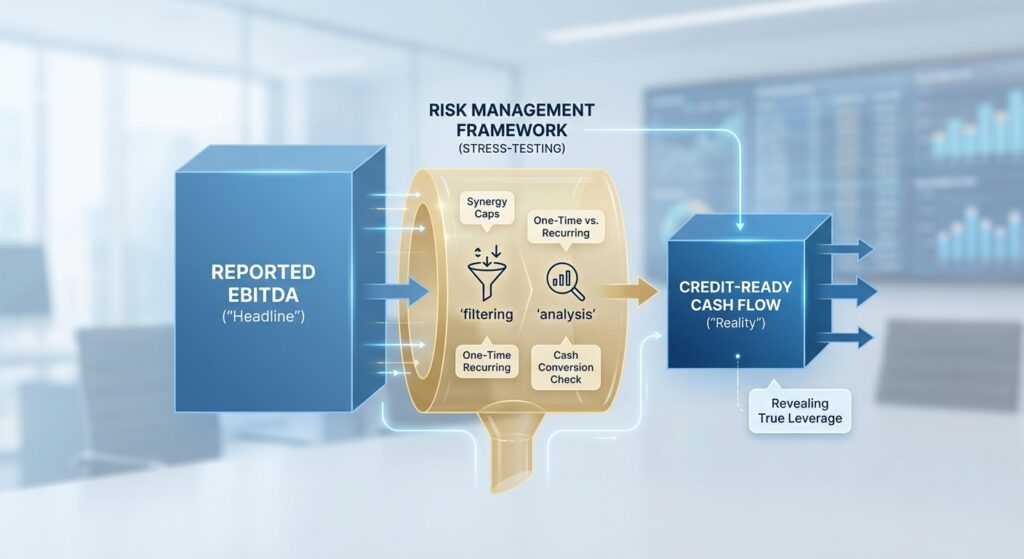
The Underwriting Challenge: Headline vs. Reality
In the high-stakes environment of credit underwriting, few metrics are as critical (or as manipulated) as EBITDA. As of early 2026, the divergence between a borrower’s reported operating income and the “Adjusted EBITDA” presented in Confidential Information Memorandums (CIMs) has widened significantly. For lenders, this gap represents “hidden leverage”, a risk factor highlighted by recent market analysis on structured credit and leverage trends.
The challenge for the modern underwriter is not merely to accept the adjustments provided by an issuer or sponsor, but to rigorously stress-test them. A borrower presenting $10 million in Adjusted EBITDA to support 4.0x leverage may, upon closer inspection of “pro forma” synergies and “one-time” fees, actually be generating $7 million in hard cash flow, implying a true leverage of 5.7x. In a macroeconomic climate where the Bank of England's December 2025 Financial Stability Report warns of increased risks to financial stability, distinguishing between accounting creativity and sustainable cash flow is the primary line of defense against default.
The Framework: Normalization Methodology
Effective underwriting requires a systematic approach to Quality of Earnings (QoE). The goal is to bridge the gap between Reported EBITDA (accounting profit) and Credit-Ready EBITDA (proxy for recurring cash flow available for debt service).
We categorize adjustments into three distinct risk buckets:
- Tier 1: Standard & Verifiable. Non-recurring legal fees for settled litigation, one-time severance paid in cash, and owner’s personal expenses (aircraft, personal vehicles) that will definitely cease post-close.
- Tier 2: Operational Pro Forma. Run-rate adjustments for contracts already signed but not fully reflected in historical financials. These are generally acceptable but require contract verification.
- Tier 3: Speculative & “Soft” Add-backs. Projected cost savings, vague “synergies” from M&A integration, and “market normalization” of salaries. This is where hidden leverage accumulates.
Example: The Manufacturing Case Study
Consider “TargetCo,” a specialized manufacturing firm seeking a refinance. The CIM presents the following Trailing Twelve Month (TTM) profile:
- Net Income: $2,500,000
- Plus Interest/Tax/Depreciation: $3,500,000
- Reported EBITDA: $6,000,000
- Total Adjustments: $4,000,000
- Marketing Adjusted EBITDA: $10,000,000
At a $40 million loan request, the sponsor argues this is 4.0x leverage. However, the $4 million in adjustments requires forensic decomposition.
The Analysis: Deconstructing the Add-Backs
To assess the true risk, the underwriter must walk through the calculations of the $4 million adjustment block:
1. Restructuring Costs ($1.2M): The company claims these are “one-time.” However, a look at the last three audits shows “restructuring” charges appear every year.
Underwriting Action: If they recur annually, they are operating expenses, not add-backs. Reject.
2. Synergies ($2.0M): The company plans to close a warehouse next year.
Underwriting Action: This is future-dated. Institutional best practice, aligned with principles found in recent Basel Committee risk guidelines, suggests capping synergies or only crediting them if actions (e.g., lease termination) are already taken. We might credit 50% ($1.0M) for sensitivity analysis.
3. Out-of-Period Inventory Adjustment ($0.8M): An accounting correction.
Underwriting Action: Verified by third-party QoE report. Accept ($0.8M).
The “Lender Case” Recalculation
- Reported EBITDA: $6.0M
- Accepted Adjustments: $0.8M (Inventory) + $1.0M (Risk-adjusted Synergies)
- Credit-Ready EBITDA: $7.8M
Result: The leverage on a $40 million loan is not 4.0x; it is 5.1x. This significant deviation alters the risk rating and may trigger different covenant requirements or pricing tiers.
Industry Standards and Red Flags
Recent insights into structured credit emphasize that risk appetite has expanded, with lenders moving deeper into “discovery-credit” segments. According to market observers, the expansion of private credit has led to more complex structures where leverage is often obscured by definition.
Institutional lenders typically impost “Capped Adjustments” in credit agreements, often limiting total add-backs to 15% to 25% of Reported EBITDA. In the TargetCo example, adjustments represented 66% of Reported EBITDA ($4M / $6M), a massive red flag indicating that the business model’s profitability is theoretical rather than actual.
Furthermore, the Bank of England’s December 2025 report notes that corporate defaults in the US have underlined the necessity for robust risk management. Aggressive EBITDA definitions are frequently the first domino to fall; when the “synergies” don’t materialize, the cash flow isn’t there to service the debt, leading to payment default despite “covenant compliance” on paper.
Underwriting Checklist: Validating Cash Flow
When assessing an opportunity, the following diligence steps are mandatory for rigorous risk assessment:
- Quality of Earnings (QoE) Reconciliation: Does the adjusted EBITDA reconcile to Operating Cash Flow (OCF) on the cash flow statement? If EBITDA is positive but OCF is negative, adjustments are likely non-cash or working capital is deteriorating.
- History of “One-Timers”: Pull 3 years of financials. Do “non-recurring” expenses occur every year? If so, treat them as operating expenses.
- Covenant Definition Review: In the credit agreement, how is “Consolidated EBITDA” defined? Watch for “uncapped” synergy clauses or “lost revenue” add-backs.
- Cash vs. Accrual: Are the add-backs valid cash expenses that will not be spent next year, or are they accounting accrual reversals?
- Capex Adjustment: Remember that EBITDA ignores CapEx. A company with $10M EBITDA and $8M Maintenance CapEx has only $2M of free cash flow. Always underwrite to (EBITDA – CapEx).
Key Takeaways
- Add-Backs Are Leverage: Every dollar of “soft” add-back accepted increases the effective leverage of the deal.
- Trend Analysis Matters: Recurring “non-recurring” items are a sign of poor cost control or aggressive accounting.
- CapEx is Real: EBITDA is not cash flow. Maintenance capital expenditures must be deducted to understand debt service capacity.
- Covenants Protect Value: Strict definitions in the loan agreement prevent borrowers from “adjusting” their way out of a default scenario.
- Macro Awareness: As noted in 2025 financial stability reports, robust risk management requires skepticism of stretched valuations and inflated earnings metrics.


