
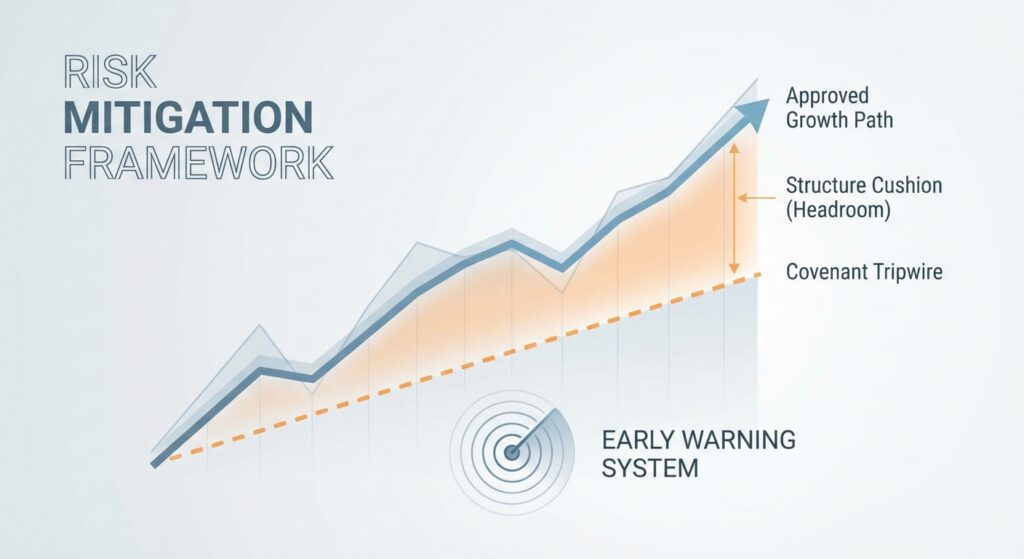
The Underwriting Challenge: Early Warning Systems
In the discipline of private credit and corporate lending, financial covenants are not merely legal boilerplate; they are the primary mechanism for risk mitigation after capital has been deployed. For underwriters, the challenge lies in designing a covenant package that functions as an effective “early warning system”, triggering a conversation before a borrower faces a liquidity crisis, while granting the borrower sufficient flexibility to execute their business plan.
As noted in the Basel Committee’s 2025 Principles for the Management of Credit Risk, specific attention must be paid to “maintaining an appropriate credit administration, measurement and monitoring process.” Covenants are the operational tools that enforce this discipline. A well-structured covenant package does not stifle growth; rather, it creates a structured framework for intervention when performance deviates materially from the underwriting base case.
The Framework: Structuring for Headroom and Flexibility
Effective covenant design begins with a clear distinction between maintenance covenants and incurrence covenants. In traditional middle-market lending, maintenance covenants (tested quarterly) are the standard, requiring borrowers to maintain specific financial ratios regardless of their activity. Incurrence covenants, common in high-yield bonds and larger syndicated loans, only test ratios when the borrower takes a specific action, such as issuing new debt or paying a dividend.
For rigorous underwriting, the focus is typically on two primary metrics:
- Leverage Ratio: Measures the magnitude of debt relative to earnings (Total Debt / EBITDA). This tests the long-term solvency and capital structure health.
- Fixed Charge Coverage Ratio (FCCR): Measures the ability to service debt and fixed obligations from cash flow.
Methodology for Setting Levels:
Experienced underwriters typically set covenant levels with a “cushion” or “headroom” of 15% to 25% to the management’s projected model (base case). This bandwidth allows for normal cyclicality but trips a breach if the company underperforms significantly.
The Analysis: Quantitative Stress Testing
To illustrate the mechanics of covenant design, consider a manufacturing company with the following underwriting profile:
- LTM EBITDA: $10.0 million
- Total Senior Debt: $35.0 million
- Closing Leverage: 3.5x
- Projected Year 1 EBITDA: $11.0 million
Setting the Leverage Covenant:
If the underwriter applies a standard 20% cushion to the projected Year 1 EBITDA ($11M), the “breach” level EBITDA would be approximately $8.8M.
Calculation:
If EBITDA falls to $8.8M, and Debt remains $35M, the Leverage Ratio becomes:
$35,000,000 / $8,800,000 = 3.98x
Therefore, a Leverage Covenant set at 4.00x would be appropriate. It allows for the business to miss its growth target ($11M) and even contract slightly below LTM levels ($10M) down to $8.8M before a default is triggered. This prevents the lender from being triggered by minor variance while ensuring they are at the table if the business deteriorates fundamentally.
Cash Flow Stress Test:
We must also test the FCCR under a downside scenario. The standard formula is:
FCCR = (EBITDA – Unfunded Capex – Cash Taxes) / (Cash Interest + Scheduled Principal Amortization)
If interest rates rise (a key consideration in 2025/2026), the denominator increases, shrinking the coverage ratio. A robust underwriting model will stress test this ratio assuming a 100-200 basis point increase in SOFR to ensure the borrower maintains a ratio above 1.10x even in a high-rate environment.
Industry Standards and Red Flags
Institutional lenders and rating agencies monitor these metrics closely to assess “financial flexibility.” According to Fitch Ratings’ 2025 Corporate Rating Criteria, a company’s financial profile is judged heavily by its “financial structure” and “financial flexibility,” which includes the distance to covenant breaches. A narrow covenant cushion reduces a company’s rating or credit score because it limits management’s ability to maneuver during downturns.
Red Flags in Covenant Negotiations:
- “EBITDA with infinite add-backs”: Borrowers often negotiate to define EBITDA in ways that add back disparate expenses (e.g., “projected synergies” or “one-time consulting fees”). If “Adjusted EBITDA” is 30% higher than GAAP EBITDA, the covenant’s protective value is diluted.
- Equity Cure Rights: Borrowers may request the right to inject cash to “cure” a covenant breach. Best practices limit this to 1-2 times per year and require the cash to be used to pay down debt, rather than just legally increasing EBITDA for the calculation.
- Covenant-Lite Structures: In competitive markets, lenders may waive maintenance covenants entirely. This removes the early warning signal, meaning the lender may only find out about distress when a payment default occurs, often too late to preserve principal.
Underwriting Checklist: Covenant Diligence
Before closing a credit facility, the risk management team should validate the following:
- Definition Rigor: Does the Credit Agreement typically define “EBITDA” with a cap on add-backs (e.g., capped at 10-15% of EBITDA)?
- Testing Frequency: Are covenants tested quarterly? For distressed interaction, are they tested monthly?
- Calculation Consistency: Are the financial statements used for compliance certificates prepared on the same basis as the underwriting model (GAAP vs. Cash Basis)?
- Cross-Default Provisions: Does a breach in another facility (e.g., a revolver) trigger a default in the term loan?
Key Takeaways for Risk Managers
- Covenants are Tripwires: They are designed to force a conversation, not necessarily to trigger a liquidation.
- Headroom Matters: Setting covenants too tight creates administrative burden; setting them too loose destroys risk checking. Target 15-25% cushion.
- Definitions Drive Outcomes: A strict leverage ratio is useless if the EBITDA definition is too loose.
- Monitor Actively: As per Basel principles, the credit granting process must be followed by rigorous ongoing administration.
- Stress Test Rates: Ensure Fixed Charge Coverage survives a high-interest rate environment.


