
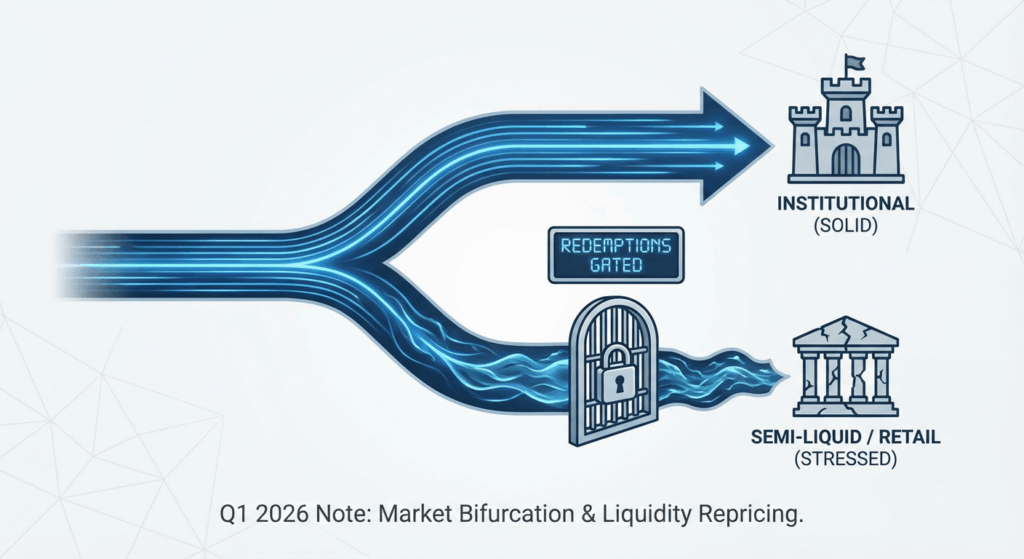
Market Headline: The “Liquidity Repricing” – Structural Stress Tests Private Credit in Q1 2026
As of late March 2026, the private credit market is navigating its most significant structural test since the asset class moved mainstream. Following the high-profile bankruptcies of Tricolor and First Brands in late 2025, the narrative has shifted from “golden age” to “liquidity repricing.” While headlines suggest a systemic “GFC 2.0” event, the data points to a more contained, albeit painful, recalibration concentrated in semi-liquid vehicles rather than a generalized solvency crisis.
The primary friction point is the “wealth channel”, specifically semi-liquid perpetual BDCs and evergreen funds. Redemption gates were triggered at major platforms including Blue Owl, which closed a $1.6 billion redemption window in February 2026, alongside increased withdrawal activity at Blackstone and BlackRock. This has forced a repricing of liquidity and underwriting standards, creating a bifurcation between stable closed-end institutional funds and democratized retail products facing duration mismatches.
Quantitative Snapshot: Q1 2026
The following metrics highlight the shifting risk premiums and credit health as the market tightens.
| Metric | Current Level (Q1 2026) | Prior Period Comparison | Trend / Notes |
|---|---|---|---|
| Proskauer Default Index | 2.46% (Q4 ’25) | 1.84% (Q3 ’25) | Defaults are rising but remain below crisis thresholds. Source |
| Target Yields | 9% – 13% | 8% – 11% (2024 Avg) | Yields widening as investors demand higher risk premiums. Source |
| Payment-in-Kind (PIK) | >8% of BDC Income | ~5-6% (2023 Avg) | Signifies cash flow stress; borrowers conserving cash. Source |
| Distressed Capital | $100B+ Raised | $40B (2023-2024) | Dry powder ready for dislocation opportunities. Source |
Sector Analysis: Software Stress and the Rise of Asset-Based Finance
Software & Technology: Once the darling of private credit, the software sector is now identified as a key “pressure point.” Concerns over valuation credibility and the sustainability of high leverage multiples in a higher-rate environment have led to increased scrutiny. Atlas Peak Research notes that reported NAVs in this sector are under question, particularly where mark-to-model valuations diverge from public market comparables.
Asset-Based Finance (ABF): Conversely, ABF is emerging as a structural winner. As direct lending faces headwinds from corporate credit stress, allocators are rotating into asset-backed strategies which offer collateral protection. With Intelligence reports that ABF could challenge direct lending volumes long-term, driven by its resilience and non-correlated nature.
Europe vs. US: A notable geographic rotation is underway. Following years of US dominance, European fundraising surged in late 2025 and early 2026. Investors are viewing the European market as offering better relative value and structural protections compared to the saturated US middle market.
Implications for the Market
For Borrowers: The era of “borrower-friendly” terms is pausing. With liquidity tighter among major retail-backed lenders, borrowers face stricter underwriting and higher costs of capital. The “repricing of underwriting discipline” means leverage multiples are contracting, and document terms are tightening to protect lenders against the kind of collateral leakage seen in recent bankruptcies.
For Lenders & Investors: We are seeing a “flight to structure.” Institutional capital is favoring traditional closed-end drawdown structures over semi-liquid vehicles to avoid the run-on-the-bank risk inherent in daily/quarterly liquidity sleeves. Distressed and opportunistic funds are best positioned to deploy capital, capitalizing on the forced selling or restructuring needs of borrowers caught in the liquidity squeeze.
Key Market Insights
- Structural Mismatch Exposed: The stress is concentrated in “semi-liquid” vehicles (wealth channels) holding illiquid assets, not in traditional institutional funds.
- Valuation Gap: Expect NAV volatility in Q2 2026 as funds mark down assets to reflect wider spreads and lower comparable valuations, particularly in software.
- Default Normalization: A 2.5% default rate is a return to historical norms, not a collapse. However, the trajectory (up 62 bps QoQ) bears watching.
- Opportunity in Dislocation: The $100B+ in fresh distressed capital suggests a busy year for secondaries and restructuring solutions.
- Retail Retreat: The “retailization” of private credit faces its first major churn test; expect slower fundraising in the wealth channel for the remainder of 2026.


