
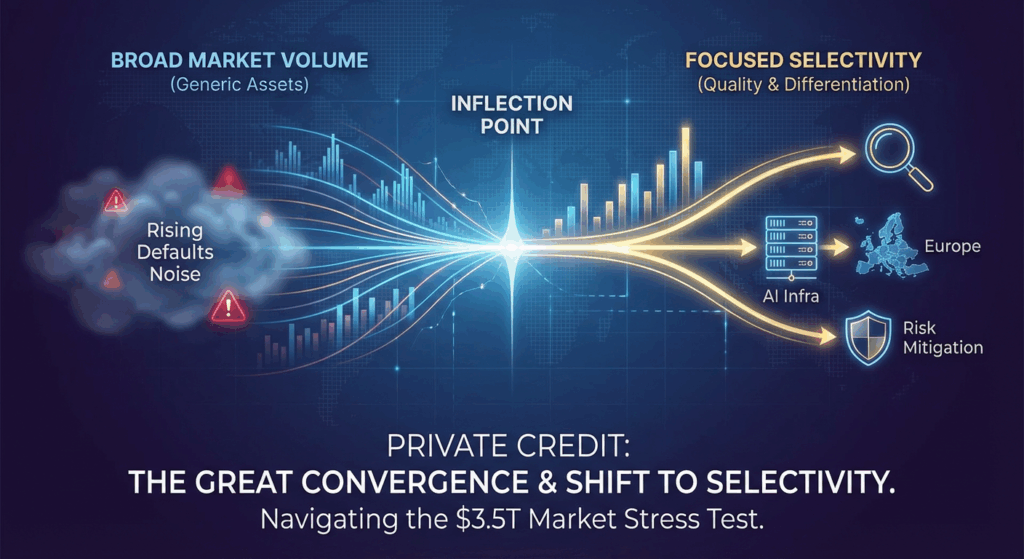
Market Headline: The $3.5 Trillion Inflection Point
As of March 2026, the private credit market has surpassed $3.5 trillion in assets under management, marking a definitive transition from a niche alternative asset class to a central pillar of corporate finance. However, this growth comes amidst a significant regime shift. After a prolonged period of benign conditions, the market is facing its “first real stress test” characterized by rising defaults and tightened spreads.
The era of scarcity capital has ended. We are witnessing a “Great Convergence” between private credit and the broadly syndicated loan (BSL) market. With the spread differential between the two compressing to historically low levels, the premium for illiquidity is shrinking. Simultaneously, investor sentiment has softened due to macro uncertainty and concerns that rapid fundraising has diluted underwriting discipline.
For lenders, the narrative has shifted from “opportunity at all costs” to extreme selectivity. While capital deployment surged 78% year-over-year in 2024, the market is now grappling with the consequences of that vintage, with middle-market default rates ticking upward. We are moving from a seller’s market to a buyer’s market, where manager differentiation and sector selection will drive returns in 2026.
Quantitative Snapshot: Key Market Metrics
| Metric | Current Level (Q1 2026) | Prior / Comparison | Trend/Signal |
|---|---|---|---|
| 1st Lien Direct Loan Yields | 8.0% – 8.5% | 10.0%+ (2023 Peaks) | Yield compression driven by competition and rate stabilization. [Source] |
| PC vs. BSL Spread Premium | 100 – 150 bps | 300+ bps (Historical Avg) | Convergence of public and private pricing. [Source] |
| Middle Market Default Rate | 5.5% | ~2-3% (Historical Avg) | Asset quality deterioration emerging. [Source] |
| LBO Deal Volume | +40% YoY | Depressed 2023/24 levels | M&A revival driving new issuance. [Source] |
| Manager Dispersion | 400 – 600 bps | ~200 bps (Pre-2024) | Gap between top/bottom quartile widens significantly. [Source] |
Sector Analysis: Rotation and Risk
Hot: AI Infrastructure & Asset-Based Finance (ABF)
The dominant source of incremental credit supply is no longer traditional corporate direct lending, but AI innovation and infrastructure. With cumulative AI-related spending expected to exceed $2.7 trillion through 2029, debt financing for data centers and power infrastructure is surging. Additionally, Asset-Based Finance (ABF) is identified by 65% of managers as the highest growth potential sector, tapping into a total addressable market projected at $40 trillion.
Hot: European Expansion
While North American fundraising has seen declines in direct lending, Europe has emerged as the key growth engine, with fundraising up nearly 40% YoY. Managers are aggressively targeting the underpenetrated European middle market, viewing it as a diversification play away from the saturated US sponsor market.
Cold/Watchlist: Enterprise Software
Once the darling of private credit, the software sector is facing scrutiny. Lenders are actively re-underwriting portfolios to account for AI disruption risks. There is growing concern that recurrence revenue loans originated at peak valuations during the zero-interest rate era may face stress as technological obsolescence accelerates.
Implications for Borrowers & Lenders
For Borrowers:
The “Great Convergence” benefits high-quality borrowers. With the syndicated market (BSL) regaining share, funding 63% of large-cap LBOs in 2025, borrowers can play private lenders against banks to secure tighter pricing. However, documentation is becoming a battleground. While private credit offers certainty, it has imported “lender-on-lender violence” tactics (e.g., uptiering) from the public markets.
For Lenders & Investors:
We have entered a period of “Selection over Scarcity.” The rising tide no longer lifts all boats. With a 5.5% default rate in the middle market, avoiding impairments is now more critical than chasing yield. The 400-600 basis point performance dispersion between managers indicates that manager selection is arguably the single biggest risk factor in 2026 portfolios. Lenders must pivot toward sectors structurally insulated from AI disruption (like sports financing or non-correlated ABF) to protect principal.
Key Market Insights
- Spread Compression is Structural: The premium for private credit over BSL has permanently reset lower (100-150 bps) as banks aggressively partner with private capital.
- Default Cycle is Here: A 5.5% middle market default rate signals that the “vintage risk” from 2021-2023 originations is materializing.
- Europe is the New Alpha: Capital flows are rotating heavily toward UK/EU private debt as the US market faces saturation and pricing pressure.
- The AI CapEx Supercycle: Infrastructure debt supporting AI (data centers, power) is replacing corporate LBOs as the primary volume driver for large-cap private credit.
- Covenants Remain Sticky: Despite public market convergence, 80% of private credit deals still retain maintenance covenants, offering a critical layer of structural protection absent in the BSL market.


