
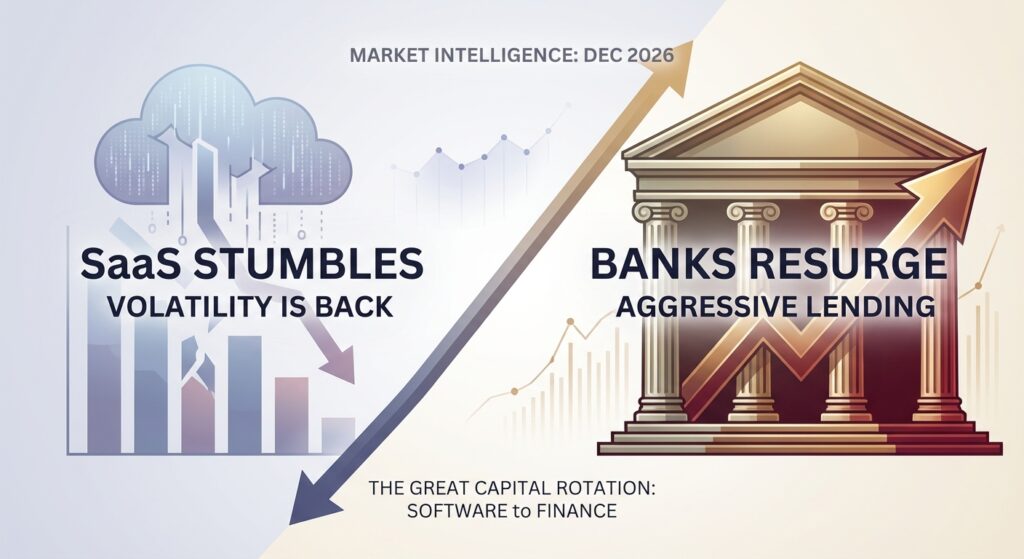
Market Headline: The Great Rotation – SaaS Stumbles as Banks Storm Back
As we close 2026, the private credit landscape is defined by two opposing forces: a structural correction in the formerly impregnable enterprise software sector and a resurgence of bank competition following regulatory easing. After a decade of dominance, the “recurring revenue” trade is facing its sternest test yet, dubbed the “SaaSpocalypse” by market observers earlier this year. Conversely, broadly syndicated loan (BSL) markets are recapturing market share, driven by aggressive underwriting standards from traditional banks no longer bound by strict leverage guidelines.
For borrowers, this marks a golden era of spread compression and optionality. For lenders, the environment demands a pivot from pure corporate cash-flow lending toward Asset-Backed Finance (ABF) and data infrastructure to maintain yield targets. The easy money in B2B software is gone; the next cycle belongs to asset-heavy complexity.
Quantitative Snapshot: Q4 2026
| Metric | Current Level | Trend (YoY) | Source |
|---|---|---|---|
| Direct Lending Yields | < 9.5% | ↓ Compression | CreditSights |
| Private Credit AUM | > $2.1 Trillion | ↑ Accelerated | Moody’s |
| Software Valuations | -20% (Index) | ↓ Correction | Chronicle Jrnl |
| Bank Leverage Appetite | > 6.0x EBITDA | ↑ Aggressive | CreditSights |
Sector Analysis: The Shift to Hard Assets
Cold: Enterprise Software
The “valuation catch-down” in software has materialized, impacting Business Development Companies (BDCs) with high exposure to Annual Recurring Revenue (ARR) loans. With public software valuations correcting violently, equity cushions beneath private credit deals have evaporated. Lenders are now scrutinizing retention rates and path-to-profitability metrics more aggressively than growth figures. The era of “sticky” revenue being a proxy for credit safety is ending, creating friction for borrowers accustomed to covenant-lite structures.
Hot: Asset-Backed Finance (ABF) & Infrastructure
Capital is rotating rapidly into Asset-Backed Finance. As corporate direct lending spreads tighten due to bank competition, managers are seeking yield in complex, asset-heavy sectors. Moody’s reports that ABF, particularly consumer loans and data infrastructure, is becoming the primary growth engine for the asset class. Data centers remain a critical bright spot, bridging the gap between real estate and technology, offering hard asset collateral that software lacks.
Implications for the Market
For Borrowers:
The withdrawal of leveraged lending guidelines for banks in late 2025 has fully altered the playing field. Banks are now competing aggressively on leverage multiples, often matching or exceeding private credit offers for high-quality credits. This has forced private lenders to compete on speed, certainty, and flexibility rather than just leverage depth. Borrowers can expect significantly tighter spreads and more favorable documentation terms as BSL and private execution converge.
For Investors & Lenders:
Yield compression suggests that the “golden age” of double-digit returns on senior secured tech paper is over. To maintain target returns, institutional capital is moving down the capital stack or into hybrid structures. There is also heightened “interconnectivity risk” as private credit funds and banks deepen ties, potentially creating contagion channels during a downturn. Investors should watch for “liability management transactions” (LMTs) where distressed borrowers exploit loose documentation to pit lender classes against each other.
Key Market Insights
- Software Reset: Expect continued volatility in SaaS loan portfolios; “recurring revenue” is no longer a golden shield against default.
- Bank Aggression: Traditional banks are back in force, driving leverage multiples up and spreads down across the upper middle market.
- Rise of ABF: Asset-Backed Finance is replacing corporate cash-flow lending as the primary source of alpha for private credit managers.
- Yield Compression: Direct lending yields have settled structurally lower (sub-10%); look to infrastructure debt for yield maintenance.
- Documentation Risks: Covenant protections are weakening as private credit terms converge with BSL standards to win competitive mandates.


