
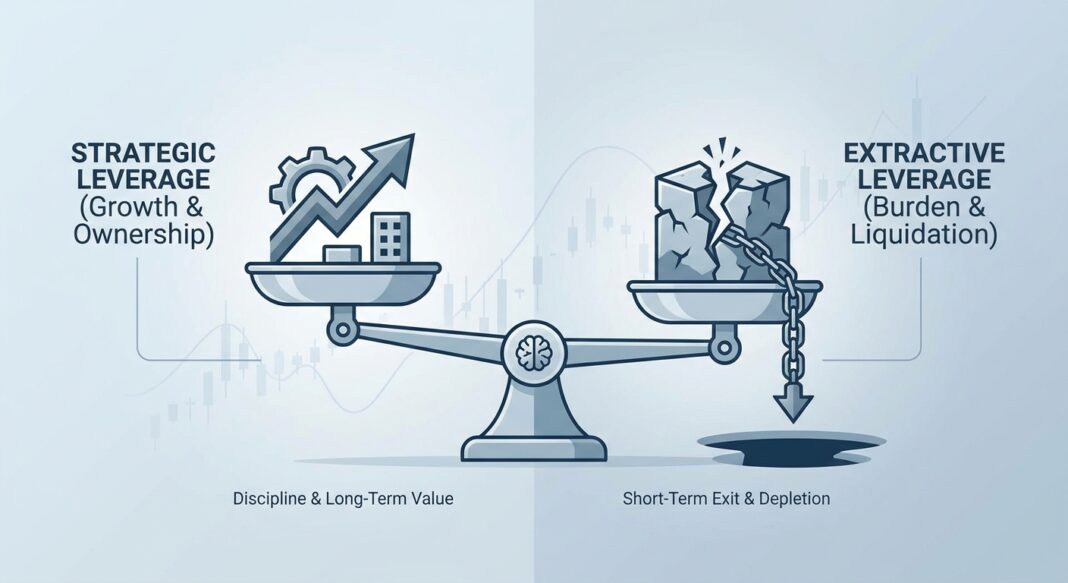
The Story: Same Instrument, Opposite Intentions
In the final weeks of 2024, two debt-fuelled stories landed in the financial press almost simultaneously, and together, they tell you nearly everything you need to know about when leverage creates lasting wealth and when it destroys it.
The first was Cohesity, a data security and management software company founded in 2013 by Mohit Aron. After building a recurring-revenue platform serving more than 12,000 enterprise customers, Cohesity closed a combination of roughly $950 million in equity alongside approximately $2 billion in debt financing to fund its December 2024 combination with the enterprise data protection business of Veritas. The debt wasn’t a rescue; it was a precision instrument, matched deliberately against durable, subscription-based cash flows. Ownership stayed intact. The cap table was preserved. Founders and early equity holders kept their stakes while the business scaled to become the world’s largest data protection software provider, with over $1.5 billion in annual recurring revenue.
The second story was the final chapter of Steward Health Care. In May 2024, Steward filed for Chapter 11 bankruptcy, one of the largest hospital bankruptcies in American history, reporting over $9 billion in total liabilities, including nearly $1 billion owed to vendors and $6.6 billion in long-term lease obligations. Its hospitals served more than 2 million patients. Five of them permanently closed. At least 30,000 jobs hung in the balance.
Both stories involve debt. One is about capital structure as discipline. The other is a case study in what happens when leverage is wielded as an extraction mechanism rather than a growth instrument.
The Decision: What Made the Structures So Different
Cohesity: Debt Matched to Cash Flow Reality
Cohesity’s decision to layer debt alongside its equity financing was documented prominently in the 2024–2025 Venture Debt Review produced by Runway Growth Capital and PitchBook as an example of how “venture debt can power ambitious growth plans without forcing founders to surrender equity.” The logic was structural: a SaaS-adjacent business with predictable contract revenues and high retention can service debt in a way that a pre-revenue startup simply cannot. The debt was sized against what the business could bear, and it left the equity table unchanged.
This is consistent with a broader market shift. Total venture debt deal value hit a record $53 billion in 2024, driven by founders deploying debt more selectively and strategically to preserve ownership and extend runway. And on the buyout side, LBO financings via direct lenders reached $81.4 billion in 2025: the highest level ever recorded by S&P LCD, as private credit cemented its role as the dominant instrument for growth financing.
Steward Health Care: Leverage as an Ownership Exit, Not a Business Strategy
Steward’s story begins in 2010 when private equity firm Cerberus Capital Management acquired six Massachusetts hospitals from nonprofit Caritas Christi Health Care in a leveraged buyout valued at $895 million, while Cerberus itself put up only $246 million in cash, roughly 27 cents on the dollar. That opening leverage ratio was aggressive for any business; for one operating in a complex, margin-thin healthcare environment, it was structurally dangerous from day one.
Then came the critical accelerant. In 2016, Steward sold the real estate of its Massachusetts hospitals to Medical Properties Trust in a transaction that generated $1.2 billion. Rather than using the proceeds to deleverage the business or invest in patient care infrastructure, Cerberus directed the proceeds toward a $484 million dividend to one of its funds, converting a corporate asset into an investor payday. When Cerberus eventually exited its position in 2020, Steward paid out an additional $111 million dividend to ownership. Cerberus reportedly made approximately $800 million during the decade it owned Steward. The hospitals, meanwhile, were left with $6.6 billion in long-term lease obligations to the very landlord that had funded their sale.
The debt never served the business. It served the exit.
The Outcome: Ownership Preserved vs. Communities Abandoned
Cohesity’s outcome is a case study in how strategic leverage compounds founder value. By combining equity and debt to execute the Veritas transaction, rather than issuing new equity at a potentially dilutive valuation, early shareholders, founders, and employees retained their proportional stakes in a company that grew its annual recurring revenue from $450 million in 2023 to over $1.3 billion ARR by 2024. The debt financed the acquisition; the equity remained the prize.
This is precisely why debt is gaining ground as a serious growth instrument. As research from the venture debt market confirms, “the stigma around debt as rescue financing is fading”, it is increasingly read as a mark of capital discipline, not distress. Founders who use debt strategically to fund a specific, cash-flow-supported expansion keep the upside they built.
Steward’s outcome was the inverse in almost every dimension. By May 2024, the system reported over $9 billion in liabilities and entered one of the largest healthcare bankruptcy proceedings in decades. Five hospitals permanently closed. At least 150,000 patients lost access to care in Massachusetts alone, and 2,400 workers lost jobs across three states. The communities that had relied on those hospitals for decades bore costs that never appeared on Cerberus’s fund statements.
The counterfactual is instructive. What if the 2016 sale-leaseback had been used to reduce the hospital system’s debt load rather than fund a dividend distribution? The lease obligations that ultimately crushed Steward were $6.6 billion, a liability that dwarfed the $484 million dividend paid to investors. The math of extraction rarely works in the long run for the operating business.
It is worth noting that the dividend recapitalization market, while legitimate and often well-structured, reached a record pace in 2025: PE-owned companies borrowed roughly $94 billion in leveraged loans and high-yield bonds to fund owner distributions for the year, according to Moody’s, with roughly $50 billion distributed directly to PE owners. That scale demands the discipline Cohesity exercised and that Steward never had.
The Lessons: A Framework for Founders and Operators
The contrast between these two stories distills into a set of clear principles that any business owner, operator, or capital allocator should carry into every financing decision.
1. Debt must serve the business, not the investor. Leverage that funds genuine operational growth (acquisitions, infrastructure, market expansion) can generate compounding returns. Leverage that funds immediate investor distributions while leaving the operating business to carry the liability is a bet against the long-term health of the enterprise.
2. Match debt tenor and structure to the underlying cash flow. Cohesity’s debt was sized against recurring, contracted revenue. Steward’s debt was layered onto a healthcare system with thin margins and enormous fixed operating costs. The instrument is not inherently good or bad, the fit is everything.
3. Equity dilution has a permanent, compounding cost that founders consistently underestimate. According to Carta’s founder ownership data, the median founding team retains approximately 56% after seed, 36% after Series A, and just 23% after Series B. By Series C, ownership has often fallen to 10–15%. Founders who use non-dilutive debt to bridge between rounds (or to fund acquisitions) keep a far larger share of the exit proceeds they worked to create.
4. The debt-vs-equity decision is ultimately a question of alignment. Equity partners with liquidation preferences and anti-dilution provisions have structural incentives that can diverge from founders’ interests over time, particularly in downside scenarios. Debt, priced correctly and matched to business reality, is transparent: you know the cost, you know the maturity, and you keep your ownership.
5. Leverage works best as a precision tool, not a blunt instrument. The private credit market now stands at approximately $3 trillion globally, with Morgan Stanley projecting growth to $5 trillion by 2029. That capital is available to operators who can demonstrate stable cash flows, a credible growth plan, and a structure that serves the business. The market is deep, but discipline is the access code.
The right question is never simply “how much can we borrow?” It is: “what does this debt do for the operating business, and who carries the risk if the thesis is wrong?”
Key Insights
- Debt as discipline, not desperation: Cohesity’s use of approximately $2 billion in debt alongside its equity financing to execute the Veritas combination preserved founder and investor ownership while scaling ARR past $1.5 billion, demonstrating that strategic leverage is a growth accelerant, not a fallback.
- Extraction vs. investment is the structural fault line: Steward Health Care’s PE ownership extracted an estimated $800 million through dividend recapitalizations and a sale-leaseback, leaving the operating business with $6.6 billion in long-term lease obligations and eventual Chapter 11 bankruptcy. The instrument was leverage; the error was intention.
- Compounding dilution is the hidden cost of equity: Founders who rely exclusively on priced equity rounds typically retain just 23% after Series B and often less than 15% by Series C. Every equity round that can be replaced with debt-financed growth is a permanent ownership cost avoided.
- The private credit market rewards businesses, not desperation: LBO financings via direct lenders hit $81.4 billion in 2025, the highest level on record, and the market strongly favors businesses with stable cash flows, recurring revenue, and capital structures matched to operational reality.
- The framework is simple, the discipline is hard: Before accessing any leverage, operators should ask three questions, Does this debt fund the business or the investor? Can operating cash flows service this debt in a downturn? And does the structure leave ownership and strategic control intact? If the answer to any of those questions is no, the structure needs to be redesigned.


