
Market Headline: The Credit Cycle Turns, Spreads Widen, Banks Tighten, and Capital Grows Selective
The U.S. credit market is undergoing its most consequential repricing since the post-pandemic rate cycle began. After nearly two years of relentless spread compression and near-record deal volumes, three converging forces have reset the credit landscape entering Q2 2026: geopolitical shock (the U.S.-Iran military conflict), an accelerating AI-driven reassessment of software credit quality, and a wave of redemption requests from retail-oriented private credit vehicles exposing structural vulnerabilities in the asset class’s newer distribution channels.
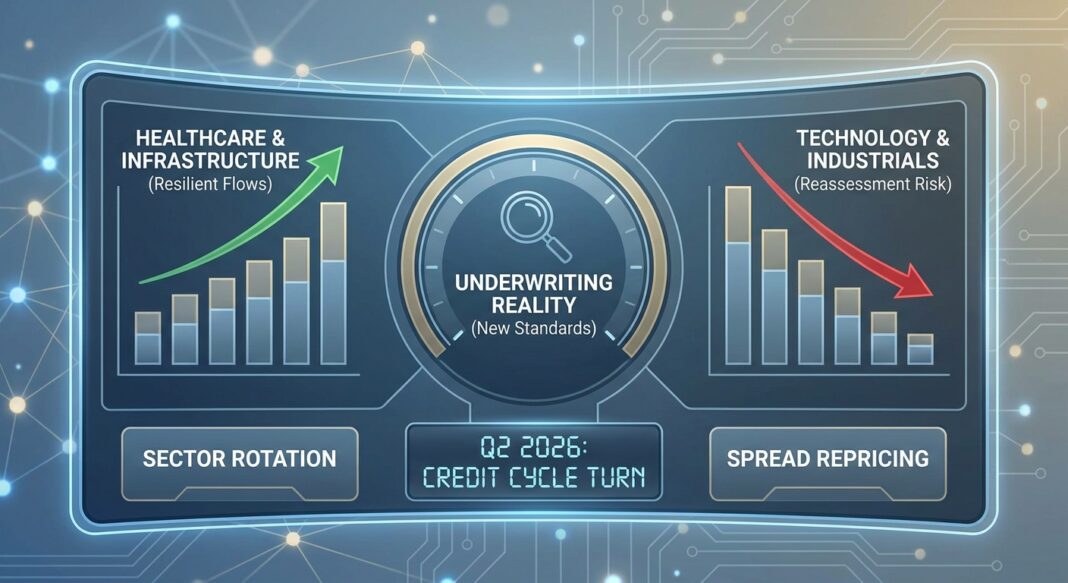
The result is a market in bifurcation. Institutional-grade, senior-secured direct lending to healthcare, infrastructure, and asset-based finance borrowers continues to attract deep lender appetite and competitive pricing. Meanwhile, technology-heavy sponsor-backed credits, energy-intensive industrials, and lower-quality leveraged structures face measurably tighter underwriting, wider spreads, and more demanding fixed charge coverage ratio (FCCR) and net leverage covenant requirements.
For institutional operators and investors, this is not a crisis; it is a long-anticipated credit cycle inflection. The differentiation now occurring between disciplined underwriting and late-cycle excess is precisely the environment in which structured, covenant-rich private credit outperforms. The question is not whether to remain active in credit markets, but where, at what price, and with what documentation.
Quantitative Market Snapshot
The table below summarizes key market metrics as of Q1 2026, with prior-period comparisons and sourced data points.
| Metric | Current Value (Q1 2026) | Prior Period (Q3–Q4 2025) | Direction | Source |
|---|---|---|---|---|
| Middle Market Direct Lending Spread (avg.) | S+500 bps (up from mid-400s) | S+450–475 bps | ▲ Widening | Hamilton Lane, April 2026 |
| BSL New-Issue Acquisition Spread (PE-backed) | ~336 bps (Jan. avg.); widening +15–30 bps Q1 | 365 bps (full-year 2025 avg.) | ▲ Selective widening | PitchBook LCD, Feb. 2026 |
| Global High Yield OAS | ~304 bps over govts. | 305 bps (Jan. 1, 2026) | → Near Flat | Man Group / ICE BofA, Nov. 2025 |
| Leveraged Loan LTM Default Rate (by issuer count) | 1.36% (Feb. 2026); 3.54% incl. distressed exchanges | 4.24% avg. (2025, incl. distressed) | ▼ Improving | Hamilton Lane / LCD, April 2026 |
| Distressed Ratio (leveraged loan market) | 8.89% (Feb. 2026) | 4–5% (most of 2025) | ▲ Elevated / Watch | Hamilton Lane, April 2026 |
| U.S. Institutional Leveraged Loan Value (YOY) | ‑22.5% YOY (Q1 2026) | Q4 2025: $320.4B PE deal value | ▼ Declining | Capstone Partners / PitchBook LCD, Q1 2026 |
| PIK Income Share (public BDCs) | ~8% of investment income | Rising trend since 2023 | ▲ Stress Signal | Within Intelligence, May 2026 |
KPI Lens, FCCR & Leverage Benchmarks: In the current environment, Jefferies Credit Partners emphasizes that Fixed Charge Coverage Ratio (FCCR): not interest coverage ratio (ICR), is the real standard most direct lenders enforce, as ICR reliance on adjusted EBITDA can obscure true cash sufficiency. FCCR measures available operating cash flow (EBITDA less cash taxes, maintenance capex, sponsor fees, and other below-the-line cash costs) divided by cash interest plus required principal amortization. A minimum FCCR of 1.0x signals breakeven; meaningful credit quality begins at 1.2x and above. As EBITDA add-back practices have become increasingly aggressive, with many leveraged loan credit agreements including multiple pages of adjustments, lenders are demanding tighter FCCR floors and scrutinizing addback reliability with renewed discipline in 2026.
The growing use of PIK toggles creates a specific structural risk: PIK interest excluded from FCCR denominators can keep the ratio intact while true leverage quietly rises through accrued obligations, creating a misleading picture of borrower health precisely when lenders most need clarity.
Sector Analysis: Where Lender Appetite Is Moving, and Where It Is Retreating
▲ Healthcare: The Dominant Direct Lending Sector of 2026
The single most significant sector shift in the private credit market this year is the displacement of Technology by Healthcare as the top direct lending vertical. According to PitchBook LCD, healthcare deals made up 22% of direct lending issuance year-to-date through Q1 2026, up from 18% in full-year 2025, while Tech’s share slipped to 14% from 18%. This rotation reflects both the deteriorating credit quality narrative around software and the durability of healthcare fundamentals.
White & Case’s Debt Explorer notes that specialist private credit healthcare funds have posted median net IRRs of 15%, compared to 11% for generalist U.S. direct lending funds, and achieved this with lower median fund-level leverage (0.3x vs. 1.0x for generalists). Healthcare’s default rate has historically stood at approximately 2.5% for the period between 1995 and Q4 2022, among the lowest of any sector. Sub-sector appetite is broadening beyond physician practices and nursing roll-ups into contract manufacturing organizations, life sciences royalty financing, and healthcare technology infrastructure, all areas where non-bank private capital holds a structural advantage.
▼ Technology / Software: Credit Quality Reassessment Underway
The most consequential new variable in leveraged credit markets in Q1 2026 was not macroeconomics; it was technology. Capstone Partners’ Q1 2026 Middle Market Leveraged Finance Update notes that an AI strategy and an evaluation of AI’s potential risk have emerged as a critical analytical component in underwriting new transactions. ARR-based loans, underwritten against software companies’ annual recurring revenue rather than profitability, face heightened scrutiny as AI disruption threatens the recurring revenue durability that originally justified aggressive leverage multiples. Banks surveyed in the January 2026 Federal Reserve SLOOS reported being less likely, on net, to approve loans to firms adversely affected by high AI exposure.
▲ Infrastructure & Asset-Based Finance: Secular Tailwinds Intensify
DLA Piper’s Q1 2026 Private Credit Pulse confirms that asset-based finance is now larger than all other private credit markets combined, with structural tailwinds including bank retrenchment, insurance demand for rated assets, and AI/data center financing needs. Per a Reuters analysis, Morgan Stanley estimates private credit could supply more than half of the $1.5 trillion needed for global data center buildouts through 2028, while AI-related private credit loans nearly doubled in the 12 months through early 2025.
▼ Energy-Intensive Industrials: Underwriting Tightens Post-Iran Conflict
Capstone Partners reports that lenders have responded to the energy cost shock from the Iran conflict by tightening underwriting standards for energy-intensive industries and businesses whose leverage was predicated on stable energy costs. The market will continue to factor oil price movements into deals with heavy energy exposure over the next several quarters.
Regulatory & Structural Forces: Bank Retreat Accelerates Private Credit’s Structural Role
The April 2026 Federal Reserve SLOOS delivered a pivotal new data set: for the first time, the survey formally queried bank lending standards to non-depository financial institutions (NDFIs). The results are instructive. The April 2026 SLOOS showed that banks reported, on net, tighter standards for all categories of NDFI loans over the past year: including significant tightening for loans to business credit intermediaries, consumer credit intermediaries, and other NDFI borrowers. The most cited changes: higher premiums on riskier loans, stricter covenants, shorter maximum maturities, stricter collateralization requirements, and lower maximum credit line sizes.
This tightening of bank credit to the private credit ecosystem itself (through subscription lines, NAV facilities, and fund financing) represents a second-order effect that constrains some managers’ deployment capacity. For well-capitalized institutional private credit platforms with stable LP bases, this is a competitive advantage: Northleaf Capital’s Q1 2026 Private Credit Market Update notes that elevated retail redemptions in retail-oriented vehicles have led some large private credit lenders to moderate investment activity, contributing to more attractive supply and demand dynamics for well-capitalized lenders backed by institutional capital.
Concurrently, the Trump administration’s August 2025 executive order opening 401(k) plans to alternative assets is creating a structural new demand pool. This regulatory shift potentially unlocks trillions in retail capital historically confined to traditional stocks and bonds, but it also introduces new manager-selection and liquidity-matching imperatives for the industry.
Implications: What This Means for Borrowers and Institutional Investors
For Borrowers and Operators
- Spreads are moving against you, act before the full repricing is complete. Northleaf data shows new private credit loans pricing approximately 25 basis points higher in Q1 2026 versus Q4 2025, with Capstone Partners and PitchBook projecting a further 25–50 bps widening for lower-quality or difficult-to-finance sectors over the next six months. Companies with refinancing flexibility should execute now rather than wait for further rate cuts that may not materialize in the expected timeline.
- FCCR documentation will be scrutinized more aggressively. Lenders are drilling into EBITDA addback reliability and maintenance capex classification. Borrowers should proactively clean up their EBITDA reconciliation, ensure CFO certifications accurately reflect addback caps, and stress-test their FCCR under base and downside scenarios before approaching lenders.
- Sector positioning matters at the structuring table. Healthcare and infrastructure borrowers are entering negotiations from a position of strength. Software-intensive businesses face materially harder terms and must demonstrate AI-resilience in their business model to access competitive pricing.
- PIK toggling is a last resort, not a planning tool. PIK exclusions from FCCR denominators can mask rising true leverage from lender monitoring, but sophisticated lenders are now tracking accrued PIK obligations in covenant models. Operators that deploy PIK toggles as convenience should expect higher risk premium demands on future financing rounds.
For Institutional Investors and Lenders
- The spread premium for disciplined underwriting is expanding. SG Analytics, citing Ares research, notes that private credit has delivered 200–400 basis points of excess return over liquid credit markets across multiple rate cycles. With spreads now widening and retail-channel competitors constrained by redemptions, the return opportunity for institutional capital is improving.
- The distressed ratio demands attention. At 8.89% in February 2026, up from 4–5% for most of 2025, the distressed ratio is an acknowledged leading indicator of future default activity. A KBRA projection cited by Northleaf forecasts the annualized default rate to rise from 1.5% in 2025 to 2.0% by year-end 2026. Stress appears idiosyncratic and vintage-specific (notably 2021 deals), not systemic, but the direction of travel warrants defensive portfolio positioning.
- Healthcare specialists command a structural premium. With median net IRRs of 15% versus 11% for generalists, and lower fund-level leverage, specialist healthcare credit managers are generating superior risk-adjusted returns. Institutional allocators should distinguish between generalist platforms expanding into healthcare and dedicated specialist managers with deep sector underwriting capabilities.
Forward-Looking View: The Next 3–6 Months
The Federal Reserve held its target rate at 3.50–3.75% in Q1 2026, contributing to a more hawkish forward curve, with market participants now projecting average base rates of approximately 3.5% through 2026–2028, roughly 20 basis points higher than prior expectations. This higher-for-longer dynamic sustains all-in yield attractiveness for private credit even as absolute spreads on the highest-quality credits remain competitive.
The 3-month average SOFR spread has hovered around 3.7%, forecasted near that level for coming quarters. Meanwhile, the pipeline of opportunistic refinancings, which generated $191.8 billion in 2025 leveraged loan refinancings alone, has largely exhausted itself, meaning incremental deal flow must be driven by genuine M&A and new buyout activity rather than technical repricings.
The structural case for private credit remains intact. The direct lending market now matches the broadly syndicated loan market at $1.5–2 trillion in size and is forecast to reach $3 trillion by 2028. Evergreen private credit fund assets reached $644 billion as of June 30, 2025, up 28% from year-end 2024, representing a permanent capital base that insulates institutional managers from the redemption pressures currently constraining retail-oriented competitors.
For the balance of 2026, the dominant theme will be bifurcation: superior outcomes for senior-secured, covenant-rich, sector-specialized lenders and operators in resilient industries, and increasing stress for late-cycle structures that prioritized volume over discipline. The credit cycle has not broken. It has matured.
🔹 Key Market Insights for Bond Capital Stakeholders
- Spreads are repricing, but selectively. Direct lending spreads have moved from the mid-400s to the S+500 context for the first time in 2026. New-issue direct lending loans for lower-quality or difficult-to-finance sectors face an additional 25–50 bps of pricing pressure over the next two quarters. High-quality credits in resilient sectors continue to clear at competitive rates. (Hamilton Lane; Capstone Partners / PitchBook LCD)
- Healthcare is the credit market’s rotation trade of 2026. Healthcare’s share of direct lending issuance rose to 22% in Q1 2026 (from 18% in 2025), displacing Technology as the #1 sector. Specialist healthcare credit managers are generating 400 bps of IRR premium over generalists with lower fund leverage. (PitchBook LCD; White & Case / bfinance)
- Bank tightening of NDFI lending is a structural competitive advantage for institutional private credit. The April 2026 SLOOS confirms that banks tightened all terms on NDFI loans over the past year. Managers with stable institutional capital bases are absorbing activity from constrained retail-channel competitors. (Federal Reserve SLOOS, April 2026)
- The distressed ratio at 8.89% is the most important leading indicator to track. While the LTM default rate by issuer count (1.36%) remains below long-term averages, the distressed ratio has nearly doubled since mid-2025. KBRA projects defaults to rise to 2.0% annualized by year-end. Stress is vintage- and sector-concentrated (2021 deals, software), not systemic. (Hamilton Lane; Northleaf Capital)
- FCCR, not EBITDA multiples, is the underwriting KPI that separates defensible credits from vulnerable ones. As EBITDA addback manipulation grows and PIK usage masks accruing leverage, FCCR (with clear cash tax, maintenance capex, and lease deductions) provides the most reliable signal of actual debt serviceability. Operators should benchmark and document FCCR under stress before approaching lenders; investors should require it before committing capital. (Jefferies Credit Partners; Private Equity Bro)


